
Government of Canada’s direct greenhouse gas emissions: National safety and security fleet
As defined in the GGS, the national safety and security fleet (NSSF) comprises aircraft, marine vessels and tactical land vehicles. NSSF operations include activities such as law enforcement by the Royal Canadian Mounted Police, search and rescue by the Canadian Coast Guard, and the operation of military vehicles and equipment by the Department of National Defence. These emissions are included in the Government of Canada’s (GC) target of net-zero emissions by 2050Footnote 1.

Figure 11 - Text version
The bar graph shows GHG emissions (in kilotonnes of carbon equivalent) reported in fiscal year 2024 to 2025, for national safety and security fleet by federal organization. Above each bar is the organization’s emissions in 2024 to 2025, as well as the percentage change compared with fiscal year 2005 to 2006 for each federal organization. Emissions reported include the use of chain‑of‑custody market‑based instruments.Footnote 2.
| Federal organization | Emissions for fiscal year 2005 to 2006 (kt CO2 eq) |
Emissions for fiscal year 2024 to 2025 (kt CO2 eq) |
Breakdown of emissions for fiscal year 2024 to 2025 (kt CO2 eq) | Percentage change compared with fiscal year 2005 to 2006 |
|
|---|---|---|---|---|---|
| Direct Scope 1 | Reduction from market-based instruments | ||||
| National Defence | 644 | 525 | 531 | 5.7 | -18% |
| Fisheries and Oceans Canada | 150 | 148 | 151 | 3.5 | -2% |
| Royal Canadian Mounted Police | 69 | 96 | 96 | 0 | 38% |
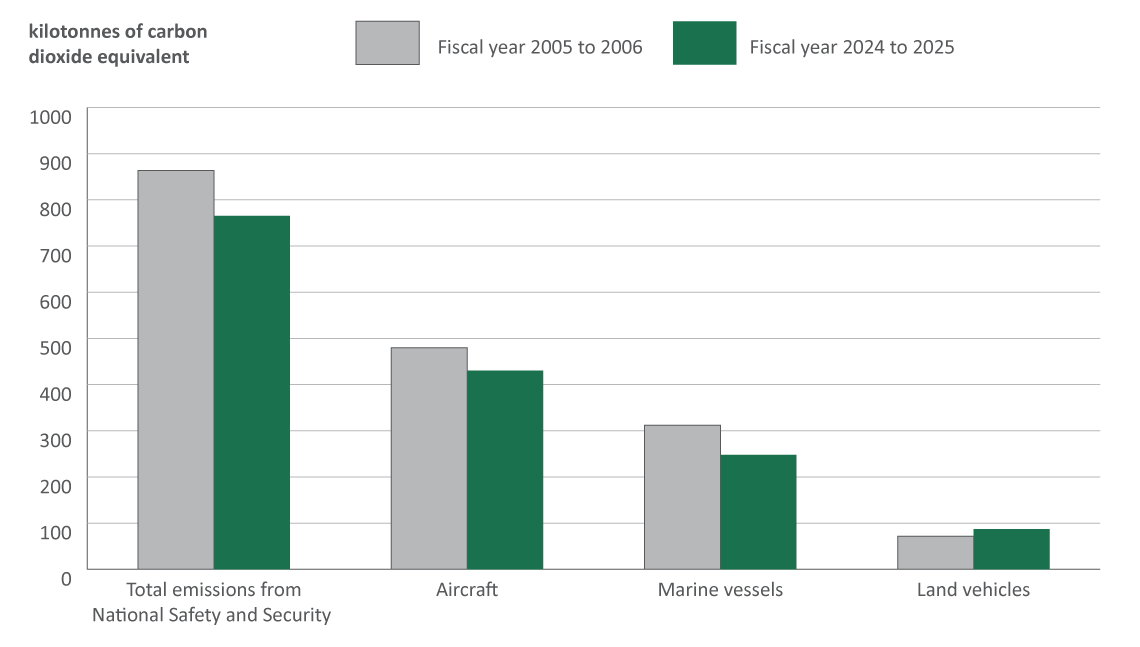
Figure 12 - Text version
The bar graph shows the GHG emissions generated by the national safety and security fleet in kilotonnes of carbon dioxide equivalent as a total and by fleet type for fiscal years 2005 to 2006 and 2024 to 2025. Emissions reported include the use of chain‑of‑custody market‑based instrumentsFootnote 2.
| National safety and security fleet type | Emissions for fiscal year 2005 to 2006 (kt CO2 eq) |
Emissions for fiscal year 2024 to 2025 (kt CO2 eq) |
Breakdown of emissions for fiscal year 2024 to 2025 (kt CO2 eq) | Percentage change compared with fiscal year 2005 to 2006 |
|
|---|---|---|---|---|---|
| Direct Scope 1 | Reductions from market-based instruments | ||||
| Aircraft | 480 | 430 | 435 | 5.7 | -10.4% |
| Marine | 312 | 251 | 254 | 3.5 | -19.6% |
| Land vehicles | 72 | 87 | 87 | 0 | -21.8% |
| Total | 863 | 768 | 777 | 9.2 | -11.1% |
Key results
- In fiscal year 2024 to 2025, the federal NSSF emitted 768 kilotonnes (kt) of carbon dioxide equivalent (CO2 eq). This includes 777 kt of direct Scope 1 emissions and 9.2 kt in emissions reductions from market-based instruments (see More information section below).
- In fiscal year 2024 to 2025, the Department of National Defence NSSF emitted 525 kt CO2 eq:
- 80% of the emissions came from aircraft
- 20% came from marine vessels
- 0.7% came from other land vehicles
- In fiscal year 2024 to 2025, the Canadian Coast Guard NSSF emitted 147 kt CO2 eq:
- 97% of the emissions came from marine vessels
- 3% came from aircraft
- In fiscal year 2024 to 2025, the Royal Canadian Mounted Police (RCMP) NSSF emitted 96 kt CO2 eq:
- 88% of the emissions came from on-road vehicles. An overall 44% increase in GHG emissions since fiscal year 2005 to 2006 is attributed to a 31% increase in the number of RCMP on-road NSS vehicles. The adoption of purpose-built large SUV and pick-up trucks is required to meet operational requirements. The RCMP is currently assessing the feasibility of incorporating electric vehicles into its policing fleet to reduce the growth in GHG emissions;
- 10% came from aircraft
- 2% came from marine vessels
More information
National safety and security fleet (NSSF) owning departments developed Operational Fleet Decarbonization Plans that outline how they will reduce their emissions from operations in line with the overall 2050 target.
In addition, NSS departments will adopt best practices to improve efficiency and reduce emissions and environmental impacts in the areas of:
- fuel procurement, including low-carbon fuels
- fleet procurement, including purchasing energy -efficient platforms
- operational efficiency and net-zero research and innovation
The GC is putting itself on a 2050 net-zero pathway by committing to buy low-carbon fuels for use in the federal domestic air and marine fleets. The Centre for Greening Government provides technical and financial support to departments to purchase such fuels and manages the Low-Carbon Fuel Procurement Program (LCFPP). Financial support for purchases began in 2023-24 and will continue until the end of fiscal year 2026-27.
To reduce NSSF emissions, the GC uses chain-of-custody market-based instruments, such as book and claim and mass balance. They allow organizations to purchase and certify ownership of the emissions reductions associated with low-carbon fuels that they do not directly consume.
These instruments are only used where there are significant logistical or supply challenges with blending, transporting and/or delivering low-carbon fuels for federal fleet operations. These instruments support the GC efforts to reduce GHG emissions and increase both public and private sector market demand for low-carbon fuels.
These instruments are tracked and reported separately from direct Scope 1 emissions for the purpose of demonstrating progress towards the Greening Government Strategy targets.