
Indirect greenhouse gas emissions: Air Travel
Through the Greening Government Strategy, the Government of Canada (GC) made a commitment to track greenhouse gas (GHG) emissions from employee work-related air travel starting in fiscal year 2018-19. These are Scope 3 emissions because the supplier (airlines) controls the emissions.
The GC is also promoting lower-carbon alternatives to work-related air travel, including the use of teleconference technology or substituting air travel with other forms of travel such as rail, where feasible.
To further incent departments to adopt lower-carbon alternatives to work-related travel, the Greening Government Fund was established through Treasury Board Secretariat in 2018. Federal departments and agencies that generate GHG emissions in excess of 1 kilotonne per year from air travel initially contribute $50 per tonne annually (rising annually with the federal carbon pollution pricing system) to the Greening Government Fund. The fund supports projects that allow departments to explore innovative approaches and reduce GHG emissions.
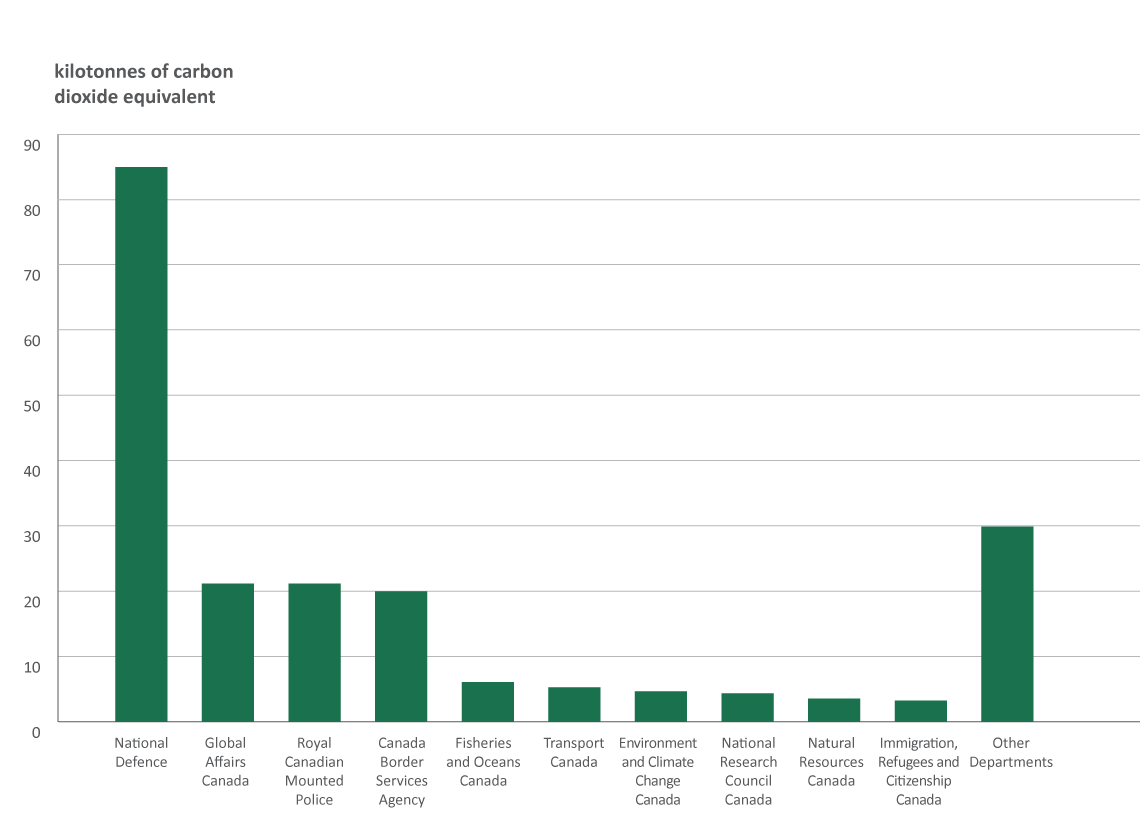
Figure 3 - Text version
The bar graph shows the total GHG emissions (in kilotonnes of carbon equivalent) for employee work-related air travel reported in fiscal year 2024 to 2025, by the top 11 emitting federal organizations. The remainder are grouped as “other”.
| Federal organization | Emissions for fiscal year 2024 to 2025 (kt CO2 eq) |
|---|---|
| National Defence | 85.3 |
| Global Affairs Canada | 21.1 |
| Royal Canadian Mounted Police | 21.1 |
| Canada Border Services Agency | 19.9 |
| Fisheries and Oceans Canada | 6.0 |
| Transport Canada | 5.2 |
| Environment and Climate Change Canada | 4.6 |
| National Research Council | 4.3 |
| Natural Resources Canada | 3.5 |
| Immigration, Refugees and Citizenship Canada | 3.2 |
| Indigenous Services Canada | 3.2 |
| Employment and Social Development Canada | 2.7 |
| Innovation, Science and Economic Development Canada | 2.3 |
| Parks Canada | 2.0 |
| Health Canada | 1.9 |
| Canada Revenue Agency | 1.9 |
| Public Services and Procurement Canada | 1.8 |
| Agriculture and Agri-Food Canada | 1.8 |
| Public Safety Canada | 1.6 |
| Justice Canada | 1.4 |
| Public Health Agency of Canada | 1.4 |
| Correctional Service Canada | 1.4 |
| Canadian Food Inspection Agency | 1.1 |
| Privy Council Office | 1.0 |
| Statistics Canada | 0.9 |
| Veterans Affairs Canada | 0.8 |
| Shared Services Canada | 0.8 |
| Canadian Space Agency | 0.7 |
| Department of Finance Canada | 0.6 |
| Canadian Heritage | 0.6 |
| Total | 204 |
Key results
- In fiscal year 2024-25, total employee work-related air travel emissions were 204 kt and were 3% below the 2019-2020 pre-pandemic levels.
- The top 5 emitting organizations (National Defence, Global Affairs Canada, Royal Canadian Mounted Police, Canada Border Services Agency, and Fisheries and Oceans Canada) generated 75% of GHG emissions attributable to employee work-related air travel.