
Progress on greening procurement: Other procurement
Shared procurement instruments
Shared procurement instruments, such as Standing Offers and Supply Arrangements (SOSAs), are key tools that the federal government uses to obtain best value for Canadians. Integrating environmental considerations into SOSAs ensures that organizations can easily make environmentally preferable choices. A key indicator demonstrating that the federal government is achieving greener procurement is the number of SOSAs that include criteria that address environmental considerations, including reductions in GHG emissions and plastic waste, as well as other environmental impacts. As of March 2025, 1,244 SOSAs are identified as green.
For more information, refer to:
- the Federal Sustainable Development Strategy
- the Green procurement course
- the sustainable development strategies for each organization
1,244
Standing offers and supply arrangements with environmental considerations
As of March 2025
Disclosure of emissions produced by suppliers
The Government of Canada (GC) will reduce its supply chain emissions by inducing suppliers to adopt a science-based target in line with the Paris Agreement, while also publicly disclosing their GHG emissions and environmental performance.
Effective April 1st, 2023, the Standard on the Disclosure of Greenhouse Gas Emissions and the Setting of Reduction Targets (the Standard) under the Policy on Green Procurement came into force.
This new Standard applies to all federal organizations that are subject to the Policy on Green Procurement and requires that procurements over $25 million induce suppliers to disclose their greenhouse gas emissions and set reduction targets in line with the Paris Agreement as part of participating in the Net-Zero Challenge or in an equivalent initiative or standard.
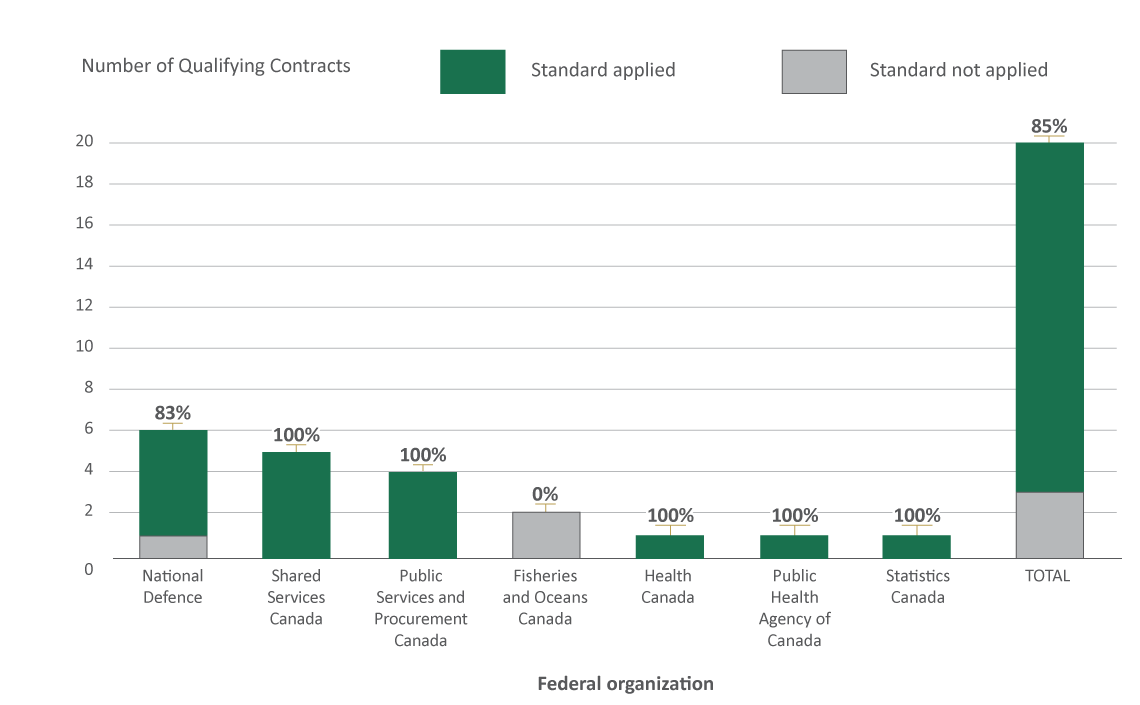
Figure 11 - Text version
The bar chart shows the number of qualifying contracts that applied and did not apply the Standard by federal organization in 2024-25.
| Federal organization | Number of contracts where the Standard was applied | Number of contracts where the Standard was not applied | Percentage compliance |
|---|---|---|---|
| National Defence | 12 | 0 | 100% |
| Public Services and Procurement Canada | 11 | 0 | 100% |
| Shared Services Canada | 4 | 0 | 100% |
| Immigration, Refugees and Citizenship Canada | 2 | 0 | 100% |
| Fisheries and Oceans Canada | 1 | 1 | 50% |
| Canadian Space Agency | 1 | 0 | 100% |
| Employment and Social Development Canada | 1 | 0 | 100% |
| Public Health Agency of Canada | 1 | 0 | 100% |
| Treasury Board of Canada Secretariat | 1 | 0 | 100% |
| Parks Canada | 0 | 1 | 0% |
| Total | 34 | 2 | 94% |
For more information, refer to:
Construction materials and design
The GC is committed to reducing the environmental impact of construction materials and design. Effective December 31st, 2022, the Standard on Embodied Carbon in Construction (the Standard) under the Policy on Green Procurement came into force with requirements related to the carbon footprint of ready-mixed concrete. All federal construction projects valued at $5 million or more using 100 cubic metres or more of ready-mixed concrete are to require service providers to disclose the carbon footprint of the ready-mixed concrete used. The concrete must also demonstrate an embodied carbon reduction of at least 10% compared to the regional industry average.
In 2024–25, the embodied carbon of the ready-mix concrete used in one qualifying major construction project subject to the standard was reduced by 21% relative to the project baseline. The corresponding difference between the embodied carbon of the concrete used and the average embodied carbon of the concrete available in the region was 31 tCO2e. The Standard applies to projects that are initiated after its requirements came into force, and results are reported upon project completion. Since construction projects have long lead times, the number reporting is small but will gradually increase in the coming years.
21%
2024–25 embodied carbon reduction of the ready-mix concrete used in one qualifying major construction project subject to the standard, relative to the project baseline
31 t CO2e
2024-25 reduction of embodied carbon of concrete used relative to the average available in the region
Effective September 1, 2025, new requirements came into force related to the carbon footprint of construction steel and to whole-building life cycle assessments. All federal construction projects using 200 tonnes of structural/reinforcement steel are to require service providers to disclose the carbon footprint of the steel used and to demonstrate procurement of the lowest-emission option available for each steel product category. In addition, all new federal buildings larger than 2,000 m² and renovations exceeding 4,000 m² are to require service providers to estimate the carbon footprint associated with preliminary and final designs through whole-building life cycle assessments and to demonstrate either a 30% reduction in the embodied carbon compared to the baseline or the maximum reduction achievable within a 2% premium on net construction cost.
By 2025, the government also aims to:
- reduce the embodied carbon in structural materials by 30%
- conduct life-cycle assessments for major buildings and infrastructure projects
For more information, refer to:
- the Greening Government Strategy
- the Green procurement course
- the Standard on Embodied Carbon in Construction
Office leases
The GC aims to:
- reduce the carbon footprint of its leased office space
- mitigate the impacts of climate change
To achieve these aims, the government has mandated that 75% of new leases and lease renewals must be for net-zero emissions, climate-resilient buildings starting in 2030. Reporting on energy use, GHG emissions, water use and waste generation will be mandatory for domestic spaces over 500 m2 in 2023, with more stringent reporting requirements coming into effect in the future.
Data and estimates on the impact of net-zero floor space in offices will be published on this page when the data and estimates become available.
For more information, refer to: