
Canadian Drugs and Substances Strategy: Substance use services and supports
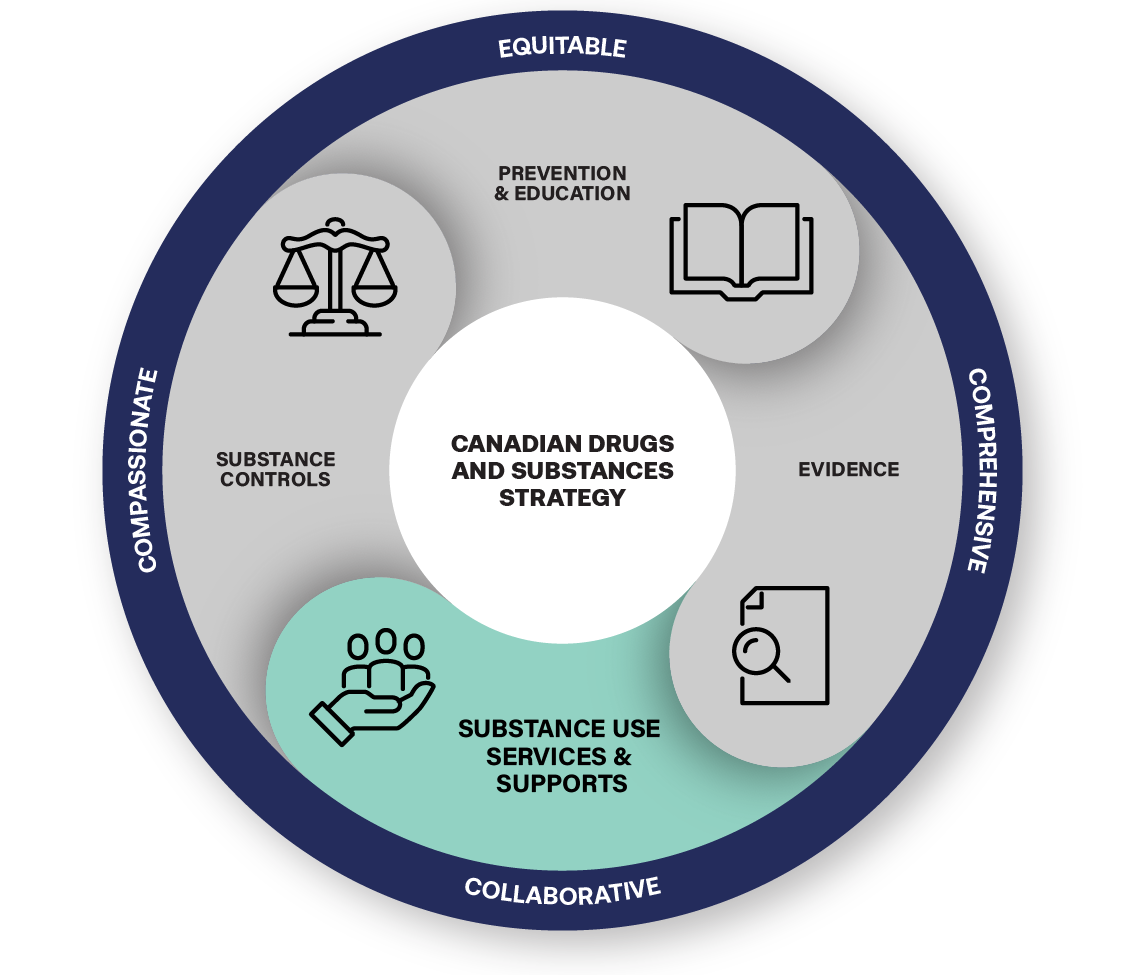
How substance use services and supports fit into the strategy.
On this page
About substance use services and supports
Substance use is different for each person, and there is no single service that will meet everyone’s needs. This is because substance use exists across a spectrum with different stages of benefits and harms.
A person may also move back and forth between different stages over time. Providing them with different services and supports based on their needs is one of the most effective ways to support their health and wellness. Services and supports could be for:
- recovery
- treatment
- harm reduction
Treatment services
These are services and supports that help reduce or stop substance use by managing withdrawal and cravings. There is no single approach to substance use treatment. What works for some may not work for others. The choice of treatment depends on each person’s circumstances and the substances they use. For example, an alcohol use disorder is treated differently than an opioid use disorder. Some examples of treatment include medications, psychological supports like therapy and counselling, peer support and withdrawal management.
Harm reduction services
These are evidence-based initiatives that help reduce the negative health, social, and economic impacts of substance use. These initiatives provide harm reduction services to people without requiring or promoting abstinence (avoiding drugs or alcohol completely).
Harm reduction aims to reduce the risks of substance use and improve a person’s health, often by connecting them with health and social services. For example:
- providing drug checking services at a supervised consumption site
- providing medically regulated alcohol through a managed alcohol program
- providing someone a naloxone kit to take to a party in case of an overdose
Recovery services
Recovery can mean different things for different people and it can take many different forms. Recovery is a process or lifestyle change where people who struggle with substance use concerns work to improve their health and wellness.
The path to recovery from substance use issues looks different for everyone. People can, and do, overcome substance use issues. For example, services could include:
- avoiding drugs or alcohol completely
- a variety of treatment and harm reduction services
How services and supports fit into the strategy
Delivering health care services is primarily the responsibility of provinces and territories. However, all levels of government, non government and community-led organizations are working together to improve access to timely, equitable and quality services to support people experiencing:
- addictions
- substance use issues
- mental health concerns
The federal government plays a crucial role by:
- supporting substance use programs
- improving equitable access to services and supports
- providing services and supports for specific populations
Supporting substance use programs
We’re providing $25 billion in funding over 10 years to provinces and territories to address areas including substance use and mental health.
We’re also providing $2 billion over 10 years to support fair and equitable access to quality and culturally safe health care services for Indigenous Peoples.
This builds on previous funding of $5 billion over 10 years to provinces and territories to help support access to mental health and substance use services. As of 2023, $2.4 billion of this funding will be spent over the next 4 years.
We also support innovative community-led approaches to treatment, harm reduction and recovery services. Examples include:
Improving equitable access to services and supports
We’re streamlining authorizations for some harm reduction services to create a process with clear public health and public safety requirements for organizations seeking to provide these evidence-based life saving services to people who use substances.
These services include:
- drug checking services
- supervised consumption sites
- urgent public health need sites
Learn more:
Providing services and supports for specific populations served by the federal government
We provide a variety of substance use services and supports to populations served by the federal government both directly and indirectly, such as:
- Indigenous peoples
- people in correctional institutions
- veterans, including those experiencing or at risk of homelessness
- youth interacting with the criminal justice system who are struggling with complex mental health issues, trauma and addictions
Learn more: