
Canadian Drugs and Substances Strategy: Evidence
What evidence the strategy uses and how it supports our decision-making.
On this page
About evidence
Accurate, timely, and reliable data are essential to policy development and decision-making. We gather evidence from research studies, surveys and public health surveillance data. This lets us:
- set policy priorities
- respond to emerging drug issues
- measure the impact of our actions
- assess the current drug landscape in Canada
- identify trends related to substance use and related harms, including:
- prevalence of use
- harms like deaths and hospitalizations
How evidence fits into the strategy
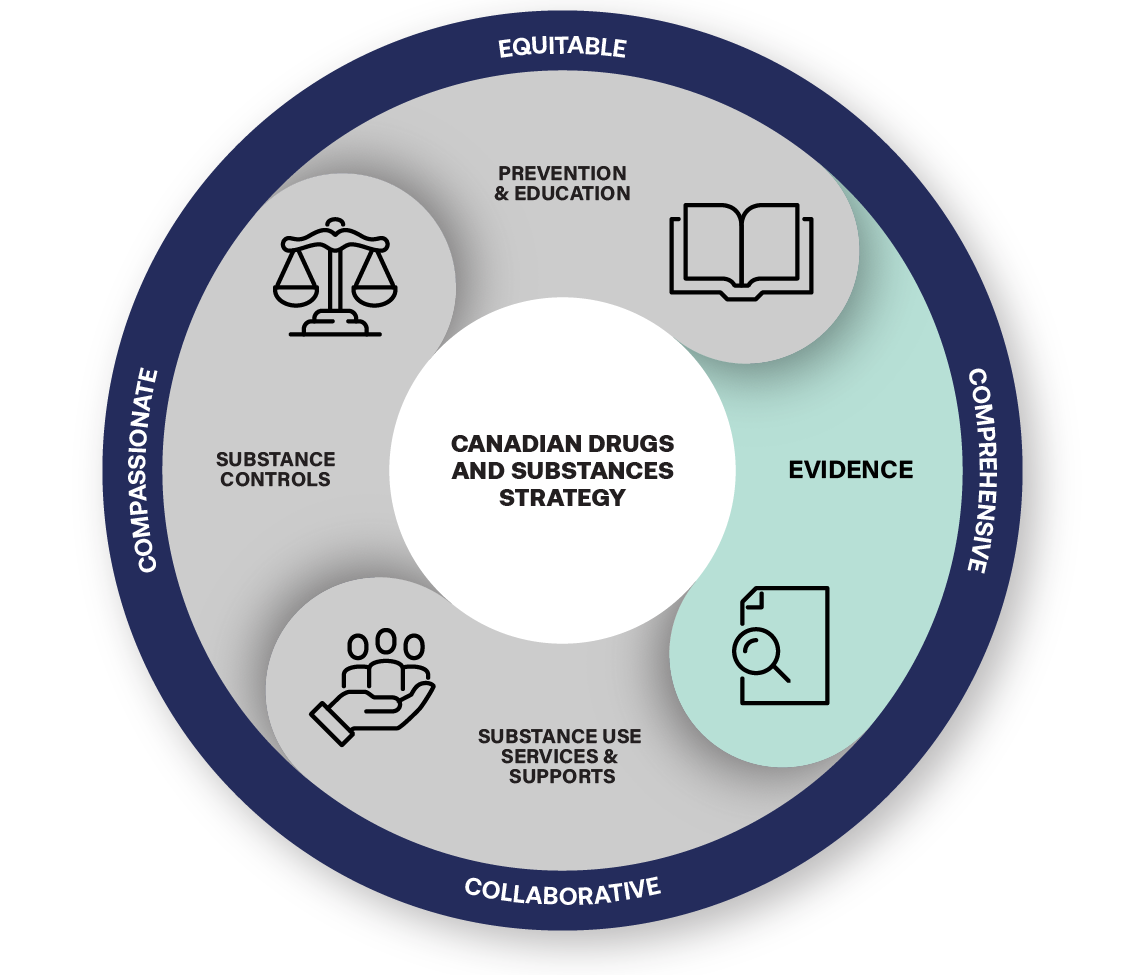
We conduct innovative monitoring, surveillance and research related to substance use in Canada. The data and information we collect forms evidence that we use to develop programs and policies related to substance use.
Implementing the Canadian Drugs and Substances Strategy (CDSS) Data and Evidence Framework will support collaboration across federal departments and agencies. It focuses on improving our ability to collect, analyze and share data to support evidence-based and equity informed decision-making.
CDSS Data and Evidence Framework
Collecting data
We continue to conduct general population and targeted surveillance activities to better understand substance use trends overall and among different population groups in Canada. Latest data:
- Canadian Substance Use Survey (CSUS)
- Canadian Student Alcohol and Drugs Survey (CSADS)
- Canadian Postsecondary Education Alcohol and Drug Use Survey (CPADS)
- People with Lived and Living Experience Survey (PWLLES)
- Online New Psychoactive Substances (NPS) Survey
Other reports, studies and surveys:
- Public Awareness of Alcohol-related Harms Survey (PAAHS) 2023
- Canadians' knowledge and awareness of polysubstance use and associated harms: Results from public opinion research
- Canadians' knowledge and attitudes around drug decriminalization: Results from a 2024 public opinion research survey
Public health officers will work with provinces and territories to collect data on opioid- and stimulant-related deaths and harms. They'll use this information to produce national data on opioid- and stimulant-related harms like:
- deaths
- hospitalizations
- emergency medical services
We'll release this data on a quarterly basis, in collaboration with provinces and territories.
Opioid- and stimulant-related harms
Using data
Evidence guides our response to the illegal drug crisis and broader substance use related harms.
- data, surveillance and research on opioids and other substances
- statistics and data related to opioids, overdoses and substance use in Canada
We'll use the data we gather to evaluate innovative interventions and policy approaches. For example, British Columbia's exemption for personal possession for small amounts of certain illegal drugs for people aged 18 and older.
This research will inform substance use services, like supervised consumption sites and safer supply, and the development of guidelines to:
- inform treatment for substance use disorders
- help people living in Canada make decisions around substance use
One example of these guidelines is the Canadian Clinical Guideline on High-Risk Drinking and Alcohol Use Disorder.
Learn more:
- Subsection 56(1) class exemption to possess small amounts of certain illegal substances in the province of British Columbia – health care clinics, shelters and private residences
- Canadian Clinical Guideline High Risk Drinking and Alcohol Use Disorder
Sharing data
We have developed the Canadian Drug and Substance Watch (CDSW), an early warning system that tracks new and emerging psychoactive substances by:
- combining data from analyzed drug samples, wastewater analysis, and online monitoring
- identifying emerging trends in the illegal drug supply in Canada
Consult the Canadian Drug and Substance Watch (CDSW)
We also publish data from wastewater drug surveillance, which provides insights into drugs detected in Canadian communities by:
- analyzing wastewater samples for drugs, metabolites, and precursor chemicals
- identifying geographic trends and emerging substances over time
Explore the National Wastewater Drug Surveillance (NWDS) Dashboard
We make data available on supervised consumption sites to describe their role in harm reduction by sharing information on:
- visits and client characteristics
- drugs used and overdose events
- referrals to health and social services
Learn more using the Supervised Consumption Site Dashboard
We hosted a Knowledge Exchange Series on Safer Supply with key stakeholders to discuss:
- evidence around safer supply
- how available evidence can help support and scale up successful models
Read about what we heard from the Knowledge Exchange Series on Safer Supply
Our Drug Analysis Service also provides statistics and trends on illegal drugs and substances by:
- issuing reports on drug trends and new substances of interest
- sharing raw data on substances identified in samples seized by law enforcement
- issuing drug notifications for newly identified potent or dangerous substances in the illegal drug supply
Explore the services and realisations of the Drug Analysis Service
We have also developed a data dashboard on the health of people in Canada which provides information and data trends on indicators like:
- alcohol use
- opioid use
- vaping
- smoking
- cannabis use
Learn more about the How healthy are people in Canada? An indicators dashboard
We also develop bi-annual simulation models of opioid-related deaths that provide information on the number of these deaths during the overdose crisis. These models help support decision-making processes related to the overdose crisis.
Learn about the modelling opioid-related deaths during the overdose crisis