
Improving the health of men and boys in Canada
On this page
- Federal Men and Boys' Health and Well-being Strategy
- National conversation
- International strategies for men and boys' health
- About men and boys' health
- Other programs
- Contact us
Federal Men and Boys' Health and Well-being Strategy
Over winter and spring 2026, the Government of Canada engaged with provincial and territorial governments, Indigenous partners and key stakeholders to develop a Federal Men and Boys' Health and Well-being Strategy. The goal is to create supportive and safe environments, challenge harmful stereotypes, reduce stigma and encourage men of all ages to seek help when they need it.
Improving the health of men and boys is a shared effort. The factors that lead to poorer health outcomes for men and boys are complex and interrelated, and don't begin in adulthood.
National conversation
In February 2026, we launched a national conversation on men and boys' health to hear about the challenges that men and boys face, what contributes to those challenges, and solutions to address them.
The conversation included:
- public engagement through an online questionnaire (closed on June 1, 2026)
- written submissions from stakeholders and experts (closed on June 1, 2026)
- Ministerial roundtables
- stakeholder-led regional roundtables
- Parliamentarian-led engagement with constituents
- discussions with federal-provincial-territorial officials and international partners
Many people across Canada participated in the conversation by answering the following questions:
- How can we support boys and men in understanding and dealing with traditional ideas about masculinity in healthy ways, including:
- overcoming stigma?
- feeling comfortable asking for help?
- How do we help men build healthy relationships and adopt healthy habits that improve their overall well-being?
- What role do male role models, mentors and community leaders play in shaping healthier norms?
- How can we amplify positive examples of masculinity?
- How do we help men seek out the care they need:
- to support their mental health and well-being?
- for any challenges with substance use or addiction?
- How do different life stages shape men's well-being? For example, adolescence, early adulthood, fatherhood, midlife and retirement.
- Where are the biggest transition points where support is most needed?
Thank you to those who took the time to share their views on this issue.
Health Canada is summarizing the findings from the national conversation and will be publishing a report on what we heard later this fall.
This input is also informing and shaping the first Federal Men and Boys' Health and Well-being Strategy, which will be published in early 2027.
The Strategy will set out the key themes from what we heard and outline what is needed to:
- create supportive and safe environments,
- challenge harmful stereotypes,
- reduce stigma
- encourage men of all ages to seek help when they need it.
International strategies for men and boys' health
As well, to inform the development of the Strategy, we are also looking at international approaches to men's health:
- Australia: National Men's Health Strategy 2020 – 2030
- Ireland: National Men's Health Action Plan 2024-2028
- United Kingdom: National Men's Health Strategy 2025 - 2030
- WHO Europe: Strategy on the Health and Well-being of Men
We are also looking at previous provincial and territorial work, such as Quebec's former men's health strategy, and work by men's health stakeholders, like Movember.
Learn more:
- Plan d'action ministériel : Santé et bien-être des hommes (2017 - 2022) (French only)
- The Real Face of Men's Health: 2025 Canadian Report
About men and boys' health
Health includes physical, mental and social well-being at all stages of life.
Men in Canada face distinct health challenges, including shorter life expectancy (80 years compared to 84 years in women). They also experience higher rates of:
- premature death
- suicide
- substance use and related harms (70% of opioid-related deaths nationwide)
- some sexually transmitted and blood-borne infections, such as gonorrhea and infectious syphilis
- some chronic diseases such as diabetes and ischemic heart disease
- gambling problems
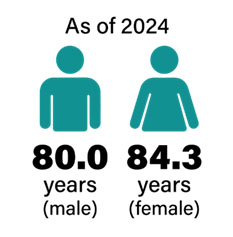
Figure 1: Descriptive text
An image with two silhouettes and text. On the top of the image, there is text saying "as of 2024". Under the male silhouette, the text reads "80.0 years (male)". Under the female silhouette, the text reads "84.3 years (female)."
Men are also less likely to engage with primary care or access preventive services, including health screening, with 65% of Canadian men waiting more than six days with symptoms before visiting the doctor.
These differences are not simply biological. Social, economic and cultural factors also play a major role in shaping health outcomes. For example, men are more likely to have lower education levels, and experience higher rates of incarceration and homelessness than women.
Mental health of men and boys
Young men aged 15 to 24 show concerning trends in their self-rated mental health and rates of mental illness. For instance, between 2012 and 2022:
- the percentage who reported "very good" or "excellent" mental health fell from 70% to 52%
- the percentage who experienced:
- mood disorders increased from11% to 16%
- generalized anxiety disorder increased from 4% to 10%
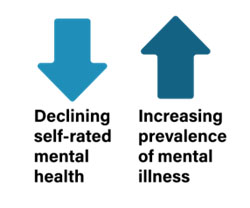
Figure 2: Descriptive text
An image with two arrows and text. On the left side, there is an arrow pointing down with the text "declining self-rated mental health" underneath. On the right side, there is an arrow pointing up with the text "increasing prevalence of mental illness."
Young men who are not in employment, education or training face higher risks of mental illness and substance use.
Learn more:
- Statistical checkup of Canadian men's health
- Online resources on men's health issues
- It's Your Health series for men
- Things you should know about men's health (Movember)
- Men's health conditions (Canadian Men's Health Foundation)
- Problem gambling (Centre for Addiction and Mental Health)
- Statement of the Chief Medical Officers of Health: Latest national data on substance-related harms
Structural, social and economic influences on health
There is a growing body of evidence on how gender, along with other social determinants of health, influence risk factors and health outcomes. Additionally, some groups of men face greater health challenges, such as men who are:
- Indigenous
- part of the 2SLGBTQIA+ community
- Black or from other racialized groups
Some groups of men in Canada are at higher risk of suicide, including men who are:
- veterans
- Indigenous
- part of the 2SLGBTQIA+ community
- in the criminal justice system or incarcerated
- lacking access to supportive relationships or sense of community
These men often face more barriers to accessing supports due to social and economic influences on health, such as:
- systemic racism
- colonialism
- discrimination
- economic inequality
Learn more:
Other programs
Within the Health Portfolio, we support men's health and well-being by:
- promoting healthy living
- helping to prevent suicide
- sharing key statistics on health trends
- providing resources for men and boys affected by:
The federal government also funds and supports:
- sexual and reproductive health initiatives
- youth mental health programs and services
- research into the influence of sex and gender on health
- chronic disease prevention programs
A focus on men's health does not replace the important work underway to support women's health. Women continue to face distinct health risks and inequities, and we remain committed to closing those gaps. Our focus on men's health complements this approach.
Learn more:
Contact us
Health Policy Branch
Health Canada
Email: menshealth-santemasculine@hc-sc.gc.ca