
Deputy Minister transition binder 2023: Nature
Purpose
To provide you with an overview of:
- The State of Nature / Biodiversity in Canada.
- ECCC’s key responsibilities on nature and the tools at the department’s disposal.
- Key challenges and opportunities – short-term and long-term.
Nature is important
Biodiversity is the variety of life on earth, including genes, species and ecosystems.
- Nature (also referred to as biodiversity) provides benefits we all depend on for survival, security, and well-being and is the foundation for much of Canada’s economic activity.
- Globally, the services nature provides are worth around $125 trillion a year.
- e.g. clean air and water, fertile soil, pollination, food and medicines, carbon sequestration, flood and drought control, many others.
- Often viewed as free, these services are prohibitively expensive or impossible to replace.
Canada’s biodiversity in numbers

Text description
Graphic with seven circles, each of which highlights a fact about Canadian biodiversity, including that Canada is home to 28% of the world’s boreal forest, 20% of the world’s freshwater, 37% of the world’s lakes, 465 species of birds, the world’s longest coastline, 25% of the world’s temperate rain forest, and 24% of the world’s wetlands.
Canadians care about nature
- 86% of Canadians supported protecting and conserving more natural spaces in Canada in 2019.
- 72% of Canadians considered protecting ecosystems and habitats a priority, with 70% finding it important to include nature-based climate solutions as part of the government’s economic recovery measures.
- 97% of Canadians have either maintained or increased their support for nature conservation since COVID-19.
- 87% of Canadians support the federal commitment to protect and conserve 25% of land and freshwater by 2025, and ranked their highest priority issues:
- Protecting natural habitats for wildlife (91%).
- Reducing water pollution (90%).
- Protecting Canada’s National Parks and National Wildlife Areas (89%).
- Protecting endangered species (86%).
- 78% of Canadians prioritize the protection of animal species at risk of extinction over the development of lands where those animals can be found.
Sources: Polling by Abacus Data, Pollara Strategic Insights and Quorus Consulting Group between 2019 and 2021.
But nature is in serious trouble
- Globally, therate of species extinctions is accelerating; unprecedented in human history; up to 1,000,000 species at risk of extinction.
Text description
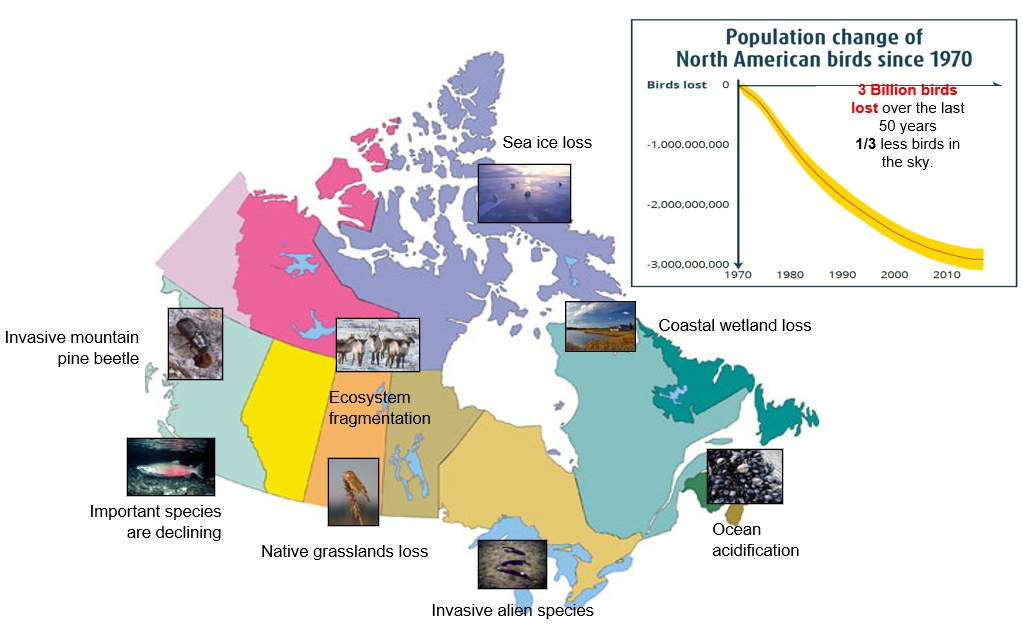
- Graph that shows population decline in North American bird populations since 1970. 3 billion birds have been lost over the last 50 years (meaning there are 1/3 less birds in the sky compared to 1970).
- A map of Canada highlighting some stressors that are affecting nature. In the west, invasive mountain pine beetle and declining important species (salmon) are mentioned with corresponding photos. In Prairies, native grassland loss is listed with a photo of a bird perched on a reed. In the North, ecosystem fragmentation is listed with a photo of barren-ground caribou. In addition, there is a photo of icebergs in the sea labelled as “sea ice loss”. In Central to Eastern Canada, there is a photo of what appears to be northern snakeheads labelled as “invasive alien species”, and a second photo of a wetland with the label “coastal wetland loss”. Along the East Coast, there is a marine photo with the title “ocean acidification”.
Why are we losing nature?
Five main drivers of change in nature
The five main drivers of change in nature in rank order (from highest to lowest):
- changes in land and sea use
- direct exploitation of organisms
- climate change
- pollution
- invasion of alien species
- Biggest driver is habitat loss, mainly from agricultural and forestry activities, resource sectors and urban and industrial development.
- Cumulative effects of multiple pressures amplify impacts.
- Nature’s decline and climate change are connected.
Biodiversity is a shared responsibility
- Most of Canada is Crown land, the vast majority of which is administered by the provinces and territories.
- Land Claim Agreements with Indigenous groups cover ~ 40% of Canada’s land mass.
- Both Protected Areas and working landscapes contribute to conservation.
- Collaboration and partnerships are essential.
| Federal government | Provinces, territories and municipalities | Indigenous governments | Landowners/managers, ENGOs |
|---|---|---|---|
|
|
|
|
ECCC mandate focuses on conserving species and spaces
- Leading domestic and international biodiversity policy and partnerships to protect nature.
- Leading on national efforts to conserve habitat and expand Canada’s network of protected and conserved areas.
- Exclusive responsibility for migratory birds conservation.
- Protecting and recovering species at risk, including through the implementation of the Species at Risk Act (Parks Canada, Fisheries and Oceans Canada, ECCC).
- Committed to meaningful Indigenous engagement in conservation.
Tools to conserve nature
Collaboration and influence
Partnerships with federal departments, PTs, Indigenous organizations, non-governmental organizations, the private and philanthropic sectors and academia are key.
- Legislative and regulatory actions
- Strong suite of legal tools - significant “must do” obligations but also flexible enabling authorities.
- Federal Species at Risk Act (SARA), Migratory Birds Convention Act and the Canadian Wildlife Act, etc.
- Direct conservation
- Establish and manage a network of federal protected areas, including ECCC’s National Wildlife Areas and Migratory Bird Sanctuaries.
- Currently, federal areas account for 38% of all protected areas in Canada.
- Funding and incentives
- Grants and Contributions are critical conservation tools enabling actions and stewardship by others.
- ECCC to administer $1.5 billion in nature G&Cs over the next four years.
- Matching funding leverages considerable financial and in-kind support.
- Tax incentives e.g. Ecogifts.
Science and Indigenous knowledge underpin all of ECCC’s conservation work.
Biodiversity policy: Global momentum, domestic implications
ECCC’s role: Lead work with Canadian and international partners to conserve nature domestically and abroad, including under the UN Convention on Biological Diversity (CBD), Convention on International Trade in Endangered Species of Wild Fauna and Flora (CITES) and the Ramsar Convention on Wetlands.
Considerations/challenges:
- Canada seen as a global nature leader, hosts the CBD Secretariat in Montreal and hosted the UN Biodiversity Conference in December 2022 (COP15).
- Pace and scale of global biodiversity loss is staggering; global response to date insufficient to address it.
- Nature is an important part of Canada’s identity and economy, particularly for Indigenous peoples, and Canada is a champion of its sustainable use.
- In 2022, the international community adopted the Kunming-Montreal Global Biodiversity Framework to guide global biodiversity conservation and sustainable use efforts to 2030.
- Investments in nature have to triple by 2030 if the world is to meet climate change and biodiversity targets; supporting developing countries is key to achieving the GBF objectives.
- Action is needed in all parts of the world to resolve the challenge of biodiversity loss.
Priorities include:
- Implementation of the Global Biodiversity Framework. First step - development of a comprehensive national biodiversity strategy and action plan to 2030.
- Ensuring sustainable wildlife trade.
Current focus:
- Development of national biodiversity strategy and action plan to 2030:
- will implicate many federal departments;
- will require close collaboration with provinces, territories, Indigenous peoples, youth, and stakeholders.
- Formal public engagement phase planned for spring 2023, launched through kick-off symposium.
- Key fora for engagement - new national Nature Advisory Council and distinction-based Indigenous Nature Tables.
- Implementation of 30x30 target underway, led by CWS.
Summer 2022
- Roundtables on Halting and Reversing Biodiversity Loss
Fall 2022
- COP 15, December 7-19, Montreal
Spring 2023
- Symposium & Thematic Engagement Events
Summer/Fall 2023
- Drafting Plan & Engaging Experts
Winter/Spring 2024
- Review & Revise Plan
Spring/Fall 2024
- Approval & Implementation
Protected and conserved areas
Text description
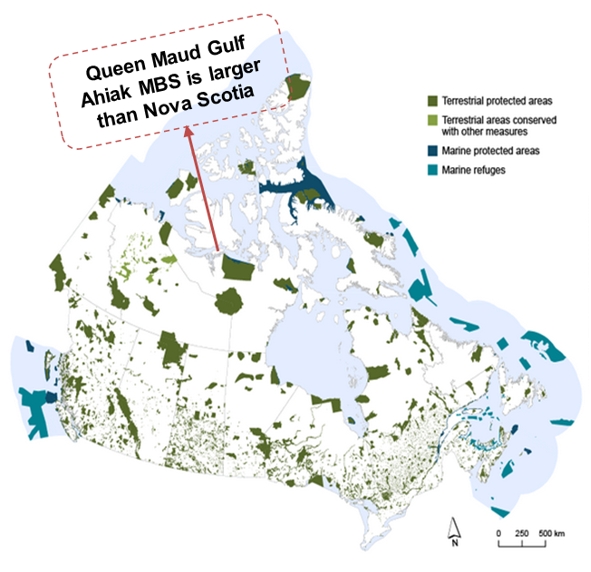
Map of Canada highlighting all terrestrial protected areas, terrestrial areas conserved with other measures, marine protected areas, and marine refuges. This graphic emphasizes that the Queen Maud Gulf (Ahiak) Migratory Bird Sanctuary is larger than Nova Scotia.
Issue: Canada committed to more than doubling the size of its protected areas by 2030.
ECCC’s role:
- Establishing and managing network of federal protected areas.
- Working with partners to expand protected areas networks across Canada.
Considerations/challenges:
- Economic interests and nature conservation: Many provinces and territories grappling with prioritizing land and resource development over protected area expansion and including working landscapes in contributions to protecting biodiversity; consider current protected areas targets as federal only.
- Indigenous-managed and/or co-managed lands growing, high interest / support for establishing Indigenous Protected and Conserved Areas. Strong support from philanthropic sector, too.
- Need to work with / fund willing partners e.g. bilateral nature agreements. No ongoing funding can be a barrier to action.
Recent focus:
- Targeting program funding to Indigenous Protected and Conserved Areas.
- Supporting Indigenous leadership and stewardship through Indigenous Guardians program, which advances Indigenous rights and responsibilities in protecting and conserving ecosystems.
- Exploring innovative financing and partnerships, including with the private sector.
- Recognizing and counting working landscapes that also deliver conservation outcomes.
Priorities include:
- Advancing up to 4 Project Finance for Permanence initiatives
- Securing Nunavut Land Use Plan Agreement
Migratory birds
Issue: One-third of all migratory birds (~3 billion) have been lost over the past 50 years. 78% of migratory bird species spend at least half of the year outside of Canada.
ECCC’s role: Exclusive responsibility for migratory birds in Canada. The Migratory Birds Convention Act, enacted in 1917, is more than 50 years older than ECCC itself.
Considerations/Challenges:
- International coordination is a key challenge, but also essential.
- Federal legislation makes it illegal to kill any migratory bird or destroy nests across Canada.
- The greatest threats to migratory birds include habitat changes in breeding, migration, and wintering areas, direct human-induced mortality (e.g., window collisions), and climate change.
- Economic interests and nature conservation: Sectors (e.g. forestry, mining) grappling with regulatory compliance and resource operations.
Recent focus: Close, treaty-based cooperation with the U.S.A. International collaboration to address shared threats. A regulatory modernization effort is underway and there are compliance challenges for industry.
Priorities include:
- *Redacted*
Species at risk
Issue: Indigenous groups and ENGOs petitioning for federal intervention through SARA’s regulatory tools due to perceived provincial inaction or weak provincial legislation. Increasing legal risk for the federal government.
ECCC’s role: Overall implementation of the Act; exercising regulatory authorities and implementing conservation measures for the recovery and protection of species at risk (SAR) and their habitat.
Considerations/challenges:
- Economic interests and nature conservation: Involves complex trade offs where conservation and protection actions often require tough, polarizing decisions affecting industries, livelihoods and traditional use.
- SARA designed as a ‘safety net’ at the federal level which relies on local action by provinces and territories.
- Stewardship action on-the-ground requires strong partnerships.
Recent focus: Implementing Pan-Canadian Approach to Transforming SAR Conservation in Canada providing focused efforts to priority species and spaces using a stewardship approach to achieve biodiversity outcomes. Successful court decisions reaffirming the Minister’s authority to take action on non-federal lands.
Priorities include:
- Securing the protection of several species on provincial lands.
- Approaches to compensation related to protecting critical habitat in Quebec.
Nature agreements
Additional context
Nature Agreements intended to support and seek commitments from provinces and territories to help achieve key federal conservation goals, notably:
- Conserving 25% of Canada by 2025 and 30% by 2030;
- Protecting and recovering species at risk and migratory birds;
- Supporting Indigenous leadership in conservation;
- Advancing nature smart climate solutions and habitat restoration.
Canada-Yukon Nature Agreement signed (Dec 2022).
Priorities include:
- Active negotiations underway with British Columbia, Nova Scotia, and Northwest Territories.
- Seeking to enter or resume discussions/negotiations with several other jurisdictions in the coming months.
Fighting biodiversity loss and climate change
Issue: The dual crises of climate change and biodiversity loss need to be tackled together.
ECCC’s role: Working with other federal departments (AAFC, NRCan) to advance actions on natural climate solutions that provide benefits for biodiversity and human well-being.
Considerations/challenges:
- Important to maximize Nature’s innate ability to support climate change mitigation and adaptation, while taking care to avoid negative impacts to biodiversity from climate change interventions.
- The Global Biodiversity Framework recognizes the important role of nature-based solutions.
- Provinces and Territories have varying degrees of interest in natural climate solutions. Strong support from ENGOs. Private sector interested in linking biodiversity and carbon offsets.
Recent focus: Implementation of 10 year ($1.411B) Nature Smart Climate Solutions Fund and supporting 2 billion trees initiative (habitat restoration).
Priorities include:
- Delivering on the natural climate solutions initiatives.
Opportunities moving forward
Moving forward, potential areas of progress and collaboration in nature protection are multiple.
- Leveraging international momentum on nature to highlight Canadian leadership and drive domestic action and ambition.
- Strengthen links between the economy and nature and climate change, and factor in the many values of nature, including in federal decisions.
- Collaborating with willing partners among PTs and municipalities in advancing an integrated nature agenda.
- Further advancing implementation of natural climate solutions, including emphasis on climate change adaptation.
- Continue building relationship for more third party investment. Foundations are keen to contribute and bigger foundations are keen to invest.
- Seeking win-win outcomes and solutions for communities – simultaneously growing our natural spaces, working landscapes, and economies.