
Rethinking aging: Myths and facts

Challenging ageism: Resources and tools
Ageism refers to stereotypes, prejudice and discrimination based on age. Deconstructing these myths is crucial to fostering respect and dignity for older adults.
Consult the infographic Rethinking aging: Myths and facts to learn about stereotypes and reality when it comes to aging.
Transcript
Music with birds chirping and ambient sound.
Text appears in an animated blue sky: Rethinking Aging.
We pan down from the sky to the facades of brightly coloured single-family homes, in front of which a green car moves from left to right.
We zoom in to the window of one of these houses. A black and white cat is sitting at the left side of the window.
Narration: Ageism is a socially tolerated and widespread form of discrimination.
A tracking shot from left to right shows a wall covered with framed photos of a man named Pedro, in his sixties, with a tan complexion and grey and white hair.
Narration: Take Pedro, who lost his job because he was considered "too old to keep up."
Pedro can be seen in all the photos on the wall, and in a variety of scenes: outdoors doing physical activities with his friends, in a community garden growing tomatoes, around a campfire playing the guitar, and in portraits with various people.
Zooming in, we plunge into the photo of the community garden, where Pedro digs in the ground and a woman picks a red tomato. A video effect shows the scene being photographed on a cell phone. The photo on the cell phone is the same one displayed on the wall when we zoom out.
Narration: Judging someone based on their age is a bias that leads to discrimination, exclusion and unfair treatments. Without realizing, it's easy to accept ideas that are ageist, depicting older adults as fragile, incapable, and disconnected. This leads to social isolation and robs them of dignity.
We return to the photos on the wall, and we continue to pan from left to right.
Narration: But Pedro is an important member of his community. We need to change how we view Pedro and older people.
Next, we see Pedro seated at a dining table, accompanied by a man and a woman, chatting and sharing a meal.
Narration: To overcome ageism, each of us, no matter our age, must learn to recognize and challenge our own biases. Let's encourage the participation of older people in all areas of society, and value their experience and skills.
We go back to an outside shot of the house facades, in front of which a woman walks from right to left, pushing a stroller.
Narration: Together, we can build a Canada in which everyone, whatever their age, feels respected.
A vertical pan upward leads us back to the blue sky from the beginning of the video. The screen fades to white, and the Canada wordmark appears.
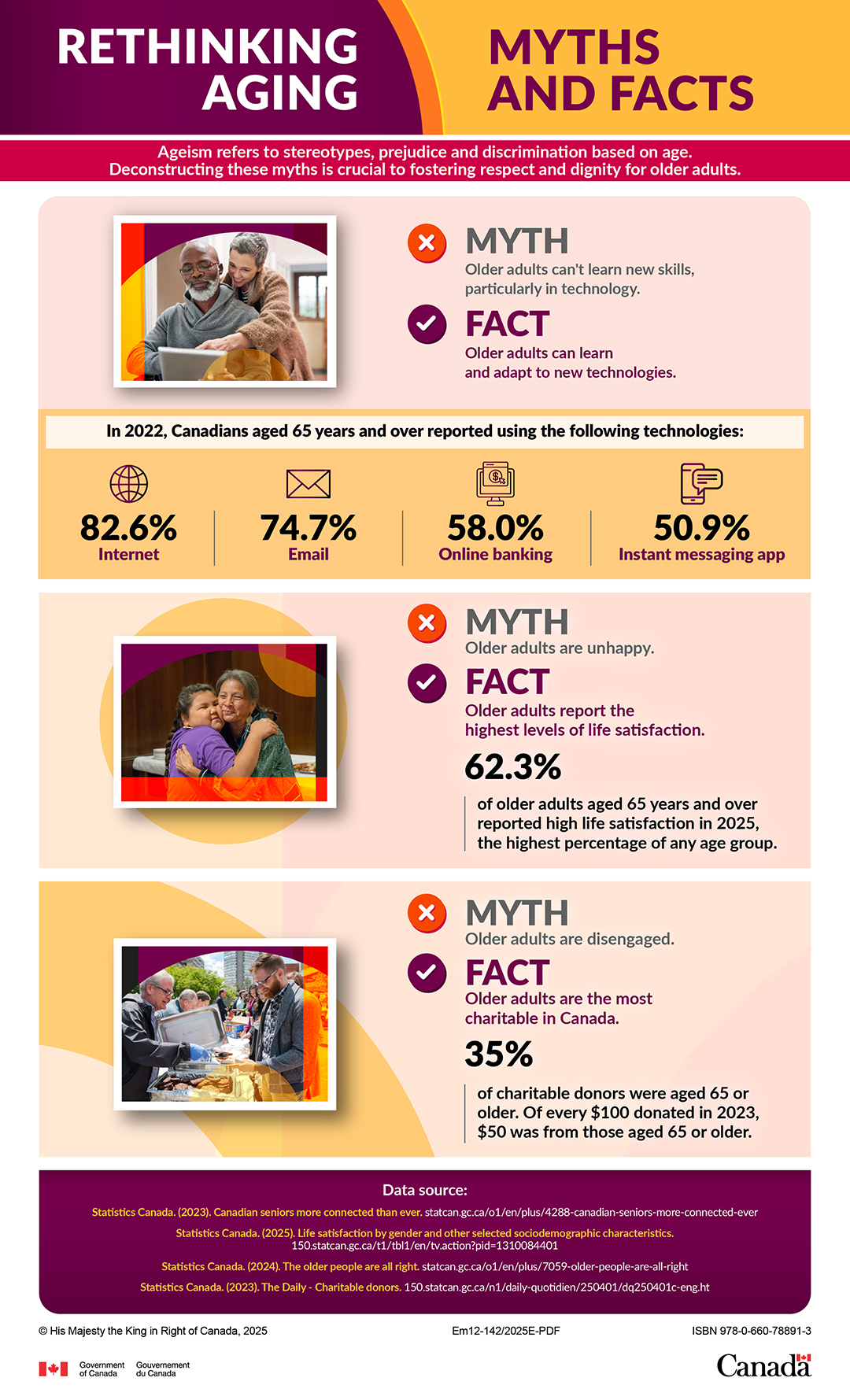
Text description: Rethinking aging: Myths and facts
Ageism refers to stereotypes, prejudice and discrimination based on age. Deconstructing these myths is crucial to fostering respect and dignity for older adults.
Myth: Older adults can't learn new skills, particularly in technology.
Fact: Older adults can learn and adapt to new technologies.
In 2022, Canadians aged 65 years and over reported using the following technologies:
- 82.6% Internet
- 74.7% Email
- 58.0% Online banking
- 50.9% Instant messaging app
Myth: Older adults are unhappy.
Fact: Older adults report the highest levels of life satisfaction.
62.3% of older adults aged 65 years and over reported high life satisfaction in 2025, the highest percentage of any age group.
Myth: Older adults are disengaged.
Fact: Older adults remain the most charitable in Canada.
35% of charitable donors were aged 65 or older. Of every $100 donated in 2023, $50 was from those aged 65 or older.
Data source:
Canadian seniors more connected than ever - Statistics Canada
Life satisfaction by gender and other selected sociodemographic characteristics