
Survey Results of the Public Servants Disclosure Protection Act Review Task Force
On this page
Introduction
Background information
The President of the Treasury Board established the Public Servants Disclosure Protection Act Review Task Force (the task force) on . It was mandated to consider opportunities to enhance federal disclosure processes and protections for public servants who come forward to report wrongdoing under the Public Servants Disclosure Protection Act (PSDPA). As part of the review, the task force developed a comprehensive consultation plan, which included a survey as a way of gathering feedback from anyone with knowledge, experience and interest in the legislation. This report on survey results complements consultations that the task force undertook with a variety of stakeholders and should be interpreted within the context of the task force’s report.
Objective of the survey
The objective of this survey was to ensure that those employed in the public sector, former public servants, contractors and members of the public had the opportunity to provide feedback on ways to improve the PSDPA and its administration.
The survey was set up as a voluntary and anonymous questionnaire to ensure that anyone who wanted to provide their feedback felt safe doing so. Several demographic questions were included to gather general statistics on the respondents who completed the survey. The survey was structured to reflect three themes that were the focus of the review throughout the consultation process. These were:
- disclosure processes
- protections from reprisal and supports
- organizational culture, administration and operations
Methodology
Survey design
The survey was developed by Dr. Stephen Maguire, Adjunct Research Professor in the Ethics and Public Affairs Doctoral Program and Executive Director of the Centre on Values and Ethics at Carleton University, and Basil Alexander, Professor in the Lincoln Alexander School of Law at Toronto Metropolitan University. They received assistance from the task force support team and expertise from the Treasury Board of Canada Secretariat’s Strategic Communications and Ministerial Affairs Sector on public opinion research.
Questions were designed to seek input on the PSDPA in relation to the review’s three themes. The survey used both quantitative and qualitative (open-ended) questions. The design allowed for respondents to complete the survey in the official language of their choice and to opt out of the survey at any time.
SimpleSurvey was contracted to provide data analysis of the survey results in accordance with requirements provided to it by the task force.
Data was collected using the non-probability sampling method.Footnote 1 The survey was available to stakeholders, including current and former public servants and; contractors, as well as members of the public. Although the information provides valuable insights, the data did not allow analysis of the full extent of all stakeholders’ experiences. The number of respondents who were former public servants, contractors and members of the public was extremely small. As such, although all responses were reviewed, the analysis was focused on the information received from current public servants. We have, however, summarized the main themes reflected in all the feedback received from former public servants, contractors and members of the public.
The findings presented are based on feedback from survey respondents. Although participation was substantial, the results should not be interpreted as representative of the entire public sector population.
Data distribution process
The survey was posted online on Canada.ca from to . The Chief Human Resources Officer also sent a message to the chief executives of public sector organizations requesting that they distribute the survey link to their employees.
Respondents
A total of 5,268 surveys were received, 3,574 of which were fully completed. Of the completed surveys, analysis focused on the 3,501 submitted by current public servants, who represented the vast majority of respondents. The number of responses from former public servants, contractors and members of the public each represented 1% or less of respondents. Figure 1 shows the distribution of respondents by profile.
Figure 1: profile of survey participants
| Choice | % | Frequency |
|---|---|---|
| A current or former federal public servant (including working for Crown corporations/agencies (Crowns), the Canadian Armed Forces (CAF), the Canadian Security Intelligence Service (CSIS), the Communications Security Establishment (CSE), and the Royal Canadian Mounted Police (RCMP)) | 98.96% | 3,537 |
| Someone who works/worked as or for a current/former contractor to the federal public sector (including Crowns, CAF, CSIS, CSE, and RCMP) | 0.50% | 18 |
| A member of the general public | 0.53% | 19 |
| Total | 100% | 3,574 |
Transparency: the use of Copilot artificial intelligence
The qualitative results included all open-ended questions based on the three themes. Copilot artificial intelligence (AI) was used to provide key themes, insights and summaries of responses, in accordance with the requirements of the Directive on Automated Decision-Making. From a privacy perspective, all the data was stripped of identifiers (names, titles and organizational unit names) before it was entered into Copilot.
All AI reports were validated by the support team by manually selecting a random sample of responses with a sample size based on a 95% confidence level to determine whether the Copilot reports were valid. Given that the reports will not be used for administrative purposesFootnote 2 as defined in the Privacy Act, an algorithmic impact assessment was not required.
The data set from each open-ended question in the survey was downloaded from SimpleSurvey into a document that was uploaded to Copilot. The prompt used was: “Please provide text analysis, insights and a summary on the attached file having translated any French data and include the translated text in the analysis, which is a data set of survey results in answer to the question:”
Copilot uses a qualitative analysis methodology to review and summarize the survey results from the document provided. Here is a breakdown of the approach:
- Content extraction: The text from the document was retrieved, ensuring that all relevant responses were included for analysis.
- Thematic analysis: Key themes and patterns were identified.
- Translation of French responses: Any French text was translated to ensure that all insights were accessible and included in the analysis.
- Insight generation: The findings were synthesized to provide insights into the overall sentiment of the respondents, highlighting both negative and positive experiences.
- Summary creation: Copilot created a summary that encapsulated the main findings and themes, ensuring clarity and coherence.
Survey results
Demographic data
Employment status of respondents
As shown in Figure 2, of those who answered the question about their employment status:
- 93% reported that they were indeterminate employees
- 6% reported their status as determinate (term, seasonal or student)
- 1% reported their status as “Other”
Figure 2: employment status of respondents
| Choice | % | Frequency |
|---|---|---|
| Indeterminate | 93.40% | 3,270 |
| Determinate (e.g., term, seasonal, student) | 5.68% | 199 |
| Other, please describe (maximum of 100 characters) | 0.91% | 32 |
| Total | 100% | 3,501 |
The total number of respondents who completed this survey question (3,501) appears in the top left portion of the figure. The number of respondents who completed other questions is likewise shown in the other figures throughout this report.
Equity-seeking groups
As shown in Figure 3, of those who completed the question on equity-seeking groups:
- 25% reported being a member of a racialized group
- 6% reported being an Indigenous person (First Nations, Inuk or Métis)
- 28% reported being a person with a disability
- 15% reported being a member of the 2SLGBTQIA+ community
- 12% reported being a member of “another equity-seeking group”
- 28% of respondents indicated that they preferred not to answer the question
Figure 3: survey respondents by equity-seeking group
| Choice | % | Frequency |
|---|---|---|
| A member of a racialized group | 25.04% | 490 |
| An Indigenous person (i.e., First Nations, Inuk (Inuit), or Métis) | 6.29% | 123 |
| A person with disability | 28.41% | 556 |
| 2SLGBTQIA+ | 14.92% | 292 |
| Another equity-seeking group (specify if you wish, maximum of 200 characters) | 12.21% | 239 |
| Prefer not to answer | 27.85% | 545 |
Gender
As shown in Figure 4, of those respondents who completed the question on gender:
- 61% identified as women
- 32% identified as men
- 1% identified as “another gender”
- 6% preferred not to answer the question
Figure 4: survey respondents by gender
| Choice | % | Frequency |
|---|---|---|
| Woman | 60.96% | 2,131 |
| Man | 31.58% | 1,104 |
| Another gender (self-identify if you wish, maximum of 100 characters) | 1.09% | 38 |
| Prefer not to answer | 6.38% | 223 |
| Total | 100% | 3,496 |
Excluded organizations
Three organizations are excluded from the definition of “public sector” in the Public Servants Disclosure Protection Act:
- the Canadian Armed Forces
- the Canadian Security Intelligence Service
- Communications Security Establishment Canada
Figure 5 shows that approximately 8% of survey respondents worked for or provided goods, equipment or services to an excluded organization.
Figure 5: survey respondents who worked for/with, or are working for/with, excluded organizations
| Choice | % | Frequency |
|---|---|---|
| Yes | 8.23% | 288 |
| No | 90.39% | 3,162 |
| Prefer not to answer | 1.37% | 48 |
| Total | 100% | 3,498 |
Workplace factors and values
Respondents were asked to rank up to five factors they consider most important to encourage and support employees to disclose, where 1 was the most important factor and 5 was least important. The top factors were determined by considering the number of respondents who selected a factor as either their first, second, third, fourth or fifth factor (the corresponding number from the “Total” column) in relation to the total number of respondents who completed the question. This process was used to determine the top results for similarly ranked survey questions.
Note that where an “Other” category was included in questions throughout the survey, respondents were able to write a personal response to the question, to a maximum length of 5,000 characters. These “Other” responses were analyzed and summarized for each question where this option was available.
Key factors that encourage and support disclosure
The top portion of Figure 6, as with similar figures throughout this report, shows the percentage split of the rankings for each factor, with each rank shown in a different colour.
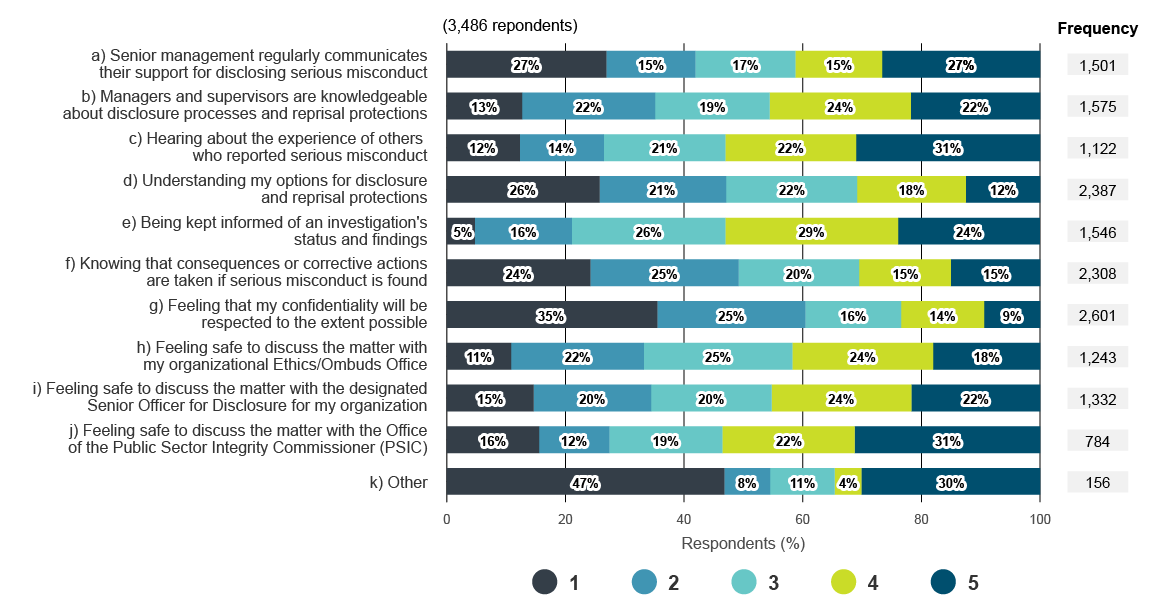
Figure 6 - Text version
| Choice | Rank | Total | ||||
|---|---|---|---|---|---|---|
| 1 | 2 | 3 | 4 | 5 | ||
| a) Senior management regularly communicates their support for disclosing serious misconduct | 26.92% 404 |
14.99% 225 |
16.86% 253 |
14.59% 219 |
26.65% 400 |
1,501 |
| b) Managers and supervisors are knowledgeable about disclosure processes and reprisal protections | 12.70% 200 |
22.41% 353 |
19.30% 304 |
23.81% 375 |
21.78% 343 |
1,575 |
| c) Hearing about the experience of others who reported serious misconduct | 12.30% 138 |
14.17% 159 |
20.50% 230 |
22.01% 247 |
31.02% 348 |
1,122 |
| d) Understanding my options for disclosure and reprisal protections | 25.76% 615 |
21.32% 509 |
22.08% 527 |
18.35% 438 |
12.48% 298 |
2,387 |
| e) Being kept informed of an investigation's status and findings | 4.72% 73 |
16.36% 253 |
25.87% 400 |
29.11% 450 |
23.93% 370 |
1,546 |
| f) Knowing that consequences or corrective actions are taken if serious misconduct is found | 24.22% 559 |
24.96% 576 |
20.32% 469 |
15.47% 357 |
15.03% 347 |
2,308 |
| g) Feeling that my confidentiality will be respected to the extent possible | 35.49% 923 |
24.95% 649 |
16.15% 420 |
13.96% 363 |
9.46% 246 |
2,601 |
| h) Feeling safe to discuss the matter with my organizational Ethics/Ombuds Office | 10.86% 135 |
22.37% 278 |
25.02% 311 |
23.73% 295 |
18.02% 224 |
1,243 |
| i) Feeling safe to discuss the matter with the designated Senior Officer for Disclosure for my organization | 14.64% 195 |
19.82% 264 |
20.27% 270 |
23.57% 314 |
21.70% 289 |
1,332 |
| j) Feeling safe to discuss the matter with the Office of the Public Sector Integrity Commissioner (PSIC) | 15.56% 122 |
11.86% 93 |
19.01% 149 |
22.32% 175 |
31.25% 245 |
784 |
| k) Other | 46.79% 73 |
7.69% 12 |
10.90% 17 |
4.49% 7 |
30.13% 47 |
156 |
The results show that:
- 75% of respondents indicated that “feeling that my confidentiality will be respected to the extent possible” was one of the most important factors in encouraging and supporting employees to disclose serious misconduct
- the second most important factor, chosen by 68% of respondents, was “understanding my options for disclosure and reprisal protections”
- “knowing that consequences or corrective actions are taken if serious misconduct is found” was the third most important factor, selected by 66% of respondents
- the category of “Other” was selected by 4% of respondents
Of those respondents who selected the “Other” category for this question, many mentioned the need for a safe environment where employees feel secure to report misconduct without fear of reprisal. Respondents also:
- emphasized the importance of anonymity and confidentiality in the reporting process
- expressed a strong desire for senior management to be held accountable for their actions
- called for transparency in the handling of reports
- called for visible consequences for misconduct
These respondents indicated the need for independent support structures and oversight bodies to foster trust in the process. In addition, they:
- highlighted the need for a strong cultural shift so that employees feel valued and heard
- highlighted the need for whistleblowers to be recognized as heroes rather than outcasts
- reported that clear communication and guidelines about processes and protections are crucial for employees to understand how to report serious misconduct and how they will be protected
These responses underscore the importance of creating a supportive and transparent environment to significantly enhance employees’ willingness to report, ultimately leading to a healthier workplace culture.
Psychological safety in the workplace
Psychological safety in the workplace was assessed in the following manner:
- the culture scale items listed in the table in Figure 7 were validated using the large number of responses in this survey to show strong inter-item correlations. The scale was proven to be a reliable assessment of psychological health and safety in the workplaceFootnote 4
- respondents were asked to indicate the extent to which they agreed with each item in the scale
Elements of psychological health and safety in the workplace
The results in Figure 7 speak to the importance of factors such as accountability, respectful workplaces, a sense of belonging, and trust in creating a psychologically safe environment for reporting serious misconduct.
The totals shown at the end of each line in Figure 7 represent the number of responses received for each of the statements. The percentages in each column reflect the proportion of responses that correspond with each statement (strongly agree, agree, neither agree nor disagree, and so on).
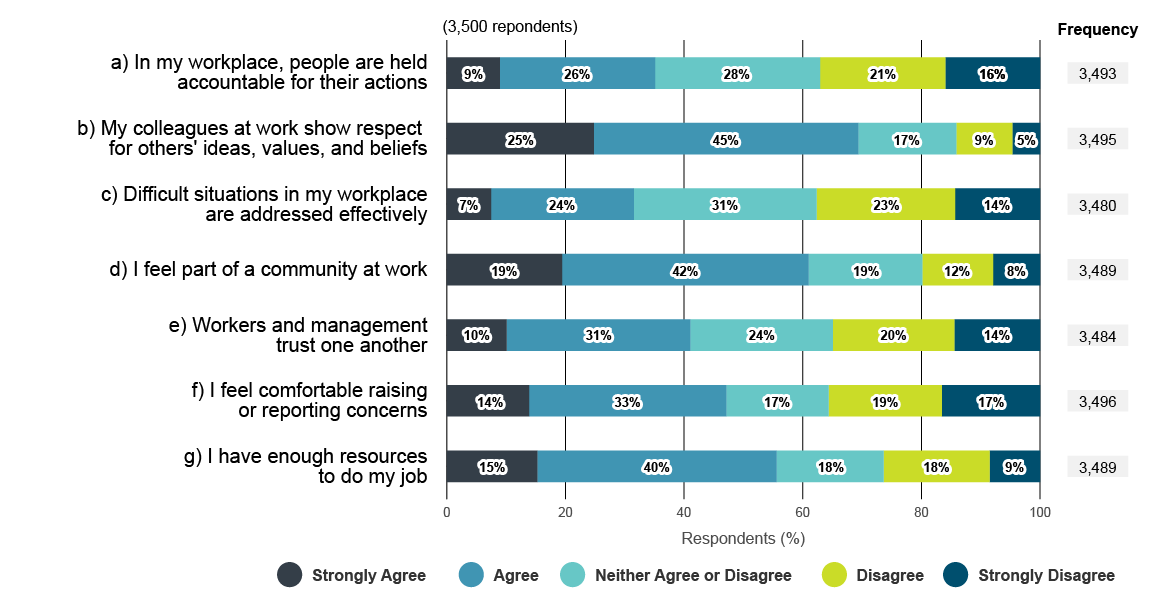
Figure 7 - Text version
| Choice | Strongly agree | Agree | Neither agree or disagree | Disagree | Strongly disagree | Total |
|---|---|---|---|---|---|---|
| a) In my workplace, people are held accountable for their actions | 8.93% 312 |
26.17% 914 |
27.83% 972 |
21.10% 737 |
15.97% 558 |
3,493 |
| b) My colleagues at work show respect for others' ideas, values, and beliefs | 24.78% 866 |
44.58% 1,558 |
16.51% 577 |
9.44% 330 |
4.69% 164 |
3,495 |
| c) Difficult situations in my workplace are addressed effectively | 7.47% 260 |
24.08% 838 |
30.80% 1,072 |
23.33% 812 |
14.31% 498 |
3,480 |
| d) I feel part of a community at work | 19.43% 678 |
41.56% 1,450 |
19.17% 669 |
11.92% 416 |
7.91% 276 |
3,489 |
| e) Workers and management trust one another | 10.07% 351 |
30.97% 1,079 |
24.05% 838 |
20.46% 713 |
14.44% 503 |
3,484 |
| f) I feel comfortable raising or reporting concerns | 13.87% 485 |
33.24% 1,162 |
17.25% 603 |
19.08% 667 |
16.56% 579 |
3,496 |
| g) I have enough resources to do my job | 15.28% 533 |
40.33% 1,407 |
18.00% 628 |
17.88% 624 |
8.51% 297 |
3,489 |
These survey results indicate quite a high degree of interpersonal respect in the workplace,Footnote 5 and 61% of respondents feel a sense of community at work, which is a strong indicator of mental health. On the other hand, three results relating to accountability were troubling:
- less than half of respondents (47%) feel comfortable raising concerns in their workplace
- only 32% believe that difficult situations are effectively addressed in their workplace
- only 35% believe that people are held accountable for their actions
Composite score for psychological health and safety in the workplace
A composite score for psychological health and safety was derived by aggregating multiple individual responses related to this topic to produce a single blended score. The composite score shown in Figure 8 enables us to report that 59% of respondents experience a psychologically safe and healthy work environment. However, nearly four in 10 respondents (37%), work in a psychologically unsafe and unhealthy work environment, as shown below.
Figure 8: aggregated results for psychological health and safety
| Composite | % |
|---|---|
| Agree | 58.5 |
| Neutral | 4.7 |
| Disagree | 36.8 |
| Total | 100 |
Feedback from other respondents
The number of respondents who were not public servants (former public servants, contractors and members of the public) was small; however, we believe that their feedback is worth mentioning:
- In comparison to current public servants, former public servants were more likely to disagree on the existence of a psychologically safe workplace. If they were to witness misconduct, they were also more likely to choose official routes to report it, such as an ethics or ombuds office or a union representative. They also identified their main factors for discouraging disclosure as fear of reprisals and a lack of evidence. In the context of what encourages disclosure, they reported that confidentiality and senior leadership support were most important.
- Of those who had witnessed misconduct, contractors were more likely to reach out to a manager or higher official, or to take no action. The main factors that would discourage them from disclosing serious misconduct included:
- situations that they believed were not serious enough
- a lack of evidence
- possible reprisals
- a lack of anonymity or confidentiality
They also identified a sense of justice, support from witnesses, and sufficient evidence as important factors in encouraging disclosure.
Workplace behaviour scenarios
As part of this survey, we were interested in obtaining data on the experience of public servants regarding the handling of misconduct in the workplace. To solicit respondents’ views on this topic, we developed four scenarios and asked respondents to express who they would reach out to if they witnessed certain types of misconduct, as described in each scenario.
The percentage of respondents considered “likely” to choose a particular option includes those who indicated they were either “very likely” or “somewhat likely” to choose it.
As a follow-up, we then asked respondents how they believe the misconduct should be handled versus how they believe it would be handled. Their responses provided insights on how employees deal with workplace misconduct and their perception of how it is managed.
Scenario 1a
One of my colleagues belittles/dismisses the ideas of others.
Who were respondents likely to discuss this situation with?
Survey respondents were asked to whom they would talk if they witnessed someone belittling a colleague or dismissing their ideas. Figure 9 indicates how likely or unlikely respondents would be to discuss this situation with each resource, listed as categories (a) to (g). The proportion of respondents selecting each option (very likely, somewhat likely and so on) appears in different colours, as shown below.
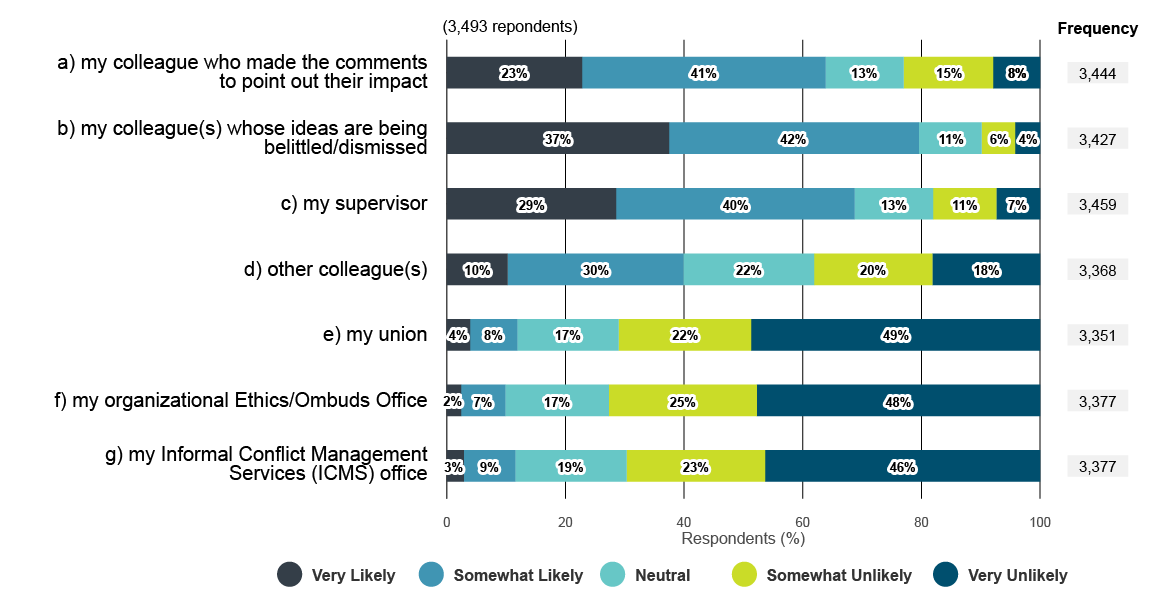
Figure 9 - Text version
| Choice | Very likely | Somewhat likely | Neutral | Somewhat unlikely | Very unlikely | Total |
|---|---|---|---|---|---|---|
| a) my colleague who made the comments to point out their impact | 22.82% 786 |
41.03% 1,413 |
13.15% 453 |
15.10% 520 |
7.90% 272 |
3,444 |
| b) my colleague(s) whose ideas are being belittled/dismissed | 37.47% 1,284 |
42.08% 1,442 |
10.59% 363 |
5.66% 194 |
4.20% 144 |
3,427 |
| c) my supervisor | 28.56% 988 |
40.19% 1,390 |
13.21% 457 |
10.67% 369 |
7.37% 255 |
3,459 |
| d) other colleague(s) | 10.24% 345 |
29.63% 998 |
22.03% 742 |
19.95% 672 |
18.14% 611 |
3,368 |
| e) my union | 3.94% 132 |
7.94% 266 |
17.07% 572 |
22.35% 749 |
48.70% 1,632 |
3,351 |
| f) my organizational Ethics/Ombuds Office | 2.40% 81 |
7.46% 252 |
17.47% 590 |
24.93% 842 |
47.73% 1,612 |
3,377 |
| g) my Informal Conflict Management Services (ICMS) office | 2.90% 98 |
8.65% 292 |
18.77% 634 |
23.33% 788 |
46.34% 1,565 |
3,377 |
The “Total” column in this figure shows the number of respondents who selected each option; the numbers on each line differ because not all respondents selected every option. The results in Figure 9 show that:
- almost 80% reported that they would likely reach out to the colleague who was the subject of the belittling or dismissive behaviour, a result that demonstrates an impressive willingness to support colleagues
- 69% reported that they would likely discuss the incident with their supervisor
- 64% reported that they would likely discuss this situation with the colleague responsible for the belittling or dismissive behaviour to point out the impact of their behaviour, a very positive finding with close to two thirds of respondents reporting a willingness to intervene in this situation
Forty percent of respondents reported that they were likely to discuss this situation with other colleagues, and 12% said that they would likely discuss it with their union. The same proportion (12%) said that they would likely discuss it with the ethics or ombuds office of their organization, and 10% said that they would likely reach out to their Informal Conflict Management Services (ICMS) group.
Scenario 1b
My colleague continues their belittling/dismissive behaviour.
If belittling behaviour continued, to whom would respondents report?
The survey results in Figure 10 reveal that if the colleague’s belittling or dismissive behaviour continued, the number of respondents who would likely report this misconduct to their supervisor increases from 69% to 87%. Respondents reported that their use of other avenues, such as union representatives, the ethics or ombuds office, or ICMS office, would also increase, as shown below.
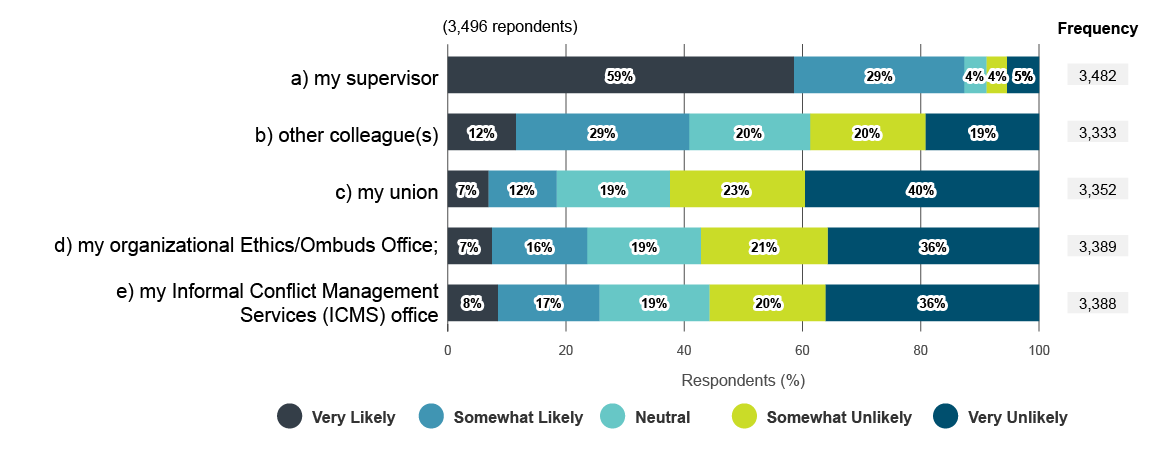
Figure 10 - Text version
| Choice | Very likely | Somewhat likely | Neutral | Somewhat unlikely | Very unlikely | Total |
|---|---|---|---|---|---|---|
| a) my supervisor | 58.53% 2,038 |
28.78% 1,002 |
3.76% 131 |
3.50% 122 |
5.43% 189 |
3,482 |
| b) other colleague(s) | 11.52% 384 |
29.31% 977 |
20.43% 681 |
19.50% 650 |
19.23% 641 |
3,333 |
| c) my union | 6.86% 230 |
11.55% 387 |
19.15% 642 |
22.82% 765 |
39.62% 1,328 |
3,352 |
| d) my organizational Ethics/Ombuds Office | 7.47% 253 |
16.11% 546 |
19.21% 651 |
21.45% 727 |
35.76% 1,212 |
3,389 |
| e) my Informal Conflict Management Services (ICMS) office | 8.47% 287 |
17.18% 582 |
18.57% 629 |
19.63% 665 |
36.16% 1,225 |
3,388 |
In this scenario:
- 41% reported that they would likely report their concerns to other colleagues
- 24% would report them to their ethics or ombuds office
- 26% would report them to their ICMS office
- 18% would likely reach out to their union
The totals shown at the end of each line in the table in Figure 10 represent the number of responses received for each of the resource options. The percentages in each column reflect the proportion of responses associated with each option (very likely, somewhat likely, neutral and so on).
What should happen if an investigation found improper behaviour?
If an investigation determined that there was improper behaviour, respondents were asked what they thought should happen; they were able to select more than one option. The numbers in the “Frequency” column in the table in Figure 11 show how many respondents selected each option.
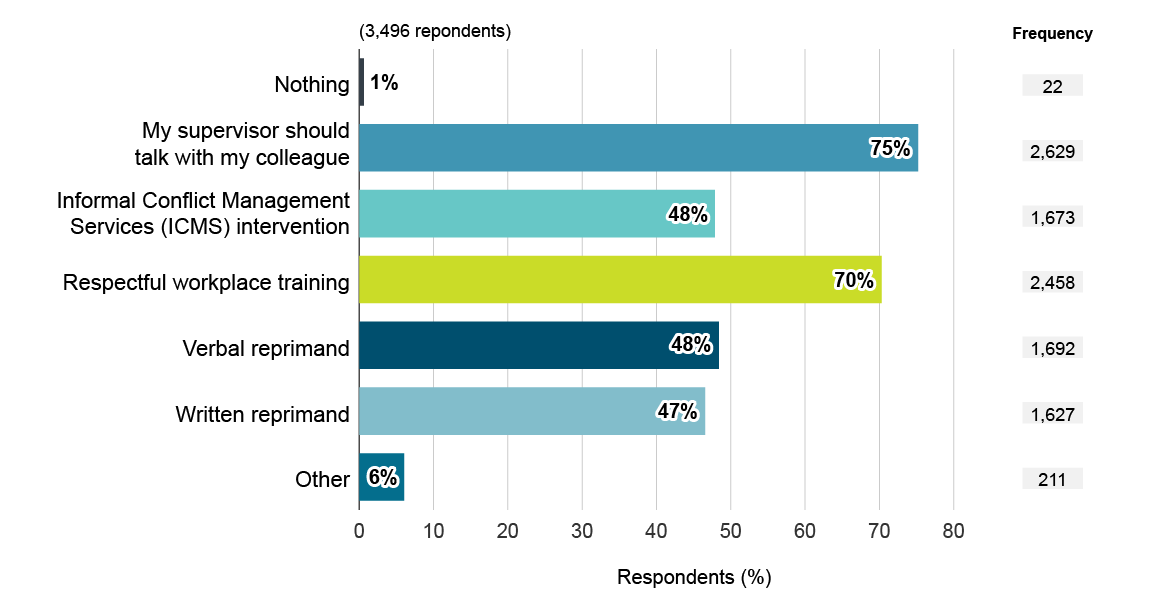
Figure 11 - Text version
| Choice | % | Frequency |
|---|---|---|
| Nothing | 0.63% | 22 |
| My supervisor should talk with my colleague | 75.20% | 2,629 |
| Informal Conflict Management Services (ICMS) intervention | 47.85% | 1,673 |
| Respectful workplace training | 70.31% | 2,458 |
| Verbal reprimand | 48.40% | 1,692 |
| Written reprimand | 46.54% | 1,627 |
| Other | 6.04% | 211 |
The “Total” number on the bottom line represents the number of respondents who completed the question, not the sum of numbers in the “Frequency” column. The survey results show that if the behaviour continued:
- 75% of respondents thought that their supervisor should talk to the colleague who behaved improperly
- 70% thought that the colleague should receive training on respectful workplaces
- 48% thought that a verbal reprimand should be given, the same percentage who thought that ICMS should be used
- 47% thought that a written reprimand should be issued
- less than 1% of respondents thought that nothing should be done in this situation
Overall, most respondents chose a supportive approach to dealing with this continued disrespectful behaviour, although many chose a disciplinary approach (for example, 48% for a verbal reprimand and 47% for a written reprimand). Of the 6% of respondents who selected the “Other” category, responses also revealed remedial and disciplinary options. Some suggestions were unique; they included:
- tools, training and mentorship
- apologies to those affected
- restorative justice approaches to address behaviour and rebuild trust
- the clear communication of expectations and consequences
These responses reflect a balanced view between punitive and supportive measures. The feedback underscores the importance of context, clear communication and transparency in handling continued improper behaviour in the workplace.
What would happen if an investigation found improper behaviour?
In contrast, respondents were asked what they thought would happen if an investigation found improper behaviour. Figure 12 illustrates their responses.
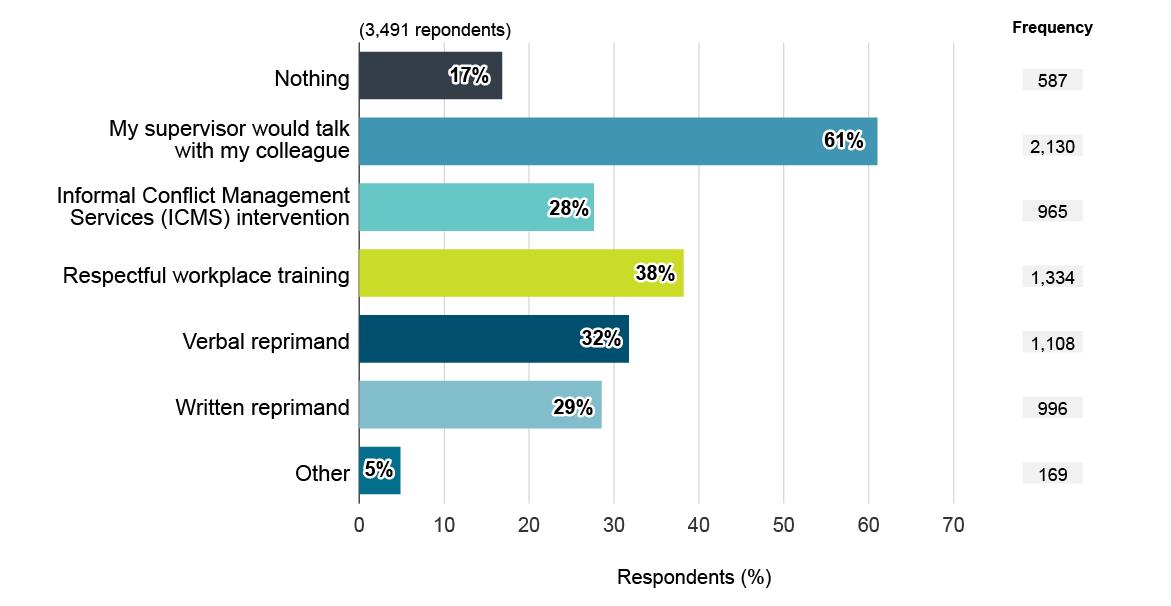
Figure 12 - Text version
| Choice | % | Frequency |
|---|---|---|
| Nothing | 16.81% | 587 |
| My supervisor would talk with my colleague | 61.01% | 2,130 |
| Informal Conflict Management Services (ICMS) intervention | 27.64% | 965 |
| Respectful workplace training | 38.21% | 1,334 |
| Verbal reprimand | 31.74% | 1,108 |
| Written reprimand | 28.53% | 996 |
| Other | 4.84% | 169 |
The results show that:
- the majority of respondents (61%) thought that their supervisor would talk with the colleague, down from 75% who thought they should
- the next most popular choice was that the colleague would receive training on respectful workplaces (38%), down from 70% who thought they should
- 32% thought a verbal reprimand would be given, less than the 48% who thought one should be given
- 29% thought a written reprimand would be given, compared to 47% who thought one should be given
- slightly fewer respondents (28%) thought that intervention with the ICMS team would occur
- 17% of respondents thought that nothing would be done
The 4.8% of respondents who selected the “Other” category expressed skepticism about meaningful consequences in comments such as “nothing happens” and reported that management often fails to take appropriate action, leading to a culture where misconduct is tolerated. They also expressed that management often protects individuals in positions of power, leading to a culture of impunity. They emphasized the importance of transparent processes and accountability.
The feedback from respondents who selected the “Other” category highlights the following:
- a pervasive belief that management often fails to act decisively against misconduct
- the need for:
- clearer disciplinary processes
- greater accountability
- clear communication about the outcomes of investigations
- a shift in workplace culture to ensure that all employees feel safe and respected
Scenario 2
During informal conversations, one of my colleagues regularly makes racist joking remarks. The person continues to make such remarks even after other colleagues, our supervisor, and the Equity, Diversity, and Inclusion (EDI) officer have explained the remarks’ offensiveness during individual discussions.
Who were respondents likely to discuss this situation with?
In the case of more serious misconduct, where a colleague regularly makes racist remarks despite various interventions, respondents’ choice of parties is illustrated in Figure 13.
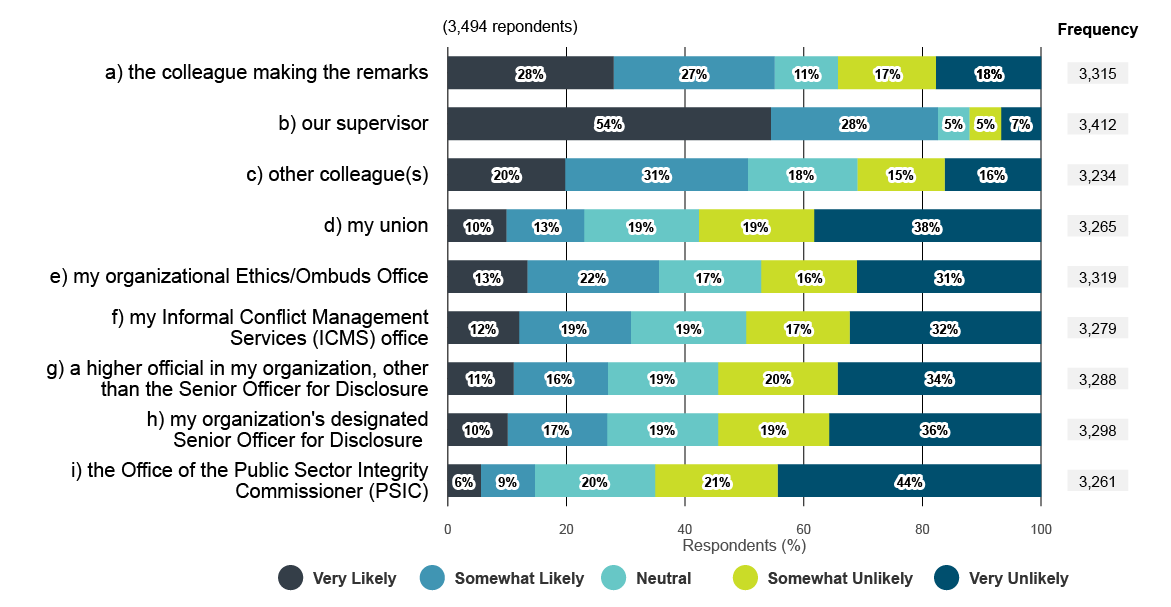
Figure 13 - Text version
| Choice | Very likely | Somewhat likely | Neutral | Somewhat unlikely | Very unlikely | Total |
|---|---|---|---|---|---|---|
| a) the colleague making the remarks | 27.96% 927 |
27.12% 899 |
10.65% 353 |
16.53% 548 |
17.74% 588 |
3,315 |
| b) our supervisor | 54.45% 1,858 |
28.17961 | 5.30% 181 |
5.33% 182 |
6.74% 230 |
3,412 |
| c) other colleague(s) | 19.76% 639 |
30.83% 997 |
18.46% 597 |
14.69% 475 |
16.26% 526 |
3,234 |
| d) my union | 9.89% 323 |
13.11% 428 |
19.30% 630 |
19.45% 635 |
38.25% 1,249 |
3,265 |
| e) my organizational Ethics/Ombuds Office | 13.41% 445 |
22.15% 735 |
17.26% 573 |
16.15% 536 |
31.03% 1,030 |
3,319 |
| f) my Informal Conflict Management Services (ICMS) office | 12.02% 394 |
18.82% 617 |
19.46% 638 |
17.44% 572 |
32.27% 1,058 |
3,279 |
| g) a higher official in my organization, other than the Senior Officer for Disclosure | 11.10% 365 |
15.88% 522 |
18.58% 611 |
20.16% 663 |
34.28% 1,127 |
3,288 |
| h) my organization's designated Senior Officer for Disclosure | 10.07% 332 |
16.77% 553 |
18.71% 617 |
18.71% 617 |
35.75% 1,179 |
3,298 |
| i) the Office of the Public Sector Integrity Commissioner (PSIC) | 5.58% 182 |
9.11% 297 |
20.27% 661 |
20.64% 673 |
44.40% 1,448 |
3,261 |
These results show that:
- 83% of respondents indicated that they were likely to discuss this situation with their supervisor
- 55% reported that they would likely speak to the colleague who made the remarks
- 51% would likely discuss the situation with other colleagues
- 36% reported that they were likely to contact their ethics or ombuds office
- 31% said that they would consult their ICMS team
- the same number of respondents selected the “higher official” and “senior officer for disclosure” options (both 27%)
- 23% of respondents would likely reach out to a union
- only 15% said that they would discuss it with the Public Sector Integrity Commissioner
The totals shown at the end of each line in the table in Figure 13 represent the number of responses received for each of the resource options. The percentages in each column reflect the proportion of those responses associated with each option (very likely, somewhat likely, neutral and so on).
The survey results clearly show that in a situation of more serious misconduct, employees would be much more likely to talk to their supervisor about it than anyone else. They would also be less likely (9% less) than in Scenario 1a to speak with their colleague who made the remarks, suggesting that the more serious the misconduct, the less willing witnesses might be to intervene. However, the number who would intervene in this way is still quite significant, at 55%.
What should happen if an investigation found improper behaviour?
Figure 14 illustrates the options chosen by respondents in a situation where an investigation determines that allegations of improper behaviour were founded.
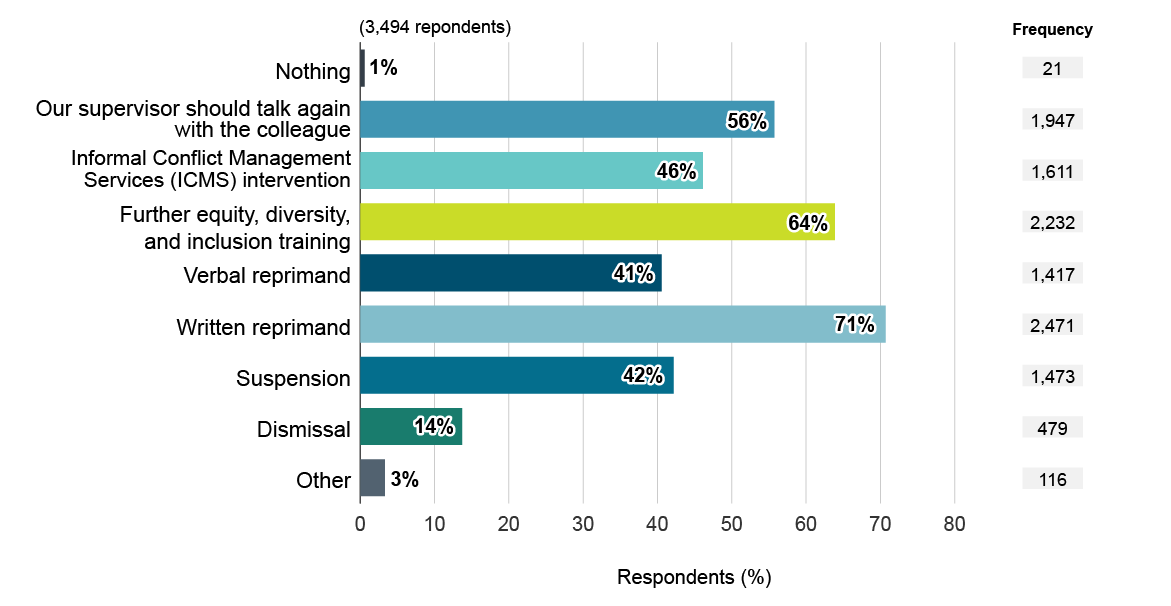
Figure 14 - Text version
| Choice | % | Frequency |
|---|---|---|
| Nothing | 0.60% | 21 |
| Our supervisor should talk again with the colleague | 55.72% | 1,947 |
| Informal Conflict Management Services (ICMS) intervention | 46.11% | 1,611 |
| Further equity, diversity, and inclusion training | 63.88% | 2,232 |
| Verbal reprimand | 40.56% | 1,417 |
| Written reprimand | 70.72% | 2,471 |
| Suspension | 42.16% | 1,473 |
| Dismissal | 13.71% | 479 |
| Other | 3.32% | 116 |
The results show that:
- the most favoured option chosen to address the ongoing racist behaviour, selected by 71% of respondents, is a written reprimand
- 64% of respondents suggested that further equity, diversity and inclusion training should be required
- 56% felt that the supervisor should talk to the colleague again
The remaining options were selected by fewer than 50% of respondents:
- 46% thought that an ICMS intervention should occur
- 42% thought that the colleague should be suspended
- 41% thought that a verbal reprimand was in order
- 14% thought that the colleague should be dismissed
Of those who selected the “Other” category, their responses reflect a balanced view between punitive and supportive measures. Although some respondents suggest discipline should involve a written reprimand, many believe that the person’s actions should result in suspension without pay or dismissal. Others suggest supportive measures such as:
- additional training (particularly in respectful workplace behaviour and leadership skills)
- mentorship to correct behaviours, especially for supervisors
- apologizing to those affected
- restorative justice frameworks, including facilitated discussions to address the impact of the behaviour and rebuild trust
The need for nuanced approaches that consider the context was also mentioned (for example, the specific circumstances and individuals involved) with the nature and severity of the improper behaviour dictating the response.
Respondents who selected the “Other” category also mentioned:
- the need for transparency
- holding individuals accountable while providing opportunities for improvement
- clear communication on expectations and consequences to demonstrate a commitment to values and to deter future misconduct
What would happen if an investigation found improper behaviour?
Figure 15 illustrates public servants’ responses when asked what they think would happen if this situation occurred in the workplace. Many respondents favoured the option of a written reprimand for what should happen, while significantly fewer respondents believed this would happen.
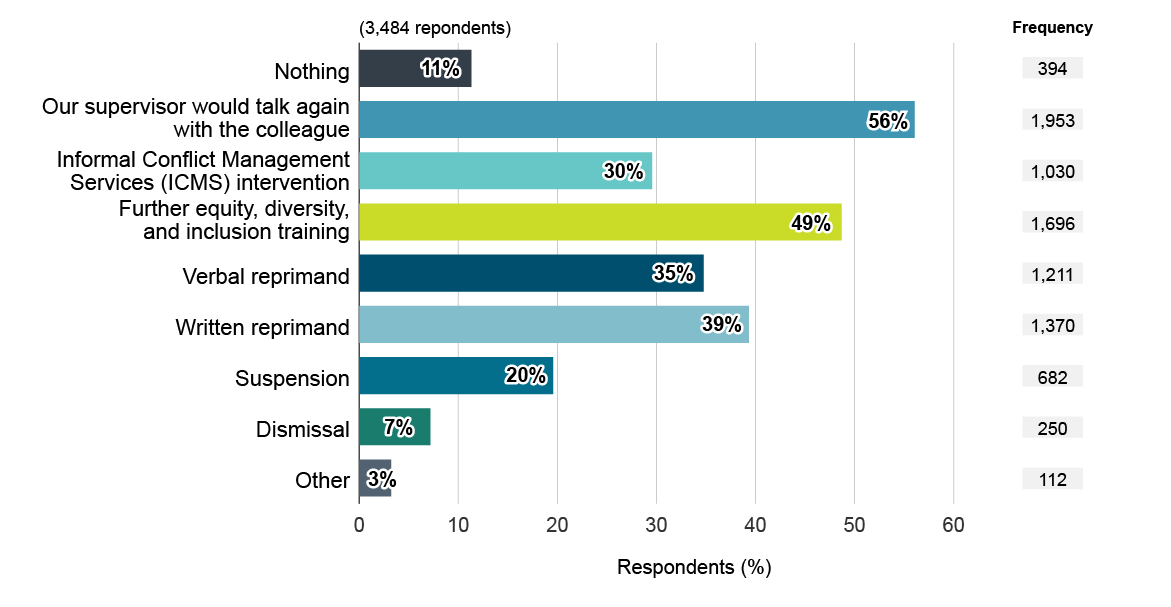
Figure 15 - Text version
| Choice | % | Frequency |
|---|---|---|
| Nothing | 11.31% | 394 |
| Our supervisor would talk again with the colleague | 56.06% | 1,953 |
| Informal Conflict Management Services (ICMS) intervention | 29.56% | 1,030 |
| Further equity, diversity, and inclusion training | 48.68% | 1,696 |
| Verbal reprimand | 34.76% | 1,211 |
| Written reprimand | 39.32% | 1,370 |
| Suspension | 19.58% | 682 |
| Dismissal | 7.18% | 250 |
| Other | 3.21% | 112 |
It is noteworthy that 11% of respondents thought that nothing would happen if the allegations of improper behaviour were deemed to be founded.
The results also showed that:
- the second-highest percentage of respondents (56%) indicated that what would happen is that their supervisor would talk to the colleague again, similar to 56% who thought this should happen
- 49% indicated that further equity, diversity and inclusion training would be the likely organizational response, compared to 64% who thought it should happen
- 35% thought that a verbal reprimand would occur, compared to 41% who thought one should occur
- 39% thought that a written reprimand would occur, compared to 71% who thought one should occur
Of the 3.2% who selected the “Other” category, results indicated a deep-seated skepticism regarding the effectiveness of disciplinary actions in response to improper behaviour; many also expressed doubts that any significant action would be taken. In addition, some believed that the consequences of improper behaviour vary significantly based on the person’s position within the organization and that individuals in higher positions often evade consequences, leading to a culture of impunity. Representative comments include:
- the need for “progressive disciplinary measures”
- “the person would likely be moved to another position with little to no consequence”
- “it would depend on who the person is, the higher the position the more likely nothing would happen”
Their responses are a clear call for systemic changes to ensure accountability and support for those who report misconduct.
Scenario 3
My supervisor favours relatives, friends, and associates when they consult, provide training opportunities, or allow people to work from home.
In a situation where a supervisor is showing preferential treatment to friends, relatives and associates, and treating others unfairly, Figure 16 shows how likely respondents would be to discuss the situation with various parties.
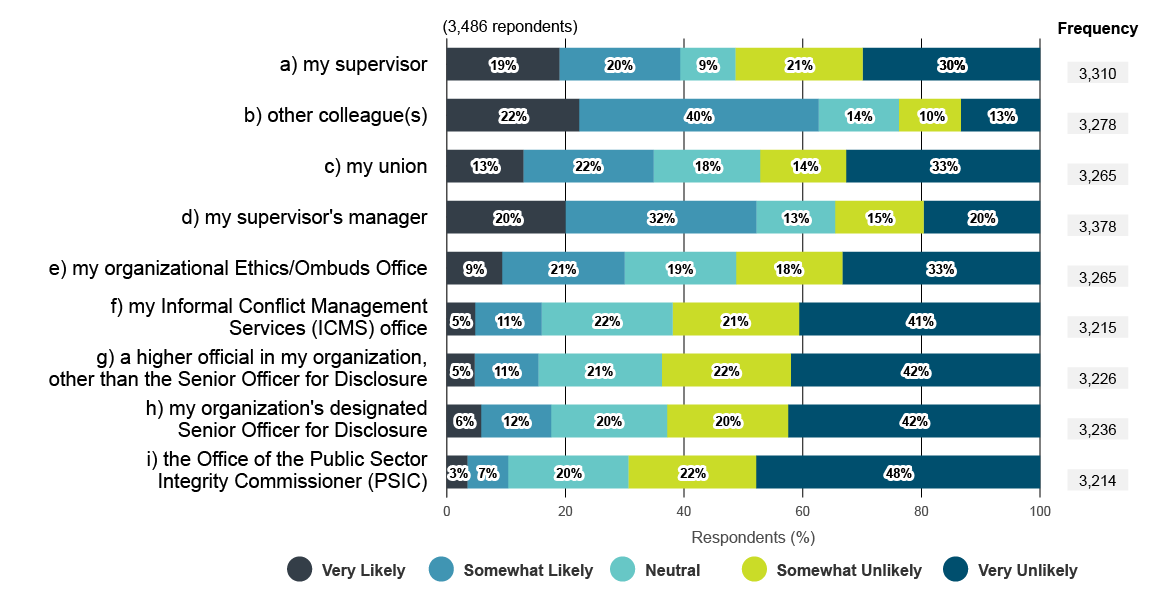
Figure 16 - Text version
| Choice | Very likely | Somewhat likely | Neutral | Somewhat unlikely | Very unlikely | Total |
|---|---|---|---|---|---|---|
| a) my supervisor | 18.97% 628 |
20.36% 674 |
9.31% 308 |
21.45% 710 |
29.91% 990 |
3,310 |
| b) other colleague(s) | 22.30% 731 |
40.39% 1,324 |
13.51% 443 |
10.46% 343 |
13.33% 437 |
3,278 |
| c) my union | 12.92% 422 |
21.96% 717 |
17.95% 586 |
14.49% 473 |
32.68% 1,067 |
3,265 |
| d) my supervisor's manager | 19.98% 675 |
32.18% 1,087 |
13.29% 449 |
14.92% 504 |
19.63% 663 |
3,378 |
| e) my organizational Ethics/Ombuds Office | 9.34% 305 |
20.64% 674 |
18.77% 613 |
17.92% 585 |
33.32% 1,088 |
3,265 |
| f) my Informal Conflict Management Services (ICMS) office | 4.76% 153 |
11.23% 361 |
22.08% 710 |
21.31% 685 |
40.62% 1,306 |
3,215 |
| g) a higher official in my organization, other than the Senior Officer for Disclosure | 4.68% 151 |
10.76% 347 |
20.83% 672 |
21.73% 701 |
42.00% 1,355 |
3,226 |
| h) my organization's designated Senior Officer for Disclosure | 5.78% 187 |
11.80% 382 |
19.56% 633 |
20.40% 660 |
42.46% 1,374 |
3,236 |
| i) the Office of the Public Sector Integrity Commissioner (PSIC) | 3.48% 112 |
6.88% 221 |
20.26% 651 |
21.50% 691 |
47.88% 1,539 |
3,214 |
The results show that:
- the most favoured option was to discuss this problem with one’s colleagues (63%)
- 52% reported that they would likely talk to their supervisor’s manager
- 39% indicated that they would likely talk to their supervisor
- the next highest-rated choice was their union (35%), followed by:
- their ethics or ombuds office (30%)
- their senior officer for internal disclosure (18%)
- ICMS (16%)
- a higher official (15%)
Only 10% said that they would likely discuss this situation with the Public Sector Integrity Commissioner.
What should happen if an investigation found improper behaviour?
Figure 17 illustrates how respondents answered when asked what they think should happen if an investigation found improper behaviour by the supervisor.
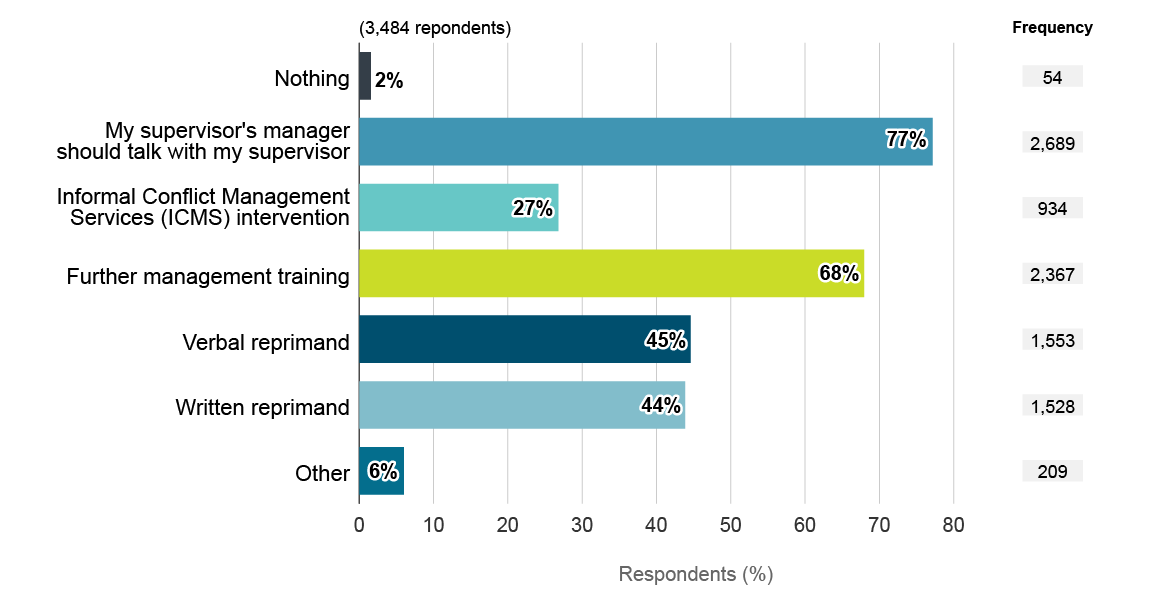
Figure 17 - Text version
| Choice | % | Frequency |
|---|---|---|
| Nothing | 1.55% | 54 |
| My supervisor's manager should talk with my supervisor | 77.18% | 2,689 |
| Informal Conflict Management Services (ICMS) intervention | 26.81% | 934 |
| Further management training | 67.94% | 2,367 |
| Verbal reprimand | 44.58% | 1,553 |
| Written reprimand | 43.86% | 1,528 |
| Other | 6.00% | 209 |
These results indicate that:
- more than three quarters of respondents (77%) believed that the supervisor’s manager should talk to them about it (although nearly 20% fewer respondents thought that this would happen, as shown in the next section)
- 68% thought that additional management training should occur
- 45% selected “verbal reprimand”
- 44% selected “written reprimand”
- 27% thought that an ICMS intervention was appropriate
- only a small fraction of respondents (less than 2%) thought that nothing should happen.
Of the 6% who selected the “Other” category, there were strong calls for accountability. Many of these respondents felt that continued improper behaviour should lead to significant disciplinary actions, including suspension without pay and “immediate dismissal” for severe cases, reflecting a desire for a zero-tolerance policy in response to this misconduct on the part of a manager.
The feedback also demonstrated clear concerns about favouritism and nepotism, with many calling for systemic changes to ensure fairness in hiring and promotion practices. Although some people advocated for additional management training, respondents expressed skepticism about its effectiveness in addressing deep-rooted issues.
What would happen if an investigation found improper behaviour?
Figure 18 provides results for what respondents thought would happen if an investigation found improper behaviour by the supervisor.
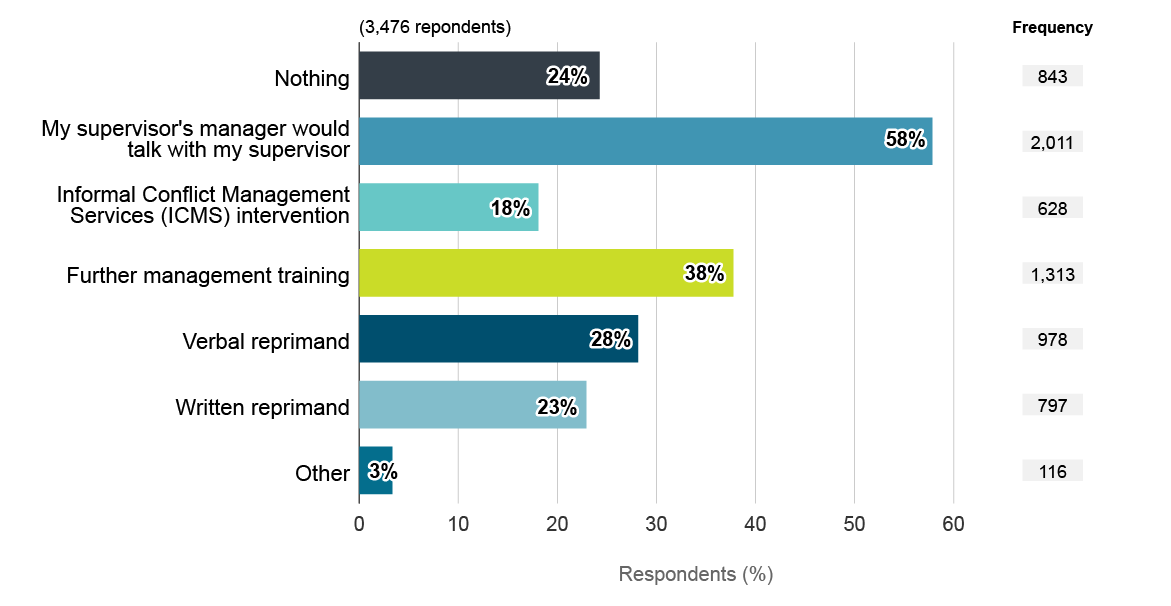
Figure 18 - Text version
| Choice | % | Frequency |
|---|---|---|
| Nothing | 24.25% | 843 |
| My supervisor's manager would talk with my supervisor | 57.85% | 2,011 |
| Informal Conflict Management Services (ICMS) intervention | 18.07% | 628 |
| Further management training | 37.77% | 1,313 |
| Verbal reprimand | 28.14% | 978 |
| Written reprimand | 22.93% | 797 |
| Other | 3.34% | 116 |
The results show that:
- the majority of respondents (58%) thought that their supervisor’s manager would talk to their supervisor, compared to 78% who thought this should happen
- 38% thought that further management training would be the organizational response, compared to 68% who thought it should be
- 28% thought that a verbal reprimand would occur, compared to 45% who thought one should occur
- 24% thought that nothing would happen, compared to only 2% who thought that there should be no action taken in this situation, revealing a significant disparity
- 23% thought a written reprimand would be given compared to 44% who thought one should be given
- 18% thought that ICMS intervention would follow the misconduct, compared to 27% who thought it should
Among the 3.3% responses in the “Other” category, there was an overarching sense of disillusionment regarding the handling of improper behaviour. Many respondents believed that little to no action would be taken against those who have engaged in improper behaviour. A representative response was “Nothing happens – this type of behaviour seems to be the norm now.”
Many also expressed concerns about potential reprisals for those who report misconduct. Representative comments included:
- “employees would face gaslighting, stalking-type behaviour”
- “the complainant would be removed, demoted, or pressured to resign”
Those who provided feedback in the “Other” category also told us that misconduct is often overlooked or inadequately addressed, leading to a culture of fear and favouritism. Although there are calls for accountability and serious consequences, the prevailing sentiment is one of skepticism about the effectiveness of existing processes.
Scenario 4
A senior leader in your organization yells at people, belittles them, ostracizes people who complain, and is known for giving contracts to friends and inappropriately expensing extravagant lunches.
Who were respondents likely to discuss this situation with?
This scenario involves a senior leader who yells at, belittles and ostracizes people, and who is known for giving contracts to friends and inappropriately expensing extravagant lunches. Figure 19 displays results for who respondents would reach out to in this serious misconduct situation.
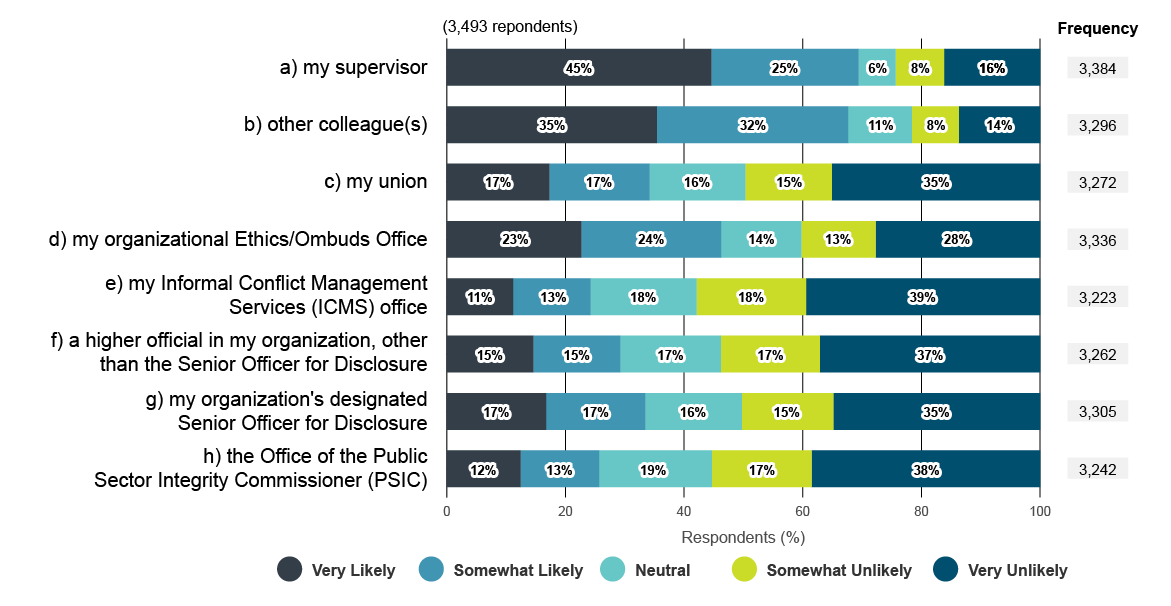
Figure 19 - Text version
| Choice | Very likely | Somewhat likely | Neutral | Somewhat unlikely | Very unlikely | Total |
|---|---|---|---|---|---|---|
| a) my supervisor | 44.59% 1,509 |
24.82% 840 |
6.24% 211 |
8.19% 277 |
16.16% 547 |
3,384 |
| b) other colleague(s) | 35.41% 1,167 |
32.25% 1,063 |
10.74% 354 |
7.89% 260 |
13.71% 452 |
3,296 |
| c) my union | 17.30% 566 |
16.90% 553 |
16.14% 528 |
14.58% 477 |
35.09% 1,148 |
3,272 |
| d) my organizational Ethics/Ombuds Office | 22.69% 757 |
23.53% 785 |
13.55% 452 |
12.50% 417 |
27.73% 925 |
3,336 |
| e) my Informal Conflict Management Services (ICMS) office | 11.20% 361 |
13.03% 420 |
17.87% 576 |
18.46% 595 |
39.44% 1,271 |
3,223 |
| f) a higher official in my organization, other than the Senior Officer for Disclosure | 14.59% 476 |
14.68% 479 |
16.92% 552 |
16.68% 544 |
37.12% 1,211 |
3,262 |
| g) my organization's designated Senior Officer for Disclosure | 16.76% 554 |
16.73% 553 |
16.25% 537 |
15.43% 510 |
34.83% 1,151 |
3,305 |
| h) the Office of the Public Sector Integrity Commissioner (PSIC) | 12.46% 404 |
13.23% 429 |
18.97% 615 |
16.84% 546 |
38.49% 1,248 |
3,242 |
The results illustrate that:
- 69% of respondents reported that they were likely to discuss this situation with their supervisor
- nearly the same proportion (68%) said that they would likely discuss it with other colleagues
- 46% reported that they would likely talk to their ethics or ombuds office
- the proportion of respondents who would reach out to a union or the senior officer for internal disclosure is the same, at 34% for each
- the next highest-rated choice was a higher official (29%)
- 26% would contact the Public Sector Integrity Commissioner
- 24% would contact the ICMS office
What should happen if an investigation found improper behaviour?
Figure 20 shows what respondents think should happen if an investigation found improper behaviour by the senior leader.
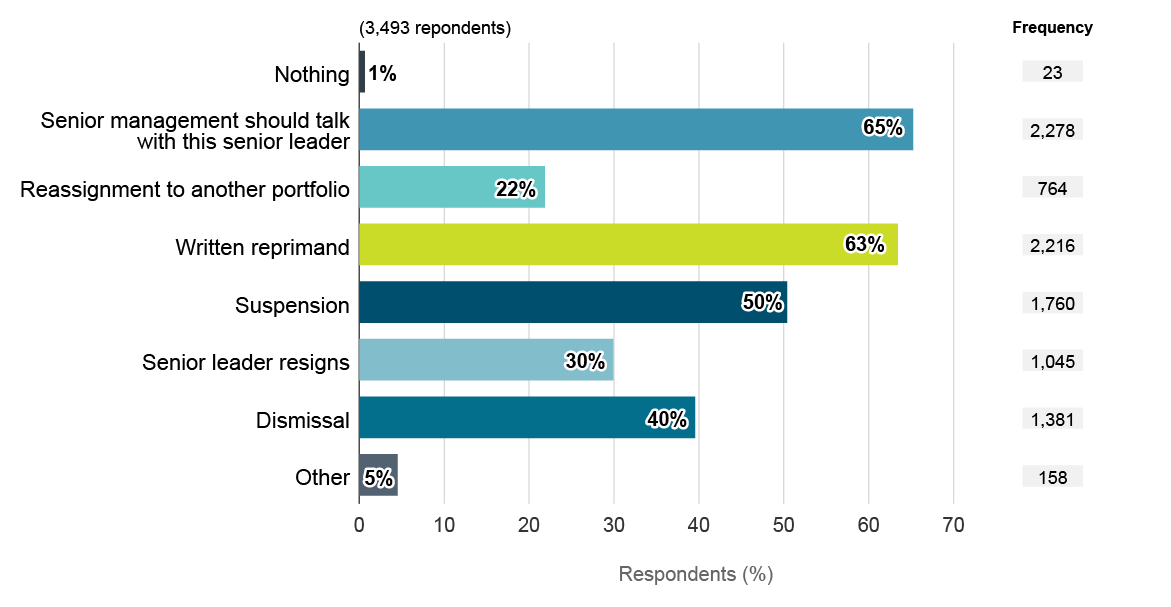
Figure 20 - Text version
| Choice | % | Frequency |
|---|---|---|
| Nothing | 0.66% | 23 |
| Senior management should talk with this senior leader | 65.22% | 2,278 |
| Reassignment to another portfolio | 21.87% | 764 |
| Written reprimand | 63.44% | 2,216 |
| Suspension | 50.39% | 1,760 |
| Senior leader resigns | 29.92% | 1,045 |
| Dismissal | 39.54% | 1,381 |
| Other | 4.52% | 158 |
The results indicate that:
- about two thirds of respondents (65%) believed that senior management should talk to the senior leader about it
- slightly fewer (63%) thought a “written reprimand” should be given
- half of respondents (50%) selected “suspension”
- 40% of respondents thought that “dismissal” was appropriate
- 30% thought that the senior leader should resign
- only 22% of respondents thought that the senior leader should be reassigned to another portfolio
- less than 1% felt that nothing should happen
Of the 4.1% of respondents who selected the “Other” category, the results reveal a strong consensus that continued improper behaviour should lead to significant disciplinary actions, including suspension and dismissal. There was clear concern about favouritism and nepotism within the organization, with many calling for systemic changes to ensure fairness in hiring and promotion practices. In addition, some respondents advocated for supportive measures to help employees get the assistance they need. Overall, the responses highlighted the urgent need for a transparent and accountable workplace culture.
What would happen if an investigation found improper behaviour?
Respondents selected a range of responses to this scenario, as shown in Figure 21.
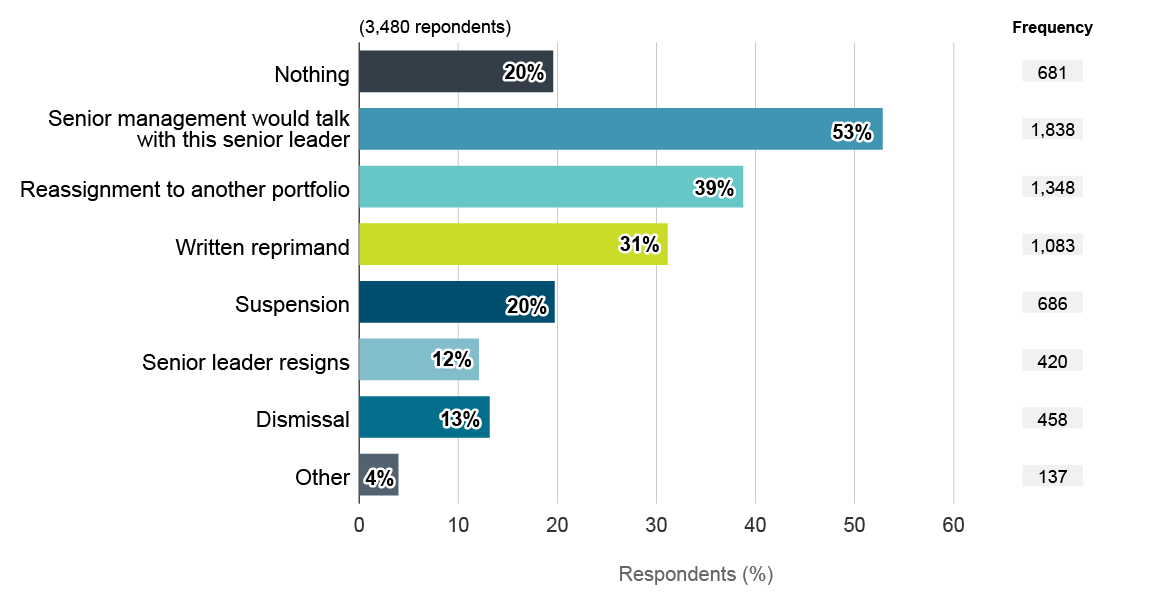
Figure 21 - Text version
| Choice | % | Frequency |
|---|---|---|
| Nothing | 19.57% | 681 |
| Senior management would talk with this senior leader | 52.82% | 1,838 |
| Reassignment to another portfolio | 38.74% | 1,348 |
| Written reprimand | 31.12% | 1,083 |
| Suspension | 19.71% | 686 |
| Senior leader resigns | 12.07% | 420 |
| Dismissal | 13.16% | 458 |
| Other | 3.94% | 137 |
The results are as follows:
- the majority (53%) thought that senior management would talk to their supervisor, compared to 65% who thought they should
- 39% thought that the senior leader would be reassigned to another portfolio, compared to 22% who thought they should
- 31% thought that a written reprimand would be given, compared to 63% who thought one should be
- 20% of respondents thought that the senior leader would be suspended, compared to 50% who thought they should be
- the same proportion (20%) thought that nothing would happen, compared to only 2% who thought that there should be no action taken in this situation
- a smaller proportion indicated that the leader:
- would be dismissed (13%), compared to 40% who thought they should be
- would resign (12%), compared to 30% who thought they should
Among the nearly 4% of responses in the “Other” category, a common sentiment was that little to no action would be taken against a senior leader. Many responses indicated a belief that a “senior leader resigns but simply gets a job at another department,” and many expressed concerns about potential reprisals for those who report misconduct. They advocated for serious consequences for such misconduct, reflecting a desire for a more ethical workplace. There were also calls for training on communication, harassment and ethical behaviour.
In conclusion, the survey results on the four scenarios revealed a significant gap between what respondents thought should happen and what they thought would happen in these situations regarding handling of improper behaviour within the organization. Although there are calls for accountability and serious consequences, the prevailing sentiment is one of skepticism about the effectiveness of existing processes. The responses highlight the urgent need for systemic changes to foster a more accountable and transparent workplace.
General culture questions
In this section of the survey, we explored the impact of organizational culture on people’s willingness to disclose misconduct. We gathered data by asking respondents to describe their workplace culture and how it supported voicing concerns and reporting misconduct. The culture questions also underscore the link between organizational culture and psychological health and safety in the workplace. As previously noted regarding the culture scale, accountability, respect, a sense of belonging, and trust help build a positive culture and create a psychologically safe environment for reporting serious misconduct.
Summary of responses to the culture questions
The survey results reflect a deep-seated concern among federal public servants regarding a culture that does not foster the reporting of serious misconduct. Respondents noted that systemic issues such as fear of retaliation and lack of accountability undermine the willingness to report wrongdoing. Respondents throughout the public sector are clear that cultural change is necessary in their organizations. Overall, there was a collective call for a more supportive and accountable environment that empowers employees to report wrongdoing without fear.
To foster such a culture, respondents reported that organizations must:
- prioritize clear communication
- provide robust training
- ensure that there are real consequences for misconduct
By doing so, organizations can build trust and encourage a more ethical workplace where all employees feel valued and heard. Respondents also called for:
- robust mechanisms for reporting and addressing misconduct
- investments in leadership training that emphasizes ethical behaviour, inclusivity and effective communication
This analysis highlights the critical need for organizations to promote policies that support voicing concerns and actively demonstrate their commitment through actions and accountability. Responses to specific survey questions are provided below.
Organizational culture within the public sector
Respondents were asked to describe their organization’s culture. The survey results paint a picture of organizations grappling with significant cultural challenges. The overarching themes of toxicity, lack of accountability and fear of reprisal create a difficult environment for many respondents. Many of these issues were likely articulated by the 37% of respondents who work in psychologically unsafe and unhealthy working environments, as discussed above in the composite score section.
A summary of the common themes that participants indicated regarding their organization’s culture is provided below; this feedback is based on responses from 2,611 public servants.
Toxic and unsafe work environment
- Many respondents describe the culture as toxic, highlighting issues such as rampant harassment, bullying and favouritism.
- Respondents reported a number of contributing factors and the existence of a culture of fear, where employees feel unsafe to report issues due to potential retaliation.
- The commonalities between respondents who described their workplace as a psychologically unsafe environment and the findings in this summary are also noticeable. This reinforces how the negative comments about organizational culture likely arise from the respondent pool working in psychologically unsafe and unhealthy workplace environments. For instance, we noted earlier that 37% of respondents describe their workplace as psychologically unsafe and unhealthy due to:
- a lack of accountability
- challenges in addressing situations effectively
- a lack of comfort in voicing concerns
Respondents’ feedback on this question regarding descriptions of their workplace culture includes similar issues related to a lack of accountability and feeling unsafe to report misconduct.
Lack of accountability and trust
- There is a pervasive sense that senior management is not held accountable for misconduct. Instances of nepotism and favouritism in hiring and promotions are frequently mentioned, as are feelings of exclusion among employees.
- The work environment is often described as hierarchical, with a disconnect between senior management and front-line employees. Respondents reported a lack of trust and transparency.
Employee well-being and support
- Concerns about employee well-being are prevalent, with mentions of stress and burnout exacerbated by ongoing issues with pay systems and health benefits.
- Some respondents report a supportive and inclusive culture within their teams.
Diversity and inclusion challenges
- Although there are efforts to promote diversity, significant gaps remain, particularly in upper management. Some respondents feel that diversity initiatives are more about optics than genuine inclusion.
While much of the feedback on culture was negative, the results did show some pockets of positivity, including some reports of good communications and some organizations’ efforts towards inclusivity.
Does the culture support voicing concerns and reporting serious misconduct?
Figure 22 provides results regarding respondents’ views on their organization’s support for voicing concerns.
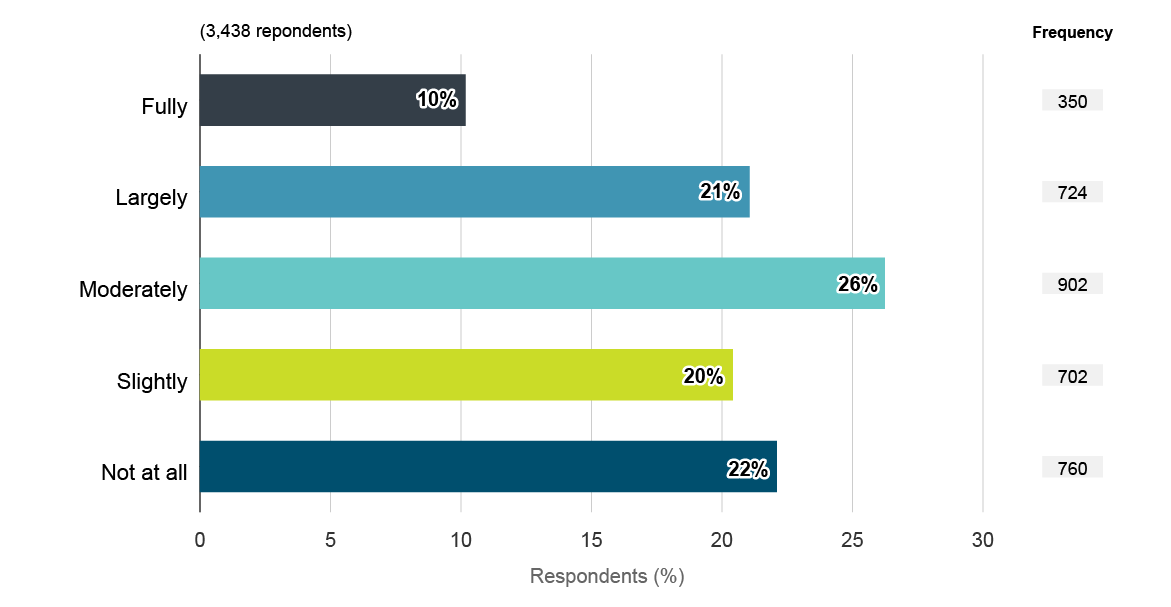
Figure 22 - Text version
| Choice | % | Frequency |
|---|---|---|
| Fully | 10.18% | 350 |
| Largely | 21.06% | 724 |
| Moderately | 26.24% | 902 |
| Slightly | 20.42% | 702 |
| Not at all | 22.11% | 760 |
| Total | 100% | 3,438 |
The results indicate that:
- only 31% of respondents believe that their workplace culture fully or largely supports voicing concerns
- 42% believe that their workplace does not support it at all or supports it only slightly
- 26% define their workplace’s support as moderate
Figure 23 illustrates respondents’ views on their organization’s support for reporting misconduct.
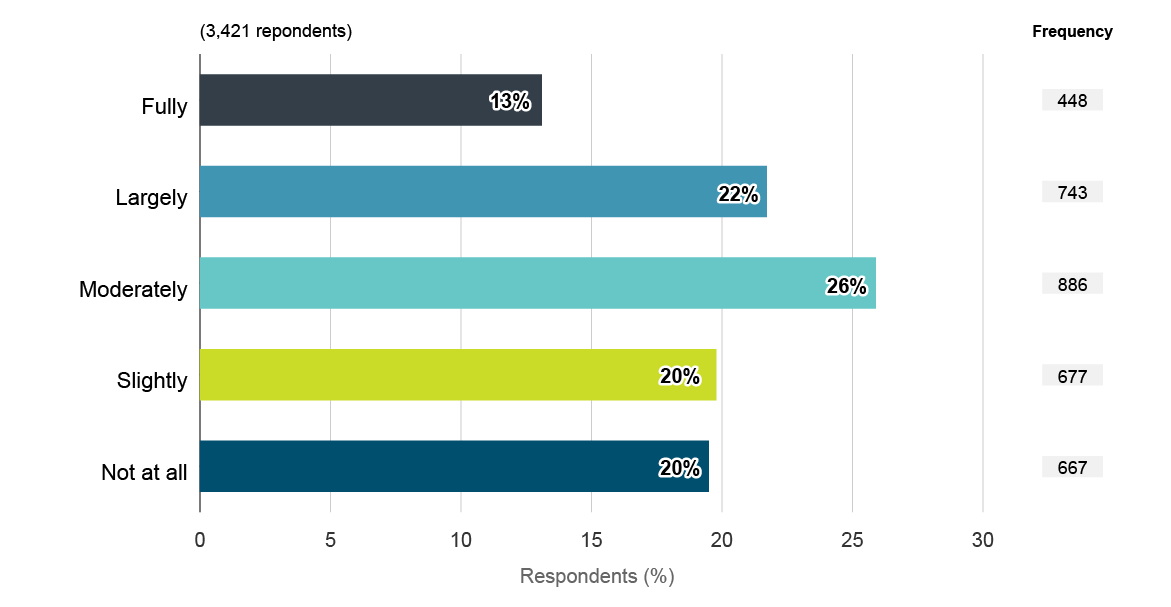
Figure 23 - Text version
| Choice | % | Frequency |
|---|---|---|
| Fully | 13.10% | 448 |
| Largely | 21.72% | 743 |
| Moderately | 25.90% | 886 |
| Slightly | 19.79% | 677 |
| Not at all | 19.50% | 667 |
| Total | 100% | 3,421 |
The survey results indicate that:
- 35% of respondents believe that their workplace culture fully or largely supports reporting serious misconduct
- 40% believe that their workplace does not support it at all or supports it only slightly
- 26% characterize their workplace’s support as moderate
The results align with the overarching theme among respondents that their workplace culture reflects a challenging and, in many cases, a psychologically unsafe working environment.
Culture that supports voicing concerns and reporting serious misconduct
When asked to describe a culture that supports voicing concerns and reporting serious misconduct, the following key characteristics and insights were provided, based on feedback from 2,244 public servants:
Transparency and reporting mechanisms
- Transparency and accessibility: Respondents emphasized the need for clear and accessible reporting mechanisms. They want to know how to report misconduct and what the processes entail. They reported that transparency in these processes builds trust and encourages reporting.
- Communication: Open lines of communication are necessary for fostering a culture of trust. Regular updates on the status of reported concerns can help employees feel valued and heard.
Psychological safety and support
- Psychological safety: A recurring theme was the importance of psychological safety. Respondents expressed a desire for an environment where they can voice concerns without fear of retaliation. They reported that safety is crucial for fostering open communication.
- Supportive environment: A supportive culture was characterized by management that actively encourages employees to report concerns. This includes regular training and reminders about the importance of reporting misconduct.
Accountability and ethical leadership
- Accountability: Respondents reported that accountability at all levels was essential. They wanted to see that misconduct is addressed appropriately, with clear consequences for those found culpable. This included disciplinary actions that are visible and communicated to the workforce.
- Leadership by example: Respondents mentioned that senior management must model the behaviour they wish to see. They also indicated that leaders should openly discuss the importance of ethical conduct and demonstrate a commitment to addressing misconduct.
Impartial investigations and training
- Impartial investigations: Many respondents highlighted the necessity for investigations to be conducted impartially and thoroughly. There was a strong call for independent bodies to handle allegations of misconduct to ensure fairness.
- Training and education: Respondents reported that regular training on ethical standards and reporting procedures is vital. They also suggested they should be educated about their rights and the processes available to them.
Additional issues or improvements related to reporting serious misconduct
Respondents were asked to identify any additional issues or improvements related to reporting serious misconduct. The feedback from 2,244 public servants is summarized below.
Fear and safety concerns
- Fear of retaliation: A prevalent concern among respondents is the fear of reprisals for reporting misconduct. Many believe that coming forward could jeopardize their careers, leading to a culture of silence.
- Support for whistleblowers: Respondents called for stronger protections for whistleblowers, emphasizing that those who report misconduct should feel safe and supported throughout the process.
Accountability and reporting mechanisms
- Accountability and consequences: There was a strong call for greater accountability for both employees and management. Respondents expressed frustration over the perception that senior officials often escape consequences for misconduct.
- Need for clear reporting mechanisms: Many respondents highlighted the lack of clarity regarding how to report misconduct as well as the processes involved. They expressed a demand for more accessible and straightforward reporting channels.
Cultural change and training
- Cultural change: A significant number of responses indicated a desire for a cultural shift within the public sector, emphasizing the need for transparency, integrity and ethical leadership.
- Training and awareness: There was a consensus on the need for ongoing training regarding misconduct reporting and the ethical standards expected within the public sector.
Feedback from other respondents
Although the number of respondents who were not currently public servants (former public servants, contractors and members of the public) was small, we believe that the following main points are worth sharing when it comes to their experiences of the public sector culture:
- Former public servants provided a mixed representation of the public sector culture. The negative aspects included:
- the presence of bullying and harassment
- a hierarchical structure that limits engagement
- fear of reprisal impacting the reporting of wrongdoing
- lack of accountability for dealing with misconduct and nepotism
- a disconnect between the leadership and employee realities
The positive aspects included the existence of respect, professionalism, transparency and open communication in some workplace environments.
- Contractors indicated that the public service culture varies significantly across organizations:
- although many organizations work to protect and improve public interests, some suffer from dysfunction due to personal agendas and siloed working, which negatively impacts teams and project success
- low morale, inexperienced employees, lack of leadership competencies, uneven work distribution and unfair treatment of consultants were the main issues they reported within workplace environments
- misconduct at higher levels erodes public trust and negatively impacts the willingness to raise concerns
- Among members of the public, a variety of key aspects, both positive and negative, were indicated, reflecting a multifaceted public sector culture:
- in some cases, the culture represented a supportive environment with an emphasis on collaboration, diversity and mutual respect
- in other instances, the culture included excessive bureaucracy, unqualified managers, harassment and distrust, and an avoidance of unanticipated negative news
Disclosure process
In this section of the survey, we explored:
- public servants’ familiarity with the disclosure process under the PSDPA
- factors that encourage or discourage the reporting of serious misconduct
- public servants’ experience in witnessing serious misconduct
- suggestions for improving the process
The questions below allowed us to gather valuable and insightful feedback that we considered as part of our report and recommendations.
Familiarity with disclosure processes
Throughout our consultations, we heard that many public servants were unfamiliar with the Public Sector Integrity Commissioner (PSIC) and internal processes for disclosing wrongdoing within the public sector; this feedback was supported by the survey results shown in Figure 24.
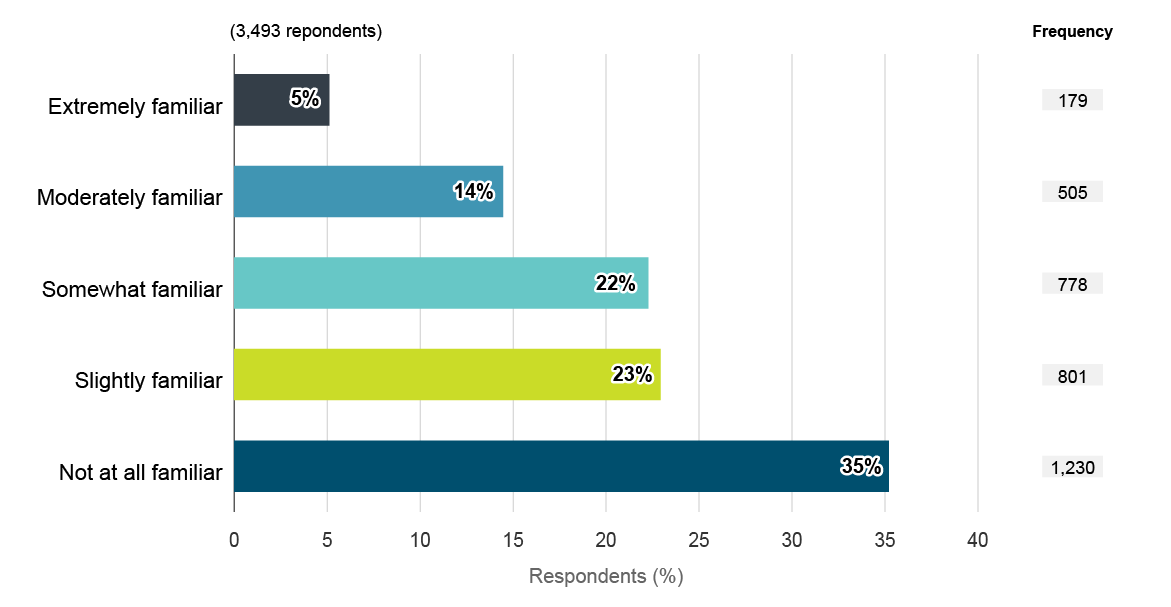
Figure 24 - Text version
| Choice | % | Frequency |
|---|---|---|
| Extremely familiar | 5.12% | 179 |
| Moderately familiar | 14.46% | 505 |
| Somewhat familiar | 22.27% | 778 |
| Slightly familiar | 22.93% | 801 |
| Not at all familiar | 35.21% | 1,230 |
| Total | 100% | 3,493 |
The results clearly show that public servants’ awareness of these processes is very low:
- close to 60% of respondents were either not at all familiar or only slightly familiar with the processes
- fewer than 20% were moderately or extremely familiar with them
Actions that respondents would take if they witnessed serious misconduct
Respondents were asked what actions they would most likely take after witnessing serious misconduct in the workplace. They were asked to rank up to five responses, with 1 being the most likely action and 5 being the least likely. Figure 25 summarizes their responses.
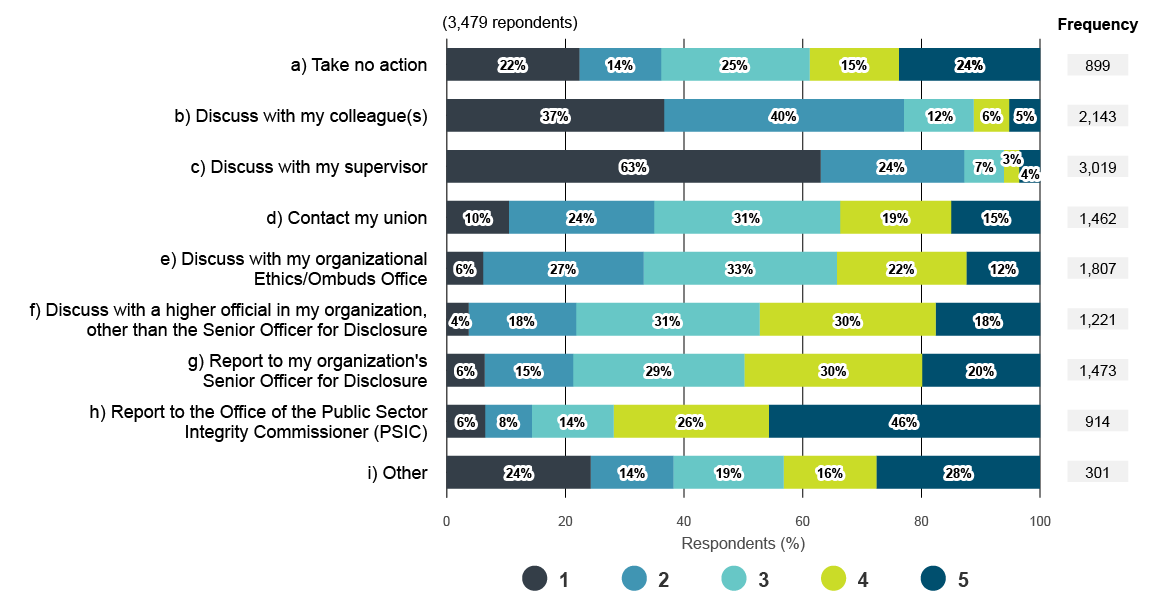
Figure 25 - Text version
| Choice | Rank | Total | ||||
|---|---|---|---|---|---|---|
| 1 | 2 | 3 | 4 | 5 | ||
| a) Take no action | 22.36% 201 |
13.79% 124 |
25.03% 225 |
15.02% 135 |
23.80% 214 |
899 |
| b) Discuss with my colleague(s) | 36.63% 785 |
40.41% 866 |
11.76% 252 |
5.97% 128 |
5.23% 112 |
2,143 |
| c) Discuss with my supervisor | 63.03% 1,903 |
24.15% 729 |
6.72% 203 |
2.55% 77 |
3.54% 107 |
3,019 |
| d) Contact my union | 10.47% 153 |
24.49% 358 |
31.33% 458 |
18.74% 274 |
14.98% 219 |
1,462 |
| e) Discuss with my organizational Ethics/Ombuds Office | 6.14% 111 |
27.06% 489 |
32.54% 588 |
21.86% 395 |
12.40% 224 |
1,807 |
| f) Discuss with a higher official in my organization, other than the Senior Officer for Disclosure | 3.69% 45 |
18.10% 221 |
30.96% 378 |
29.65% 362 |
17.61% 215 |
1,221 |
| g) Report to my organization's Senior Officer for Disclosure | 6.38% 94 |
14.94% 220 |
28.85% 425 |
29.94% 41 |
19.89% 293 |
1,473 |
| h) Report to the Office of the Public Sector Integrity Commissioner (PSIC) | 6.46% 59 |
7.88% 72 |
13.79% 126 |
26.15% 239 |
45.73% 418 |
914 |
| i) Other | 24.25% 73 |
13.95% 42 |
18.60% 56 |
15.61% 47 |
27.57% 83 |
301 |
The results regarding most likely actions show that:
- most respondents (87%) would likely discuss the situation with their supervisor
- 77% would discuss it with colleagues
- 35% would reach out to their union, slightly more than the proportion who would contact their organizational ethics or ombuds office (33%)
- 21% of respondents would discuss it with their Senior Officer for Disclosure
One of the least likely options was to report to the Office of the Public Sector Integrity Commissioner (14%), and this lower percentage may partly be explained by the high level of unfamiliarity with the disclosure processes. Approximately 36% also reported they would take no action, which is a concerning proportion.
“Other” category
Results under the “Other” category indicated common themes of:
- fear of reprisal
- lack of trust in official reporting channels
- a preference for direct confrontation or external advice
Many respondents who added feedback in this category also emphasized the importance of documenting information to protect themselves.
Factors that discourage the reporting of serious misconduct
Identifying the factors that discourage people from reporting serious misconduct was important for us in our review of the PSDPA. It was also important in developing appropriate recommendations for improving its administration. Respondents were accordingly asked to select up to five factors most likely to discourage reporting from the nine options provided, and to rank them from 1 to 5, with 1 being the most likely factor to discourage reporting. The results are presented in Figure 26.
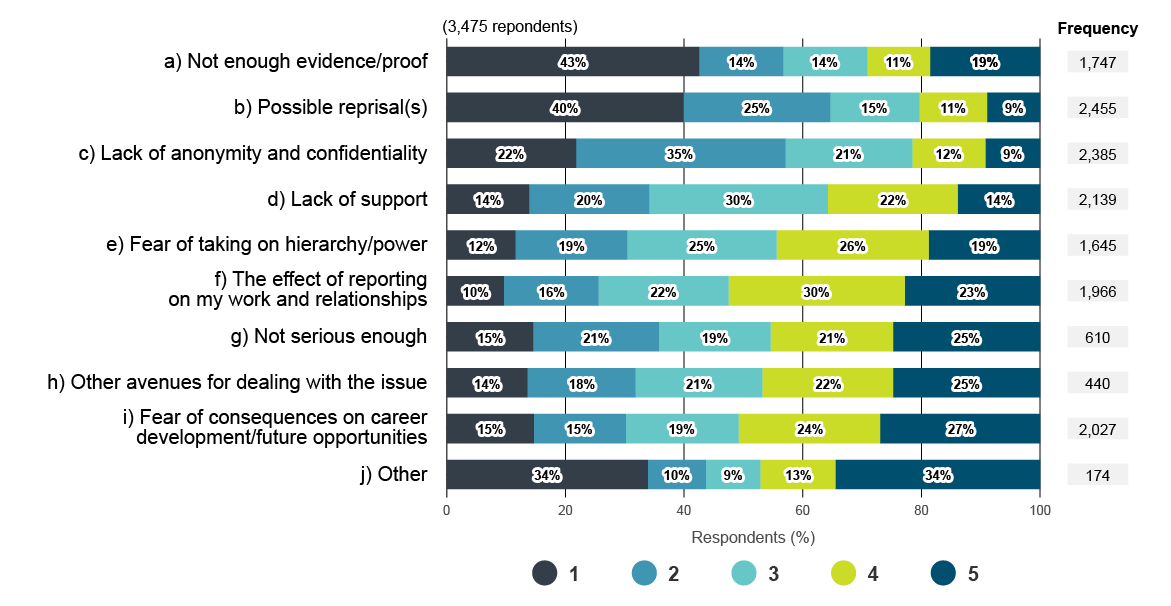
Figure 26 - Text version
| Choice | Rank | Total | ||||
|---|---|---|---|---|---|---|
| 1 | 2 | 3 | 4 | 5 | ||
| a) Not enough evidence/proof | 42.59% 744 |
14.14% 247 |
14.14% 247 |
10.59% 185 |
18.55% 324 |
1,747 |
| b) Possible reprisal(s) | 39.92% 980 |
24.68% 606 |
15.11% 371 |
11.36% 279 |
8.92% 219 |
2,455 |
| c) Lack of anonymity and confidentiality | 21.80% 520 |
35.30% 842 |
21.38% 510 |
12.29% 293 |
9.22% 220 |
2,385 |
| d) Lack of support | 13.93% 298 |
20.20% 432 |
30.11% 644 |
21.88% 468 |
13.88% 297 |
2,139 |
| e) Fear of taking on hierarchy/power | 11.61% 191 |
18.78% 309 |
25.23% 415 |
25.59% 421 |
18.78% 309 |
1,645 |
| f) The effect of reporting on my work and relationships | 9.61% 189 |
15.97% 314 |
21.92% 431 |
29.70% 584 |
22.79% 448 |
1,966 |
| g) Not serious enough | 14.59% 89 |
21.15% 129 |
18.85% 115 |
20.66% 126 |
24.75% 151 |
610 |
| h) Other avenues for dealing with the issue | 13.64% 60 |
18.18% 80 |
21.36% 94 |
22.05% 97 |
24.77% 109 |
440 |
| i) Fear of consequences on career development/future opportunities | 14.70% 298 |
15.49% 314 |
18.99% 385 |
23.88% 484 |
26.94% 546 |
2,027 |
| j) Other | 33.91% 59 |
9.77% 17 |
9.20% 16 |
12.64% 22 |
34.48% 60 |
174 |
The relative influence of each factor was determined by considering the number of respondents who selected that factor as their first, second, third, fourth or fifth choice (the corresponding number from the “Total” column) in relation to the total number of respondents who completed the questions.
Based on these results, the factors most likely to discourage public servants from reporting serious misconduct, and the corresponding percentage of respondents who selected those factors, in order of influence, were:
- the risk of possible reprisals (71%)
- the lack of anonymity and confidentiality (69%)
- lack of support (62%)
- fear of consequences on career development or future opportunities (58%)
- the effect of my reporting on my work and relationships (57%)
- not enough evidence or proof 50%)
- fear of taking on hierarchy or power (47%)
The factors that had less impact were:
- misconduct not serious enough (18%)
- other avenues available for dealing with the issue (13%)
These results reinforce key workplace culture and environment considerations. They also reinforce how public servants approach and consider such issues, including what they do less of (for example, analyzing potential seriousness or available options, which potentially indicates that public servants simply want the issues they raise dealt with).
Factors that encourage the reporting of serious misconduct
It was also important for us to understand the factors that encourage reporting of serious misconduct. Respondents were therefore asked to select up to five factors most likely to encourage reporting, from the nine options provided, and to rank them from 1 to 5, with 1 being the most likely factor to encourage reporting. Figure 27 illustrates the results.
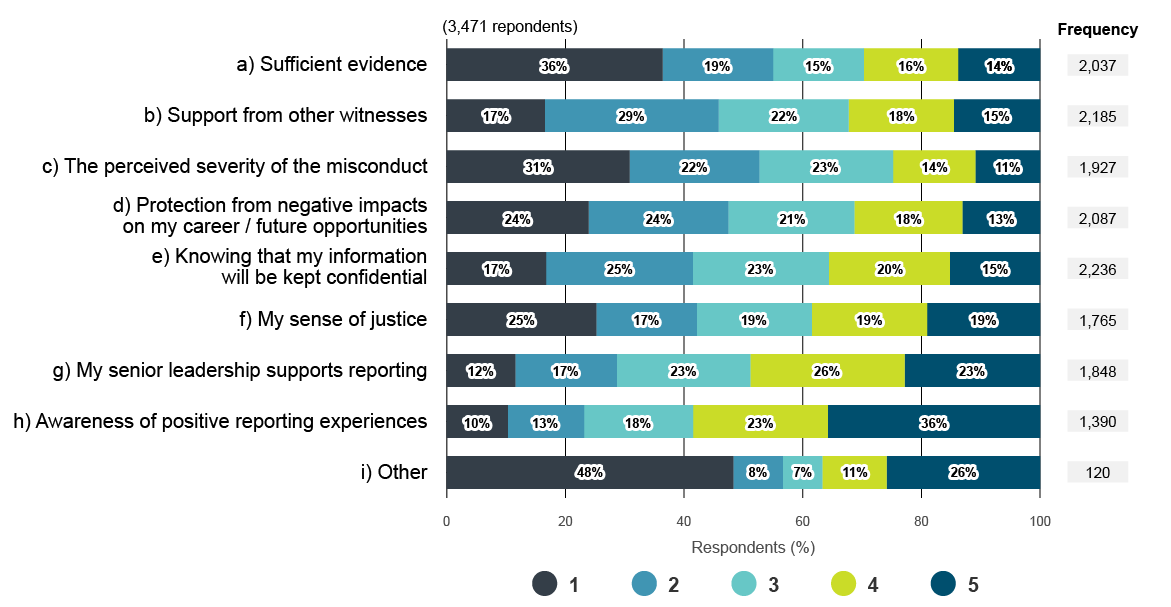
Figure 27 - Text version
| Choice | Rank | Total | ||||
|---|---|---|---|---|---|---|
| 1 | 2 | 3 | 4 | 5 | ||
| a) Sufficient evidence | 36.38% 741 |
18.61% 379 |
15.32% 312 |
15.86% 323 |
13.84% 282 |
2,037 |
| b) Support from other witnesses | 16.52% 361 |
29.29% 640 |
21.92% 479 |
17.76% 388 |
14.51% 317 |
2,185 |
| c) The perceived severity of the misconduct | 30.83% 594 |
21.85% 421 |
22.57% 435 |
13.86% 267 |
10.90% 210 |
1,927 |
| d) Protection from negative impacts on my career / future opportunities | 23.91% 499 |
23.57% 492 |
21.23% 443 |
18.21% 380 |
13.08% 273 |
2,087 |
| e) Knowing that my information will be kept confidential | 16.77% 375 |
24.73% 553 |
22.90% 512 |
20.39% 456 |
15.21% 340 |
2,236 |
| f) My sense of justice | 25.21% 445 |
16.94% 299 |
19.38% 342 |
19.43% 343 |
19.04% 336 |
1,765 |
| g) My senior leadership supports reporting | 11.58% 214 |
17.10% 316 |
22.51% 416 |
25.97% 480 |
22.84% 422 |
1,848 |
| h) Awareness of positive reporting experiences | 10.29% 143 |
12.88% 179 |
18.35% 255 |
22.73% 316 |
35.76% 497 |
1,390 |
| i) Other | 48.33% 58 |
8.33% 10 |
6.67% 8 |
10.83% 13 |
25.83% 31 |
120 |
Based on these results, the factors most likely to encourage public servants to report serious misconduct, and the corresponding percentage of respondents who selected those factors, in order of influence were:
- knowing that my information will be kept confidential (64%)
- support from other witnesses (63%)
- protection from negative impacts on my career or future opportunities (60%)
- sufficient evidence (59%)
- the perceived severity of the misconduct (56%)
- senior leadership that supports reporting (53%)
- my sense of justice (51%)
- an awareness of positive disclosure experiences (40%)
Public servants’ answers to this question reinforce the importance of such factors for encouraging reporting as part of the workplace culture and environment.
“Other” category
The respondents who selected the “Other” category underscored the importance of creating a supportive and transparent environment for whistleblowers, leading to a healthier workplace culture overall and contributing to employees’ willingness to report serious misconduct.
Respondents who witnessed serious misconduct
Of the 3,464 respondents who completed this section of the survey, almost half (44%) expressed that they had witnessed serious misconduct, as shown in Figure 28.
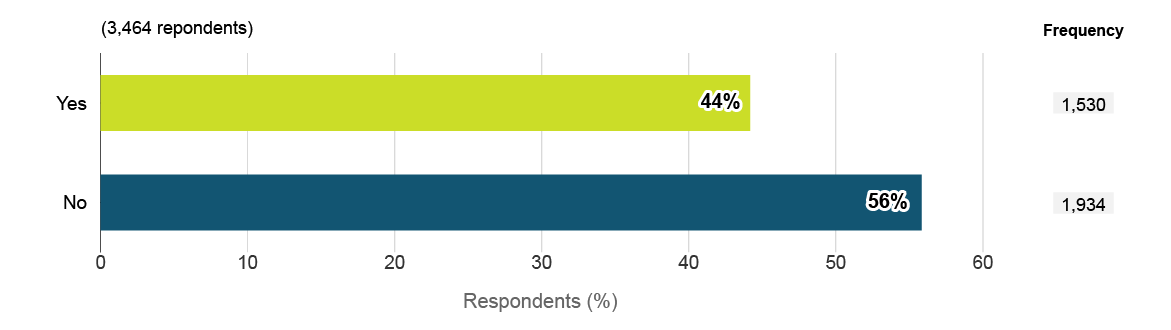
Figure 28 - Text version
| Choice | % | Frequency |
|---|---|---|
| Yes | 44.17% | 1,530 |
| No | 55.83% | 1,934 |
| Total | 100% | 3,464 |
Of those who had witnessed serious misconduct, 66% described the experience as traumatic, as shown in Figure 29.
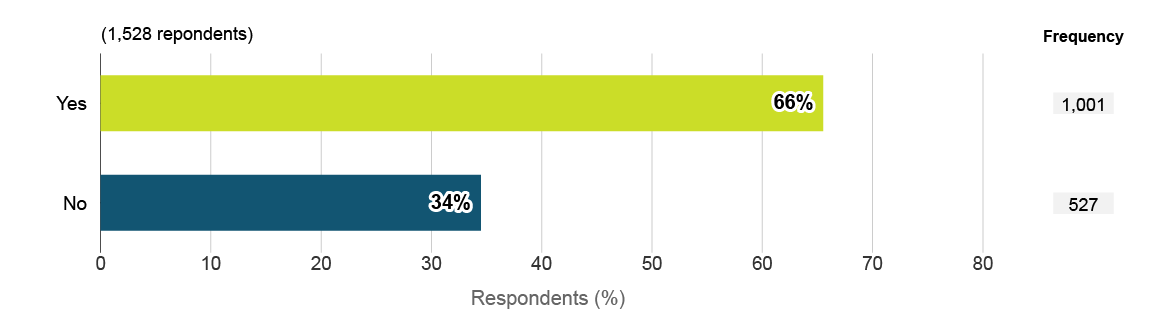
Figure 29 - Text version
| Choice | % | Frequency |
|---|---|---|
| Yes | 65.51% | 1,001 |
| No | 34.49% | 527 |
| Total | 100% | 1,528 |
These results might not represent the public sector as a whole, as respondents who chose to respond to this voluntary survey may be particularly interested in the subject of misconduct. Nonetheless, the relationship between witnessing misconduct and experiencing trauma reveals a significant negative impact on psychological health and safety in the workplace.
When it came to reporting serious misconduct, only 58% of respondents who had witnessed the behaviour reported it, as shown in Figure 30.
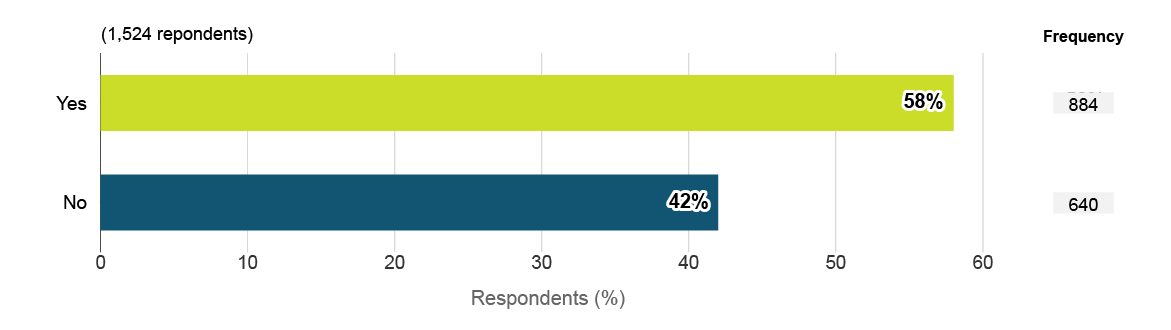
Figure 30 - Text version
| Choice | % | Frequency |
|---|---|---|
| Yes | 58.01% | 884 |
| No | 41.99% | 640 |
| Total | 100% | 1,524 |
The many factors that can impact someone’s decision to report these behaviours are explored in further questions below.
Respondents who reported serious misconduct
We wanted to further explore the reasons why respondents who had witnessed and subsequently reported serious misconduct had reported the behaviour. The following key themes emerged from the input of 775 respondents.
- Ethical responsibility: Many respondents reported a strong sense of ethical duty and personal integrity. They felt that it was the right thing to do to uphold the values and ethics of their organization.
- Protection of others: Many respondents were motivated to protect their colleagues from experiencing similar issues. They wanted to prevent further harm and create a safer work environment.
- Personal impact: A number of respondents reported the misconduct because it directly affected them, causing stress, anxiety or other negative impacts on their mental health and well-being.
- Desire for change: Many respondents hoped that reporting misconduct would lead to positive changes within their organization, such as improved policies and accountability and a more respectful workplace culture.
- Fear of reprisal: Some respondents expressed fear of retaliation or negative consequences for reporting misconduct, which sometimes deterred them from coming forward sooner.
Feedback on how the serious misconduct was handled
We wanted to know whether respondents who had reported serious misconduct were satisfied with what happened after they reported. The following key themes emerged based on 783 responses:
- General dissatisfaction: A predominant theme was a dissatisfaction with the handling of reports. Many respondents felt that their concerns were not taken seriously, which led to feelings of frustration and betrayal. Common responses included phrases such as “nothing happened,” “management ignored my report” and “the perpetrator faced no consequences.”
- Lack of transparency and communication: Many respondents expressed a lack of communication regarding the outcomes of their complaints. Respondents often reported feeling left in the dark about any actions taken, which contributed to a sense of being unheard. For example, one respondent noted, “I still don’t know if the risk was even worth taking,” highlighting the uncertainty surrounding the reporting process.
- Fear of retaliation: A number of responses indicated a fear of reprisals for speaking up. Individuals reported feeling isolated or targeted after making their complaints, which discouraged future reporting. Phrases such as “I was labelled a troublemaker” and “I faced reprisals” were common, illustrating the chilling effect of a lack of protective measures.
- Some positive outcomes: Although many expressed dissatisfaction, some respondents reported positive outcomes. A few noted that their reports led to meaningful changes, such as the removal of problematic individuals or improvements in workplace conditions. For instance, one respondent mentioned, “I was satisfied because the issues were looked at objectively,” indicating that not all experiences were negative.
- Cultural issues: The responses highlighted systemic issues within organizations, such as a culture that protects wrongdoers, particularly those in positions of power. Many felt that senior management prioritized maintaining the status quo over addressing misconduct. Comments such as “management protected each other” and “the old boys’ club” reflect a pervasive culture that undermines accountability.
Respondents who did not report the serious misconduct
Survey respondents were asked, to the extent that they were comfortable and willing to say, why they did not report the serious misconduct they had witnessed. The key themes that emerged from the 554 responses are provided below.
Fear and hesitation
- Fear of retaliation: Many respondents expressed fear of retaliation from their supervisors or colleagues. This fear included concerns about losing their job, being demoted or facing a hostile work environment.
- Fear of being labelled a troublemaker: Respondents were concerned about being labelled as troublemakers or complainers, which could negatively impact their career progression.
- Previous negative experiences: Some respondents had previously reported misconduct and had negative experiences, such as being ignored or facing retaliation. This discouraged them from reporting again.
Lack of trust and perceived futility
- Lack of trust in the reporting process: A significant number of respondents did not trust the reporting process. They believed that their reports would not be taken seriously or that no action would be taken.
- Perceived futility: Some respondents felt that reporting misconduct would not lead to any meaningful change. They believed that the individuals involved would not face any consequences.
Challenges in reporting
- Lack of evidence: A number of respondents mentioned that they did not have enough evidence to support their claims. This made them hesitant to report the misconduct.
How can the federal government improve the reporting of serious misconduct?
Survey respondents were asked to provide feedback on how the federal government could make it easier for them to report serious misconduct. The key suggestions from the 2,184 respondents are described below.
Reporting mechanisms and procedures
- Anonymous reporting options: Many respondents recommended more robust anonymous reporting options to help alleviate fears of retaliation and ensure confidentiality.
- Clear and simple reporting procedures: Respondents emphasized the need for clear, simple and straightforward reporting procedures. Complicated processes can deter individuals from reporting misconduct.
Support and protection
- Support systems: Respondents highlighted the need for better support systems, including counselling and legal support, for those who report misconduct.
- Protection against retaliation: The need for stronger protections against retaliation was frequently mentioned. Respondents wanted assurances that they would not face negative consequences for reporting misconduct.
Training and transparency
- Training and awareness programs: There were numerous suggestions for regular training and awareness programs to educate employees about the reporting process and the importance of reporting misconduct.
- Transparency and accountability: Many respondents called for greater transparency and accountability in handling reports of misconduct. They wanted to be informed about the actions taken in response to their reports.
Suggestions for improving current mechanisms and processes for reporting serious misconduct
Respondents were asked to provide comments or suggestions for improving current mechanisms and processes for reporting serious misconduct. The common themes and suggestions from the 1,424 respondents are provided below.
Accountability and transparency
- Accountability and transparency: Many respondents emphasized the need for greater accountability and transparency in handling reports of serious misconduct. They said that perpetrators should be held accountable and that the outcomes of investigations should be made public to build trust in the system.
- Public reporting and data transparency: Publishing anonymized reports on the nature and disposition of misconduct cases was suggested to demonstrate transparency and foster public trust in the system.
Reporting mechanisms and procedures
- Anonymous reporting options: A significant number of respondents called for more robust anonymous reporting options to protect whistleblowers from retaliation and ensure confidentiality.
- Clear and simple reporting procedures: Respondents highlighted the need for clear, simple and straightforward reporting procedures. Complicated processes can deter individuals from reporting misconduct.
- Independent oversight: Some respondents suggested establishing an independent oversight body to review investigations and handle complaints, ensuring impartiality and fairness.
Support and protection
- Support systems: Respondents stressed the importance of providing better support systems, including counselling and legal support, for those who report misconduct.
- Protection against retaliation: Stronger protections against retaliation were a common suggestion. Respondents want assurances that they will not face negative consequences for reporting misconduct.
- Timely resolution: There were calls for implementing clear timelines for investigations and follow-up communication with victims to ensure a more efficient and less stressful process.
Training and awareness
- Training and awareness programs: Regular training and awareness programs were frequently mentioned as necessary to educate employees about the reporting process and the importance of reporting misconduct.
Feedback from other respondents
The following key points come from former public servants and contractors who indicated their views on familiarity with the disclosure process and their experiences as witnesses of serious misconduct:
- Over 50% of former public servants who responded indicated that they were familiar with the disclosure process; however, 39% of them were not at all familiar with it. Over 60% had witnessed serious misconduct, and the majority had reported the incident. Among those who reported, the common reasons for reporting included:
- a sense of duty and justice
- the importance of protecting the team’s and their own well-being
- the severity of the misconduct
The overall sentiment related to the handling of the misconduct was negative, as the majority did not believe that the person who committed the misconduct was properly held accountable. Some individuals had also suffered reprisals.
- Contractors indicated that their familiarity with the process was minimal. In cases where they had witnessed misconduct and reported it, they were dissatisfied because of the reprisals they subsequently experienced.
- Overall, respondents’ strategies for improving these processes reflect the themes identified above by current public servants such as proper accountability, protections and supports.
Protection from reprisal
In this section of the survey, we explored the respondents’ familiarity with the reprisal protections, processes and supports under the PSDPA. The questions below allowed us to gather valuable feedback that we considered as part of our report and recommendations.
Familiarity with reprisal protections, processes and supports
Figure 31 shows that overall, survey respondents reported a very low level of awareness of reprisal protections and processes.
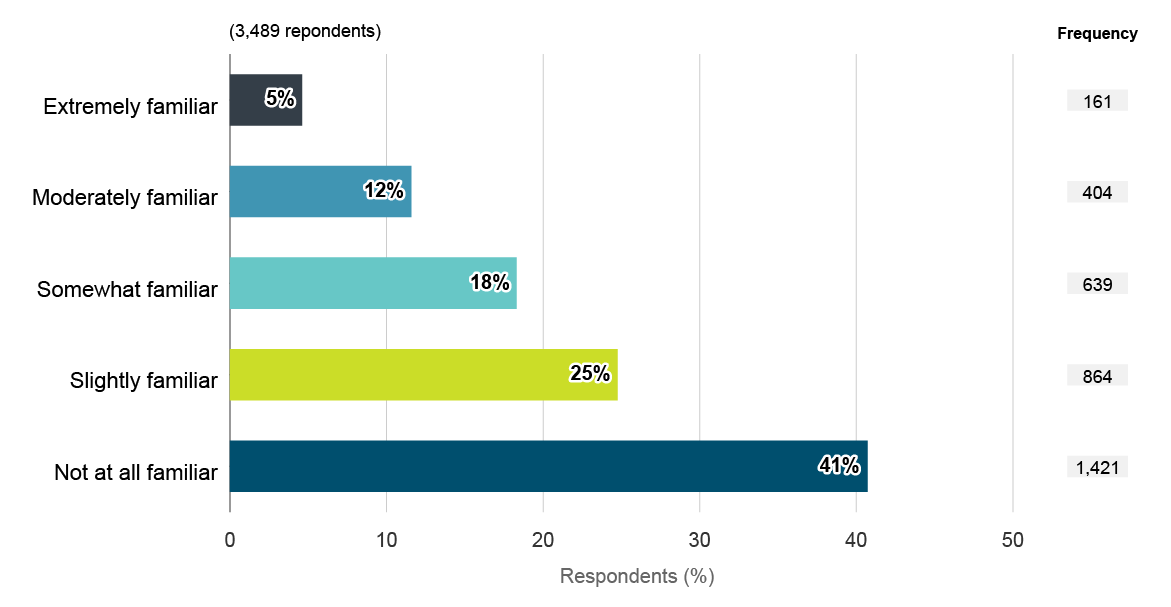
Figure 31 - Text version
| Choice | % | Frequency |
|---|---|---|
| Extremely familiar | 4.61% | 161 |
| Moderately familiar | 11.58% | 404 |
| Somewhat familiar | 18.31% | 639 |
| Slightly familiar | 24.76% | 864 |
| Not at all familiar | 40.73% | 1,421 |
| Total | 100% | 3,489 |
The survey results indicate that:
- a little more than 65% of respondents were either not at all familiar (41%) or only slightly familiar (25%) with the reprisal processes
- 18% reported being somewhat familiar with them
- 17% were moderately or extremely familiar with them
Respondents who witnessed reprisal
Survey respondents were asked if they had witnessed reprisal in their workplace. Of the 3,459 respondents who completed this question, 34% reported seeing a reprisal, as shown in Figure 32.
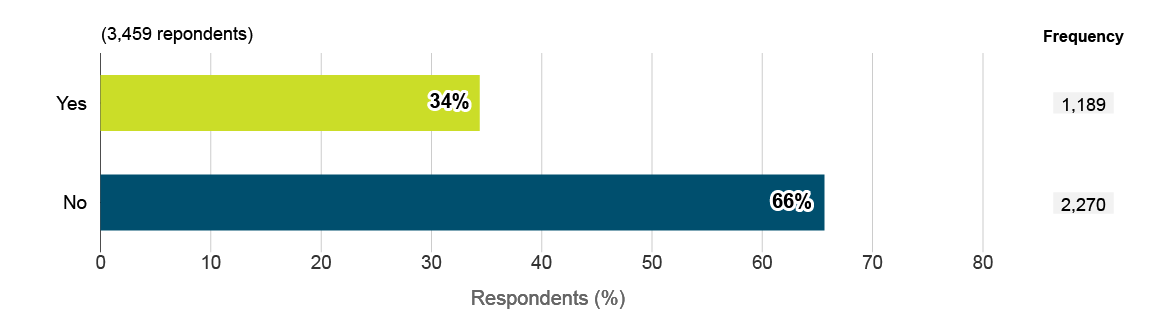
Figure 32 - Text version
| Choice | % | Frequency |
|---|---|---|
| Yes | 34.37% | 1,189 |
| No | 65.63% | 2,270 |
| Total | 100% | 3,459 |
Of those who witnessed a reprisal, almost two thirds (63%) found this to be a traumatic experience, as shown in Figure 33.
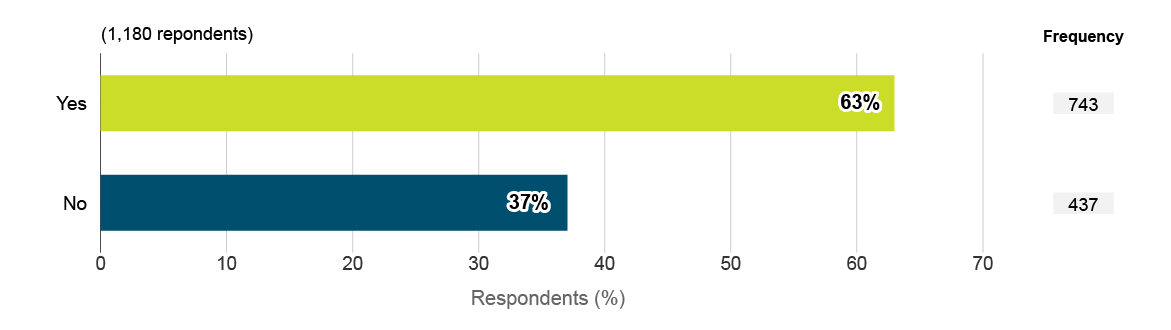
Figure 33 - Text version
| Choice | % | Frequency |
|---|---|---|
| Yes | 62.97% | 743 |
| No | 37.03% | 437 |
| Total | 100% | 1,180 |
Respondents who reported reprisal
Survey respondents who indicated that they had seen a reprisal were asked if they reported it; Figure 34 demonstrates that only 28% reported doing so.
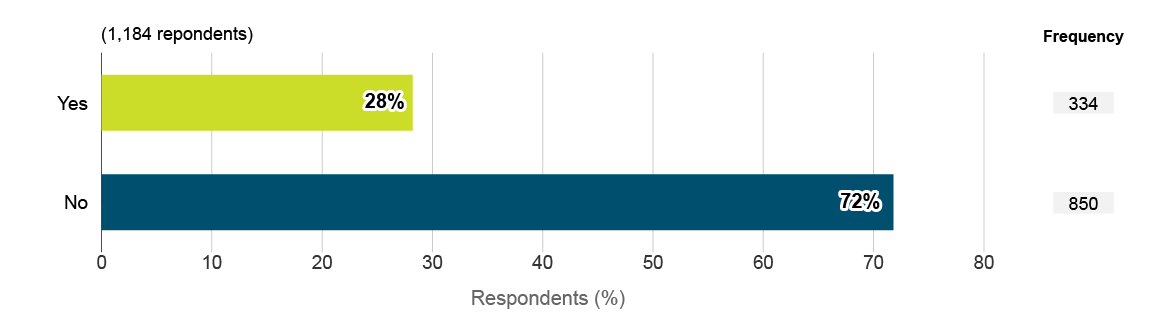
Figure 34 - Text version
| Choice | % | Frequency |
|---|---|---|
| Yes | 28.21% | 334 |
| No | 71.79% | 850 |
| Total | 100% | 1,184 |
Survey respondents who reported a reprisal were asked why they reported it (to the extent that they were comfortable and willing to say). The common themes that emerged from the 285 respondents who provided feedback are described below.
- Sense of justice and ethics: Many respondents reported reprisals because they felt it was the right thing to do, driven by a strong sense of justice, ethics and personal morals.
- Desire for systemic change: Some respondents hoped that by reporting reprisals, they could contribute to systemic changes within their organizations, making them more transparent and accountable.
- Personal impact: A significant number of respondents reported reprisals because they were directly affected, having experienced negative impacts on their careers, mental health and personal well-being.
- Witnessing injustice: Some respondents reported reprisals because they witnessed unfair treatment or bullying of colleagues and felt compelled to act.
- Lack of accountability: There was a recurring theme of frustration with the lack of accountability and follow-up from management and human resource departments.
Feedback on how the reprisal was handled
Survey respondents who reported a reprisal were asked if they were satisfied with what happened after their report. An overview of the 288 responses is provided below.
Overall satisfaction
- Predominantly negative: The majority of respondents expressed dissatisfaction with the outcomes after reporting reprisals. Common reasons included lack of action, continued reprisals and lack of transparency.
- Few positive responses: A small number of respondents reported satisfaction, often due to immediate action taken or resolution of the issue.
Common themes
- Lack of action: Many respondents felt that no meaningful action was taken after their reports. This includes no consequences for perpetrators and no changes in the work environment.
- Continued reprisals: Some respondents experienced ongoing reprisals even after reporting, leading to further trauma and dissatisfaction.
- Lack of transparency: Respondents frequently mentioned not being informed about the outcomes of their reports, leading to feelings of being ignored and unsupported.
- Impact on career and mental health: Many respondents reported negative impacts on their careers and mental health, including being sidelined, transferred or forced to leave their jobs.
Respondents who did not report the reprisal
Survey respondents who did not report the reprisal were asked, to the extent that they were comfortable and willing to say, why they did not report the reprisal they had witnessed or experienced. The key themes from the 667 responses are provided below.
- Fear of reprisal: A significant number of respondents did not report reprisals due to fear of further retaliation. This fear was often based on past experiences or observations of others facing negative consequences after reporting.
- Lack of trust in the system: Many respondents expressed a lack of faith in the reporting system, believing that nothing would be done or that the system was biased in favour of management.
- Lack of evidence: Some respondents felt they did not have enough concrete evidence to support their claims, making them hesitant to report.
- Impact on career: Concerns about potential negative impacts on their careers, such as being sidelined, losing opportunities or being blacklisted, were frequently mentioned.
- Management involvement: In many cases, the individuals responsible for the reprisals were in positions of power, making it difficult for respondents to find a safe and impartial avenue to report the issues.
How can reprisal protections and supports be improved?
Survey respondents were asked to provide comments or suggestions on what protections and supports should be in place so that disclosers are not subject to reprisal before, during or after they report serious misconduct. The key comments and suggestions from the 1,351 responses are provided below.
Confidentiality and oversight
- Confidentiality and anonymity: Many respondents emphasized the importance of maintaining confidentiality and providing anonymous reporting options to protect disclosers from reprisals.
- Independent oversight and reporting mechanisms: There was a strong call for independent bodies to handle reports of misconduct and reprisals, ensuring unbiased investigations and decisions.
Support and legal frameworks
- Support services: Respondents suggested providing comprehensive support services – including legal aid, counselling and career guidance – to help disclosers navigate the reporting process and any subsequent challenges.
- Legal and policy frameworks: Suggestions included strengthening legal protections and ensuring clear, accessible policies and procedures for reporting misconduct and handling reprisals.
- Monitoring and follow-up: Respondents recommended implementing mechanisms for regular follow-up with disclosers to ensure they are not experiencing reprisals and to provide ongoing support.
Education and cultural change
- Education and training: Regular training and awareness programs were recommended for all employees, including management, on the importance of whistleblowing, the protections available and the consequences of reprisals.
- Cultural change: Recommendations included building a workplace culture that supports honesty, inclusion and openness, and that actively discourages misconduct and reprisals.
Feedback from other respondents
The following key points came from former public servants and contractors who indicated their views on familiarity with the reprisal process and their experiences as witnesses of reprisal:
- Most of the former public servants indicated that they were familiar with the reprisal process; a very small percentage were not at all familiar. Of the 49% who had witnessed reprisal action, only half decided to report it. The reasons for reporting were very similar to the reasons for reporting misconduct; however, the reasons for not reporting the incident were related to:
- a fear of reprisal
- lack of support
- the sentiment that nothing would be done
The vast majority of those who reported the reprisal were dissatisfied because of a lack of action, communication and support.
- Most contractors indicated that they were not familiar with the reprisal process. Of the small number of contractors who responded to the survey, over 50% had witnessed reprisal, and most of them reported the incident. Their reasons for reporting included a sense of justice and fairness. The reason they provided for not reporting it was related to their fear of losing job opportunities.
- In terms of recommended strategies for improvements, former public servants mentioned the need for:
- increased accountability
- proper communication
- clear protections
- policies that include consequences for retaliation
Accountability, oversight and public reporting
Accountability
Survey respondents were asked to provide their input on how federal organizations and their senior officials could improve accountability to better support disclosures of serious misconduct and protect against reprisal. The 1,559 respondents offered the following input:
Strengthening reporting and protection mechanisms
Strengthening reporting mechanisms
- Establish centralized and independent reporting systems outside individual organizations to reduce fear of retaliation.
- Provide multiple reporting channels (online, phone and in person) and ensure that procedures are clear and accessible.
Protecting whistleblowers
- Reinforce legal protections and prohibit all forms of retaliation.
- Offer guarantees of anonymity and confidentiality throughout investigations.
- Provide comprehensive support services for victims of retaliation, including legal aid, counselling and career guidance.
Accountability and transparency
Accountability and consequences
- Hold senior officials accountable for their actions and decisions related to misconduct.
- Include accountability in performance management assessments for senior officials.
- Ensure that those who engage in reprisals face appropriate consequences.
Transparency and communication
- Implement standardized procedures for investigations and follow-ups across all organizations.
- Mandate clear communication of investigative results while respecting confidentiality.
- Publish anonymized reports on misconduct cases to foster public trust.
Education and cultural change
Education and training
- Provide continuous education and training for all employees, including upper management, on accountability, trust, confidentiality, professionalism and the importance of protecting whistleblowers.
Cultural change
- Promote a culture of transparency, ethical conduct and open communication.
- Encourage senior officials to lead by example and demonstrate a commitment to addressing wrongdoing.
Acting on existing advice
- Ensure that federal organizations act on the advice and suggestions that have been provided over the years in various reports.
Oversight
Survey respondents were asked to provide their suggestions on how the central offices and agencies, such as the Office of the Chief Human Resources Officer (OCHRO), the Treasury Board of Canada Secretariat (TBS) or the Public Sector Integrity Commissioner (PSIC), could provide effective oversight of the federal disclosure and reprisal protection regime; 1,311 respondents provided a number of suggestions and insights, which are summarized below.
Transparency and communication
- Many respondents emphasized the need for better communication and transparency about the roles and processes of central offices such as OCHRO, TBS and PSIC.
- Suggestions included regular updates, clear guidelines and public reporting on the outcomes of investigations.
Training and support for whistleblowers
Training and education
- There was a strong call for comprehensive training programs for both employees and management on their rights and responsibilities under the disclosure and reprisal protection regimes.
- Respondents suggested that training should cover how to report misconduct, the support available to whistleblowers, and the consequences of reprisals.
Support for whistleblowers
- Providing robust support systems for whistleblowers, including legal assistance, counselling and protection against retaliation was a common theme.
- Ensuring confidentiality and security for those who report misconduct was seen as crucial.
Independent oversight and accountability
Independent oversight and investigations
- Many responses highlighted the importance of having independent bodies to oversee and investigate allegations of misconduct and reprisals.
- The need for impartial and thorough investigations was frequently mentioned, with some respondents suggesting the establishment of a central office where all incidents are initially reported.
Accountability and consequences
- Respondents stressed the importance of holding wrongdoers accountable and ensuring that there are real consequences for misconduct and reprisals.
- Some suggested that senior officials should face stricter penalties for failing to address or for covering up misconduct.
Monitoring and evaluation
- Regular audits, reviews and assessments of organizational practices and performance in handling disclosures were recommended.
- Monitoring compliance with policies and procedures was seen as essential to ensure the effectiveness of the regime.
Public reporting
Survey respondents were asked to provide their suggestions on improving public reporting on the disclosure and reprisal protection regime under the PSDPA:
- 1,045 respondents provided feedback for improvements to reporting
- some focused on public reporting of case outcomes, while others provided suggestions for improving the initial processes for reporting misconduct
As earlier questions dealt with improvements to the initial disclosure or reporting processes, the responses provided below relate to the subsequent reporting on the outcomes of a case.
- Transparency and accessibility: Many respondents emphasized the need for greater transparency in reporting outcomes and making information easily accessible. Suggestions included publishing detailed reports, case summaries, and statistics on disclosures and reprisals.
- Independent oversight: Some respondents called for independent bodies to handle investigations and reporting, to avoid conflicts of interest and to ensure impartiality. This included having third-party reviews and external audits.
- Regular reporting and updates: There were suggestions for regular updates and summaries on the status of reported cases, including the outcomes of investigations and actions taken. This could be in the form of annual reports, newsletters or dashboards.
Feedback from other respondents
The following key points came from former public servants, contractors and members of the public, who indicated their views on accountability, oversight and public reporting:
- A number of points were raised regarding the importance of accountability, both in reporting serious misconduct and in reprisal protection. These include:
- the requirement for meaningful consequences
- ongoing communication and transparency in reporting
- a focus on expected behaviours identified in the Values and Ethics Code for the Public Sector
- increased union support
- independent external processes and oversight
- improved internal mechanisms, evaluation, leadership accountability, organizational support, cultural sensitivity and public reporting
- These respondents also made suggestions for improving oversight of the disclosure process and reprisal protection regime, including:
- increasing public reporting
- improving the transparency and accountability of decisions
- having a central body for oversight
- ensuring independence
- having a central agency set standards to increase support and training
- improving protections
- increasing collaboration with stakeholders
- conducting audits
- The following feedback was provided on ways to improve public reporting on the disclosure and reprisal protection regimes under the PSDPA:
- enhancing transparency
- ensuring confidentiality
- increasing awareness
- independent oversight
- regular updates
- support for whistleblowers
General final question
Additional issues and improvements to the federal government’s disclosure of wrongdoing and reprisal protection regime
Approximately one third of all survey respondents (1,078) provided input to this final general question that sought their input into any other possible issues or improvements to the disclosure of wrongdoing and reprisal protection regime. Participants’ responses are summarized in the key themes and insights outlined below, which are consistent with the key themes identified throughout this report.
Cultural change and ethical leadership
Need for cultural change
- Ethical leadership: Many respondents emphasized the importance of ethical leadership and a culture that promotes integrity and accountability at all levels.
- Support for whistleblowers: There was a strong call for creating a supportive environment where whistleblowers are respected and protected.
Training and awareness
- Education: Many responses highlighted the need for better education and training on the disclosure process and reprisal protection, including mandatory training for all employees.
- Visibility: Increasing the visibility of the PSDPA and related resources through regular communication and training sessions was frequently mentioned.
Transparency, accountability and oversight
Transparency and accountability
- Public reporting: Respondents suggested that public reporting of investigation findings and disciplinary actions is necessary to build trust and demonstrate accountability.
- Consequences for wrongdoers: There was a demand for harsher penalties and clear consequences for those found guilty of misconduct, including senior officials.
Independent oversight
- External investigations: A significant number of respondents called for independent bodies to handle investigations to ensure impartiality and avoid conflicts of interest.
Process improvements
- Simplified reporting: Respondents suggested simplifying the reporting process to make it more accessible and less burdensome.
- Timeliness: There was a call for quicker investigations and timely resolution of cases to prevent prolonged stress for those involved.
Support and protection for whistleblowers
Protection and support for whistleblowers
- Anonymity and confidentiality: Ensuring the anonymity and confidentiality of whistleblowers was seen as crucial to encourage reporting.
- Support systems: Providing legal, emotional and career support to whistleblowers was frequently mentioned as necessary to protect them from reprisals.
Consistency across organizations
- Standardization: Respondents reported the need for standardized procedures and consistent application of the PSDPA across all federal public sector organizations to ensure fairness and effectiveness.
- Clear guidelines: Providing clear guidelines and examples of what constitutes wrongdoing and how to report it was seen as essential.
References
Appendix: Public Servants Disclosure Protection Act Online Survey
Information for survey respondents
About this survey
In , the President of Treasury Board established the PSDPA Review Task Force, comprised of individuals with relevant expertise and experience, to recommend revisions to the Public Servants Disclosure Protection Act (PSDPA). As part of their review, the Task Force has developed this survey to provide an opportunity for input on possible improvements to the PSDPA. The survey should take 20 to 30 minutes to complete.
Si vous préférez répondre au sondage en français, veuillez cliquer sur « Français » dans le coins supérieur droit de la page Web.
Completing the survey
Participation in this research is voluntary. Your answers will remain anonymous. You do not have to answer every question; however, the initial items marked as required must be completed to understand your stakeholder perspective and provide you with customized questions. If you decide you no longer wish to continue participating in the survey, click the applicable checkbox to end the survey and delete all your answers. Once you complete the survey, you will be unable to change or delete your answers given the survey’s anonymous nature. If you do not have time to finish the survey, your responses will be stored. Surveys that are at least 40% completed will contribute to the analysis.
You may enter and exit the survey as many times as needed. To return to where you left off in the survey, you must select the “Save and continue later” button to save your responses. This button is available at the bottom of every page. A “Copy and save the web link” prompt will appear on your screen. Make sure to copy this unique link to return to your partially completed survey at a later time. Failing to do so will result in you being unable to resume, change, or delete your previous answers and being prompted to restart the survey.
This survey is being administered using the third-party online service SimpleSurvey. For additional information on how SimpleSurvey stores and protects information, please see their Privacy and Security webpage (opens in a new window) and Privacy Policy (opens in a new window). Please do not include any sensitive, confidential, or personal information about yourself or any other individual in your responses. Any such information will not be used and will be deleted.
If you would like to complete this survey using an alternative format, or should you have any questions about the survey, please send an email to: PSDPAReviewConsultations/ConsultationsexamenLPFDAR@tbs-sct.gc.ca.
Thank you for helping with this research.
Note to readers of this report
Depending on how respondents answered the first question in the survey, they were automatically directed to the appropriate series of questions based on which respondent group they belonged to. Each survey question below includes a label indicating which group of respondents answered the question. The respondent groups were:
[PS] Current or former federal public servant
[C] Current or former contractor
[GP] A member of the general public
[All] All respondents
Stakeholder identification questions
[All] Which of the following best describes you? (Check one)
- A current or former federal public servant (including working for Crown corporations/agencies (Crowns), the Canadian Armed Forces (CAF), the Canadian Security Intelligence Service (CSIS), the Communications Security Establishment (CSE), and the Royal Canadian Mounted Police (RCMP))
- Someone who works/worked as or for a current/former contractor to the federal public sector (including Crowns, CAF, CSIS, CSE, and RCMP)
- A member of the general public
[PS] Which of the following best describes you? (Check one)
- A current federal public servant
- A former federal public servant
[PS] Which of the following best describes your status/appointment? (Check one)
- Indeterminate
- Determinate (e.g., Term, Seasonal, Student)
- Other, please describe (maximum of 100 characters):
[C] Which of the following best describes you? Someone who works/worked as or for… (required) (Check one)
- A current contractor to the federal public sectors
- A former contractor to the federal public sector
[C] Which of the following best describes your contractor’s general role to the federal public sector? (required) (Check one)
- A consultant
- Providing large-scale infrastructure, equipment, or upgrades
- Providing other goods/equipment/services
- Other, please describe (maximum of 200 characters):
[PS] [C] Do/did you work for, or provide goods/equipment/services to, primarily the Canadian Armed Forces, the Canadian Security Intelligence Service, or the Communications Security Establishment?
- Yes
- No
- Prefer not to answer
If you want to end the survey and delete all your answers, please check this box and click “Next page.”
[All] What is your gender? (Check one)
- Woman
- Man
- Another gender (self-identify if you wish – maximum of 100 characters):
- Prefer not to answer
If you want to end the survey and delete all your answers, please check this box and click “Next page.”
[All] Do you identify as any of the following? Please check all that apply. If none apply, do not select any responses.
- A member of a racialized group
- An Indigenous person (First Nations, Inuk (Inuit), or Métis)
- A person with a disability
- 2SLGBTQIA+
- Another equity-seeking group (specify if you wish – maximum of 200 characters):
- Prefer not to answer
If you want to end the survey and delete all your answers, please check this box and click “Next page.”
Workplace factors and values
[C] Which factors are most important to encourage and support you to disclose serious misconduct? Rank up to 4 responses, with 1 being the most important.
| Factor | Rank | |||
|---|---|---|---|---|
| 1 | 2 | 3 | 4 | |
| a) My company supports disclosing serious misconduct | ||||
| b) My manager/supervisor would support me | ||||
| c) I feel comfortable approaching my Project Manager / Contract Authority | ||||
| d) Other | ||||
If you want to end the survey and delete all your answers, please check this box and click “Next page.”
[C] As a consultant, you may be able to answer the following question based on your work with the public service. If not, please skip this question.
[C] Please indicate your level of agreement to the following statements.
| Choice | Strongly Agree | Agree | Neither Agree nor Disagree | Disagree | Strongly Disagree |
|---|---|---|---|---|---|
| a) In the organization I work for, people are held accountable for their actions. | |||||
| b) The people I work with show respect for others’ ideas, values, and beliefs. | |||||
| c) In the organization I work for, difficult situations are addressed effectively. | |||||
| d) Consultants and the people they work with trust one another. | |||||
| e) I feel comfortable raising or reporting concerns. | |||||
| f) I have appropriate resources to do my job. |
If you want to end the survey and delete all your answers, please check this box and click “Next page.”
[PS] Which factors are most important to encourage and support employees to disclose serious misconduct? Rank up to 5 responses, with 1 being the most important.
| Factor | Rank | ||||
|---|---|---|---|---|---|
| 1 | 2 | 3 | 4 | 5 | |
| a) Senior management regularly communicates their support for disclosing serious misconduct | |||||
| b) Managers and supervisors are knowledgeable about disclosure processes and reprisal protections | |||||
| c) Hearing about the experience of others who reported serious misconduct | |||||
| d) Understanding my options for disclosure and reprisal protections | |||||
| e) Being kept informed of an investigation’s status and findings | |||||
| f) Knowing that consequences or corrective actions are taken if serious misconduct is found | |||||
| g) Feeling that my confidentiality will be respected to the extent possible | |||||
| h) Feeling safe to discuss the matter with my organizational Ethics/Ombuds Office | |||||
| i) Feeling safe to discuss the matter with the designated Senior Officer for Disclosure for my organization | |||||
| j) Feeling safe to discuss the matter with the Office of the Public Sector Integrity Commissioner (PSIC) | |||||
| k) Other | |||||
If you want to end the survey and delete all your answers, please check this box and click “Next page.”
[PS] Please indicate your level of agreement to the following statements.
| Choice | Strongly Agree | Agree | Neither Agree nor Disagree | Disagree | Strongly Disagree |
|---|---|---|---|---|---|
| a) In my workplace, people are held accountable for their actions. | |||||
| b) My colleagues at work show sincere respect for others’ ideas, values, and beliefs. | |||||
| c) Difficult situations in my workplace are addressed effectively. | |||||
| d) I feel part of a community at work. | |||||
| e) Workers and management trust one another. | |||||
| f) I feel comfortable raising or reporting concerns. | |||||
| g) I have enough resources to do my job. |
If you want to end the survey and delete all your answers, please check this box and click “Next page.”
Workplace behaviour scenarios
Scenario 1a
One of my colleagues belittles/dismisses the ideas of others.
[PS] I would discuss this situation with:
| Choice | Very Likely | Somewhat Likely | Neutral | Somewhat Unlikely | Very Unlikely |
|---|---|---|---|---|---|
| a) my colleague who made the comments to point out their impact; | |||||
| b) my colleague(s) whose ideas are being belittled/dismissed; | |||||
| c) my supervisor; | |||||
| d) other colleague(s); | |||||
| e) my union; | |||||
| f) my organizational Ethics/Ombuds Office; | |||||
| g) my Informal Conflict Management Services (ICMS) office. |
If you want to end the survey and delete all your answers, please check this box and click “Next page.”
Scenario 1b
My colleague continues their belittling/dismissive behaviour.
[PS] If my colleague continues their belittling/dismissive behaviour, I would report my concern(s) to:
| Choice | Very Likely | Somewhat Likely | Neutral | Somewhat Unlikely | Very Unlikely |
|---|---|---|---|---|---|
| a) my supervisor; | |||||
| b) other colleague(s); | |||||
| c) my union; | |||||
| d) my organizational Ethics/Ombuds Office; | |||||
| e) my Informal Conflict Management Services (ICMS) office. |
If you want to end the survey and delete all your answers, please check this box and click “Next page.”
[PS] If an investigation finds continued improper behaviour, what do you think should happen? Assume they have no other recorded discipline. (Check all that apply)
- Nothing
- My supervisor should talk with my colleague
- Informal Conflict Management Services (ICMS) intervention
- Respectful workplace training
- Verbal reprimand
- Written reprimand
- Other
If you want to end the survey and delete all your answers, please check this box and click “Next page.”
[PS] If an investigation finds continued improper behaviour, what do you think would happen? Assume they have no recorded discipline. (Check all that apply)
- Nothing
- My supervisor would talk with my colleague
- Informal Conflict Management Services (ICMS) intervention
- Respectful workplace training
- Verbal reprimand
- Written reprimand
- Other
If you want to end the survey and delete all your answers, please check this box and click “Next page.”
Scenario 2
During informal conversations, one of my colleagues regularly makes racist joking remarks. The person continues to make such remarks even after other colleagues, our supervisor, and the Equity, Diversity, and Inclusion (EDI) officer have explained the remarks’ offensiveness during individual discussions.
[PS] I would discuss this situation with:
| Choice | Very Likely | Somewhat Likely | Neutral | Somewhat Unlikely | Very Unlikely |
|---|---|---|---|---|---|
| a) the colleague making the remarks; | |||||
| b) our supervisor; | |||||
| c) other colleague(s); | |||||
| d) my union; | |||||
| e) my organizational Ethics/Ombuds Office; | |||||
| f) my Informal Conflict Management Services (ICMS) office; | |||||
| g) a higher official in my organization, other than the Senior Officer for Disclosure; | |||||
| h) my organization’s designated Senior Officer for Disclosure; | |||||
| i) the Office of the Public Sector Integrity Commissioner (PSIC). |
If you want to end the survey and delete all your answers, please check this box and click “Next page.”
[PS] If an investigation found improper behaviour, what do you think should happen? Assume they have no recorded discipline. (Check all that apply)
- Nothing
- Our supervisor should talk again with the colleague
- Informal Conflict Management Services (ICMS) intervention
- Further equity, diversity, and inclusion training
- Verbal reprimand
- Written reprimand
- Suspension
- Dismissal
- Other
If you want to end the survey and delete all your answers, please check this box and click “Next page.”
[PS] If an investigation found improper behaviour, what do you think would happen? Assume they have no recorded discipline. (Check all that apply)
- Nothing
- Our supervisor would talk again with the colleague
- Informal Conflict Management Services (ICMS) intervention
- Further equity, diversity, and inclusion training
- Verbal reprimand
- Written reprimand
- Suspension
- Dismissal
- Other
If you want to end the survey and delete all your answers, please check this box and click “Next page.”
Scenario 3
My supervisor favours relatives, friends, and associates when he/she consults, provides training opportunities, or allows people to work from home.
[PS] I would discuss this situation with:
| Choice | Very Likely | Somewhat Likely | Neutral | Somewhat Unlikely | Very Unlikely |
|---|---|---|---|---|---|
| a) my supervisor; | |||||
| b) other colleague(s); | |||||
| c) my union; | |||||
| d) my supervisor’s manager; | |||||
| e) my organizational Ethics/Ombuds Office; | |||||
| f) my Informal Conflict Management Services (ICMS) office; | |||||
| g) a higher official in my organization, other than the Senior Officer for Disclosure; | |||||
| h) my organization’s designated Senior Officer for Disclosure; | |||||
| i) the Office of the Public Sector Integrity Commissioner (PSIC). |
If you want to end the survey and delete all your answers, please check this box and click “Next page.”
[PS] If an investigation found improper behaviour, what do you think should happen? Assume they have no recorded discipline. (Check all that apply)
- Nothing
- My supervisor’s manager should talk with my supervisor
- Informal Conflict Management Services (ICMS) intervention
- Further management training
- Verbal reprimand
- Written reprimand
- Other
If you want to end the survey and delete all your answers, please check this box and click “Next page.”
[PS] If an investigation found improper behaviour, what do you think would happen? Assume they have no recorded discipline. (Check all that apply)
- Nothing
- My supervisor’s manager would talk with my supervisor
- Informal Conflict Management Services (ICMS) intervention
- Further management training
- Verbal reprimand
- Written reprimand
- Other
If you want to end the survey and delete all your answers, please check this box and click “Next page.”
Scenario 4
A senior leader in your organization yells at people, belittles them, ostracizes people who complain, and is known for giving contracts to friends and inappropriately expensing extravagant lunches.
[PS] I would discuss this situation with:
| Choice | Very Likely | Somewhat Likely | Neutral | Somewhat Unlikely | Very Unlikely |
|---|---|---|---|---|---|
| a) my supervisor; | |||||
| b) other colleague(s); | |||||
| c) my union; | |||||
| d) my organizational Ethics/Ombuds Office; | |||||
| e) my Informal Conflict Management Services (ICMS) office; | |||||
| f) a higher official in my organization, other than the Senior Officer for Disclosure; | |||||
| g) my organization’s designated Senior Officer for Disclosure; | |||||
| h) the Office of the Public Sector Integrity Commissioner (PSIC). |
If you want to end the survey and delete all your answers, please check this box and click “Next page.”
[PS] If an investigation found improper behaviour, what do you think should happen? Assume they have no recorded discipline. (Check all that apply)
- Nothing
- Senior management should talk with this senior leader
- Reassignment to another portfolio
- Written reprimand
- Suspension
- Senior leader resigns
- Dismissal
- Other
If you want to end the survey and delete all your answers, please check this box and click “Next page.”
[PS] If an investigation found improper behaviour, what do you think would happen? Assume they have no recorded discipline. (Check all that apply)
- Nothing
- Senior management would talk with this senior leader
- Reassignment to another portfolio
- Written reprimand
- Suspension
- Senior leader resigns
- Dismissal
- Other
If you want to end the survey and delete all your answers, please check this box and click “Next page.”
General culture questions
[PS] How would you describe your organization’s culture? (maximum of 5,000 characters)
If you want to end the survey and delete all your answers, please check this box and click “Next page.”
[C] [GP] How would you describe the public service’s culture? (maximum of 5,000 characters).
If you want to end the survey and delete all your answers, please check this box and click “Next page.”
[All] How much does that culture support voicing concerns?
- Fully
- Largely
- Moderately
- Slightly
- Not at all
If you want to end the survey and delete all your answers, please check this box and click “Next page.”
[All] How much does that culture support reporting serious misconduct?
- Fully
- Largely
- Moderately
- Slightly
- Not at all
If you want to end the survey and delete all your answers, please check this box and click “Next page.”
[All] Describe a culture that supports voicing concerns and reporting serious misconduct (maximum of 5,000 characters). Please do not include any sensitive, confidential, or personal information about yourself or any other individual in your response.
If you want to end the survey and delete all your answers, please check this box and click “Next page.”
[All] Is there anything you would like to add concerning possible issues or improvements regarding the federal public sector’s culture in relation to reporting serious misconduct? (maximum of 5,000 characters)
If you want to end the survey and delete all your answers, please check this box and click “Next page.”
Disclosure process
[All] How would you rate your familiarity with disclosure processes under the Public Servants Disclosure Protection Act (PSDPA)?
- Extremely familiar
- Moderately familiar
- Somewhat familiar
- Slightly familiar
- Not at all familiar
If you want to end the survey and delete all your answers, please check this box and click “Next page.”
[C] [GP] What options are available to you for reporting serious misconduct? (maximum of 5000 characters).
If you want to end the survey and delete all your answers, please check this box and click “Next page.”
[PS] If you witnessed serious misconduct in the workplace, what actions would you most likely take? Rank up to 5 responses, with 1 being the most likely.
| Action | Rank | ||||
|---|---|---|---|---|---|
| 1 | 2 | 3 | 4 | 5 | |
| a) Take no action | |||||
| b) Discuss with my colleague(s) | |||||
| c) Discuss with my supervisor | |||||
| d) Contact my union | |||||
| e) Discuss with my organizational Ethics/Ombuds Office | |||||
| f) Discuss with a higher official in my organization, other than the Senior Officer for Disclosure | |||||
| g) Report to my organization’s Senior Officer for Disclosure | |||||
| h) Report to the Office of the Public Sector Integrity Commissioner (PSIC) | |||||
| i) Other | |||||
If you want to end the survey and delete all your answers, please check this box and click “Next page.”
[C] If you witnessed serious misconduct while working as or for a federal contractor, what actions would you most likely take? Rank up to 5 responses, with 1 being the most likely.
| Action | Rank | ||||
|---|---|---|---|---|---|
| 1 | 2 | 3 | 4 | 5 | |
| a) Take no action | |||||
| b) Discuss with my colleague(s) (if applicable) | |||||
| c) Discuss with my manager/supervisor (if applicable) | |||||
| d) Contact my union (if applicable) | |||||
| e) Discuss with a higher official in my organization | |||||
| f) Discuss with the Project Manager / Contract Authority | |||||
| g) Report to the Office of the Public Sector Integrity Commissioner (PSIC) | |||||
| i) Other | |||||
If you want to end the survey and delete all your answers, please check this box and click “Next page.”
[PS] [C] What factors/concerns would most likely discourage you from reporting serious misconduct? Rank up to 5 responses, with 1 being the most likely.
| Factor | Rank | ||||
|---|---|---|---|---|---|
| 1 | 2 | 3 | 4 | 5 | |
| a) Not enough evidence/proof | |||||
| b) Possible reprisal(s) | |||||
| c) Lack of anonymity and confidentiality | |||||
| d) Lack of support | |||||
| e) Fear of taking on hierarchy/power | |||||
| f) The effect of reporting on my work and relationships | |||||
| g) Not serious enough | |||||
| h) Other avenues for dealing with the issue | |||||
| i) Fear of consequences on career development / future opportunities | |||||
| j) Other | |||||
If you want to end the survey and delete all your answers, please check this box and click “Next page.”
[PS] [C] What factors would most likely encourage you to report serious misconduct?
| Factor | Rank | ||||
|---|---|---|---|---|---|
| 1 | 2 | 3 | 4 | 5 | |
| a) Sufficient evidence | |||||
| b) Support from other witnesses | |||||
| c) The perceived severity of the misconduct | |||||
| d) Protection from negative impacts on my career / future opportunities | |||||
| e) Knowing that my information will be kept confidential | |||||
| f) My sense of justice | |||||
| g) My senior leadership supports reporting | |||||
| h) Awareness of positive reporting experiences | |||||
| i) Other | |||||
If you want to end the survey and delete all your answers, please check this box and click “Next page.”
If the following triggers emotional distress or trauma and you want to talk to someone, free counselling is available 24 hours a day, 7 days a week, through the Employee Assistance Program (EAP). Please consult the Organizational EAP Provider List (opens in a new window) to find your EAP’s contact information.
[PS] Have you seen serious misconduct in your workplace?
- Yes
- No
If you want to end the survey and delete all your answers, please check this box and click “Next page.”
[C] Have you seen serious misconduct while working as or for a federal contractor?
- Yes
- No
If you want to end the survey and delete all your answers, please check this box and click “Next page.”
[PS] [C] Was seeing the serious misconduct a traumatic experience for you?
- Yes
- No
If you want to end the survey and delete all your answers, please check this box and click “Next page.”
[PS] [C] Did you report the serious misconduct?
- Yes
- No
If you want to end the survey and delete all your answers, please check this box and click “Next page.”
[PS] [C] To the extent you are comfortable and willing, why did you report the serious misconduct? (maximum of 5,000 characters)
If you want to end the survey and delete all your answers, please check this box and click “Next page.”
[PS] [C] To the extent you are comfortable and willing, were you satisfied with what happened after your report? Why or why not? (maximum of 5,000 characters)
If you want to end the survey and delete all your answers, please check this box and click “Next page.”
[PS] [C] To the extent you are comfortable and willing, why did you not report the serious misconduct? (maximum of 5,000 characters)
If you want to end the survey and delete all your answers, please check this box and click “Next page.”
[All] How can the federal government make it easier for you to report serious misconduct? (maximum of 5,000 characters)
If you want to end the survey and delete all your answers, please check this box and click “Next page.”
[All] Do you have any comments or suggestions for improving current mechanisms and processes for reporting serious misconduct? (maximum of 5,000 characters)
If you want to end the survey and delete all your answers, please check this box and click “Next page.”
Protection from reprisal
[All] How would you rate your familiarity with potential reprisal issues, protections, and supports under the Public Servants Disclosure Protection Act (PSDPA)?
- Extremely familiar
- Moderately familiar
- Somewhat familiar
- Slightly familiar
- Not at all familiar
If you want to end the survey and delete all your answers, please check this box and click “Next page.”
If the following triggers emotional distress or trauma and you want to talk to someone, free counselling is available 24 hours a day, 7 days a week, through the Employee Assistance Program (EAP). Please consult the Organizational EAP Provider List (opens in a new window) to find your EAP’s contact information.
[PS] Have you seen reprisal(s) occur in your workplace?
- Yes
- No
If you want to end the survey and delete all your answers, please check this box and click “Next page.”
[C] Have you seen reprisal(s) occur while working as or for a federal contractor?
- Yes
- No
If you want to end the survey and delete all your answers, please check this box and click “Next page.”
[PS] [C] Was seeing the reprisal(s) a traumatic experience for you?
- Yes
- No
If you want to end the survey and delete all your answers, please check this box and click “Next page.”
[PS] [C] Did you report the reprisal(s)?
- Yes
- No
If you want to end the survey and delete all your answers, please check this box and click “Next page.”
[PS] [C] To the extent you are comfortable and willing, why did you report the reprisal(s)? (maximum of 5,000 characters)
If you want to end the survey and delete all your answers, please check this box and click “Next page.”
[PS] [C] To the extent you are comfortable and willing, were you satisfied with what happened after your report? Why or why not? (maximum of 5,000 characters)
If you want to end the survey and delete all your answers, please check this box and click “Next page.”
[PS] [C] To the extent you are comfortable and willing, why did you not report the reprisal(s)? (maximum of 5,000 characters)
If you want to end the survey and delete all your answers, please check this box and click “Next page.”
[All] Do you have any comments or suggestions on what protections and supports should be in place so that disclosers are not subject to a reprisal before, during, or after they report serious misconduct? (maximum of 5,000 characters)
If you want to end the survey and delete all your answers, please check this box and click “Next page.”
Accountability, oversight and public reporting
[All] How could federal organizations and their senior officials improve accountability to better support disclosures of serious misconduct and protect against reprisal? (maximum of 5,000 characters)
If you want to end the survey and delete all your answers, please check this box and click “Next page.”
[C] [GP] How could central offices/bodies (e.g., the Public Sector Integrity Commissioner) provide effective oversight of the federal disclosure and reprisal protection regime? (maximum of 5,000 characters)
If you want to end the survey and delete all your answers, please check this box and click “Next page.”
[PS] How could central offices/bodies (e.g. the Chief Human Resources Officer, the Treasury Board Secretariat, or the Public Sector Integrity Commissioner) provide effective oversight of the federal disclosure and reprisal protection regime? (maximum of 5,000 characters).
If you want to end the survey and delete all your answers, please check this box and click “Next page.”
[All] Do you have any suggestions for how public reporting could be improved for the federal disclosure and reprisal protection regime? (maximum of 5,000 characters)
If you want to end the survey and delete all your answers, please check this box and click “Next page.”
Final general question
[All] Is there anything else you would like to add concerning possible issues with or improvements to the federal government’s disclosure of wrongdoing and reprisal protection regime? (maximum of 5,000 characters)
If you want to end the survey and delete all your answers, please check this box and click “Next page.”