
Report on the Use of Indigenous Languages in Canada’s Public Service
On this page
Executive summary
In this section
This Joint Report presents the results of the first inquiry into the scale and scope of the use of Indigenous languages in 24 federal public service organizations for the Program and Administrative Services (PA) and Education and Library Services (EB) occupational groups and Parks Canada (PC) Bargaining Unit Members. Two questionnaires, one at the organizational level and one at the team level, were developed to collect data between October 21, 2021, and January 10, 2022. Twenty-five organizations were selected to participate based on their mandates and their interaction and engagement with or impact on Indigenous communities.
While the findings of the Joint Report cannot be deemed representative, they provide a first-ever insight into the use of Indigenous languages in the federal public service.
Team-level highlights
- A total of 905 managers submitted responses to the team-level questionnaire. The total number of managers who received the questionnaire is unknown.
- Responding teams are situated within 21 different federal organizations in all provinces and territories.Footnote 1
- 59 managers out of the 905 submissions, or 6.5% from 16 organizations, reported having employees in their teams who use Indigenous languages in the workplace.
- Within these 59 teams, a total of 460 employees were found to use Indigenous languages in the workplace out of a total of 2,557 employees.
- Of these 460 employees, 44 had a reference to an Indigenous language in their job descriptions as a requirement and/or skill.
- Responding teams reported undertaking a total of 23,518 staffing actions in the 2020–21 fiscal year. Of these staffing actions, 193 contained a reference to the use of Indigenous languages.
- Indigenous languages in staffing actions were indicated 19 times as an asset qualification and twice as an essential qualification. In three instances, the reference appeared in other sections, and in two instances, the reference appeared in the knowledge and skills section.
- A total of 68 team managers reported receiving requests for information or services in Indigenous languages from Indigenous governments, communities, organizations, clients, citizens or other sources.
- A total of 132 team managers reported obtaining services in Indigenous languages from organizations or individuals outside of their teams. Most of these services were obtained from outside the federal government.
Organizational-level highlights
- Out of the 25 organizations invited to participate, a total of 23 heads of human resources (HHRs), representing 24 federal organizations, submitted responses to the organizational-level questionnaire.
- 19 HHRs indicated that Indigenous languages are used in the context of or to support the delivery of their organization’s mandate.
- Six HHRs indicated that there are positions within their organization that reference an Indigenous language in the generic or unique job descriptions.
- HHRs reported undertaking a total of 236,609 staffing actions in the 2020–21 fiscal year. Of these staffing actions, 32 contained a reference to the use of Indigenous languages.
- Subsequent information provided from one organization explained that corporate reporting only includes formal staffing actions and may not account for regional or team informal expressions of interest or transfers from other departments. This situation would explain the discrepancy between the numbers at the organizational level and those at the team level, which are likely more accurate.
- In total, seven HHRs indicated where in the staffing action the reference to the use of Indigenous languages was made. In five staffing actions, the criteria were reported to be classified as an asset qualification. In one instance, a reference to Indigenous languages was included in the title of the position, and in another, the respondent indicated that the reference was not explicitly listed. No HHR reported the criteria as an essential qualification.
- HHRs reported that decisions to recruit employees who use Indigenous languages are made at all management levels: deputy head, assistant deputy minister, director general, director and manager.
- 10 HHRs indicated that their organizations inform the public about programs or services offered in Indigenous languages.
Part I
In this section
Introduction
During the 2018 round of collective bargaining, the Treasury Board (the Employer) and the Public Service Alliance of Canada (PSAC-Union) agreed to memoranda of understanding (MOUs) on the use of Indigenous languages in the PAFootnote 2 and EBFootnote 3 collective agreements. The MOUs stem from negotiations during collective bargaining about the use of Indigenous languages by federal public service employees.Footnote 4 In early 2021, the Union and PC reached a collective agreement that included a similar MOU.Footnote 5
The MOUs committed the parties to establish a Joint Committee on Indigenous Languages (the Committee) co-chaired by a representative from each party. The Committee is bound to:
- review the use of Indigenous languages in the public service
- examine Indigenous language skills in the performance of employee duties
- consider the advantages that Indigenous language speakers bring to the public service
Specific to the EB occupational group, the Committee sought to examine Indigenous language use in the performance of employee duties within the context of on-reserve schools where Indigenous languages are teachable subjects within the assigned curriculum.
The Committee began meeting in November 2020 and is chaired by the Treasury Board of Canada Secretariat–Office of the Chief Human Resources Officer (TBS-OCHRO) and the PSAC. Membership included representatives of the Union and of the Employer, including Canadian Heritage, Employment and Social Development Canada, Indigenous Services Canada, the Public Prosecution Service of Canada, the Royal Canadian Mounted Police and PC.
The quotes presented in this report are unabridged and were offered voluntarily in response to the questionnaires distributed as part of this inquiry. They cannot be taken as representative because a comprehensive qualitative analysis was not carried out.
Context
The Indigenous Languages Act (Bill C-91) (the Act), passed by the Government of Canada in 2019, recognized “that the rights of Indigenous peoples recognized and affirmed by section 35 of the Constitution Act, 1982 include rights related to Indigenous languages.”Footnote 6 In addition to recognizing that a history of discriminatory government policies and practices, including assimilation, forced relocation, the Sixties Scoop and residential schools, were detrimental to Indigenous languages and contributed significantly to the erosion of those languages and cultures, the Act identifies an urgent need to support the efforts of Indigenous peoples to reclaim, revitalize, maintain and strengthen Indigenous languages. The Act includes, among other things, provisions to support access to services in Indigenous languages provided by federal institutions and establishes an Office of the Commissioner of Indigenous Languages to support the implementation of the Act.
In addition to this, the United Nations (UN) is presently raising awareness about the rapid decline of Indigenous languages worldwide and the concomitant negative impact on Indigenous cultures. The UN recognized 2019 as the International Year of Indigenous Languages and proclaimed the years 2022 to 2032 the International Decade of Indigenous Languages to draw attention to the critical loss of Indigenous languages and to generate global engagement among organizations and governments in the preservation, revitalization and strengthening of the world’s Indigenous languages. The Government of Canada, which endorsed the UN Declaration on the Rights of Indigenous Peoples in 2016, is a partner in this endeavour.
“The government continues to tackle and speak out against the systemic inequities and discrimination that Indigenous Peoples experience in Canada. We are working with First Nations, Inuit, and Métis to renew our nation-to-nation, Inuit-Crown, and government-to-government relationships, through healing, truth, meaningful reconciliation, and cooperation. Last June, the United Nations Declaration on the Rights of Indigenous Peoples Act was passed into law in Canada, establishing a roadmap for fully recognizing, respecting, and protecting the human rights of Indigenous Peoples.”Footnote 7
Questionnaires on the use of Indigenous languages
Questionnaire development
Two questionnaires were developed to provide us with an understanding of the use of Indigenous languages in the federal public service by Indigenous employees. In the interest of achieving its mandate, the Committee determined that obtaining information directly from federal organizations would be the most effective approach to data collection.
Methodological and logistical considerations resulted in the development of two questionnaires: an organizational-level questionnaire directed to the HHRs of participating organizations, and a team-level questionnaire distributed within organizations that collected data about employees from managers.
- The organizational-level questionnaire gathered information from an organization-wide, or corporate, perspective through a single submission completed by the respective departmental HHR or another senior corporate official. (For the full questionnaire, please refer to Appendix A.)
- The team-level questionnaire gathered more detailed information from managers about their employees’ use of Indigenous languages. The HHRs were encouraged to distribute the questionnaire to managers in their organization. (For the full questionnaire, please refer to Appendix B.)
Both questionnaires were developed with advice and feedback from Committee members as well as PSAC and TBS research and survey experts. Federal Indigenous employee networks were also invited to comment on the survey.
To ensure a common understanding and obtain accurate and consistent responses, several concepts such as “workplace” and “employee” were defined in the questionnaire.
Questionnaire roll-out
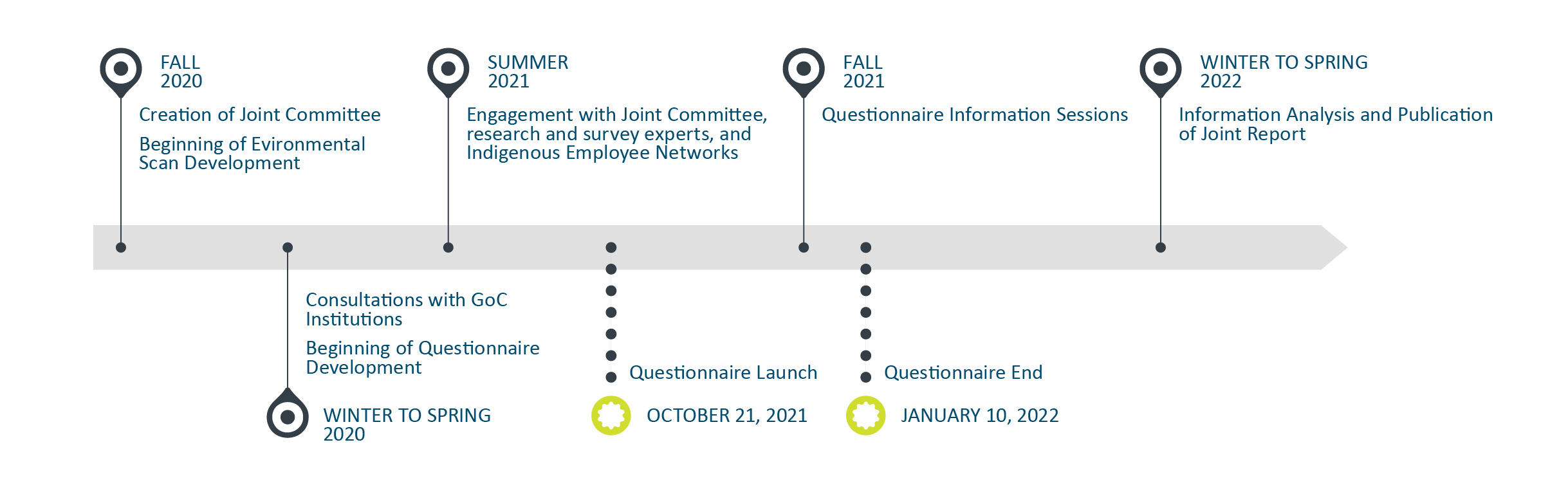
Figure 1 - Text version
Timeline of questionnaires roll-out:
- fall 2020: creation of the Joint Committee and beginning of environmental scan development
- winter to spring 2020: consultations with Government of Canada institutions and beginning of questionnaires development
- summer 2021: engagement with Joint Committee, research and survey experts, and Indigenous employee networks
- October 21, 2021: questionnaires launch
- fall 2021: questionnaires information sessions
- January 10, 2022: questionnaires end
- winter to spring 2022: information analysis and publication of joint report
Twenty-five organizations were selected based on their mandates and their interaction and engagement with or impact on Indigenous communities. It was not possible for the committee to survey all organizations throughout the federal government, meaning not all PA and EB members were reached. (For the list of organizations selected, please refer to Appendix D.)
The questionnaires were sent out on October 21, 2021, by the Employer, on behalf of the Committee, using the third-party online service, SimpleSurvey. Organizational HHRs were asked to respond directly to the organizational-level questionnaire and to distribute the team-level questionnaire to managers. Following the launch of the questionnaire, 10 information sessions were held to provide guidance to responding organizations. Participants were advised that their responses were protected under the Privacy Act, subject to the Access to Information Act, and would remain anonymous.
Nature of the Joint Report
Given the scope of the Committee’s mandate and limitations in data collection, the findings presented in this report cannot be extended to represent the entire federal public service. The central purpose of this Joint Report is to provide insight into the use of Indigenous languages by the members of the PA, EB and PC bargaining units. According to PSAC membership data, these bargaining units represent approximately 100,000 employees as of March 31, 2022. However, some respondents voluntarily provided information pertaining to employees who are outside of the PA, EB and PC groups, and this data could not always be separated from the core data that was sought by the Committee. Therefore, the results presented in this Joint Report reflect the responses provided between October 2021 and January 2022, and all findings are contingent on the accuracy of the information reported by respondents.
Methodology and interpretation of data
The questionnaires distributed to organizations were broad and sought both quantitative and qualitative information. The analysis provided in this report is limited to certain quantitative responses and was conducted using descriptive statistics functions in Microsoft Excel. The data presented in this Joint Report consists of all interpretable replies obtained by predetermined cut-off dates. Responses that were obviously incomplete, and cells that had clear keying errors and unreadable entries, were discounted during data cleanup.
It is important to note that participation, although strongly encouraged, was voluntary. A total of 23 HHRs, representing 24 federal organizations, responded to the organizational-level questionnaire, and 21 organizations were represented at the team level. Due to the way the team-level questionnaire was distributed within organizations, the total number of managers who received the questionnaire is unknown, and therefore an accurate response rate cannot be determined.
Organizational-level questionnaire
Organizational-level submissions were received from 24 out of the 25 participating organizations (Statistics Canada and Statistical Survey Operations share the same HHR):
- Canada Border Services Agency (CBSA)
- Canada Revenue Agency (CRA)
- Canadian Heritage (PCH)
- Canadian Northern Economic Development Agency (including Pilimmaksaivik) (CanNor)
- Correctional Service Canada (CSC)
- Crown-Indigenous Relations and Northern Affairs Canada (CIRNAC)
- Employment and Social Development Canada (including Labour Canada and Service Canada) (ESDC)
- Environment and Climate Change Canada (ECCC)
- Fisheries and Oceans Canada (DFO)
- Health Canada (HC)
- Impact Assessment Agency of Canada (IAAC)
- Indigenous Services Canada (ISC)
- National Defence (DND)
- National Security and Intelligence Review Agency (NSIRA)
- Natural Resources Canada (NRCan)
- Parks Canada (PC)
- Public Health Agency of Canada (PHAC)
- Public Prosecution Service of Canada (PPSC)
- Public Services and Procurement Canada (PSPC)
- Royal Canadian Mounted Police (RCMP)
- Statistics Canada (StatCan), including Statistical Survey Operations (SSO)Footnote 8
- Transport Canada (TC)
- Veterans Affairs Canada (VAC)
Team-level questionnaire response rates
While 914 team-level submissions were received, after data verification and cleaning, it was determined that 905 submissions were interpretable and could therefore be included. The team-level responses were provided by 21 organizations (Figure 2).
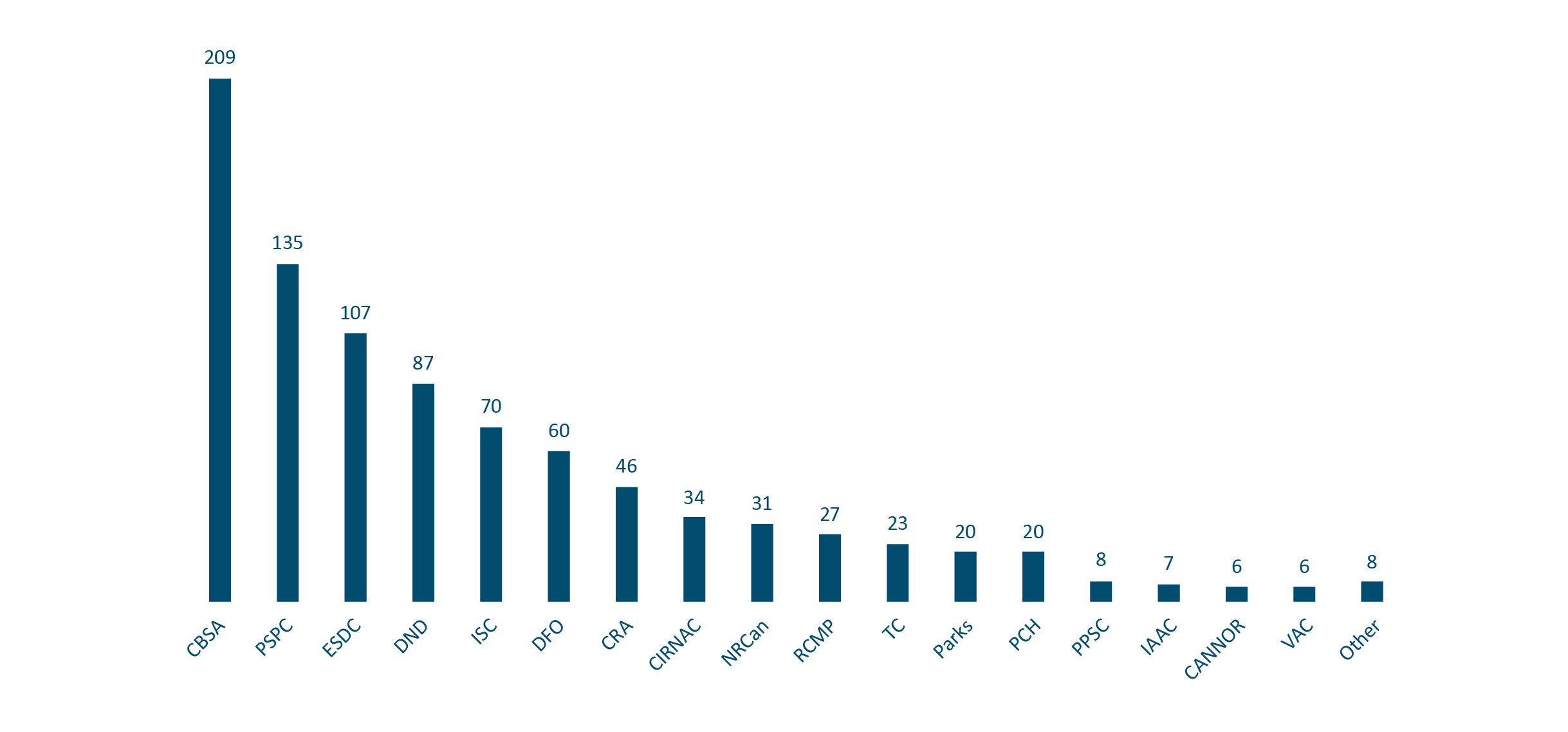
Figure 2 - Text version
| CBSA | 209 |
|---|---|
| PSPC | 135 |
| ESDC | 107 |
| DND | 87 |
| ISC | 70 |
| DFO | 60 |
| CRA | 46 |
| CIRNAC | 34 |
| NRCan | 31 |
| RCMP | 27 |
| TC | 23 |
| PC | 20 |
| PCH | 20 |
| PPSC | 8 |
| IAAC | 7 |
| CanNor | 6 |
| VAC | 6 |
| Other | 8 |
Notes
Total team responses: 905
The “Other” category includes the following organizations that submitted three or fewer team-level responses: CSC (3), SSO (3), StatCan (1) and PHAC (1).
Team-level responses by province and territory
Responding teams were distributed across all provinces and territories. The most team-level submissions were received from Ontario and the least from the Northwest Territories (Figure 3). However, it is important to note that organizational structure may influence these results (for example, a team located in one province might provide services to communities in another province or territory).
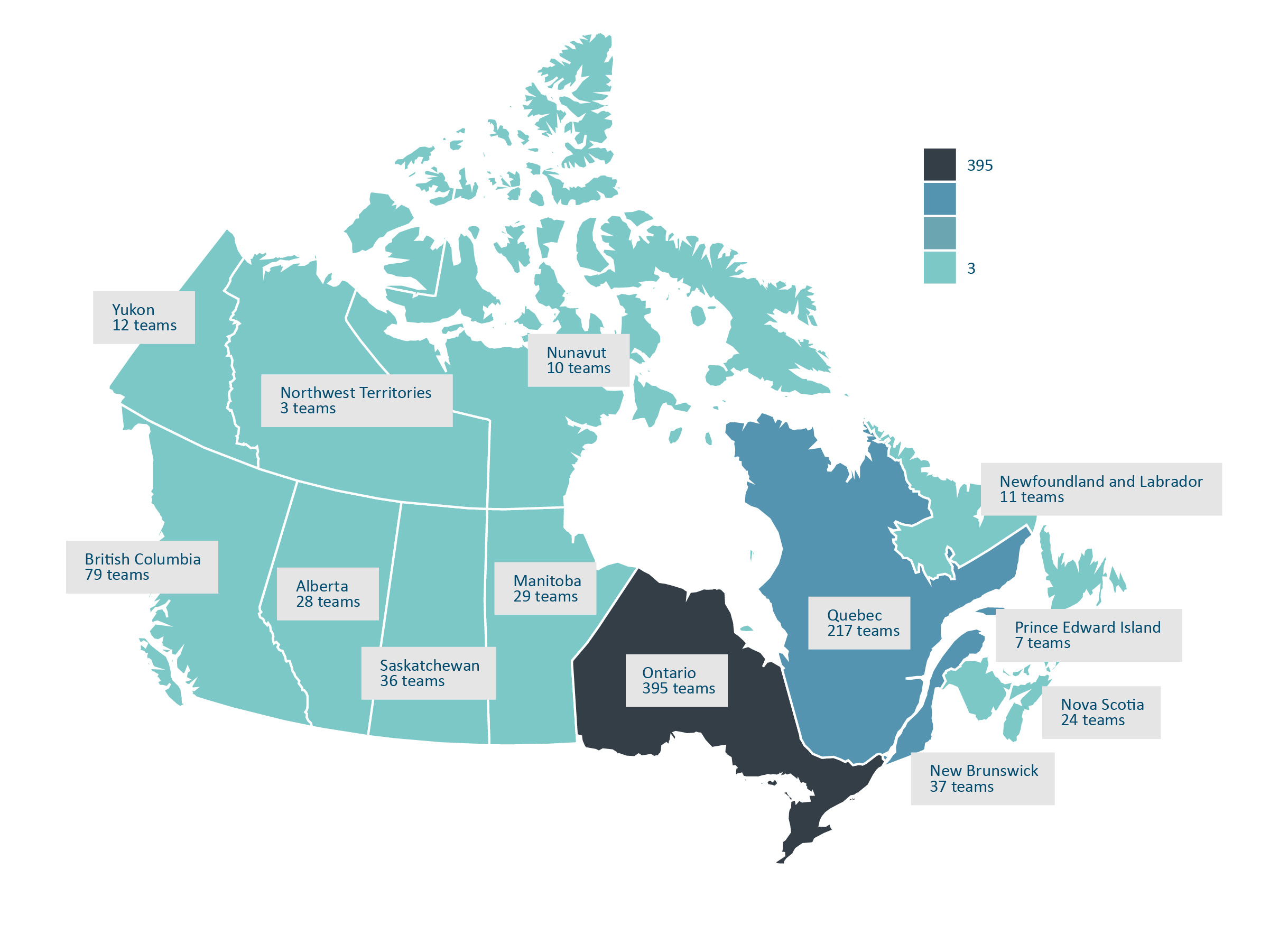
Figure 3 - Text version
Depiction of map of Canada that shows the number of teams that responded to the questionnaire, by province and territory:
- Yukon: 12
- Northwest Territories: 3
- Nunavut: 10
- British Columbia: 79
- Alberta: 28
- Saskatchewan: 36
- Manitoba: 29
- Ontario: 395
- Quebec: 217
- Newfoundland and Labrador: 11
- Prince Edward Island: 7
- Nova Scotia: 24
- New Brunswick: 37
Notes
Total team responses: 888
The numbers in Figure 3 represent the number of teams that responded by province or territory.
While we know anecdotally that there are high concentrations of Indigenous language users in the North, the data received from organizations in the northern areas did not reflect this.
Part II
In this section
Departmental mandates
Organizational question (Q2)Footnote 9: Are Indigenous languages used in your organization in the context of, or to support the delivery of, its mandate?
Nineteen of the 23 organizations that responded to this question indicated that Indigenous languagesFootnote 10 were used in the context of, or to support the delivery of, their mandates (Figure 4).
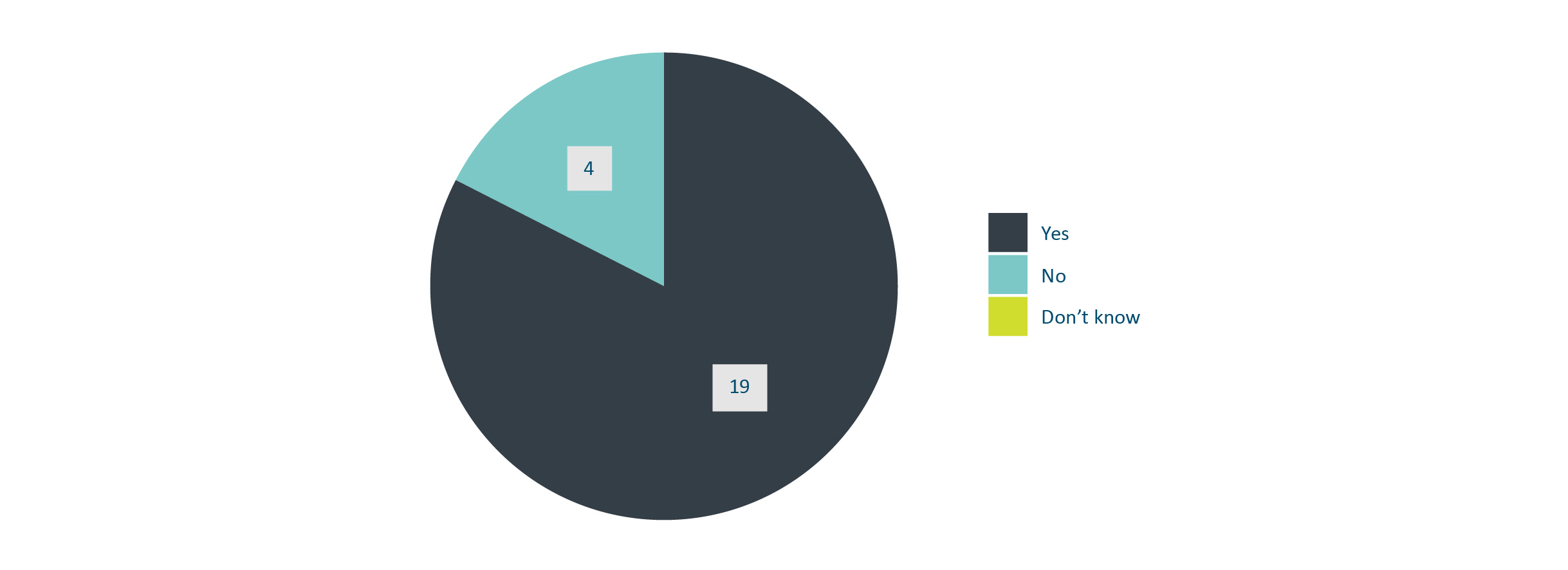
Figure 4 - Text version
| Yes | 19 |
|---|---|
| No | 4 |
| Don’t know | 0 |
Notes
Total organizational responses: 23
“Yes” responses: CBSA, CRA, CanNor, CSC, CIRNAC, DFO, DND, ECCC, ESDC, IAAC, ISC, NRCan, PC, PPSC, PSPC, RCMP, StatCan/SSO, TC and VAC.
“Integrating Indigenous languages in the public service is very noble and respectful of reconciliation. I would encourage the government to pace itself and make progress one step at a time. I think there are many lessons learned that should guide this work based on the use of Official Languages in minority language environments (for example, francophones in the [National Capital Region], New Brunswick, Manitoba or anglophones in Quebec City, etc.). As we all know, as soon as a group of francophone public servants are joined by one bilingual anglophone, conversations switch to English. The equitable use of French and English is still not part of the reality. I would hate for us to be set up for failure with the introduction of Indigenous languages in the workplace.”
Classifying and staffing positions
Organizational question (Q4): Are there positions within your organization that reference Indigenous languages within the generic or unique job descriptions (for example, in the key activities, knowledge, skills or other sections)?
Six organizations indicated that they have positions within their organization that reference an Indigenous language in the generic or unique job descriptions (Figure 5).
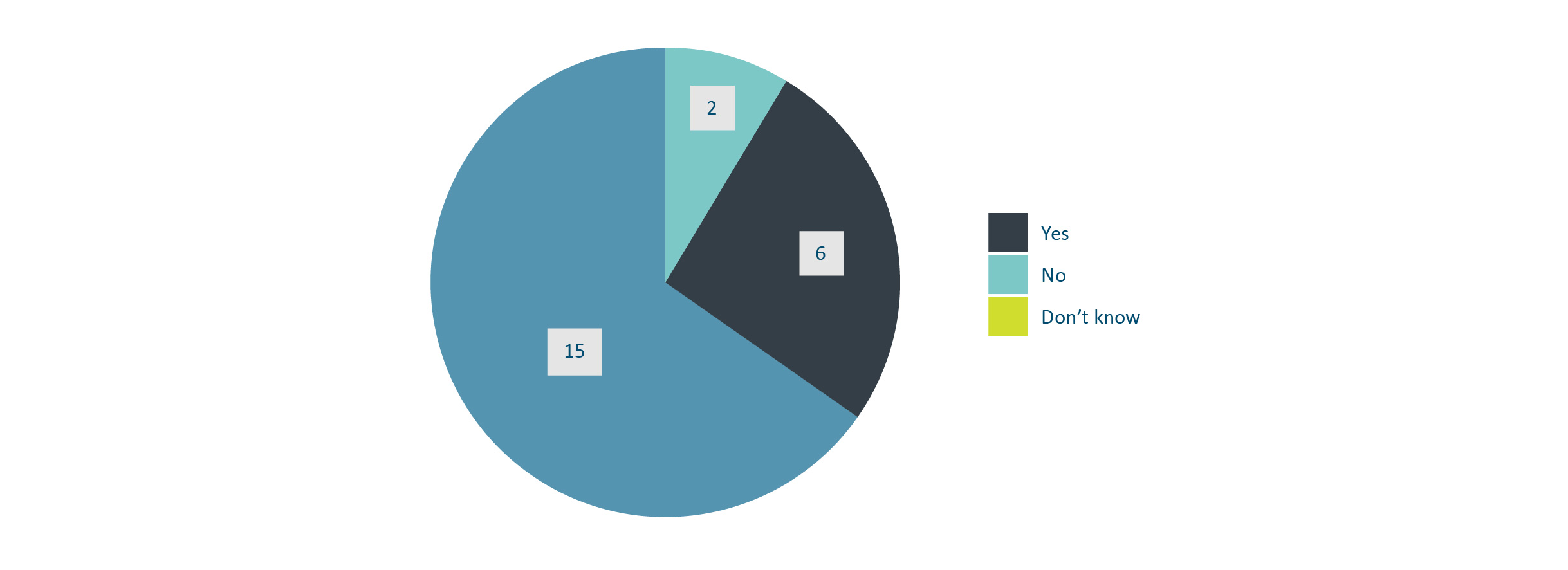
Figure 5 - Text version
| Yes | 6 |
|---|---|
| No | 15 |
| Don’t know | 2 |
Notes
Total organizational responses: 23
“Yes” responses: CanNor, CSC, ESDC, PC, PCH and PPSC.
Team question (Q2.f): How many employees have a reference to Indigenous languages as a requirement and/or skill set in their job description?
Managers were asked to report how many employees who use Indigenous languages in the workplace have a reference to an Indigenous language as a requirement and/or skill set in their job description. Information aggregated per organization is shown in Table 1.
| Responding organizations with employees who use Indigenous languages | Number of employees per organization who use Indigenous languages | Number of employees per organization who have a reference to Indigenous languages in their job description |
|---|---|---|
| CBSA | 7 | 3 |
| CRA | 2 | 0 |
| CanNor | 13 | 0 |
| CSC | 14 | 0 |
| CIRNAC | 36 | 5 |
| ESDC | 19 | 6 |
| DFO | 5 | 0 |
| DND | 1 | 0 |
| IAAC | 6 | 0 |
| ISC | 269 | 17 |
| PC | 29 | 1 |
| PHAC | 1 | 1 |
| PPSC | 30 | 9 |
| PSPC | 20 | 2 |
| RCMP | 3 | 0 |
| VAC | 5 | 0 |
| Total | 460 | 44 |
Organizational question (Q5): How many staffing actions in 2020–21 referenced Indigenous languages and where is the reference in the Statement of Merit Criteria?
Respondents reported that a total of 236,609 staffing actions were undertaken in the 2020–21 fiscal year. Of these staffing actions, 32 contained a reference to an Indigenous language. In five staffing actions, the criteria were reported as an asset qualification. In one instance, a reference to Indigenous languages was included in the title of the position, and in another, the respondent indicated that the reference was not explicitly listed (Table 2).
| Organizations | Total staffing actions in 2020–21 | Staffing actions with reference to an Indigenous language | Where in staffing action an Indigenous language was made |
|---|---|---|---|
| CBSA | 17,123 | 1 | Asset qualification |
| CanNor | 84 | 5 | Asset qualification |
| CRA | 80,912 | 0 | Not applicable |
| CSC | 2,396 | Footnote * | Not applicable |
| CIRNAC | 202 | 0 | Not applicable |
| DFO | 17,791 | 16 | Asset qualification |
| DND | 20,169 | Footnote * | Not applicable |
| ECCC | 6,278 | 3 | Asset qualification |
| ESDC | 30,034 | Footnote * | Not applicable |
| HC | 10,520 | 0 | Not applicable |
| IAAC | 506 | 0 | Not applicable |
| ISC | 568 | 0 | Not applicable |
| NRCan | 3,911 | Footnote * | Not applicable |
| NSIRA | 20 | 0 | Not applicable |
| PC | 370 | 0 | Not applicable |
| PCH | 2,033 | 3 | Position title |
| PHAC | 5,614 | 1 | No explicit reference |
| PPSC | 708 | 3 | Asset qualification |
| PSPC | 25,873 | Footnote * | Not applicable |
| RCMP | Footnote * | 0 | Not applicable |
| StatCan (including SSO) | 5,551 | 0 | Not applicable |
| TC | 3,450 | 0 | Not applicable |
| VAC | 2,496 | 0 | Not applicable |
| Total | 236,609 | 32 | |
Team question (Q3): How many staffing actions in 2020–21 referenced Indigenous languages?
Team managers reported that a total of 23,518 staffing actions were undertaken in the 2020–21 fiscal year (Table 3). Of these staffing actions, 193 included a reference to an Indigenous language. Of the staffing actions that contained a reference to an Indigenous language, 121 can be attributed to teams that reported having employees who use Indigenous languages, and 72 to teams that did not report having employees who use Indigenous languages. Within staffing actions that referenced Indigenous languages, team managers reported the reference 19 times as an asset qualification and twice as an essential qualification. In three instances, the reference appeared in other sections, and in two instances, the reference appeared in the knowledge and skills section.
Please note: Organizational numbers were captured through coding and represent formal staffing actions only. As such, the numbers may not account for regional or team informal expressions of interest for example, which would likely explain the increased numbers reported at the team level.
| Organizations | Total staffing actions in 2020–21 | Staffing actions with reference to an Indigenous language |
|---|---|---|
| CBSA | 1,374 | 59 |
| CanNor | 20 | 6 |
| CRA | 3,815 | 0 |
| CSC | 10 | 1 |
| CIRNAC | 152 | 4 |
| DFO | 286 | 4 |
| DND | 610 | 3 |
| ESDC | 2,470 | 14 |
| IAAC | 41 | 0 |
| ISC | 742 | 97 |
| NRCan | 744 | 0 |
| PC | 1,466 | 1 |
| PCH | 2,194 | 0 |
| PHAC | 1 | 1 |
| PPSC | 78 | Footnote * |
| PSPC | 466 | 2 |
| RCMP | 49 | 0 |
| StatCan | 1,060 | 0 |
| SSO | 3,185 | 0 |
| TC | 92 | 1 |
| VAC | 4,663 | 0 |
| Total | 23,518 | 193 |
Organizational question (Q6): Who in your organization determines the need to recruit employees who can use Indigenous languages?
Organizations’ responses revealed that decisions to recruit employees who can use Indigenous languages are made at all management levels (Figure 6). Several organizations indicated that these decisions can be made at all five levels (Table 4).
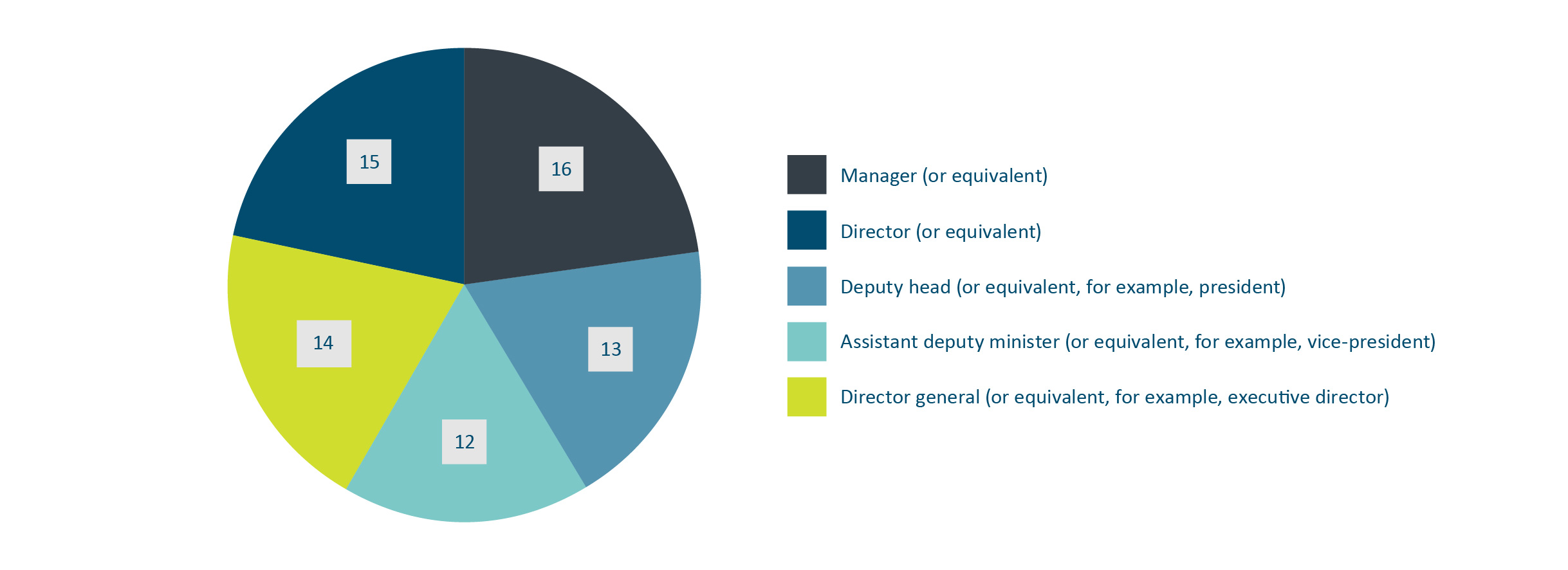
Figure 6 - Text version
| Deputy head (or equivalent, for example, president) | 13 |
|---|---|
| Assistant deputy minister (or equivalent, for example, vice-president) | 12 |
| Director general (or equivalent, for example, executive director) | 14 |
| Director (or equivalent) | 15 |
| Manager (or equivalent) | 16 |
Note
Total organizational responses: 19
| Organizations | Level at which recruitment needs are determined |
|---|---|
| CBSA | All five levels |
| CRA | Director general or director |
| CanNor | Deputy head, assistant deputy minister, director general or director |
| CSC | All five levels |
| CIRNAC | All five levels |
| ESDC | All five levels |
| ECCC | Manager |
| DFO | All five levels |
| HC | All five levelsFootnote * |
| IAAC | No information received |
| ISC | All five levels |
| DND | ManagerFootnote † |
| NSIRA | Deputy head |
| NRCan | All five levels |
| PC | Director or manager |
| PCH | All five levels |
| PPSC | Director general level |
| PSPC | Manager |
| PHAC | All five levelsFootnote ‡ |
| RCMP | Manager |
| StatCan (including SSO) | Director |
| TC | All five levels |
| VAC | No information received |
Informing and serving the public
“The use of Indigenous languages is incredibly important to CanNor and to ensuring a workplace environment that is welcoming of Indigenous employees. It’s key to our ability to recruit and retain employees that are representative of the northern territories that we serve. We need to do more to enhance the use of Indigenous languages in all federal workplaces to help the Government of Canada become truly reflective of the Canadian population.”
Organizational question (Q3): Does your organization inform the public about programs and/or services offered in Indigenous languages?
Ten organizations out of the 22 organizations that responded to this question indicated that they inform the public about programs and/or services offered in Indigenous languages (Figure 7).
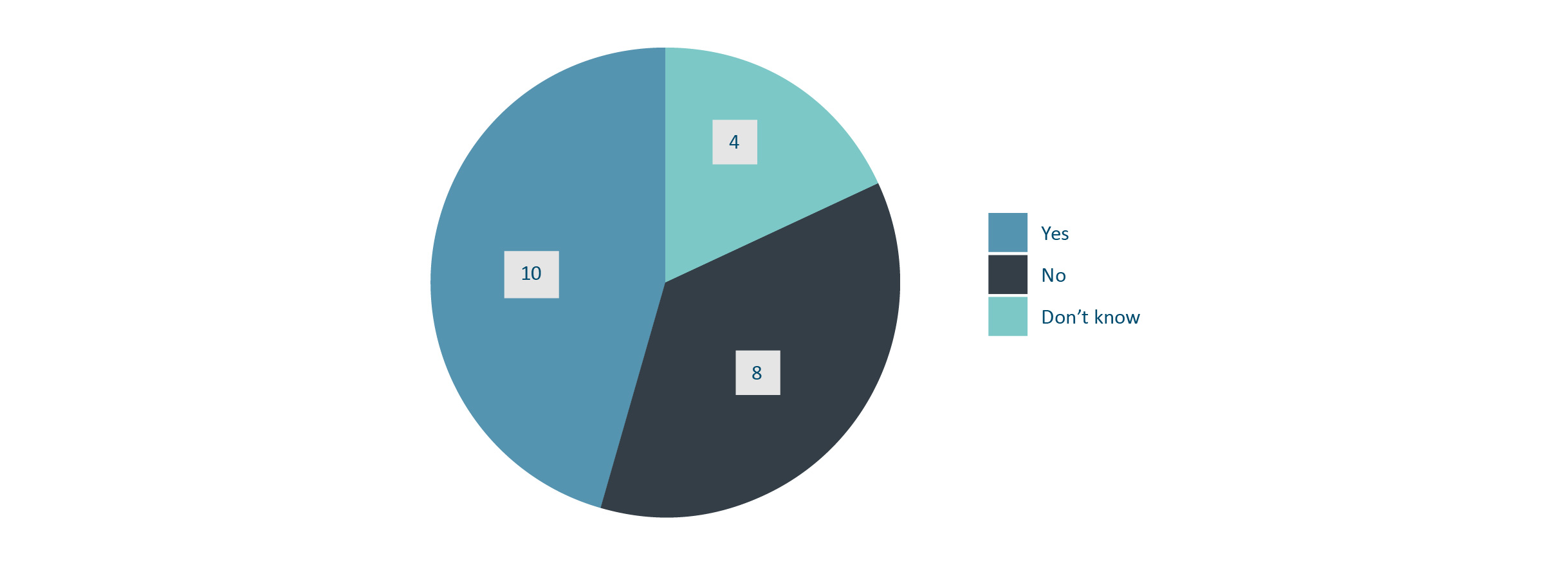
Figure 7 - Text version
| Yes | 10 |
|---|---|
| No | 8 |
| Don’t know | 4 |
Notes
Total organizational responses: 22
“Yes” responses: CRA, CanNor, ECCC, HC, IAAC, NRCan, PC, PHAC, PSPC and StatCan/SSO.
Team question (Q4): Does your team inform the public about programs and/or services offered in Indigenous languages?
A total of 55 team managers out of 898 indicated that their teams inform the public about programs and/or services offered in Indigenous languages (Figure 8).
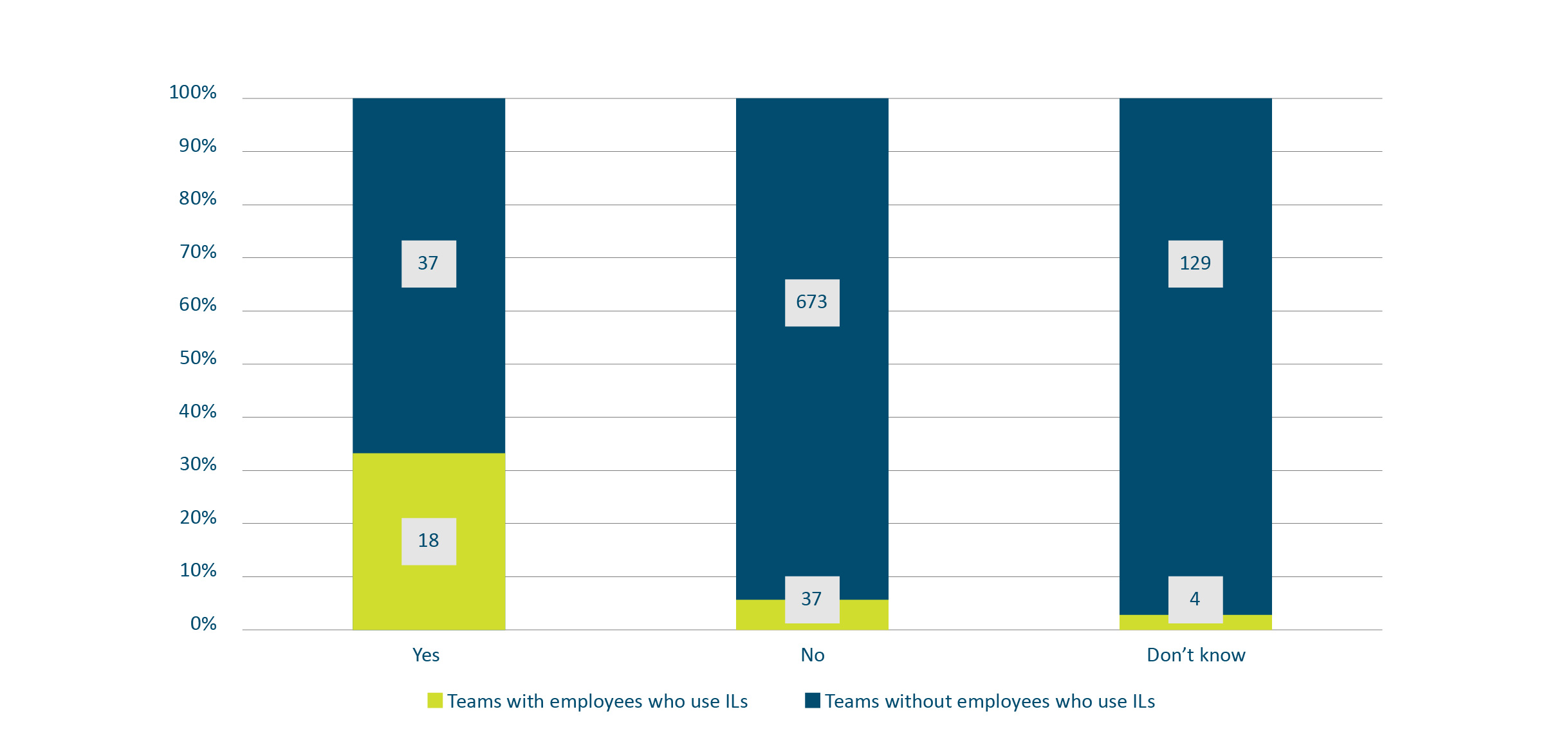
Figure 8 - Text version
| Teams with employees who use Indigenous languages | Teams without employees who use Indigenous languages | |
|---|---|---|
| Yes | 18 | 37 |
| No | 37 | 673 |
| Don’t know | 4 | 129 |
Notes
Total team responses: 898
Breakdown of responses:
- 59 teams with employees who use Indigenous languages
- 839 teams without employees who use Indigenous languages
Team question (Q5): Has your team been asked to provide information or services in Indigenous languages?
A total of 68 team managers indicated that they have received requests for information or services in Indigenous languages from Indigenous governments, communities, organizations, clients, citizens and/or other sources (Figure 9).
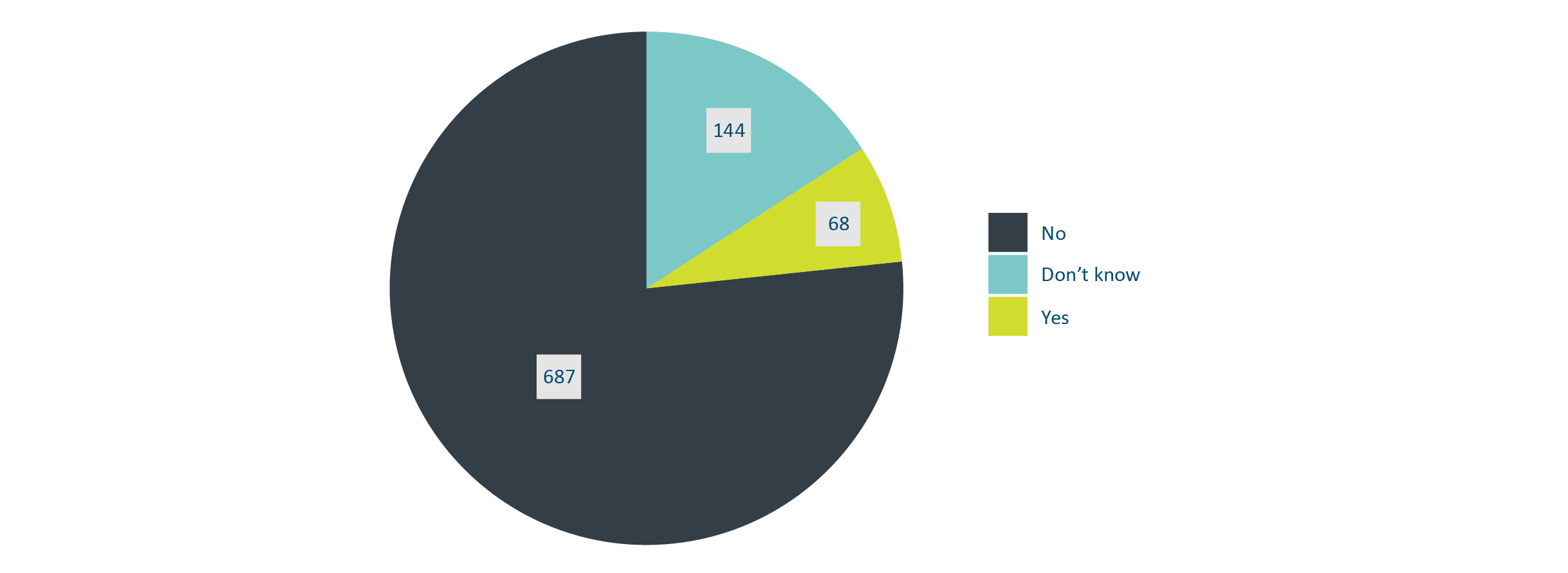
Figure 9 - Text version
| Teams with employees who use Indigenous languages | Teams without employees who use Indigenous languages | |
|---|---|---|
| Yes | 24 | 44 |
| No | 29 | 658 |
| Don’t know | 6 | 137 |
Notes
Total team responses: 899
Breakdown of responses:
- 59 teams with employees who use Indigenous languages
- 839 teams without employees who use Indigenous languages
Team question (Q6): Does your team obtain services in any Indigenous languages from organizations or individuals outside of your team?
A total of 132 team managers indicated that their teams obtained services in Indigenous languages from organizations or individuals outside of their teams (Figure 10).
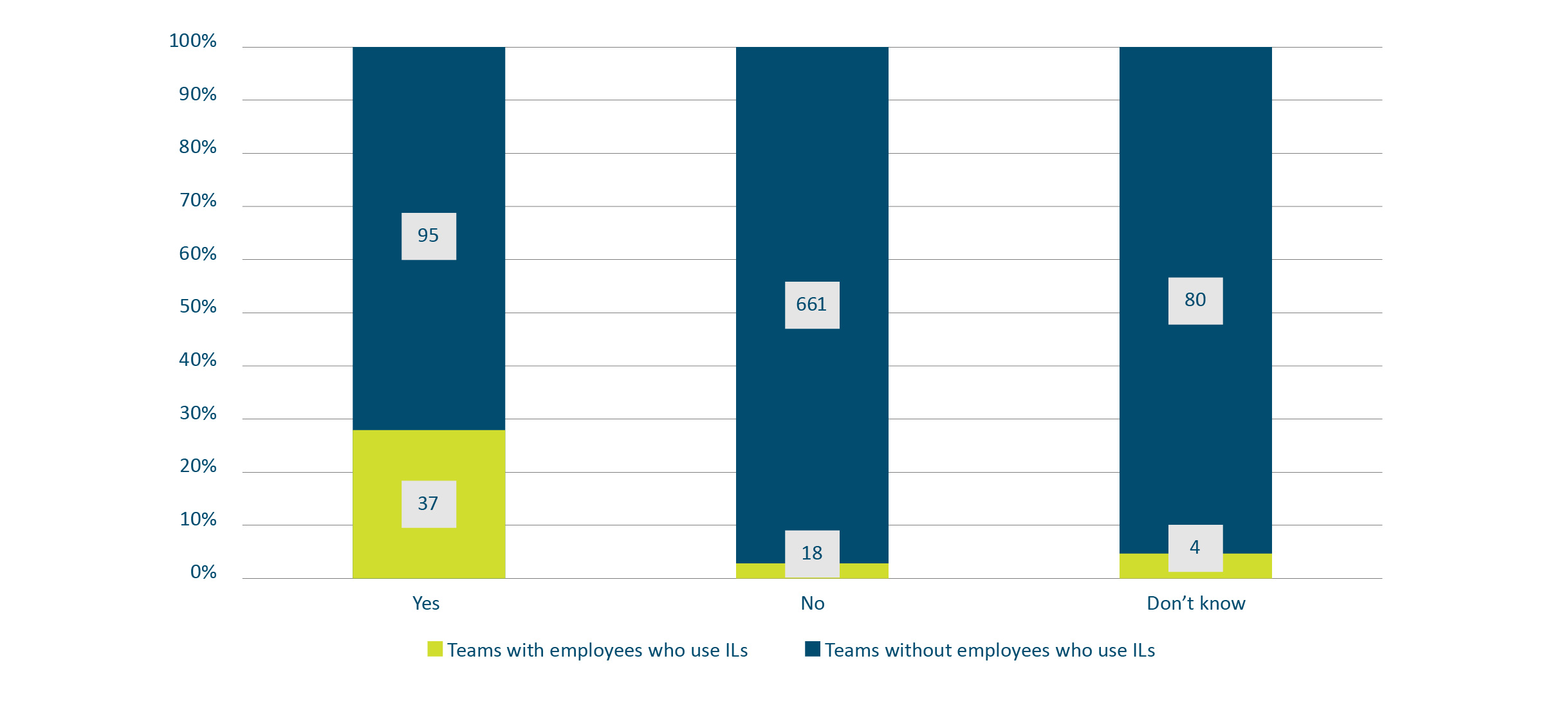
Figure 10 - Text version
| Teams with employees who use Indigenous languages | Teams without employees who use Indigenous languages | |
|---|---|---|
| Yes | 37 | 95 |
| No | 18 | 661 |
| Don’t know | 4 | 80 |
Notes
Total team responses: 896
Breakdown of responses:
- 59 teams with employees who use Indigenous languages
- 839 teams without employees who use Indigenous languages
Team question (Q6b): If your team obtains services in any Indigenous language from organizations or individuals outside of your team, from where are the services obtained?
Team managers who indicated that their teams obtained services in Indigenous languages were asked to indicate where the services were obtained. Services obtained from outside of the federal government was the most cited response option (Figure 11).
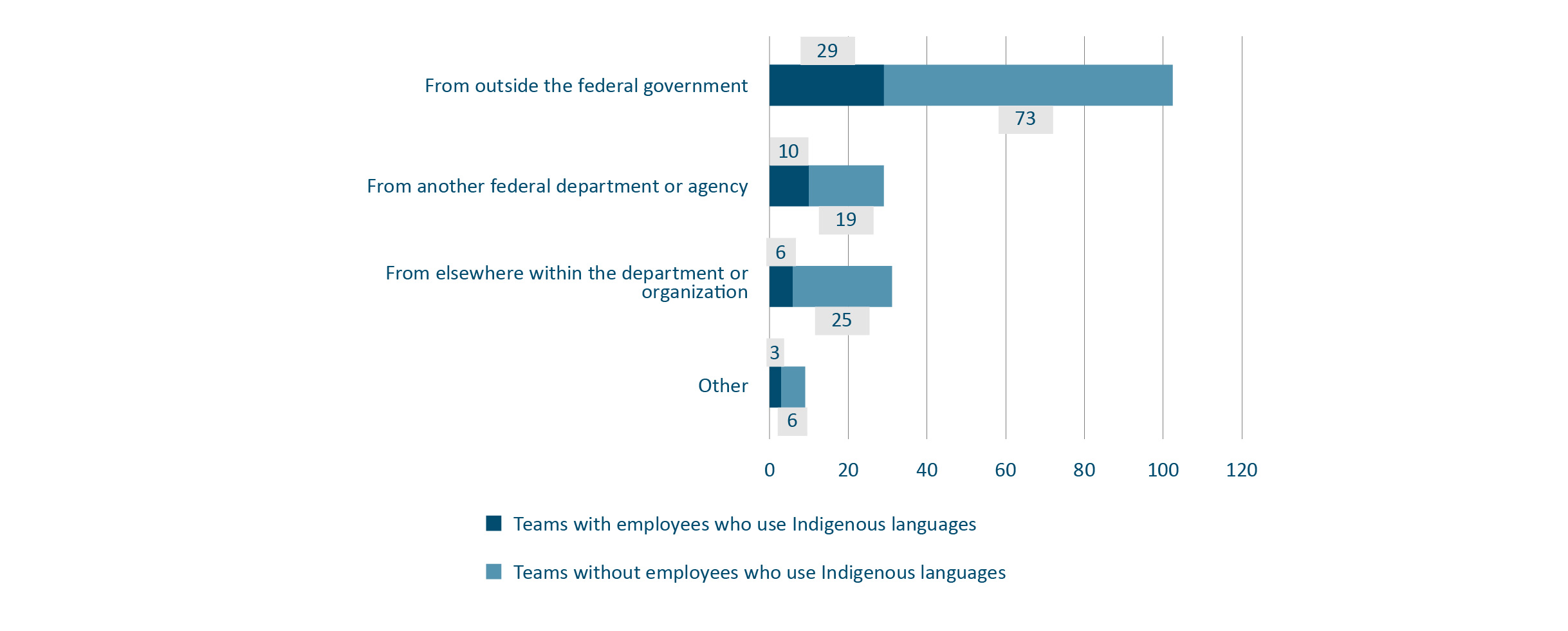
Figure 11 - Text version
| Teams with employees who use Indigenous languages | Teams without employees who use Indigenous languages | |
|---|---|---|
| Other | 3 | 6 |
| From elsewhere within the department or organization | 6 | 25 |
| From another federal department or agency | 10 | 19 |
| From outside the federal government | 29 | 73 |
Note
Teams were invited to select all responses that applied to their situation.
Supporting Indigenous language learning
Organizational question (Q7): Does your organization support Indigenous language learning opportunities for employees?
Nine organizations indicated that they currently support Indigenous language learning opportunities for employees, and one indicated that it is planning to do so in the future (Figure 12).
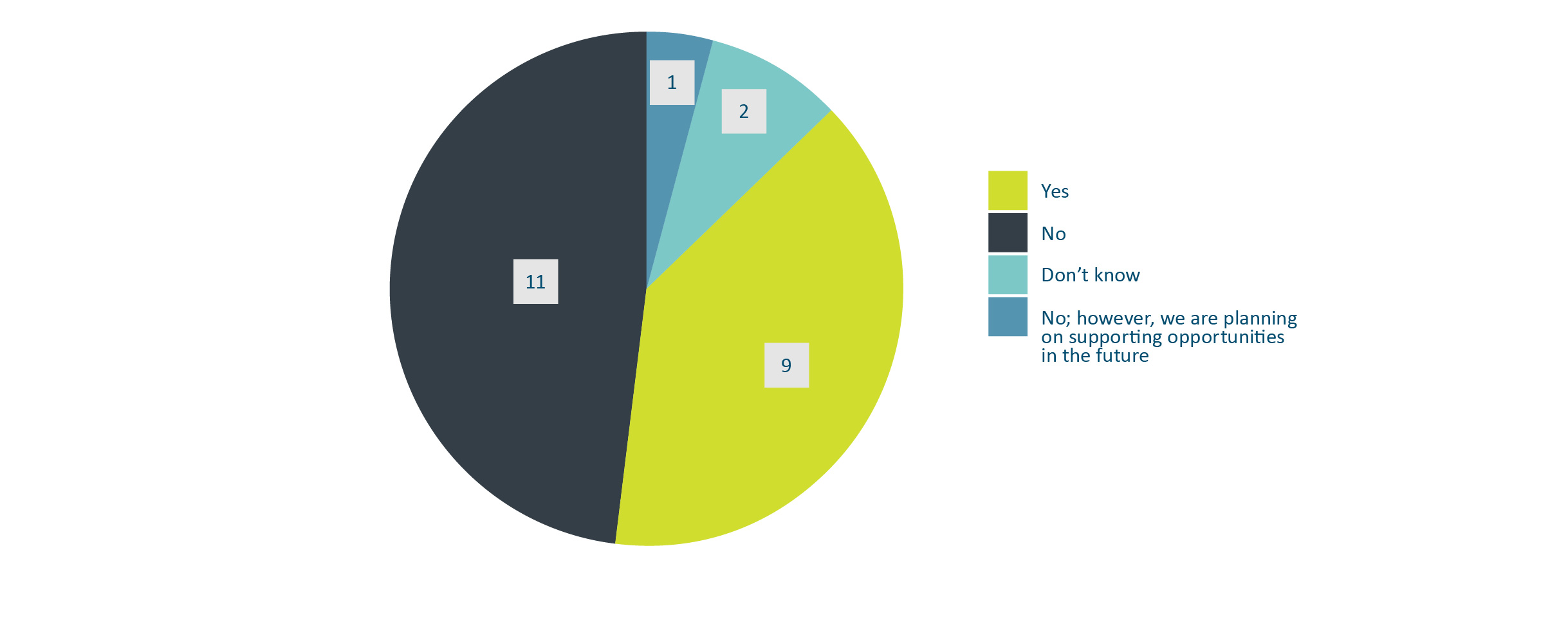
Figure 12 - Text version
| Yes | 9 |
|---|---|
| No | 11 |
| No; however, we are planning on supporting opportunities in the future | 1 |
| Don’t know | 2 |
Notes
Total organizational responses: 23
“Yes” responses: CIRNAC, ISC, DND, ESDC, DFO, CanNor, ECCC, PC and PPSC.
Team question (Q7): Does your team support Indigenous language learning opportunities for employees?
A total of 163 teams indicated that they currently support Indigenous language learning opportunities for employees, and 28 indicated that they are planning to do so in the future (Figure 13).
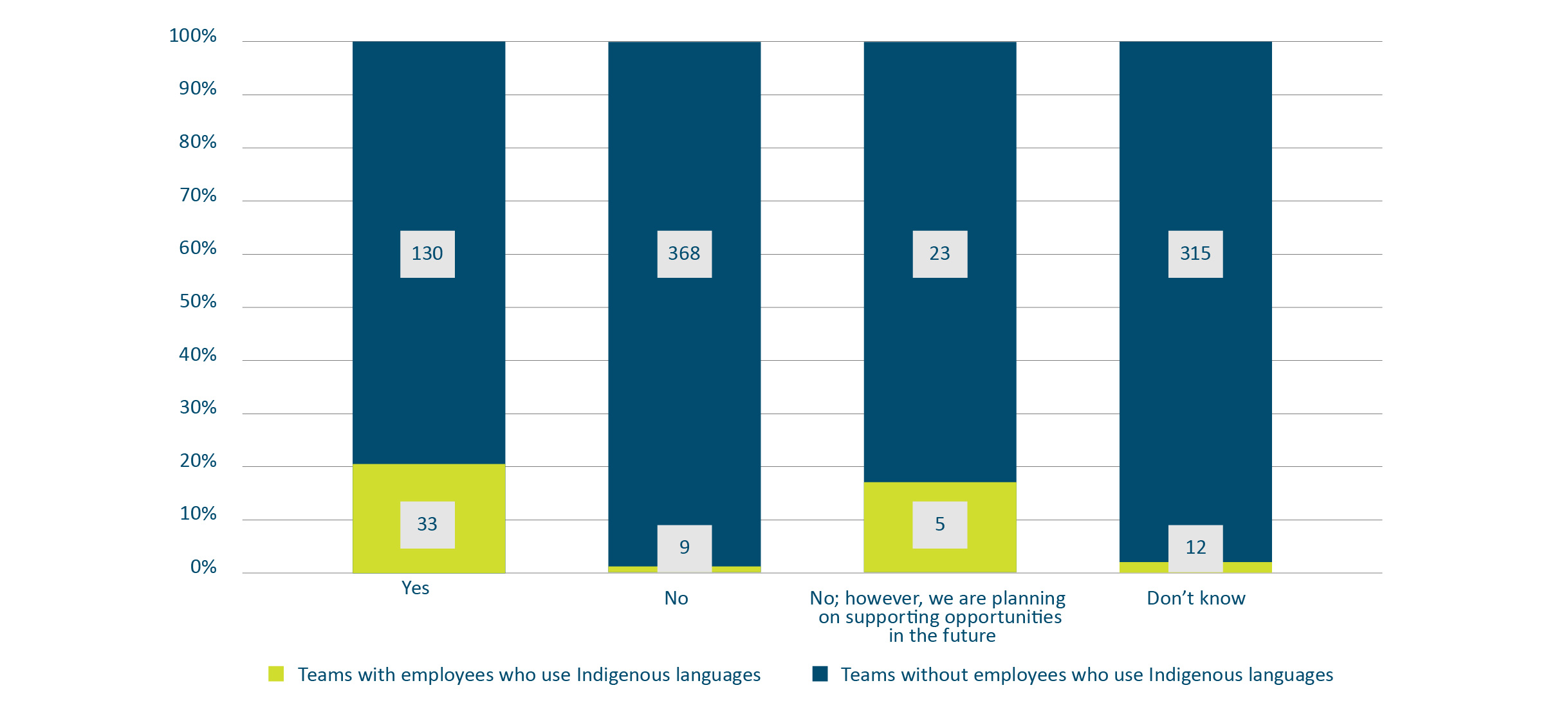
Figure 13 - Text version
- For teams without employees who use Indigenous languages:
- 130 teams said no
- 368 teams said yes
- 23 teams said no, but plan to do so in the future
- 315 teams said they did not know
- For teams with employees who use Indigenous languages:
- 33 teams said no
- 9 teams said yes
- 5 teams said no, but plan to do so in the future
- 12 teams said they did not know
Notes
Total team responses: 895
Breakdown of responses:
- 59 teams with employees who use Indigenous languages
- 839 teams without employees who use Indigenous languages
Team question (Q7.b): If your team supports Indigenous language learning opportunities for employees, which types?
The most reported types of learning opportunities were those offered in the workplace by a knowledgeable speaker who is not a federal public service employee, followed by online learning tools and informal sessions offered by an employee in the workplace (Figure 14).
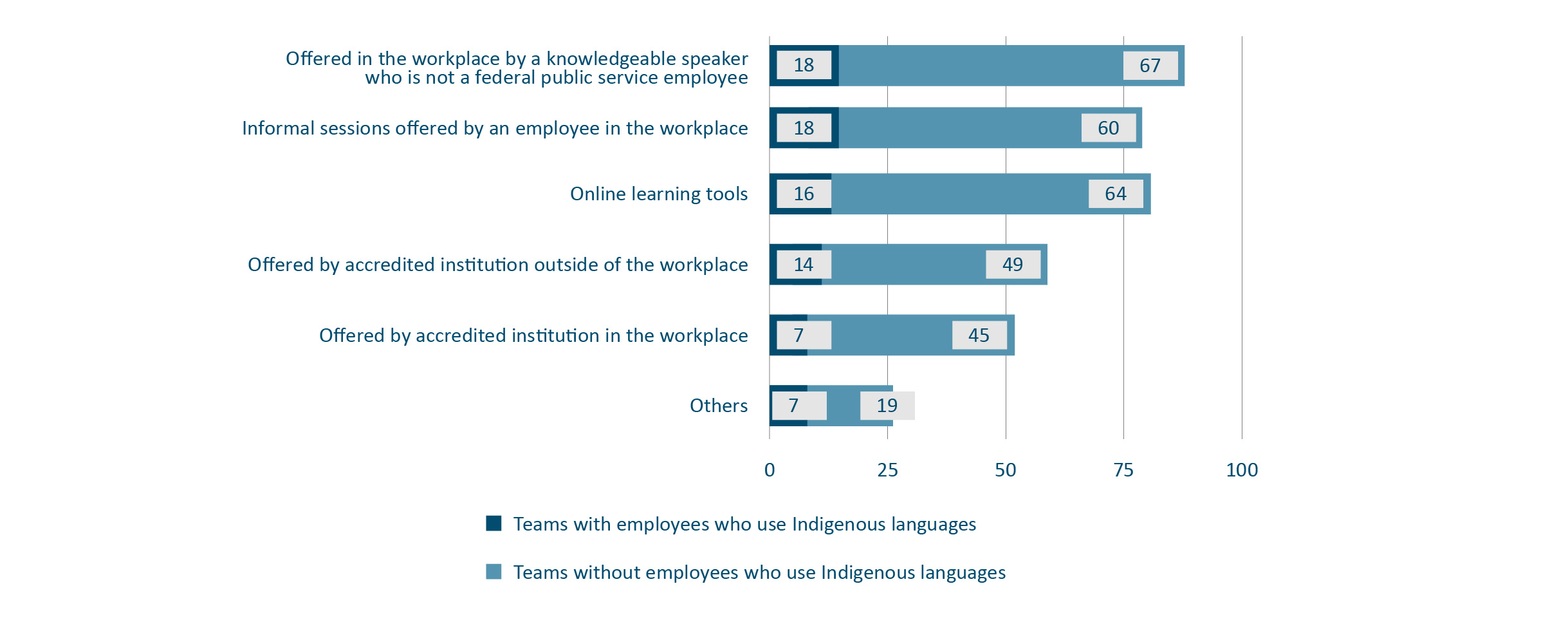
Figure 14 - Text version
| Teams with employees who use Indigenous languages | Teams without employees who use Indigenous languages | |
|---|---|---|
| Others | 7 | 19 |
| Offered by accredited institution in the workplace | 7 | 45 |
| Offered by accredited institution outside of the workplace | 14 | 49 |
| Online learning tools | 16 | 64 |
| Informal sessions offered by an employee in the workplace | 18 | 60 |
| Offered in the workplace by a knowledgeable speaker who is not a federal public service employee | 18 | 67 |
Note
Teams were invited to select all the responses that applied to their situation.
Employees who use Indigenous languages in the workplace
Team question: Does your team have one or more employees who use Indigenous languages in the workplace?
A total of 59 managers from 16 organizations reported having employees in their teams who use Indigenous languages in the workplace. Of the 16 organizations, nine organizations had more than one team with employees who use Indigenous languages (Figure 15).
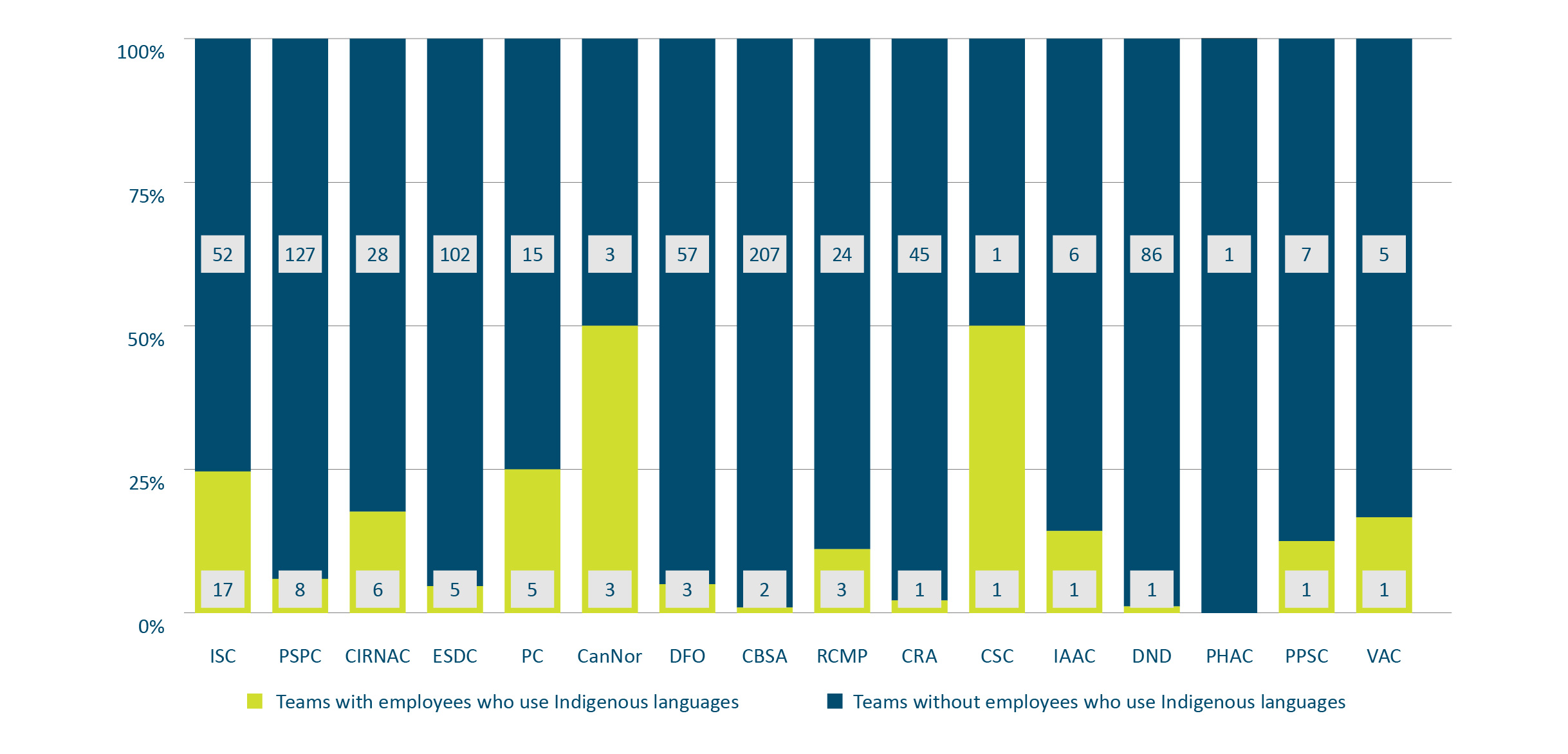
Figure 15 - Text version
| Teams with employees who use Indigenous languages | Teams without employees who use Indigenous languages | |
|---|---|---|
| ISC | 17 | 52 |
| PSPC | 8 | 127 |
| CIRNAC | 6 | 28 |
| ESDC | 5 | 102 |
| PC | 5 | 15 |
| CanNor | 3 | 3 |
| DFO | 3 | 57 |
| CBSA | 2 | 207 |
| RCMP | 3 | 24 |
| CRA | 1 | 45 |
| CSC | 1 | 1 |
| IAAC | 1 | 6 |
| DND | 1 | 86 |
| PHAC | 1 | 0 |
| PPSC | 1 | 7 |
| VAC | 1 | 5 |
Notes
Total team responses: 903
The following seven organizations indicated having one team with employees who use Indigenous languages: CRA, CSC, IAAC, DND, PHAC, PPSC and VAC. These seven organizations are not portrayed in this figure.
Team question (Q2a): How many employees in your team use Indigenous languages in the workplace?
Team managers reported a total of 460 employees who use Indigenous languages in the workplace. These employees work within 16 federal organizations (Figure 16) in nine provinces and territories. It is important to note that these results only represent the teams whose managers submitted questionnaires and responded to the corresponding question. Furthermore, organizational structure may influence these results (for example, a team located in one province might provide services to communities in another province or territory).
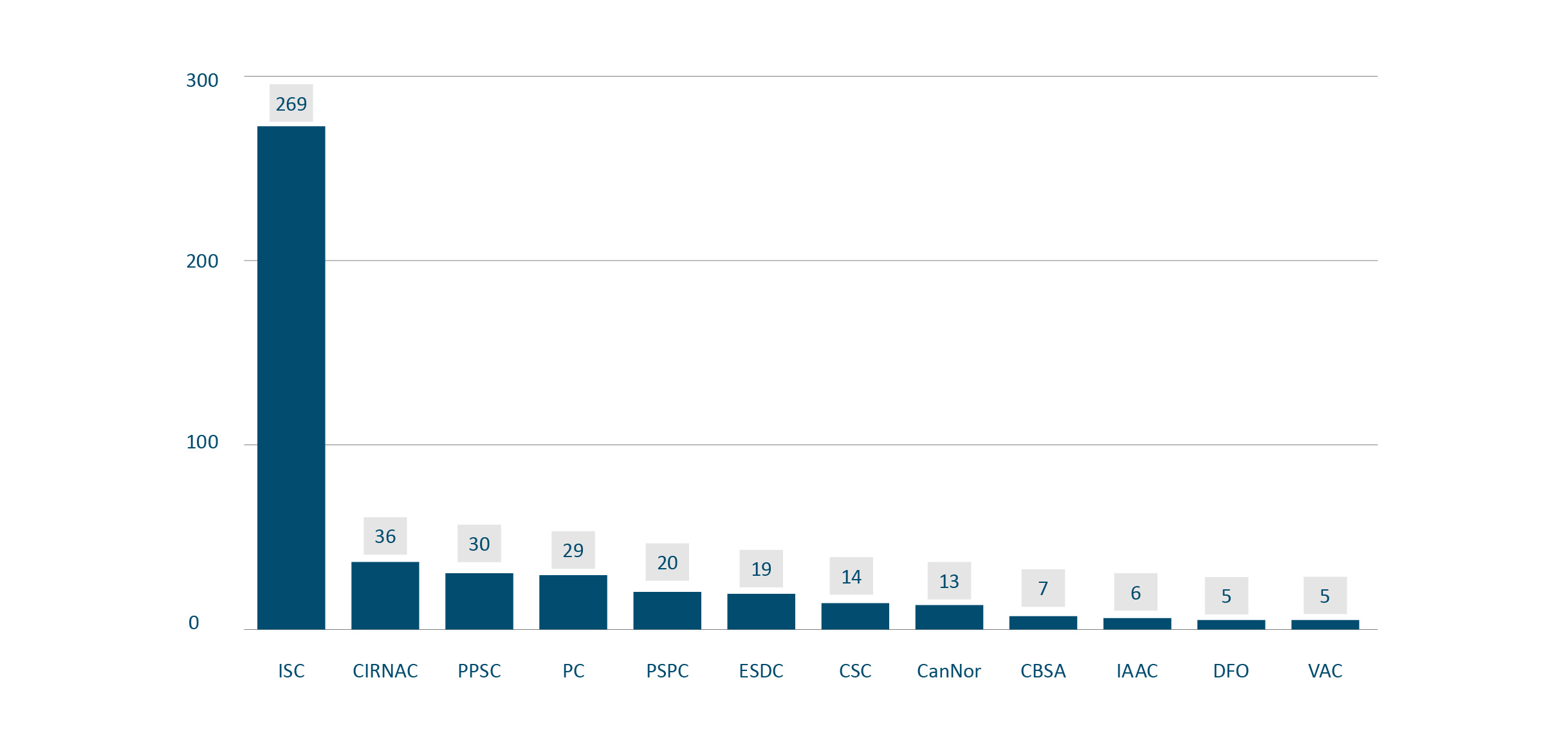
Figure 16 - Text version
| ISC | 269 |
|---|---|
| CIRNAC | 36 |
| PPSC | 30 |
| PC | 29 |
| PSPC | 20 |
| ESDC | 19 |
| CSC | 14 |
| CanNor | 13 |
| CBSA | 7 |
| IAAC | 6 |
| DFO | 5 |
| VAC | 5 |
Notes
Total organization responses: 59
The following organizations each reported fewer than five employees who use Indigenous languages in the workplace: RCMP (3), CRA (2), DND (1) and PHAC (1).
According to the responses from managers, 59 teams included 460 employees who use Indigenous languages in the workplace.
Using Indigenous languages in the workplace
Team question (Q2c): What Indigenous languages do public service employees use?
There is a rich diversity of First Nation, Inuit and Métis languages in Canada. For this question, respondents were provided with a list of languages based on the 2016 classification of Indigenous languages by StatCan. However, the Committee recognized that this list is not exhaustive and that the names or spellings of the Indigenous languages presented may not be those that are commonly used or recognized by Indigenous communities. Respondents were therefore invited to indicate languages that were not included on the list. The Committee extends its gratitude to respondents for contributing to a better understanding of the Indigenous languages used in the federal public service.
Team managers identified the following Indigenous languages used by employees in the workplace:
- Algonquin (16)
- Atikamekw (1)
- Babine (Wet’suwet’en) (1)
- Blackfoot (1)
- Carrier (1)
- Cayuga (4)
- Chilcotin (2)
- Comox (1)
- Dene (4)
- Dogrib (Tlicho) (1)
- Gitxsan (Gitksan) (2)
- Haida (2)
- Halkomelem (1)
- Heiltsuk (1)
- Inuinnaqtun (Inuvialuktun) (2)
- Inuktitut (16)
- Kwakiutl (Kwak’wala) (3)
- Lillooet (1)
- Malecite (1)
- Mi’kmaq (9)
- Michif (6)
- Mohawk (11)
- Nisga’a (1)
- Nuu-chah-nulth (Nootka) (1)
- Ojibway (6)
- Oji-Cree (6)
- Okanagan (2)
- Other (8)
- Plains Cree (4)
- Sekani (1)
- Shuswap (Secwepemctsin) (2)
- Squamish (1)
- Swampy Cree (2)
- Tahltan (1)
- Tlingit (1)
- Woods Cree (3)
Note: Team managers were invited to select all responses that applied to their situation.
Context of Indigenous language use
Team question (Q2d): In what context do public service employees use Indigenous languages?
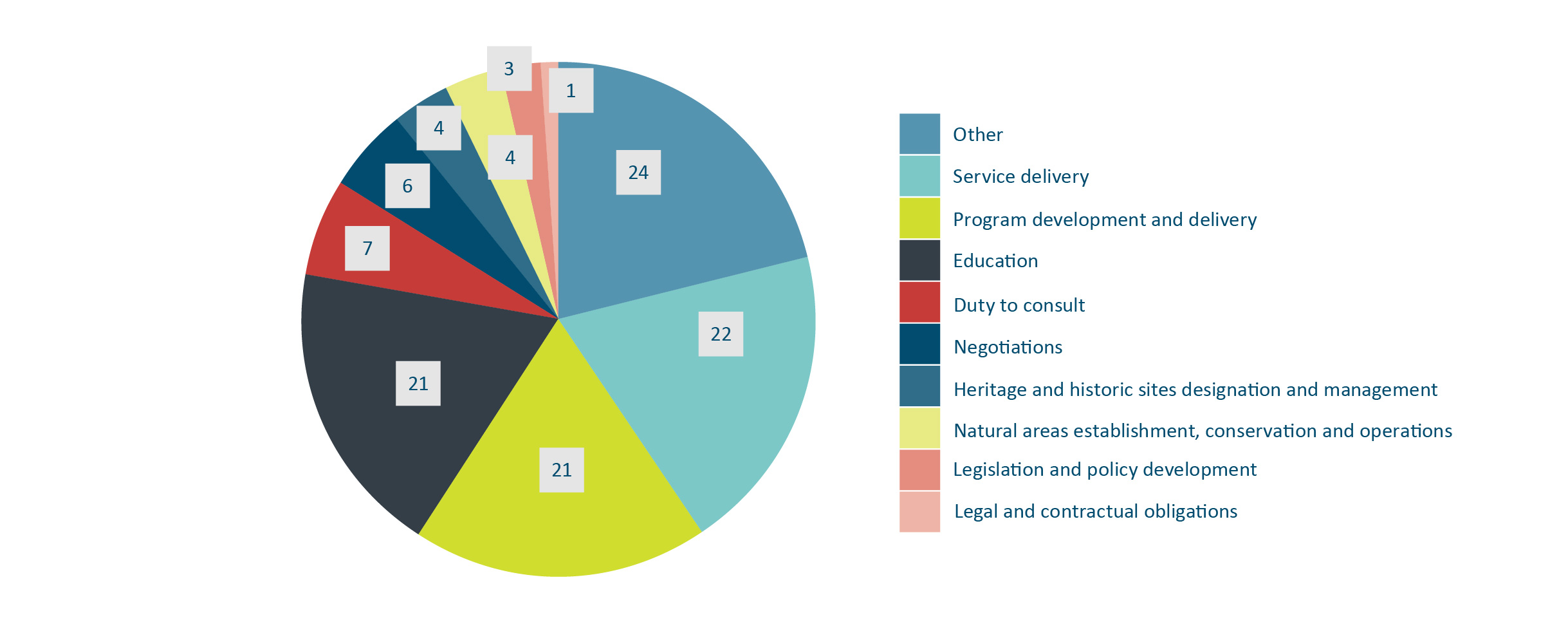
Figure 17 - Text version
| Other | 24 |
|---|---|
| Service delivery | 22 |
| Program development and delivery | 21 |
| Education | 21 |
| Duty to consult | 7 |
| Negotiations | 6 |
| Heritage and historic sites designation and management | 4 |
| Natural areas establishment, conservation and operations | 4 |
| Legislation and policy development | 3 |
| Legal or contractual obligations | 1 |
Notes
The “Other” category accounted for almost one quarter of responses. Examples of other contexts reported included (in no particular order): ceremony and cultural events, Indigenous recruitment, engagement, internal meetings, communications and outreach, information discussions among employees, and networking.
Team managers were invited to select all responses that applied to their situation.
“Language is part of reconciliation.
When we use Indigenous language within our public buildings that are open to the public, we are showing that Indigenous peoples and culture is important. This helps us create a space that is welcoming and feels safer in the sense that we are acknowledging Indigenous people and are turning our backs on ideologies of the federal governments of our past that broke the relationship with Indigenous people.”
Team question (Q2e): For which types of activities do public service employees use Indigenous languages?
Team managers reported the following activities for which employees use Indigenous languages (Figure 18). Numbers represent the frequency of which each activity was reported by managers who were invited to select all applicable responses.
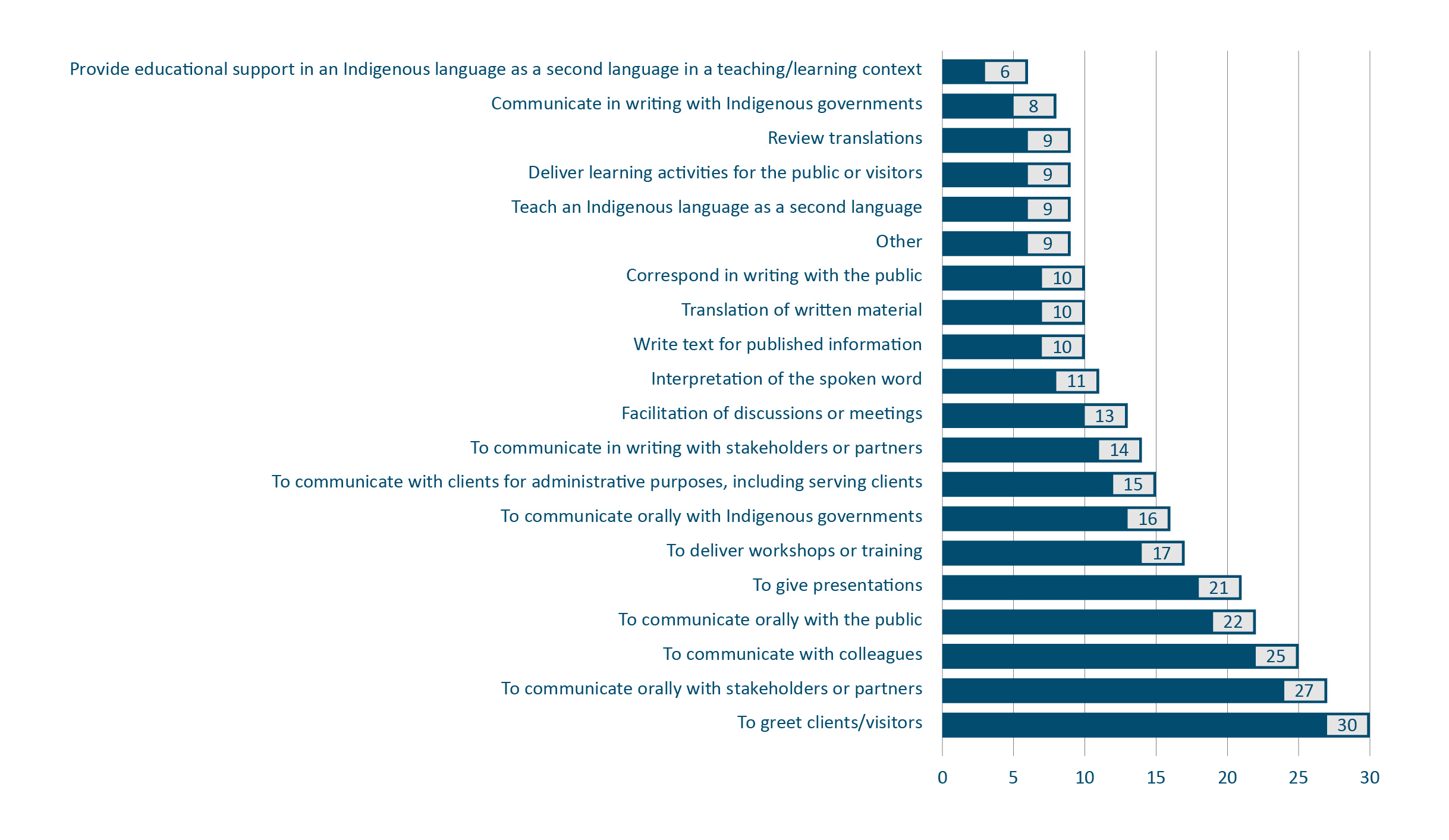
Figure 18 - Text version
| Provide educational support in an Indigenous language as a second language in a teaching/learning context | 6 |
|---|---|
| Communicate in writing with Indigenous governments | 8 |
| Review translations | 9 |
| Deliver learning activities for the public or visitors | 9 |
| Teach an Indigenous language as a second language | 9 |
| Other | 9 |
| Correspond in writing with the public | 10 |
| Translation of written material | 10 |
| Write text for published information | 10 |
| Interpretation of the spoken word | 11 |
| Facilitation of discussions or meetings | 13 |
| To communicate in writing with stakeholders or partners | 14 |
| To communicate with clients for administrative purposes, including serving clients | 15 |
| To communicate orally with Indigenous governments | 16 |
| To deliver workshops or training | 17 |
| To give presentations | 21 |
| To communicate orally with the public | 22 |
| To communicate with colleagues | 25 |
| To communicate orally with stakeholders or partners | 27 |
| To greet clients/visitors | 30 |
Notes
According to the responses from managers, 59 teams included 460 employees who use Indigenous languages in the workplace.
The following activities were reported five times or less:
- design Indigenous second language education curriculum (5)
- communicate with students, parents or guardians for administrative purposes (5)
- deliver Indigenous second language education curriculum (for example, professional development training) (4)
- Indigenous language instruction (other than in a formal school setting) (4)
- conduct research (3)
- teach an Indigenous language in an Indigenous language immersion program (3)
- provide educational support in an Indigenous language immersion program context (3)
- design Indigenous language immersion education curriculum (3)
- deliver Indigenous language immersion education curriculum (3)
“Each day the announcements begin in Mohawk, along with an opening. Our traditional values are reviewed monthly, both as a school and in the classrooms. Outdoor learning is a large part of our programming, as the language and culture are intertwined, and are more fulsome when taught in tandem. Teachers and support staff are encouraged to take additional qualifications centred on the language.”
Part III
Indigenous language use in the PA, EB and PC occupational groups
As per the three MOUs that were signed at the PA, EB and PC bargaining tables, the parties agreed to review the use of Indigenous languages in the public service, examine Indigenous language skills in the performance of employee duties, and consider the advantages that Indigenous language speakers bring to the public service.
Because employees were not surveyed directly, it was not possible to collect data that could be tied to individual employees based on their classification. Despite this, the responses indicate the minimum number of employees in the participating bargaining units who use Indigenous languages in the workplace.
Team-level questionnaire responses show that some teams are composed of members of a single bargaining unit (for example, only PA members), and some comprise a blend of bargaining unit members and, in some cases, non-represented employees. As a result, the Committee is able to present the number of employees who use Indigenous languages in the PA, EB and PC bargaining units as a range. The minimum of this range represents the possible lowest number of employees who use Indigenous languages in a given bargaining unit, and the maximum represents the upper limit of employees who may use Indigenous languages in a bargaining unit, given that they were reported in teams that are blended. For example, a manager at ISC reported having a team located on the territory of the Six Nations of the Grand River that comprises a blend of PA and EB members. Thirty-eight members of this team were reported to use Indigenous languages in the workplace. Since the team was reported as a blend, it is not possible for the Committee to determine how many of these 38 language users belong to the PA group compared to the EB group.
Tables 5a to 5h report on data collected with precise numbers, but, again, it is important to note that it does not provide a comprehensive analysis of the use of Indigenous languages by all federal public service employees; rather, the responses that were provided by the organizations that were surveyed.
Tables 5a to 5g: summary tables – results for the PA, EB and PC occupational groups
In the following tables, note that no definition of “team” was provided in the questionnaire; therefore, this term was open to interpretation by respondents.
Four responses (representing six employees) were omitted from the tables below because the classification and bargaining unit membership of the employees was not clear.
The total number of responses varies slightly because some managers left some questions blank.
| Department | Province or territory | Location of responding teams or rolled-up teams | Total number of employees per team or rolled-up teams | Number within a given team or rolled-up team who use Indigenous languages | Percentage who uses Indigenous languages |
|---|---|---|---|---|---|
| Parks Canada | Nova Scotia |
Atlantic Region |
142 | 10 | 7% |
British Columbia |
Western |
205 | 10 | 5% | |
British Columbia |
Haida Gwaii |
10 | 7 | 70% | |
Ontario |
Northern Ontario |
45 | 1 | 2% | |
Manitoba |
Riding Mountain National Park |
215 | 1 | 0% | |
Subtotal |
617 | 29 | Not applicable |
||
| Department | Province or territory | Location of responding teams or rolled-up teams | Total number of employees per team or rolled-up teams | Number within a given team or rolled-up team who use Indigenous languages | Percentage who uses Indigenous languages |
|---|---|---|---|---|---|
| Veterans Affairs Canada | Ontario |
Ontario |
200 | 5 | 3% |
| Royal Canadian Mounted Police | Saskatchewan |
North |
21 | 2 | 10% |
| Public Services and Procurement Canada | Quebec |
National |
500 | 4 | 1% |
Nunavut |
Western |
5 | 2 | 40% | |
Ontario |
National Capital Region |
6 | 1 | 17% | |
Quebec |
National Capital Region |
7 | 1 | 14% | |
Ontario |
Ottawa |
4 | 1 | 25% | |
| Public Prosecution Service of Canada | Nunavut |
Nunavut Regional Office |
45 | 30 | 67% |
| National Defence (includes Canadian Rangers) | British Columbia |
National |
7 | 1 | 14% |
| Indigenous Services Canada | British Columbia |
British Columbia |
300 | 60 | 20% |
British Columbia |
British Columbia |
48 | 3 | 6% | |
New Brunswick |
Atlantic |
6 | 2 | 33% | |
British Columbia |
British Columbia |
40 | 2 | 5% | |
Saskatchewan |
Saskatchewan |
7 | 1 | 14% | |
| Fisheries and Oceans Canada (includes Canadian Coast Guard) | British Columbia |
Pacific |
8 | 2 | 25% |
British Columbia |
Interior |
7 | 2 | 29% | |
| Employment and Social Development Canada (includes Labour Canada and Service Canada) | Nunavut |
All of Nunavut |
7 | 6 | 86% |
National |
National |
125 | 5 | 4% | |
Quebec |
Laurentides / Abitibi-Témiscamingue / Outaouais / Nord du Québec |
117 | 4 | 3% | |
Manitoba |
Western and Territories Region |
12 | 1 | 8% | |
| Crown-Indigenous Relations and Northern Affairs Canada | Nunavut |
Nunavut |
17 | 6 | 35% |
Nunavut |
Nunavut |
5 | 4 | 80% | |
Nunavut |
Nunavut |
6 | 1 | 17% | |
| Correctional Service Canada | British Columbia |
Pacific |
60 | 14 | 23% |
| Canadian Northern Economic Development Agency (includes Pilimmaksaivik) | Nunavut |
Nunavut |
14 | 6 | 43% |
Nunavut |
Nunavut |
4 | 2 | 50% | |
Subtotal |
1,578 | 168 | Not applicable |
||
| Department | Province or territory | Location of responding teams or rolled-up teams | Total number of employees per team or rolled-up teams | Number within a given team or rolled-up team who use Indigenous languages | Percentage who uses Indigenous languages |
|---|---|---|---|---|---|
| Indigenous Services Canada | Ontario |
Education |
12 | 12 | 100% |
Ontario |
South |
35 | 9 | 26% | |
Ontario |
Ontario |
30 | 4 | 13% | |
| Crown-Indigenous Relations and Northern Affairs Canada | Ontario |
Tyendinaga |
22 | 22 | 100% |
Subtotal |
99 | 47 | Not applicable |
||
| Department | Province or territory | Location of responding teams or rolled-up teams | Total number of employees per team or rolled-up teams | Number within a given team or rolled-up team who use Indigenous languages | Percentage who uses Indigenous languages |
|---|---|---|---|---|---|
| Indigenous Services Canada | Ontario |
Six Nations |
38 | 38 | 100% |
Ontario |
Ontario Region Federal Schools |
23 | 22 | 96% | |
Alberta |
Alberta |
26 | 13 | 50% | |
Subtotal |
100 | 6 | Not applicable |
||
| Department | Province or territory | Location of responding teams or rolled-up teams | Total number of employees per team or rolled-up teams | Number within a given team or rolled-up team who use Indigenous languages | Percentage who uses Indigenous languages |
|---|---|---|---|---|---|
| Public Services and Procurement Canada | British Columbia |
National |
100 | 6 | 6% |
Subtotal |
100 | 6 | Not applicable |
||
| Department | Province or territory | Location of responding teams or rolled-up teams | Total number of employees per team or rolled-up teams | Number within a given team or rolled-up team who use Indigenous languages | Percentage who uses Indigenous languages |
|---|---|---|---|---|---|
| Indigenous Services Canada | Manitoba |
Manitoba |
90 | 75 | 83% |
| Crown-Indigenous Relations and Northern Affairs Canada | Quebec |
Quebec |
25 | 2 | 8% |
| Canadian Northern Economic Development Agency (includes Pilimmaksaivik) | Nunavut |
Nunavut, Northwest Territories, Yukon, National Capital Region |
8 | 5 | 63% |
Subtotal |
123 | 82 | Not applicable |
||
| Department | Province or territory | Location of responding teams or rolled-up teams | Total number of employees per team or rolled-up teams | Number within a given team or rolled-up team who use Indigenous languages | Percentage who uses Indigenous languages |
|---|---|---|---|---|---|
| Royal Canadian Mounted Police | Ontario |
East |
1 | 1 | 100% |
| Public Services and Procurement Canada | Quebec |
National Capital Region |
12 | 1 | 8% |
Ontario |
All |
6 | 4 | 67% | |
| Public Health Agency of Canada | Saskatchewan |
No information received |
No information received |
1 | No information received |
| Indigenous Services Canada | No information received |
No information received |
80 | 15 | 19% |
Ontario |
National Headquarters |
21 | 5 | 24% | |
Ontario |
No information received |
11 | 3 | 27% | |
Saskatchewan |
No information received |
11 | 2 | 18% | |
| Impact Assessment Agency of Canada | Ontario |
National |
26 | 6 | 23% |
| Fisheries and Oceans Canada (includes Canadian Coast Guard) | Nova Scotia |
Maritimes |
12 | 1 | 8% |
| Crown-Indigenous Relations and Northern Affairs Canada | Quebec |
National Capital Region |
3 | 1 | 33% |
| Canada Revenue Agency | Quebec |
Mauricie |
14 | 2 | 14% |
| Canada Border Services Agency | Ontario |
National |
8 | 6 | 75% |
No information received |
No information received |
2 | 1 | 50% | |
Subtotal |
207 | 49 | Not applicable |
||
| Total number of employees per team or rolled-up teams | Number within a given team or rolled-up team who use Indigenous languages | |
|---|---|---|
| Grand total | 2,811 | 454 |
Results for Program and Administration Services (PA)
PA Bargaining Unit Members who speak Indigenous languages in the workplace were reported in the following classifications:
- AS: Administrative Services
- CR: Clerical and Regulatory
- IS: Information Services
- PM: Program Administration
- ST: Secretarial, Stenographic and Typing
- WP: Welfare Programs
Of the responding teams, between 168 and 329 PA members use Indigenous languages in the workplace.
Results for Education and Library Sciences (EB)
EB Bargaining Unit Members who speak Indigenous languages in the workplace were reported in the following classifications:
- ED-EDS: Education Services Sub-Group
- ED-EST: Elementary and Secondary Teaching Sub-Group
- EU-TEA: Educational Support
Of the responding teams, between 47 and 126 EB members use Indigenous languages in the workplace.
Results for Parks Canada (PC)
Parks Canada Bargaining Unit Members who speak Indigenous languages in the workplace were reported in the following classifications:
- AS: Administrative Services
- PCX: Parks Canada Executive
- PM: Program Administration
- GS-MPS: (Operational Services) General Services
- GT: General Technical
- SU: (not found)
Four hundred and fifty-four PC employees were represented in 20 team responses. Of these 454 employees, 29 were reported to use Indigenous languages in the workplace.
Results for non-represented groups
Some respondents provided information related to employees in occupational groups outside of the PA, EB and PC occupational groups, and in some cases for employees who belong to other PSAC bargaining units, other unions or who are unrepresented by a union.
Employees outside the PA, EB and PC bargaining tables were reported in the following classifications:
- CO: Commerce
- EC: Economics and Social Services
- EX: Executive
- EG: Engineering and Scientific Support
- GS-BUS: General Services
- GS-PRC: General Services
- GT: General Technical
- NU CHN: Nursing
- PC: Physical Sciences
- PE:Personnel Administration
- PHS: Pharmacy
Of the responding teams, between 49 and 137 members of non-represented groups use Indigenous languages in the workplace.
“Our PM 03 and 04 employees are Crown Witness Coordinators. They use Inuit languages daily to communicate with victims and witnesses in the criminal justice system. Their ability to do so is essential to provide culturally appropriate services to criminal justice system participants, including Indigenous women and girls.”
Conclusion
This Joint Report provides the first insight into the use of Indigenous languages in the federal public service. Through this exercise, the Committee has learned that 19 out of the 24 responding organizations have employees who use Indigenous languages in the workplace in fulfillment of their departmental mandates. According to the team-level questionnaire, 460 federal employees use Indigenous languages in the workplace.
Indigenous languages were reported being used in the workplace in a wide range of contexts, including service delivery, program development and delivery, education, duty to consult, negotiations, heritage and historic sites designation and management, natural areas establishment, conservation and operations, legislation and policy development, and legal or contractual obligations. Language use was also reported in the context of ceremonial and cultural events, Indigenous recruitment, engagement, internal meetings, communications and outreach, information discussions among employees, and networking. These results suggest that federal public service employees who use Indigenous languages in the workplace offer general advantages such as:
- providing culturally appropriate services to clients
- understanding and communicating with Canadians, in the context of providing essential and emergency services in the working language of communities
- performing duties in the working language of the office
- actively contributing to the promotion and preservation of Indigenous languages
Among the 460 employees who use Indigenous languages in the workplace, 44 job descriptions of these employees contain a reference to Indigenous languages.
Although the results reported in this Joint Report cannot be considered to be representative of the entire federal public service, the Committee found that this initiative has provided worthwhile insight into the use of Indigenous languages by public service employees. The rich information respondents have shared through this collaborative exercise underscores the value and advantages that Indigenous language speakers bring to the federal public service.
Appendices
In this section
Appendix A: organizational-level questionnaire
Appendix B: team-level questionnaire
See Questionnaire on the Use of Indigenous Languages in the Federal Public Service (Team Level).
Appendix C: definitions and principles
The following definitions were included in the Questionnaire on the Use of Indigenous Languages in the Federal Public Service:
- Indigenous languages
-
The Committee recognizes the rich diversity of First Nation, Inuit, and Métis languages and dialects used in Canada. Throughout the questionnaire, the use of “Indigenous languages” refers to First Nation, Inuit, and Métis languages.
- in the workplace
-
“In the workplace” means employees use an Indigenous language in the context of their overall work environment. This may or may not be specified in the employee job description. Questionnaire participants were asked to consider all possible workplace contexts or arrangements in their response (for example, office setting, virtual work, field work, travel, conferences, meetings, classroom and educational settings).
- employee
-
“Employees” includes active employees of all tenure types (for example, indeterminate, term, acting appointments, casual, seasonal or student).
Please note that no definition of “team” was provided in the questionnaire; therefore, this term was open to interpretation by respondents.
Appendix D: list of participating organizations
- Canada Border Services Agency (CBSA)
- Canada Revenue Agency (CRA)
- Canadian Heritage (PCH)
- Canadian Northern Economic Development Agency (including Pilimmaksaivik) (CanNor)
- Correctional Service Canada (CSC)
- Crown-Indigenous Relations and Northern Affairs Canada (CIRNAC)
- Employment and Social Development Canada (including Labour Canada and Service Canada) (ESDC)
- Environment and Climate Change Canada (ECCC)
- Fisheries and Oceans Canada (including Canadian Coast Guard) (DFO)
- Health Canada (HC)
- Impact Assessment Agency of Canada (IAAC)
- Indigenous Services Canada (ISC)
- National Defence (including Canadian Rangers) (DND)
- Natural Resources Canada (NRCan)
- National Security and Intelligence Review Agency (NSIRA)
- Parks Canada (PC)
- Polar Knowledge Canada (POLAR)
- Public Health Agency of Canada (PHAC)
- Public Prosecution Service of Canada (PPSC)
- Public Services and Procurement Canada (PSPC)
- Royal Canadian Mounted Police (RCMP)
- Statistical Survey Operations (SSO)
- Transport Canada (TC)
- Veterans Affairs Canada (VAC)
- Statistics Canada (StatCan) (added on January 4, 2022)
Appendix E: Joint Committee Terms of Reference
Terms of Reference
Joint Committee on the Use of Indigenous Languages in the Public Service
Background
In July 2020, as a result of negotiations, a new collective agreement was struck with the Program and Administrative Services (PA) and Education and Library Services (EB) bargaining units that included Memoranda of Understanding (MOU) on Indigenous Languages.Footnote 11 The MOUs set out that the Treasury Board of Canada Secretariat–Office of the Chief Human Resources Officer (the Employer) and the Public Service Alliance of Canada (PSAC) will establish a time-limited Joint Committee. The Joint Committee on the use of Indigenous Languages in the Public Service met for the first time in November 2020.
Through its latest round of collective bargaining with the PSAC where a similar MOUFootnote 12 was ratified, Parks Canada (PC) has agreed participate in the Joint Committee established by the Treasury Board of Canada Secretariat–Office of the Chief Human Resources Officer.
The Joint Committee on the Use of Indigenous Languages in the Public Service will undertake the activities identified below and report back to their principals by December 31, 2021.
Mandate
The mandate of the Joint Committee is to:
- review the use of Indigenous languages in the public service
- examine Indigenous language usage in the performance of employee duties
- consider the advantages that Indigenous language speakers bring to the public service
- examine Indigenous language usage in the performance of employee duties within the context of on-reserve schools where Indigenous languages are teachable subjects within the assigned curriculum
- provide advice, analysis, and findings with respect to these issues to their principals
The Joint Committee will take into consideration the requirements and implications of relevant legislation, including the Indigenous Languages Act and the Rights of the Aboriginal Peoples of Canada as per section 35 of the Constitution of Canada, job requirements posted by the Employer, and the demographics of the Public Service.
Membership
The Joint Committee will be co-chaired by one Employer and one PSAC representative and have a maximum of 15 members each.
Employer members
- Co-Chair: Carsten Quell, TBS
- Jane Luthasaari, ESDC
- Janet Legge, TBS
- Jason Buccino, PPSC
- Jenna Boon, PCA
- Jerome Europa, PCA
- Jonathan Arnold, PCA
- Karen Grace-Pankratz, ISC
- Nathalie Leblanc, AAFC
- Paul Pelletier, PCH; Amanda Shannon, PCH
- Tooneejoulee Kootoo-Chiarello, RCMP
- Travis Anderson, ISC
- William Eric Sinden, ESDC; Denis Lamouche, ESDC
PSAC members
- Co-Chair: Gail Lem
- Christopher Schwartz
- Djimy Théodore
- Elanor Sherlock
- Geoff Ryan
- Mary Kootoo
- Matthew Nauyuq
- Michael Freeman
- Tom Deer
Participation/attendance by others
Participation and/or attendance by technical experts outside of the Employer and PSAC members is permitted. Requests for technical experts must be submitted to the co-chairs and agreed upon in advance of the meeting.
Secretariat support
The Office of the Chief Human Resources Officer, Workplace Policies and Services Sector, within the Treasury Board of Canada Secretariat, will provide secretariat support to the Joint Committee, including agenda management, meeting summaries, document distribution, meeting logistics, tracking, monitoring, and information management.
Meeting summaries shall be circulated to the two (2) co-chairs prior to being circulated to the members of the committee.
Meetings
Frequency and location
- Co-chairs may be called upon to meet on an ad hoc basis.
- The Joint Committee will endeavour to meet on a monthly basis.
- Ad hoc meetings of the Joint Committee may also be called upon agreement of the co-chairs.
- Due to the ongoing COVID-19 pandemic, meetings will be hosted using an Employer-approved electronic communications platform, for example, MS Teams.
- Notwithstanding, an in-person meeting can take place if all public health orders and recommendations can be met. In such a case, members will be offered the opportunity to participate in-person or through the Employer-approved electronic communications platform, for example, Microsoft Teams.
Quorum
- Quorum is achieved when the co-chairs as well as one additional member from each party is in attendance.
- Substitutes are allowed with co-chair approval.
Deliverables
The Joint Committee will produce:
- An environmental scan of the use of Indigenous languages for the PA and EB groups in the federal public service.
- The joint findings shall not preclude either party from making recommendations to its principals.
- [Parks Canada] is a separate employer, and its single collective agreement covers all the different occupational groups within the Agency. [Parks Canada] will therefore carry out the environmental scan to capture information on its entire workforce, noting that this goes beyond the MOU ratified by the Employer and should not be considered as creating a precedent outside of [Parks Canada].
- Others to be determined
Timelines
- Upon the conclusion of the above-noted work, the parties will report their findings and/or recommendations to their respective principals by December 31, 2021. The parties may mutually agree to extend this timeline.
Approval
- The Terms of Reference were approved by the Joint Committee members on June 2, 2021, and will be reviewed as needed.