
President of the Treasury Board’s Fees Report for the 2024–25 Fiscal Year
On this page
About this report
The Service Fees Act (SFA), which came into force on June 22, 2017, modernized the Government of Canada’s fee regime and established a solid foundation for departmentsFootnote 1, while providing fee payers with information on the level of service that they can expect.
The information in this report has been extracted from Departmental Fees Reports that were tabled under section 20 of the SFA and subsection 4.2.9 of the Treasury Board Directive on Charging and Special Financial Authorities. Departmental Fees Reports contain information about all fees that are under departmental authority, even if some or all of the fees were collected by another department. Departmental Fees Reports do not contain information on fees charged by departments under the Access to Information Act (ATIA) because those fees are not subject to the SFA.
This report also outlines the various types of fee adjustments and authorities that allow departments to issue remissions.
This consolidated report provides an overview of government-wide fees and is broken down into the following sections:
- the Fees section provides information on the types of fees that are charged and the number of fees that were reported and tabled in Parliament;
- the Revenue section provides information on total revenue from fees, along with highlights for the three revenue streams (i.e. fees set by contract, fees set by market rate or auction, fees set by act, regulation or fees notice);
- the Fee adjustments section summarizes the different mechanisms for adjusting fees, including the SFA requirement for an automatic annual adjustment;
- the Service standards and remissions section describes the purpose of a service standard, explains remissions and the types of authorities that exist, and provides a breakdown of the remissions issued by departments;
- the Approvals section provides the list of approvals given by the President of the Treasury Board in 2025–26 under the SFA.
Fees
Under the Directive on Charging and Special Financial Authorities, all departments that charge fees must produce a fees report, regardless of whether they are exempt from the SFA.
The Government of Canada has three mechanisms for departments to set fees for the provision of a service, the provision of the use of a facility, the conferral by the means of a licence, permit or other authorization of a right or privilege, the provision of a product, or the provision of a regulatory process:
- Fees set by contract: Ministers have the authority to enter into contracts, which are usually negotiated between the Minister and an individual or an organization, and which cover fees and other terms and conditions. In some cases, that authority may also be provided by an act of Parliament.
Example: services provided under a cost-sharing arrangement with other orders of government. - Fees set by market rate or auction: The authority to set these fees is pursuant to an act of Parliament or regulation, and the Minister, department or Governor in Council has no control over the fee amount.
Example: auction of a licence to the highest bidder that meets the preestablished regulatory requirements. - Fees set by act, regulation or fees notice: An act of Parliament delegates the fee-setting authority to a department, Minister or Governor in Council.
Example: a fixed fee for the review of an application for a licence to operate in Canada.
A total of 37,718Footnote 2 fees set by act, regulation or fees notice were reported in Parliament by departments in the 2024–25 fiscal year, compared to 37,721 such fees in the 2023–24 fiscal year. During the 2024–25 fiscal year, 255 new fees were introduced, 97 fees were eliminated, and 2,866 fees were under review.
Table 1 lists the top 10 departments in respect of number of fees set by act, regulation or fees notice, the number of fees each department had the authority to charge and the percentage of total revenue these fees represent. It also provides a total of such fees for all other departments (26) which represent 69.97% of total revenues for these types of fees.
| Rank | Department | Number of fees | Percentage of total revenue generated by fees set by act, regulation or fees noticeFootnote † |
|---|---|---|---|
| 1 | National Film Board of Canada | 30,373 | <0.01 |
| 2 | Transport Canada | 2,112 | 0.85 |
| 3 | Parks Canada | 1,897 | 3.99 |
| 4 | Canadian Food Inspection Agency | 616 | 1.19 |
| 5 | Innovation, Science and Economic Development Canada | 572 | 15.36 |
| 6 | Fisheries and Oceans Canada | 525 | 1.73 |
| 7 | Health Canada | 223 | 6.28 |
| 8 | National Research Council Canada | 220 | 0.07 |
| 9 | Natural Resources Canada | 211 | 0.41 |
| 10 | Canadian Heritage | 175 | 0.14 |
| Other | Remaining 26 departments | 794 | 69.97 |
| Total | 37,718 | 100.00 | |
Revenue
In this section
When fees are collected from fee payers, they are treated as revenue by the Government of Canada.
In the spirit of open and transparent fee management, departments must:
- disclose lump-sum amounts for fees set by contract and fees set by market rate or auction
- provide greater detail for fees set by act, regulation or fees notice
In the 2024–25 fiscal year, the Government of Canada collected approximately $10.89 billion in fees:
- fees set by contract made up $4.12 billion (38%) of the fees collected
- fees set by market rate or auction made up $1.71 billion (16%) of the fees collected
- fees set by act, regulation or fees notice made up $5.06 billion (46%) of the fees collected
Figure 1 shows the revenue generated in fiscal years 2023–24 and 2024–25, by fee type.
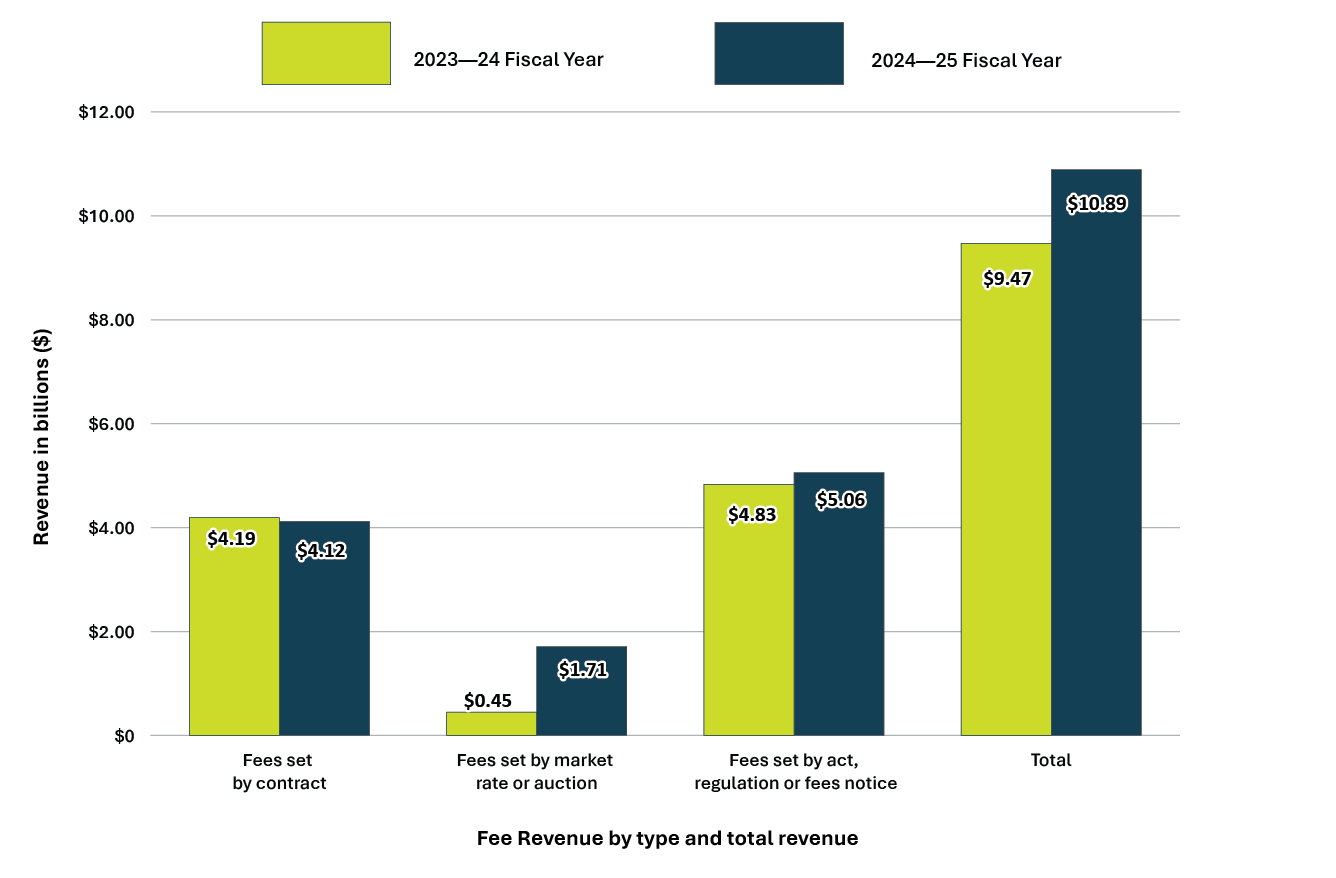
Figure 1 - Text version
| 2023-2024 fiscal year | 2024-2025 fiscal year | |
|---|---|---|
| Fees set by contract | 4,190,410,922 | 4,121,946,140 |
| Fees set by market rate or auction | 453,270,867 | 1,710,036,731 |
| Fees set by act, regulation or fees notice | 4,827,178,077 | 5,054,570,318 |
| Total | 9,470,859,867 | 10,886,553,189 |
Fees set by contract
Table 2 shows the top 10 departments that had the most revenue generated by fees set by contract and the total revenue generated by these fees for all other departments.
| Rank | Department | 2024–25 revenue (dollars)* | Percentage of total revenueFootnote † |
|---|---|---|---|
| 1 | Royal Canadian Mounted Police | 3,500,630,835 | 84.93 |
| 2 | National Research Council Canada | 172,602,666 | 4.19 |
| 3 | Canada Revenue Agency | 151,262,372 | 3.67 |
| 4 | Environment and Climate Change Canada | 84,644,086 | 2.05 |
| 5 | Global Affairs Canada | 57,621,962 | 1.40 |
| 6 | Public Services and Procurement Canada | 50,033,042 | 1.21 |
| 7 | Statistics Canada | 26,566,731 | 0.64 |
| 8 | National Defence | 21,505,962 | 0.52 |
| 9 | Natural Resources Canada | 11,687,580 | 0.28 |
| 10 | Parks Canada | 8,079,043 | 0.20 |
| Other | Remaining 17 departments | 37,311,861 | 0.91 |
| Total | 4,121,946,140 | 100.00 | |
In the 2024–25 fiscal year, the Government of Canada collected $4,121,946,140 in fees set by contract, compared with $4,190,410,922 in 2023–24, representing a decrease of $68,464,782 (1.6%).
Fees set by market rate or auction
Table 3 lists the department that reported revenue generated by fees set by market rate or auction during the 2024–25 fiscal year.
| Rank | Department | 2024–25 revenue (dollars) | Percentage of total revenue |
|---|---|---|---|
| 1 | Innovation, Science and Economic Development Canada | 1,710,036,731 | 100.00 |
| Total | 1,710,036,731 | 100.00 | |
In the 2024–25 fiscal year, Innovation, Science and Economic Development Canada reported revenue of $1,710,036,731 in fees set by market rate or auction, which is $1,256,765,864 (277%) more than the $453,270,867 in total revenue that was reported in the 2023–24 fiscal year. This increase from last year is mainly due to revenue generated from a spectrum licencing auction held in 2023–24, which is reflected in the 2024–2025 fiscal year.
Fees set by act, regulation or fees notice
In the 2024–25 fiscal year, the Government of Canada collected $5,054,570,318 in revenue from fees set by act, regulation or fees notice. This represents an increase of $227,392,241 (4.7%) from the 2023–24 fiscal year. The following section provides departmental explanations of the variances highlighted for departments listed in Table 4, which include, among others, changes in demand or volume and increases to amounts collected as a result of annual adjustments.
Table 4 highlights, for fees set by act, regulation or fees notice:
- the top 10 departments for revenue generated during the 2024–25 fiscal year, which accounted for 90% of all revenue collected;
- the consolidated data for all other departments;
- the variances between the last two fiscal years.
| Rank | Department | 2023–24 revenue (dollars) | 2024–25 revenue (dollars)Footnote * | Variance in revenue from 2023–24 to 2024–25 (dollars)Footnote * | Percentage of total revenue generated in 2024–25Footnote * |
|---|---|---|---|---|---|
| 1 | Immigration, Refugees and Citizenship Canada | 2,342,644,667 | 2,330,797,616 | -11,847,051 | 46.11 |
| 2 | Innovation, Science and Economic Development Canada | 710,134,160 | 776,242,392 | 66,108,232 | 15.36 |
| 3 | Health Canada | 307,041,206 | 317,406,120 | 10,364,914 | 6.28 |
| 4 | Office of the Superintendent of Financial Institutions Canada | 293,129,529 | 294,695,770 | 1,566,241 | 5.83 |
| 5 | Parks Canada | 160,670,550 | 201,645,607 | 40,975,057 | 3.99 |
| 6 | Canadian Nuclear Safety Commission | 134,264,255 | 146,484,644 | 12,220,389 | 2.90 |
| 7 | Employment and Social Development Canada | 165,757,100 | 146,470,000 | -19,287,100 | 2.90 |
| 8 | Canada Energy Regulator | 133,175,727 | 136,823,210 | 3,647,483 | 2.71 |
| 9 | Global Affairs Canada | 91,805,443 | 104,932,428 | 13,126,985 | 2.08 |
| 10 | Canadian Radio-television and Telecommunications Commission | 84,121,115 | 104,001,385 | 19,880,270 | 2.06 |
| Subtotal | 4,422,743,752 | 4,559,499,172 | 136,755,420 | 90.22 | |
| Other | Remaining 25 departments | 404,434,325 | 495,071,146 | 90,363,821 | 9.78 |
| Total | 4,827,178,077 | 5,054,570,318 | 227,392,241 | 100.00 | |
Following are explanations of the variances indicated in Table 4, as provided by the departments.
1. Immigration, Refugees and Citizenship Canada
Immigration, Refugees and Citizenship Canada’s decrease in revenues from immigration service fees in 2024–25 is mainly attributable to the imposition of intake caps on temporary workers and international students to support the goal of reducing non-permanent residents, combined with a reduction in permanent residence.
2. Innovation, Science and Economic Development Canada
Innovation, Science and Economic Development Canada’s revenues for fees set by act, regulations or fees notices increased by 9% from the previous year. This growth was driven by a higher volume of applications, enhanced operational capacity, and adjustments to fees linked to the Consumer Price Index (CPI).
Notably, the Competition Bureau Canada saw a rise in their requests; the Office of the Superintendent of Bankruptcy Canada saw a steady increase in filings since 2021–22 and is now generating corresponding levy revenues; and the Canadian Intellectual Property Office experienced increased revenues driven by higher activity in trademarks, patents, and industrial designs, largely attributable to strengthened operational capacity and higher renewal fees. Additionally, revenue increases in the Spectrum management and telecommunications sector reflect the higher fees introduced mid-way through the previous year, with the full effect realized in 2024–25.
3. Health Canada
Health Canada’s increase in revenues is mainly attributed to legislative annual fee adjustments.
4. Office of the Superintendent of Financial Institutions Canada
The Office of the Superintendent of Financial Institutions (OSFI) adjusts fees each year to fully recover its actual costs, so any variance in OSFI’s fees revenue is mainly due to increases in its operating costs. Although OSFI’s total number of assessments remained stable, the cost per individual assessment increased in 2024–25.
5. Parks Canada
The variance between 2023–24 and 2024–25 is mainly due to the adjustment of Parks Canada fees on January 1, 2024, based on the two-year cumulative change in the annual CPI, as published by Statistics Canada, in accordance with the SFA. Most visitor services occur during the summer months of June to September. Additionally, the number of visitors experiencing Parks Canada places continues to increase.
6. Canadian Nuclear Safety Commission
The Canadian Nuclear Safety Commission’s increase in revenue is attributable to higher cost recovery amounts, driven largely by increases in salaries and other expenses.
7. Employment and Social Development Canada
Employment and Social Development Canada’s revenue dropped mainly because fewer employers used the Temporary Foreign Worker Program. As the labour market loosened in 2024, the government rolled back the pandemic‑era measures from 2022, which limited access to the Program, especially for low‑wage jobs. This led to fewer Labour Market Impact Assessments being processed.
8. Canadian Energy Regulator
The Canada Energy Regulator is funded through parliamentary appropriations. The Government of Canada recovers most of these appropriations from the regulated industry. Revenues are deposited to the Receiver General for Canada’s account and credited to the Consolidated Revenue Fund. The process is regulated by the National Energy Board Cost Recovery Regulations. Revenues shown are based on the actual costs incurred in the fiscal year. Year-over-year variances are primarily driven by changes in recoverable expenditures, including salaries and operating expenses.
9. Global Affairs Canada
Global Affairs Canada’s increase in revenue is primarily a result of a continued increase in demand for passports. The passport service fee includes the consular services fee.
10. Canadian Radio-television and Telecommunications Commission
The Canadian Radio-television and Telecommunication Commission (CRTC) collects fees to cover the costs of regulating the broadcasting and telecommunications industries. In 2024–25, CRTC’s revenue increased compared to the previous fiscal year, mostly due to the coming into force of amendments to the Broadcasting Act and the Broadcasting Fees Regulations. These changes expanded the scope of the CRTC’s broadcasting regulatory activities and broadened the base of fee payers. Additionally, the ratification of various collective agreements during fiscal year 2023–24 increased the CRTC’s operating costs, which also contributed to some of the revenue increase in 2024–25.
Fee adjustments
In this section
Prior to the SFA coming into force in 2017, certain fees set by act, regulation or fees notice had periodic adjustments to keep up with inflationary increases; however, many fees had no mechanism for keeping pace with the impact of inflation on the cumulative cost of delivering the service or product.
To make sure departments can keep up with inflation for delivering services, the SFA introduced an automatic annual adjustment. Most fees set by act, regulation or fees notice are subject to this annual adjustment by default.
Certain fees are not subject to the annual adjustment requirement set out in the SFA because they are fixed in a manner that takes inflation into account, or another act of Parliament prescribes a periodic adjustment, or because they are exempt from the SFA. Fees that are considered to be low-materiality fees under the Low-materiality Fees Regulations are also not subject to the SFA’s annual adjustment.
Service Fees Act annual adjustment
Subsection 17(1) of the SFA requires responsible authorities to adjust their applicable fees each fiscal year by the percentage change over 12 months in the April CPI for all items for Canada, as published by Statistics Canada.
The 2024–25 Departmental Fees Reports include a CPI adjustment, based on the CPI for April 2023 of 4.4% for applicable fees.
Periodic adjustment
A periodic fee adjustment is made pursuant to an act of Parliament or a regulation and is applied according to an established frequency, based on a specific rate, formula or other factor, other than the adjustment rate set out in subsection 17(1) of the SFA.
Service standards and remissions
In this section
Service standards
To improve services to fee payers, the SFA requires that applicable fees have an established service standard. A service standard is a public commitment to provide a service in a way that is measurable and relevant to fee payers under normal circumstances.
The Low-Materiality Fees Regulations establish criteria that define what low-materiality fees are and which fees are not required by the SFA to establish service standards to provide a more cost-effective way for departments to administer low-materiality fees.
Table 5 shows the number of fees set by act, regulation or fees notice in 2024–25, broken down by the application of sections 4 to 7 of the SFA and whether a service standard applies.
| Breakdown of fees | Number of fees |
|---|---|
| Fees subject to sections 4 to 7 of the SFA that require a service standard | 3,516 |
| Fees subject to sections 4 to 7 of the SFA that are not required to have a service standard (the fee is set by contract, the person or body that fixes the fee does so by fixing a manner for determining the amount of the fee over which that person or body has no control, the fee is for the provision of a product; refer to section 3 of the SFA) | 31,362 |
| Fees subject to sections 4 to 7 of the SFA that are considered to be low-materiality pursuant to section 22 of the SFA and the Low-materiality Fees Regulations and that therefore do not have service standards | 2,628 |
| Fees not subject to the SFA and that may have service standards under other instruments | 212 |
| Total | 37,718 |
Of the 3,516 fees that require service standards under the SFA, departments reported that, as of March 31, 2025, 3,183 (91%) fees had existing service standards. Departments continue to work toward establishing service standards for their remaining fees to comply with the SFA.
For departments that charge fees set by act, regulation or fees notice, information about service standards and corresponding performance results can be found in the “Details on each fee set by act, regulation or fees notice” section of their Departmental Fees Reports.
Remissions
To ensure accountability for departmental service standards, the SFA introduced a requirement for remissions, which is a partial or full return of a fee to a fee payer when a department deems that the relevant service standard was not met. Departments must issue the remission before July 1 of the following fiscal year, in accordance with their remission policy.
Departments are required to develop policies and procedures to determine whether a service standard has been met and what portion of a fee will be remitted to a fee payer when a service standard is deemed not met, according to the Directive on Charging and Special Financial Authorities. Departmental remission policy and procedures must be available to the public.
Other Treasury Board policies and directives may require the establishment of service standards (e.g., Directive on Service and Digital); however, those requirements are not related to remission requirements under the SFA.
Authorities to remit
With regard to fees, three authorities allow departments to remit fees under different circumstances. They are as follows.
Authority to remit pursuant to the Service Fees Act
Subsection 7(2) of the SFA provides the authority to remit the appropriate portion of a fee only when a service standard in relation to that fee has been deemed not met. The remission is to be made in accordance with the Treasury Board Directive on Charging and Special Financial Authorities and the departmental remission policy.
Authority to remit pursuant to the Financial Administration Act
Departments may submit a Treasury Board submission to the Governor in Council in order to obtain an authority to remit pursuant to the Financial Administration Act (FAA). If granted, the authority may be provided for a specific fee or for a designated period. This type of authority is sought for matters other than the authority provided by the SFA. In other words, it could be for reasons other than a service standard that was deemed not met.
Authority to remit pursuant to other acts of Parliament
Certain departments have received an authority to remit fees pursuant to their enabling act or acts and may remit depending on the context and the wording in the act and related regulations, which may be for reasons other than a service standard that was deemed not met.
The 2024–25 Departmental Fees Reports include remissions issued under departments’ enabling legislation, the FAA or remissions issued under the authority of the SFA.
Remissions issued
Table 6 shows the 10 departments that had the largest reported amounts in remissions issued in 2024–25 and total remissions issued by all other departments. The amounts include remissions from the authority delegated pursuant to the SFA, FAA and other acts of Parliament.
Approvals
As part of amendments to the SFA in June 2023, new authorities were granted to the President of the Treasury Board, effective April 1, 2024, to improve consistency in the non-application of requirements related to:
- performance standards (sections 4 to 7);
- consultation and parliamentary review (sections 10 to 15);
- annual adjustment (sections 17 and 18).
The President of the Treasury Board must now approve when these sections do not apply, based on three criteria:
- The person or body that sets the fee does not choose the amount and as such has no control; using a method like an auction or market rate determines the amount.
- The fee is fixed in a manner that takes inflation into account.
- The fee is adjusted periodically by operation of an act of Parliament other than the SFA or by operation of an instrument made under such an act.
Departments are required to submit business cases to the Treasury Board of Canada Secretariat for consideration and approval of the non-application of these sections. In fiscal year 2024–25, two cases were submitted. The Treasury Board of Canada Secretariat analyzed the business cases to confirm they met the criteria for non-application before recommending them to the President for approval. Approvals for non-application requests for 2024–25 were obtained via the approval process for the 2023–24 President’s Fee Report. Table 7 lists the approvals that were put into effect for 2024–25.
| Section of Service Fees Act | Criteria | Department, fee or program, and fee-setting authority |
|---|---|---|
Section 16(2)(c) – non-application of annual adjustment (sections 17 and 18) |
The fee is adjusted periodically by operation of an act of Parliament other than this act or by operation of an instrument made under such an act. |
Transport Canada Canadian Grain Commission |
Appendix: links to Departmental Fees Reports for the 2024–25 fiscal year
Listed below are links to the Departmental Fees Reports for the 2024–25 fiscal year. Each report contains information on specific departmental fee regimes, including:
- financial information about the total costs, total revenues generated by and any remissions of:
- fees set by contract;
- fees set by market rate or auction;
- fees set by act, regulation or fees notice.
- for each fee set by act, regulation or fees notice, detailed information about:
- the date the fee was introduced and last amended, if applicable;
- the dollar amount of the fee in the 2024–25 fiscal year;
- the adjusted dollar amount of fees for the 2026–27 fiscal year, if applicable;
- service standards, if applicable;
- performance results against these standards;
- total remissions issued for the fee, if applicable.
Links to Departmental Fees Reports for the 2024–25 fiscal year:
- Agriculture and Agri-Food Canada
- Canada Border Services Agency
- Canada Energy Regulator
- Canada Revenue Agency
- Canadian Centre for Occupational Health and Safety
- Canadian Food Inspection Agency
- Canadian Grain Commission
- Canadian Heritage
- Canadian Nuclear Safety Commission
- Canadian Radio-television and Telecommunications Commission
- Canadian Space Agency
- Canadian Transportation Agency
- Crown-Indigenous Relations and Northern Affairs Canada
- Department of Justice Canada
- Employment and Social Development Canada
- Environment and Climate Change Canada
- Financial Consumer Agency of Canada
- Financial Transactions and Reports Analysis Centre of Canada
- Fisheries and Oceans Canada
- Global Affairs Canada
- Health Canada
- Immigration, Refugees and Citizenship Canada
- Impact Assessment Agency of Canada
- Indigenous Services Canada
- Innovation, Science and Economic Development Canada
- Library and Archives Canada
- National Defence
- National Film Board
- National Research Council Canada
- Natural Resources Canada
- Office of the Auditor General of Canada
- Office of the Secretary to the Governor General
- Office of the Superintendent of Financial Institutions Canada
- Parks Canada
- Parole Board of Canada
- Privy Council Office
- Public Health Agency of Canada
- Public Services and Procurement Canada
- Royal Canadian Mounted Police
- Shared Services Canada
- Statistics Canada
- The National Battlefields Commission
- Transport Canada
© His Majesty the King in Right of Canada, represented by the President of the Treasury Board, 2026,
ISSN: 2562 413X