
Infographic: Farm to Fork: FoodNet Canada 2017 Results
Download the alternative format
(PDF format, 1.05 KB, 1 page)
Organization: Health Canada
Type: Infographic
ISBN: 978-0-660-28031-8Published: 2018-11
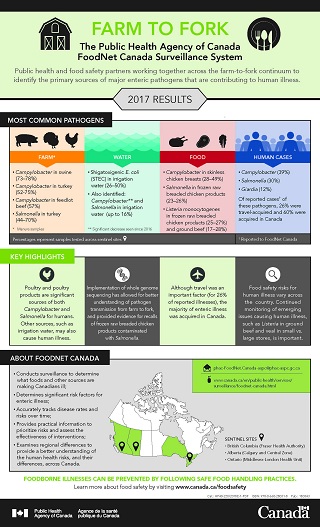
Public health and food safety partners working together across the farm-to-fork continuum to identify the primary sources of major enteric pathogens that are contributing to human illness.
2017 Results
Most Common Pathogens:
Farm (manure samples)
- Campylobacter in swine (73–78%)
- Campylobacter in turkey (52-75%)
- Campylobacter in feedlot beef (57%)
- Salmonella in turkey (44–70%)
Water
- Shigatoxigenic E. coli (STEC) in irrigation water (26-50%)
- Also identified: Campylobacter (significant decrease seen since 2016) and Salmonella in irrigation water (up to 16%)
Food
- Campylobacter in skinless chicken breasts (28-49%)
- Salmonella in frozen raw breaded chicken products (23-26%)
- Listeria monocytogenesin frozen raw breaded chicken products (25-27%) and ground beef (17-28%)
Percentages represent samples tested across sentinel sites
Human Cases
- Campylobacter (39%)
- Salmonella (30%)
- Giardia (12%)
Of cases reported to FoodNet Canada of these pathogens, 26% were travel-acquired and 60% were acquired in Canada
Key Highlights:
Poultry and poultry products are significant sources of both Campylobacter and Salmonella for humans. Other sources, such as irrigation water, may also cause human illness.
Implementation of whole genome sequencing has allowed for better understanding of pathogen transmission from farm to fork, and provided evidence for recalls of frozen raw breaded chicken products contaminated with Salmonella.
Although travel was an important factor (for 26% of reported illnesses), the majority of enteric illness was acquired in Canada.
Food safety risks for human illness vary across the country. Continued monitoring of emerging issues causing human illness, such as Listeria in ground beef and veal in small vs. large stores, is important.
About FoodNet Canada
- Conducts surveillance to determine what foods and other sources are making Canadians ill
- Determines significant risk factors for enteric illness
- Accurately tracks disease rates and risks over time
- Provides practical information to prioritize risks and assess the effectiveness of interventions
- Examines regional differences to provide a better understanding of the human health risks, and their differences, across Canada
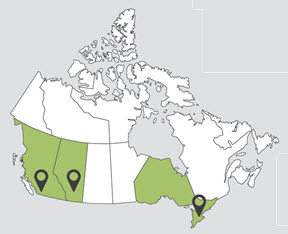
Figure 1: Provinces where the three FoodNet Canada sites are located
Text Description
A map showing the provinces and territories of Canada highlights the provinces where the three FoodNet Canada sites are located. The sentinel sites are located in British Columbia (Fraser Health Authority), Alberta (Calgary and Central Zone), and Ontario (Middlesex-London Health Unit).
FoodNet Canada’s email address is phac-FoodNet.Canada-aspc@phac-aspc.gc.ca
Find information about FoodNet Canada.
Foodborne illnesses can be prevented by following safe food handling practices