
Strengthening Canada’s border security: Actions taken to date
Targeting illicit drugs, cross-border crime and illegal crossings
The Government of Canada has been resolute in its commitment to doing whatever it takes to keep our border secure, because we know that a strong border is essential to our economy, national security, and the safety of our communities. Through the $1.3 billion Border Plan, the Government of Canada has invested in equipment and technology for border and law enforcement agencies to tackle the flow of illegal fentanyl, other illicit drugs, and precursor chemicals; deter organized crime and illegal migration; and increase information sharing and operational coordination with partners.
Securing the border
- 24/7 surveillance of the border
- Approximately 10,000 frontline personnel, with 1,000 new CBSA officers to come
- New technology and intelligence capabilities, such as Black Hawk helicopters, drones counter-drone technologies, and mobile surveillance towers
- New tools in place to address illegal migration
- More visa fraud investigations, more resources identifying high-risk individuals and bringing back some visa requirements on Mexico
- Illegal crossings from Canada to the U.S. down 99% in January 2026 from peak levels in June 2024
- Northbound apprehensions now outnumber southbound
- Using new tools to detect and identify synthetic drugs and precursor chemicals
- Imaging and trace detection, regional satellite laboratories, ion scanners, detector dog teams
- More equipment still to come
- More resources dedicated to removing foreign nationals inadmissible to Canada
- In 2025, 22,576 removals were enforced, the most in over a decade. 1,010 removals were due to serious inadmissibility (national security, war crimes or human rights violations, organized crime and criminality)
- Expanded CBSA international operations to enhance pre-departure intelligence and targeting, preventing inadmissible individuals and illicit goods from entering Canada
- Border officers increasingly able to focus on higher-risk activity with ending of "flagpoling"
Combatting transnational organized crime and fentanyl
- Canada is not a significant source of illegal fentanyl entering the US. Less than 1% of fentanyl seized in the US comes from Canada
- In 2025, approximately 430 kg (948 lb) of fentanyl was intercepted through combined Canadian border law enforcement operations
- Fentanyl Czar
- Leads multi-agency coordination efforts to tackle the production and trafficking of illegal fentanyl
- Inter-agency cooperation
- Prime Ministerial Directive issued on improving intelligence sharing and cooperation between government agencies
- New Joint Operational Intelligence Cell
- Bringing together security agencies and law enforcement partners to target cross-border organized crime, money laundering and drug trafficking to improve border security
- Since February 2025, 12 organizations have been listed as terrorist entities
- Property of those groups can now be frozen and law enforcement has enhanced authorities to investigate and prosecute terrorism-related offences including those related to financing, participation, recruitment, and travel in support of terrorist activity
- North American Joint Strike Force
- Launched with the U.S. to target transnational organized crime, precursor chemicals, and illegal substances, including fentanyl
- Direct engagement and action with source countries
- Taking place to stop the shipments of illegal precursor chemicals to Canada
- Three new Regional Integrated Drug Enforcement Teams (RIDET)
- Being created to bring together seconded law and border enforcement resources from multiple agencies and jurisdictions to combat organized drug crime in areas most impacted. Announced funding for the first RIDET located in British Columbia in November 2025, and for a second located in Ontario in January 2026
- Precursor Chemical Risk Management Unit
- Established to provide greater oversight of precursor chemicals and distribution channels
- New Canadian Drug Analysis Centre being established to expand laboratory drug testing capabilities and provide more forensic information and services to law enforcement
- Targeted law and border enforcement operations
- Greater focus on fentanyl and drugs
Disrupting illegal financing
- Integrated Money Laundering Intelligence Partnership now in operation
- Will increase targeted information sharing between law enforcement and Canada's financial sector
- Public, searchable Beneficial Ownership Registry for Federal Corporations is now in place
- Will help crack down on criminal abuse of corporate structures
- Trade Transparency Unit established
- Easier data-sharing with the U.S. to expose and shut down trade-based money laundering
- New requirement in place for businesses regulated for anti-money laundering purposes to enroll with the Financial Transactions and Reports Analysis Centre of Canada (FINTRAC).
Strengthening Canada's Immigration System and Borders Act (Bill C-12)
On March 26, 2026, the Strengthening Canada's Immigration System and Borders Act (Bill C-12), received Royal Assent, strengthening our immigration and asylum systems and providing law enforcement agencies with more tools to keep our borders secure, combat transnational organized crime, illegal fentanyl, and illicit financing.
Results Achieved
Monthly irregular crossings from Canada to the U.S. down 99% since peak in June 2024.
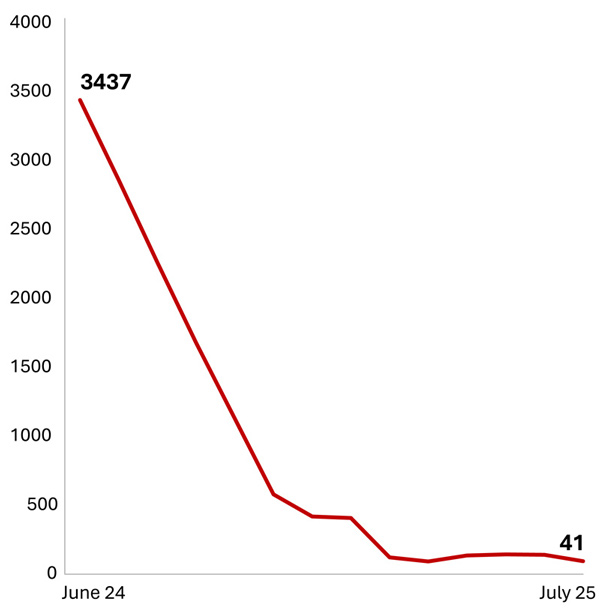
Figure 1: Image description
This line graph illustrates the monthly number of individual southbound apprehensions recorded between June 2024 and January 2026. The vertical axis (y-axis) shows the number of apprehensions, ranging from 0 to 4,000. The horizontal axis (x-axis) represents each month in the one-year period, starting with June 2024 and ending with January 2026.
The data reveals a clear and consistent downward trend in apprehensions over the course of the year. In June 2024, the number of apprehensions was at its highest point, with 3,437 individuals apprehended. This figure steadily declined month over month, with notable drops occurring in the fall and winter months. By January 2026, the number of apprehensions had decreased to 19 individuals.
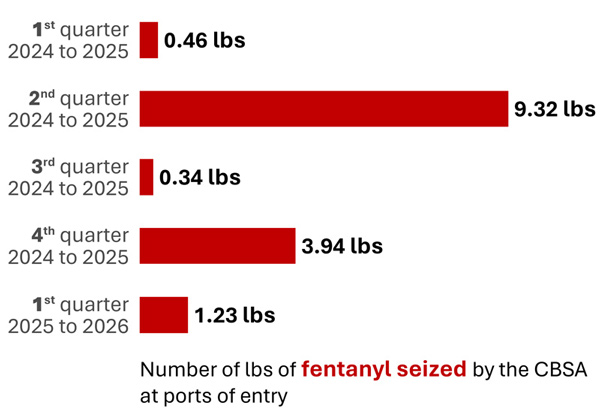
Figure 2: Image description
The bar graph below illustrates the quantity of fentanyl seized by the CBSA by quarter. In the fourth quarter of the 2024–2025 fiscal year, 3.94 pounds (1.79 kilograms) of fentanyl were seized. In the third quarter of the 2025–2026 fiscal year, 0.43 pounds (0.20 kilograms) were seized. In the second quarter of the 2025–2026 fiscal year, 0.54 pounds (0.25 kilograms) were seized. In the first quarter of the 2025–2026 fiscal year, 1.25 pounds (0.57 kilograms) were seized.
Source: Canada Border Services Agency enforcement action statistics.
U.S. Border Patrol are finding low amounts of fentanyl at the northern border:
- Even though amounts fluctuate, seizures at the Canada-U.S. border are a very small amount of total fentanyl seized by the U.S. Border Patrol
- Amounts seized per month has been going down since July 2024
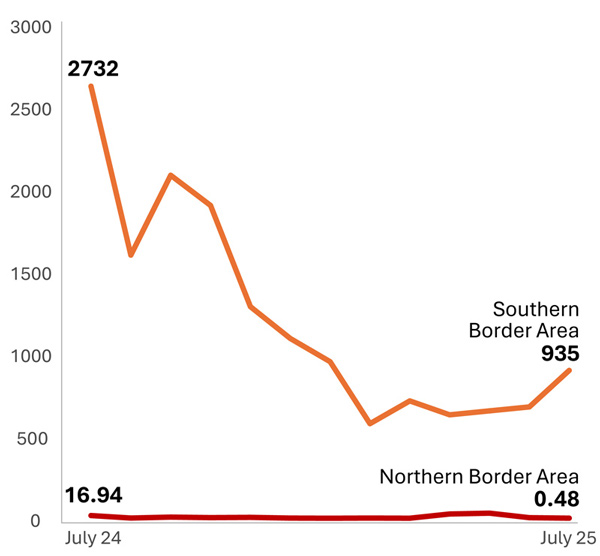
Figure 3: Image description
This line graph shows the number of pounds of fentanyl seized by United States Customs and Border Protection over an 12-month period, from July 2024 to February 2026. The vertical axis (y-axis) represents the quantity of fentanyl seized, measured in pounds, from 0 to 3,000. The horizontal axis (x-axis) displays the months in chronological order, beginning with July 2024 and ending with February 2026.
At the start of the reporting period in July 2024, seizures at the southern border were significantly higher than those at the northern border. Specifically, 2,700 pounds of fentanyl were seized at the southern border (first line), compared to 17 pounds at the northern border (second line).
Over the following months, the quantity of fentanyl seized at the southern border declined steadily. This downward trend continued into the spring of 2025, with the lowest recorded amount 687 pounds in May 2025.
In contrast, fentanyl seizures at the northern border remained relatively low and stable throughout the period. While there were minor fluctuations, the overall trend was flat. By February 2026, the amount seized at the northern border was 0.3 pounds.
Source: U.S. CBP Drug Seizure Statistics: Drug Seizure Statistics | U.S. Customs and Border Protection.
Efforts to stop fentanyl and other illegal drugs are working
CIROC-led enforcement sprint
- In December 2024 and January 2025, the Canadian Integrated Response to Organized Crime (CIROC), made up of federal, provincial and municipal law enforcement agencies, seized about 100 pounds of fentanyl and nearly 16,000 pills made from fentanyl and other synthetic opioids, among other items
- A second sprint took place between May 20 and October 31, 2025. This nationwide law enforcement action led to 8,136 arrests/charges with 217 individuals specifically arrested for trafficking fentanyl. Large quantities of drugs and other commodities were seized including 849.2 lb (386 kg) of fentanyl, 594 lb (270 kg) of precursor chemicals, 11,966 lb (5,983 kg) of cocaine, 3,757.6 lb (1,708 kg) of methamphetamine, and $13.46 million in cash
Operation Meridian
- In November 2025, CBSA announced the results of Operation Meridian, whose goal was to disrupt the import and export of illicit narcotics through commercial channels at ports of entry across Southern Ontario. Border officers with support from the RCMP, Ontario Provincial Police (OPP), Municipal Police and CBSA National Targeting Centre seized 238.9 lb (108.6 kg) of cocaine, 769.6 lb (349.8 kg) of methamphetamines, 585.2 lb (266 kg) of khat, 9 firearms (including 1 stolen firearm), and US $93,100. Roughly 90% of these seizures were attempts to smuggle into Canada
Operation LIBERTERRA
- The RCMP and CBSA took part in INTERPOL's Operation LIBERTERRA in November 2025. Law enforcement agencies around the world mobilized over 14,000 officers to disrupt human trafficking and irregular migration. Worldwide, international cooperation led to the arrest of over 3,000 suspects, detected 13,000 irregular migrants across 119 countries, and safeguarded over 4,400 potential victims of human trafficking