
Amendments to CSIS Act Warrant Authorities
Bill C-70, An Act respecting countering foreign interference, amended the Canadian Security Intelligence Service Act (CSIS Act), providing the Canadian Security Intelligence Service (CSIS) a greater variety of investigative tools enabling CSIS to use the right tool, at the right time, to protect all Canadians. These new tools can ultimately be less intrusive overall because CSIS will not have to use multiple non-warranted techniques for extended periods of time, allowing CSIS to focus its investigations to rule people out so that CSIS can quickly focus on the right threat actors.
Federal Court approval is required for any activity that is more than minimally intrusive of privacy, and the Court may impose any terms or conditions it deems appropriate.
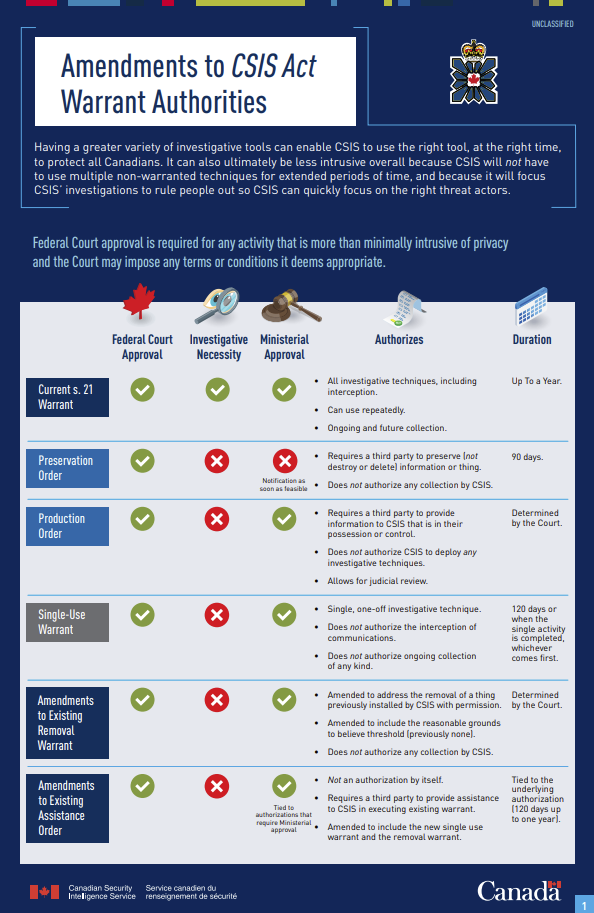
| Federal Court Approval | Investigative Necessity | Ministerial Approval | Authorities | Duration | |
| Existing S.21 Warrant | ✔ | ✔ | ✔ |
|
Up to a year. |
| New Preservation Order | ✔ | X | X |
|
90 days. |
| New Production Order | ✔ | X | ✔ |
|
Determined by the Court. |
| New Single-Use Warrant | ✔ | X | ✔ |
|
120 days or when the single activity is completed, whichever comes first. |
| Amendments to Existing Removal | ✔ | X | ✔ |
|
Determined by the Court. |
| Amendments to Existing Assistance Order | ✔ | X | ✔ Tied to authorizations that require ministerial approval. |
|
Tied to underlying authorization (120 days up to one year). |
Gaps Filled
- The toolkit in the CSIS Act was old and predated the internet.
- The amendments, while new to the CSIS Act, are not new tools; they are modelled on powers routinely relied on by Canadian law enforcement and intelligence agencies in other democracies.
- The threshold for accessing these tools is still high. Safeguards have been built in and are strong. The amendments ensure no Charter or other rights are negatively affected.
Impact of amendments
- Enable CSIS to compel the preservation of perishable information.
- Enable CSIS to compel the production of information.
- Enable CSIS to perform a single collection activity to focus investigations.
Example: Preservation and production order
Most Internet service providers have policies requiring routine deletion of information. A preservation order from the Federal Court could authorize CSIS to require a provider to retain account information for an individual operating on behalf of a foreign state and observed to be posting mis- and disinformation about a candidate for mayor. This would prevent deletion. Afterwards, CSIS could seek a production order from the Federal Court to require the Internet provider to provide the account information to CSIS.
Production orders could also allow CSIS to acquire:
- subscriber information;
- call, transaction or financial records; and
- stored communications and phone or computer backups.
Investigative Necessity
CSIS’ existing s. 21 warrant authority requires that an application for a warrant demonstrate that other investigative techniques:
- Have been tried and failed or why they are unlikely to succeed;
- Are impractical in urgent circumstances; or
- That information of importance will not be obtained without the warrant.
These elements are referred to as ‘investigative necessity’ requirements.
Example: Single-use warrant
If there was a foreign interference threat actor who is transiting through a Canadian airport, CSIS may only have a small window to examine their electronic device (eg., Smartphone) because they may only be in Canada for a few hours.
With CSIS’ existing s. 21 warrant, CSIS would have to establish investigative necessity to seek a warrant. This would be nearly impossible given the very short window to first use other investigative techniques such as interviews or surveillance. The new single-use warrant could be used for a one-time examination of their electronic device while the threat actor is in transit.