
Income Tax Audit Manual
Compliance Programs Branch (CPB)
Information
This chapter was last updated July 2026.
Chapter 11.0 Completing the audit
Table of Contents
- 11.1.0 Completion checklists
- 11.2.0 Communications and negotiations with taxpayer
- 11.3.0 Normal reassessment period
- 11.3.1 Income tax reassessment period
- 11.3.2 For future use
- 11.3.3 Application of losses
- 11.3.4 Tax credits
- 11.3.5 For future use
- 11.3.6 Examples of loss application and the investment tax credit
- 11.3.7 Assessment after the normal assessment or reassessment period and penalty for false statements or omissions
- 11.4.0 Waivers
- 11.5.0 Assessments
- 11.5.1 General policy – Assessments and reassessments
- 11.5.2 Priority reassessments
- 11.5.3 Assessments under subsection 152(7) of the ITA
- 11.5.4 Definitions Assessment, Reassessment, Notification of no tax payable, and additional assessments
- 11.5.5 Jeopardy assessments
- 11.5.6 For future use
- 11.5.7 For future use
- 11.5.8 For future use
- 11.5.9 NIL assessment – Notification
- 11.5.10 Loss determination
- 11.5.11 Joint liability assessments (ITA)
- 11.5.12 Consequential assessments
- 11.5.13 Collection stall code procedures
- 11.6.0 Auditor’s reports
- 11.7.0 Supporting forms for assessments
- 11.8.0 Audit completion – Storage of working papers and other documents
- 11.9.0 Assembling the audit file
- 11.10.0 Processing the audit file
- Appendix 11.1.0 Letters
- Appendix 11.2.0 Nationally used forms and instructions
- A-11.2.1 Form T7W-C, Explanation of Changes on Reassessment, for T1
- A-11.2.2 Sample format for Form T7W-8, Explanation of assessment or of change made
- A-11.2.3 Form T7W-C, Explanation of changes on reassessment, for T2
- A-11.2.4 Sample format for Form T7W-9
- A-11.2.5 Sample pro-forma Form T7W-8, Explanation of assessment or of change made
- A-11.2.6 Sample Form T7W-8, Explanation of assessment or of change made
- A-11.2.7 Sample Form T7W-9
- A-11.2.8 Sample Form T7W-9
- A-11.2.9 Bankrupt and deceased taxpayers mailing address
- A-11.2.10 Form T99, T1 and T3 tax calculation information
- A-11.2.11 Online reassessment program for T1 file
- A-11.2.12 Submit Final RAP, T2 tax calculation information
- A-11.2.13 For future use
- A-11.2.14 For future use
- A-11.2.15 Instructions for completing Form T287, Priority assessments and reassessments control
- A-11.2.16 Permanent document folder and retention period
- A-11.2.17 Form T20, Audit Report
- A-11.2.18 For future use
- A-11.2.19 For future use
- A-11.2.20 For future use
- A-11.2.21 Penalty Recommendation Report
- A-11.2.22 Pursuit of Profit Report
- A-11.2.23 Farm Loss Report
- A-11.2.24 SMED Taxpayer Relief Recommendation Form
- A-11.2.25 Assessment after Normal (Re)Assessment Period Recommendation Report
- A-11.2.26 Capital Gain vs Income Report
- Appendix 11.3.0 Examples of forms and procedures used locally
| Taxpayer: |
| Address: |
| BN/SIN: |
| Statute-barred date: |
| Case no.: |
| File no.: |
| Type of organization: |
| Names of shareholders: |
| Number of years in operation: |
| Major NAICS code: |
| Description of products and services provided |
| Yes | No | N/A | WP ref | |
|---|---|---|---|---|
| 1. Review all working papers and ensure that they are properly cross-referenced and that findings are clearly summarized. | ||||
| 2. Have all the audit concerns been addressed? If a previous audit indicated that follow-up was required to ensure that the taxpayer was in compliance, have these issues been addressed and clearly summarized? |
||||
| 3. Have contentious issues been discussed with the team leader and resolved prior to the final interview with the taxpayer? |
||||
| 4. Have audit findings with national implications been identified and the information forwarded to Headquarters (HQ)? | ||||
| 5. Are you considering gross negligence penalties? |
||||
| 6. Are you referring the case to Criminal Investigations? If you are, go to Parts B and C of this checklist and complete what is applicable at the time of the referral. Do not initiate any further contact with the taxpayer and do not issue the proposal letter or the reassessment until Criminal Investigations reviews the referral. Go to 10.11.8 for more guidelines on referrals to Criminal Investigations. | ||||
| 7. Provide the taxpayer with a summary of the adjustments. |
||||
| 8. Discuss the proposed adjustments with the taxpayer. Determine if the taxpayer concurs. Allow 30 days for the taxpayer to review the adjustments and provide additional information. | ||||
| 9. Ensure that the taxpayer's representations have been reviewed and discussed. Prepare a revised schedule of adjustments, if required. |
||||
| 10. Ensure that relevant schedules (capital cost allowance (CCA), non-capital loss, and net capital loss) have been updated and a copy sent to the taxpayer. | ||||
| 11. If necessary, discuss the need for adequate records and recommendations. | ||||
| 12. If the adjustments are material, complete the Collection Report. |
||||
| 13. Have all significant issues raised by the taxpayer been clearly answered? |
||||
| 14. Have borrowed books, records, and documents been returned to the taxpayer and has Form T2213, Receipt for Borrowed Books, Records and Documents, been updated as required? | ||||
| 15. Determine if follow-up is required. |
||||
| 16. Advise the taxpayer of the CRA’s position and prepare a letter that confirms the adjustments. |
| Yes | No | N/A | WP ref | |
|---|---|---|---|---|
| Include these reports and documents in the electronic audit file: | ||||
Place applicable documents in the audit file, including:
|
||||
| Place priority reassessments in red file folders and attach completed Form T287, Priority assessments and re-assessments control |
| Yes | No | N/A | WP ref | |
|---|---|---|---|---|
| Include copies of these documents and reports when necessary in the audit file. Other units need these documents and reports to process the audit file or for follow-up. | ||||
|
Permanent document folder
Although the audit file is completed electronically, certain documents must be printed and stored in the permanent document (PD) folder. These documents include:
- internal reports, for example:
- Form T20, Audit Report
- Penalty Recommendation Report
- SMED Taxpayer Relief Recommendation Form.
- special elections, agreements, and returns;
- prescribed forms and legal documents; and
- net worth statements and schedules (not the working papers).
For more information, go to Appendix A-11.2.16, Permanent document folder and retention period.
11.2.0 Communications and negotiations with taxpayer
If, at any time after initial contact, communications break down and the taxpayer refuses telephone calls and delivery of mail, the auditor must include evidence in the file. Notes on Form T2020, Memo for file, will support unreturned telephone calls. For undelivered mail, the Form T2020 notes must be augmented with a scanned copy of the undelivered envelope (regular mail), or copy 4 of the T973 tracking form (registered mail).
11.2.1 No change audits
If no adjustments are to be made, send a no change letter to the taxpayer to confirm that the file is being closed without any changes. Where the taxpayer is involved in several businesses and the audit covered only one of the businesses, the no change letter will specify which business was audited and that the other businesses may be audited at some future time. Attach Income Tax Information Circular IC78-10R5, Books and Records Retention/Destruction, to the letter.
For sample letters, go to the Integras Template Library.
11.2.2 Downscreened audit
If information is obtained after contacting the taxpayer that indicates there is low or no potential risk and the audit is downscreened according to 9.16.6, advise the taxpayer that the audit of the business will not be done and state the reason. For more information, go to 9.16.6, Downscreening audits by Business Intelligence.
If the taxpayer is involved in several businesses and the downscreened audit covered only one of the businesses, advise the taxpayer that the other businesses may be audited at some future time and note on Form T2020, Memo for file.
11.2.3 Taxpayer concurrence at the end of field work
Depending on the size and nature of the taxpayer's business being audited, the complexity of the files, and any proposed adjustments, the auditor may discuss potential adjustments with the taxpayer or with the person designated by the taxpayer. An agreement may have been reached with the taxpayer on the appropriate assessing action for these items during the course of the audit.
The taxpayer or the auditor may suggest a meeting to discuss all potential adjustments identified during the course of the audit. Include the team leader in the meeting where considered appropriate. During the meeting, resolve outstanding issues and attempt to obtain taxpayer concurrence for the adjustments.
If concurrence is reached on all items under discussion, send a final letter to the taxpayer to confirm the agreed upon adjustments. Provide with the letter, any relevant schedules reflecting revisions to items such as capital cost allowance (CCA) and continuity of losses.
11.2.4 Audit completion – Proposal letter
Send a proposal letter outlining potential adjustments to the taxpayer as soon as possible after completing the audit procedures. In the case of a no change audit, send a no change letter. The proposal letter provides details of all proposed adjustments. The taxpayer is usually given 30 days from the date of the proposal letter to provide any response, rebuttal, explanation, or further documentation relating to the proposed adjustments.
Depending on the circumstances, the proposal letter may be presented to the taxpayer during a meeting to explain the proposed adjustments or sent to the taxpayer, suggesting that a meeting be held to discuss the proposed adjustments. In some cases, the taxpayer may wish to conduct research before discussing the issues in the proposal letter.
In all cases, it is essential that the taxpayer receive a full explanation of the proposed adjustments and is given an adequate opportunity to respond. Where the taxpayer is involved in several businesses and the audit covered only one of the businesses, the proposal letter must specify that the audit was restricted to a particular business and that the other businesses may be audited at some future time.
Following receipt of any representations and/or submissions from the taxpayer, discuss any outstanding issues by telephone or in person in a final meeting.
Include the summary of adjustments, by year, with supporting schedules with the proposal letter.
If the proposal letter includes a recommendation for a gross negligence penalty, give details of the items and amounts subject to penalty, and the penalty rate. For more information, go to the Integras Template Library, letter A‑11.1.7, Proposal with Gross Negligence Penalty.
A reasonable extension of time requested by the taxpayer to review the proposed adjustments and to prepare a response should be considered.
A request from a taxpayer for additional days past the proposal deadline should be granted for factors or events that are outside of the taxpayer’s control, such as illness, death, natural disaster, and may include a change in representative. These events or factors are not intended to be exhaustive and professional judgment should be used when issuing revised timelines. The justification for granting or disallowing any additional days to respond to a request must be documented in the audit file.
The deadline for a response to a proposal letter should take into consideration statute-barred dates and treaty time limits. The timeline for a response to the proposal letter and/or the follow-up request may be shortened, or the follow-up request may be eliminated/denied, as appropriate. Auditors should be mindful of the impact of further communications between the CRA and the taxpayer on statute-barred dates and treaty time limits (see 11.4.2, Filing a waiver, for audit policy on accepting waivers in certain circumstances.)
When considering issuing a revised deadline to provide information, auditors will adhere to established standard timelines for taxpayers to respond, as outlined in Annex A in Communiqué AD-20-01, Standard Timelines for Information Requests to Taxpayers for Audit Purposes, and discuss the file with the team leader.
If the taxpayer fails to respond within the time period, the reassessment may be processed. The auditor should contact the taxpayer to ensure that a response is not in the mail or to determine if the taxpayer needs more time to complete their response to the proposal letter.
If a tax year for which adjustments are proposed will become statute-barred shortly after the 30‑day response period, the proposal letter should state that no extension of the 30-day period for representations will be provided without a signed waiver having been received prior to that time. If the taxpayer refuses to sign a waiver, process the file without delay at the conclusion of the representation period.
Where adjustments are being considered but the file will become statute-barred before the expiry of the 30-day representation period, a decision will be made to either withdraw the proposed adjustment or provide a representation period of less than 30 days. A representation period of less than 30 days requires approval from the assistant director, Audit (ADA).
11.2.5 Final interview/meeting
A final interview with the taxpayer is essential (when feasible) to provide a detailed explanation of all adjustments and to discuss any representations and submissions the taxpayer and representative may have in response. The team leader should attend the final interview at the taxpayer’s or auditor's request or when circumstances warrant.
The meeting is generally held after the taxpayer has been provided with the proposal letter. However, this meeting can also be conducted prior to issuing the proposal letter, if circumstances and timing warrant. For more information, go to 11.2.3, Taxpayer concurrence at the end of field work. Where complex issues are to be resolved, consider sending relevant information to the taxpayer for review in advance of any meetings.
Schedule a final interview within a reasonable time period after the fieldwork is completed. While discussions with the taxpayer may take place throughout the audit process and audit issues and possible adjustments can be resolved as they arise, the final interview is the opportunity to conclude all issues and to ensure that everyone is aware of the adjustments that will be made, whether or not concurrence is reached.
Except for a no change file or when full concurrence was achieved at the final interview, the auditor should make a final contact. On the last day of the representation period or shortly thereafter, the auditor must confirm that the taxpayer is not providing any further representations.
Auditors must document all discussions at the final interview on Form T2020, Memo for file.
Prepare a letter to the taxpayer following this meeting or if it is determined that the taxpayer is not making a representation to the proposal; outline the CRA's final position and the reasons for the adjustments to ensure that the taxpayer understands the adjustments.
If the taxpayer made a representation, include in the letter a proper response to the taxpayer’s representation or the rationale for not accepting the representation. State if each of the taxpayer’s representations is accepted, partially denied, or denied and why; this needs to be detailed in the letter.
Include with the final letter to the taxpayer, any revised continuity schedules as a result of the audit; for example:
- capital cost and CCA schedules, including undepreciated capital cost (UCC)
- continuity of loss schedules
- Form T2SCH31, Schedule 31, Investment tax credit – Corporations
- Form T2SCH27, Schedule 27, Calculation of Canadian manufacturing and processing profits deduction
- Form T2SCH23, Schedule 23, Agreement among associated Canadian-controlled private corporations to allocate the business limit
- Form T2SCH49, Schedule 49, Agreement among associated Canadian-controlled private corporations to allocate the expenditure limit
If the taxpayer was informed at the proposal stage that gross negligence penalties were being considered but they will not be applied, make this clear in the letter. For more information, go to the Integras Template Library, letter A-11.1.18, Change - No Gross Negligence Penalty after Review.
It is important to remember that the Taxpayer Bill of Rights states:
- The taxpayer has the right to complete, accurate, clear, and timely information.
- The taxpayer has the right to lodge a service complaint and to be provided with an explanation of our findings.
- The taxpayer has the right to expect us to be accountable.
Adjustments in taxpayer's favour
Unclaimed deductions in computing income may be discovered during the course of the audit. Advise the taxpayer of the deductions that the taxpayer is entitled and include these deductions in the proposal letter.
Revision of capital cost allowance and other permissive deductions
The taxpayer may wish to claim additional CCA, other permissive deductions, or apply unclaimed losses from other years to minimize the tax payable resulting from the proposed audit adjustments. These requests will usually be accepted; however, the taxpayer must submit a letter with revised schedules and pertinent information detailing the requested adjustments.
Full concurrence
Where there is no doubt that the /content/canadasite/en/revenue-agency/services/forms-publications/publications/ic taxpayer is in full agreement on all proposed adjustments, the auditor may complete and process the file without waiting for the representation period to elapse.
Proactive waiver of interest and penalties
With the approval of the team leader, or other designated responsible authority, auditors recommend the waiver of interest and/or penalties at the time the audit is being finalized.
For more information, go to:
- 3.0, Taxpayer rights and taxpayer relief
- 11.6.1, Form T20, Audit Report
- Income Tax Information Circular IC07-1R1, Taxpayer relief provisions
Informal agreement, books and records
Where applicable, the auditor requests that the taxpayer sign the informal books and records letter. For more information, go to the Integras Template Library, letter A-10.1.2, Informal books and records letter.
11.2.6 Accepting payment
Taxpayers may offer payment towards future tax debt. The responsibility for collecting tax debt lies with the Collections Enforcement Division of the Collections and Verification Branch. Before accepting any payment, auditors must advise taxpayers that they need to contact Collections if they want to establish a payment arrangement since only Collections employees can establish such arrangements. Taxpayers should go to canada.ca/payments for information on setting up a payment arrangement.
Auditors should encourage taxpayers who want to pay tax debt in advance to go to canada.ca/payments. Payments made through taxpayers’ financial institutions and the other options at Make a payment for individuals and Making payments for businesses, represent the easiest and most efficient methods of processing funds received. Large payments of $25 million or more can only be made at a financial institution.
Prepaying reassessments is a useful webpage for taxpayers anticipating a reassessment and wanting to make and manage an advance deposit.
Taxpayers who insist on providing cheques to auditors should make them payable to the Receiver General. Any cheques received must be kept secure prior to processing. When auditors receive cheques for tax debt, they should follow local tax services office (TSO) procedures. While some offices have the Revenue Collections program handle the processing, others send payments directly to a tax centre. To locate the correct tax centre, go to Tax services offices and tax centres and click the appropriate TSO. In the absence of local procedures, the team leader should contact a team leader in Collections to assist.
Inter-office mail
The procedures outlined in Cheques received at the TSO, must be followed when sending current and post-dated cheques by internal mail. Auditors may calculate the approximate tax owing, but must caution the taxpayer that it is an estimate and does not include interest or any penalty amounts.
Current-dated cheques
For offices that send payments directly to a tax centre, current-dated cheques received by auditors should be sent to the applicable tax centre.
If the auditor receives a current-dated cheque and a personalized remittance voucher is not provided, the auditor must prepare Form RC105, Internal Payment Transcript. For assistance with completing the form, see Cheques received at the TSO.
Post-dated cheques
Taxpayers must be advised that the receipt of post-dated cheques does not constitute an acceptable payment arrangement, which must be approved by Collections.
A cheque dated more than 10 days from the date received by the CRA is considered post-dated. Single post-dated cheques must be accompanied by the taxpayer’s personalized remittance voucher or a completed Form RC105, Internal Payment Transcript.
A series of post-dated cheques must be accompanied by a completed Form T924, Receipt/transmittal of post-dated cheques.
Post-dated cheques must be mailed to PDC Unit at the Sudbury TC, accompanied by the applicable payment form (RC105 or T924). Cheques and completed processing forms must be sent by internal mail in a sealed envelope that is marked "Protected B" and inserted in an economy envelope bearing the name and the complete address of the applicable TC. Complete the electronic or paper T973 Internal Mail Tracking Form. For instructions on how to complete the T973, refer to Know How – T973 Form.
11.2.7 Compliance letters
For sample letters to complete an audit, go to the Integras Template Library.
11.2.8 Audit agreement and waiver of right of objection or appeal
The CRA may come to an agreement with the taxpayer as to how certain audit issues may be assessed or reassessed. Audit agreements should be in accordance with legislation and should not compromise the CRA’s policies. For more information, go to Communiqué AD-19-01, Audit Agreement and Waiver of Objection Rights Guidelines.
11.3.0 Normal reassessment period
11.3.1 Income tax reassessment period
The normal reassessment period for a tax year for a mutual fund trust and a corporation, other than a Canadian-controlled private corporation (CCPC), is the four-year period commencing with the date an original notice of assessment or an original notification of no tax payable for that year was mailed out.
In any other case (individuals, trusts other than mutual fund trusts, and CCPCs), the normal reassessment period is three years from the mailing date for the original notice or reassessment or notification of loss for the particular year.
The minister may at any time assess or reassess a taxpayer for additional taxes, interest, or penalties during a year that is part of that normal reassessment period.
Income tax implications – Normal reassessment period
Subsection 152(4) of the Income Tax Act (ITA) lists the situations when a return can be assessed or reassessed. Also go to subsection 152(3.1).
| Normal reassessment period | Situation |
|---|---|
| 4 years |
For mutual fund trust or a corporation other than a Canadian-controlled private corporation (CCPC) |
| 3 years |
In any other case (an individual, a trust other than a mutual fund trust, or a CCPC) |
| 3 years plus the normal reassessment period | Subsection 152(4)(b) of the ITA – when subsection 152(6) is applicable, for example, losses carried back, assessment or reassessment of another taxpayer's tax payable, transactions involving the taxpayer and a non-resident person with whom the taxpayer was not dealing at arm’s length, or additional payment or reimbursement of tax to another country. |
| Date of initial assessment | January 18, 2009 |
| Last day a notice of reassessment may be issued |
January 18, 2012 |
| Statute-barred date | January 19, 2012 |
If the last day falls on a holiday, the last day of the normal reassessment period is extended to the next working day in accordance with Section 26 of the Interpretation Act.
Statute-barred date – Second notice of assessment issued
Under subsection 152(4) of the ITA, the minister may reassess or make additional assessments or assess tax, interest, or penalties under Part I within the normal reassessment period.
While the minister is able to correct a previous assessment by way of a new assessment, as opposed to a reassessment or additional assessment, the new assessment does not extend the normal reassessment period. Paragraphs 152(4)(a) and 152(4)(b) ensure that such a reassessment, additional assessment, or new assessment for a particular tax year must be issued within the appropriate time frame as established by the first notice of assessment received by the taxpayer.
Exceptions to the normal reassessment period
Subsection 152(4) of the ITA outlines the situations in which an assessment may be made after the normal reassessment period.
The minister may assess or reassess a person for a tax year at any time beyond the normal reassessment period if that person has:
- made any misrepresentation that is attributable to neglect, carelessness, or wilful default, or
- committed any fraud in filing a return of income or in supplying any information under the ITA, or
- filed a prescribed waiver before the end of the normal reassessment period
Re-opening income tax returns
Subsection 152(4) of the ITA refers to subsection 152(6) which provides that where a taxpayer claims a deduction for an unused loss carry-over, investment tax credit or foreign tax credit, the CRA must reassess the year at issue to allow these items to be carried over, provided that the taxpayer has filed the prescribed form amending the particular return by the date on which the return for the carry-over year was filed.
11.3.2 For future use
11.3.3 Application of losses
For more information, go to 29.0, Losses.
The following rules apply to losses:
- Non-capital losses may be carried back up to three years and forward up to twenty years under paragraph 111(1)(a), and may apply them against any type of income for the year of loss application.
- Net capital losses may be carried back up to three years and forward indefinitely under paragraph 111(1)(b). For the purpose of computing the amount of net capital loss for the loss year that can be deducted in the year of loss application, go to Income Tax Interpretation Bulletin IT-232R3, Losses – Their Deductibility in the Loss Year or in Other Years.
- Restricted farm losses may be carried back up to three years and forward up to twenty years under paragraph 111(1)(c). However, under this paragraph, no amount of restricted farm losses is deductible for the year of loss application, except to the extent of any income for the year from all farming businesses carried on by the taxpayer.
- Farm losses may be carried back up to three years and forward up to twenty years under paragraph 111(1)(d), and may deduct them from any type of income for the year of loss application.
- Limited partnership losses cannot be carried back but may be carried forward indefinitely in accordance with 111(1)(e). However, no amount of limited partnership loss is deductible for the year of loss application, except to the extent of the taxpayer’s at-risk amount in respect of the partnership (within the meaning assigned by subsection 96(2.2)) at the end of the last fiscal year of the partnership ending in the year of loss application, less certain amounts specified in subparagraph 111(1)(e)(ii).
Administrative policy – Loss carry-over
A request to apply or change loss carry forwards will be accepted, provided:
- the request can be processed within the time limits specified under subsection 152(4), and
- the loss amount has been accepted as valid.
Subsection 152(6) of the ITA says that when a taxpayer has filed a return for a year (application year) and wants to carry-back a loss (paragraph (c)) from a loss year, they must file a prescribed form on or before the filing due-date of the return of income for the loss year. At which point, the minister must reassess the application year. Notwithstanding the wording of subsection 152(6), the following is the CRA general policy regarding the re-opening of prior year returns to make adjustments applicable under subsection 152(6):
- A request to apply or change loss carry backs will be accepted, provided that the request can be processed within the time limits specified under paragraph 152(4)(b), that is, less than three years after the normal reassessment period.
- Requests for a loss carry-back should be submitted on the prescribed form. Where the request is submitted on a facsimile form and there is no doubt as to the completeness of the information, such a request will not be denied. If there is any element of uncertainty regarding the taxpayer’s request or the completeness of the information submitted, the taxpayer is to be provided with a blank prescribed form and instructed that the request will be processed upon receipt of the completed form.
This does not mean that the adjustments are made automatically. The request is accepted, but the carry-back amount can be modified or brought to zero if that is the minister’s finding. It should be noted that the wording in subsection 152(6) binds the minister to reassess the application year. Even if the change was zero dollars, a reassessment is issued and the taxpayer has the right to object under subsection 165(1).
There are certain times when the general policy will not be followed and these are normally exceptions due to their egregious nature. For example, where there is a consistent pattern of filing carry-backs of inflated or non-existent losses.
Administratively, where an internally generated adjustment results:
- in an increase to income and a loss of another year has been applied to that year, the taxpayer will be given the opportunity to amend the loss application.
- in a decrease to a loss incurred and such a loss was applied to more than one taxation year, the taxpayer will be asked which loss application is to be changed.
Changing the loss balance in the year of application
Statute-barred loss year
Even if the loss year is statute-barred, the return for the years in which that loss is applied can be reassessed to reduce the overstated loss carry over. However, the return for the statute-barred loss year cannot be reassessed, even if the changes that are made also affect the taxable income or taxes due in the loss year.
Example – Statute-barred loss year
Facts:
- The individual taxpayer claimed a non-capital loss (NCL) of $100,000 in 1995.
- The claim was treated originally as filed.
- The normal reassessment period for 1995 ends in 1999.
- The 1995 NCL was deducted from an income of $200,000 in computing taxable income for the 2000 taxation year.
- During an audit conducted in 2001, the auditor discovers that the $100,000 NCL incurred in 1995 included non-allowable expenses of $120,000, thus the taxpayer had, in fact, income for that year of $20,000.
Tax consequences:
- A reassessment of the 2000 taxation year to reduce to nil the 1995 NCL of $100,000 claimed can be issued.
- The CRA cannot issue a notice of reassessment on income of $20,000 for the 1995 taxation year because 1995 is statute-barred. Since Form T7W-C, Explanation of changes on reassessment, is no longer mandatory for T1 audits, if not using Form T7W-C, indicate the change in the loss in letter A-11.1.24, Loss Determination Notification. The letter is available in the Integras Template Library.
Loss year that is not statute-barred
When the loss year is not statute-barred, the minister may issue a notice of reassessment for the loss year:
- if the previous assessment was not nil
- if the changes result in taxable income or tax payable for the loss year
When the changes only reduce or cancel the loss and do not affect the taxable income or the tax payable, a notice of reassessment is not necessary for the loss year return. However, since Form T7W-C, Explanation of changes on reassessment, is no longer mandatory for T1 audits, if not using Form T7W-C, include the loss year and the change in the loss in letter A-11.1.24, Loss Determination Notification. The letter is available in the Integras Template Library.
For T2 audits, Form T7W-C for the loss year, indicating the change in the loss should accompany the notice of reassessment of the carry over year, with a note to the effect that a loss determination notice will be issued upon request.
Carry back of losses
Time limit in paragraph 152(4)(b)
Any claim for a carry back of losses under subsection 152(6) will be allowed on the condition that the claim can be processed within the time limits specified in paragraph 152(4)(b).
The minister should issue a reassessment for the taxation year to which the claim is carried back, to take into account the claim made on the prescribed form, and issue a reassessment for any ensuing taxation year that could be affected by the taxpayer’s claim.
The minister is not obligated, however, to issue a reassessment for a year prior to the year to which the claim is carried back.
Example of the time limit in paragraph 152(4)(b)
The notice of assessment for a taxpayer’s 1995 return was mailed on March 31, 1996. The normal period for assessing 1995 ends on March 31, 1999. If the 1995 return is reassessed under subsection 152(6), the minister has until March 31, 2002, to issue a reassessment of this return.
Example – Effect of loss carry-over on investment tax credit (ITC) and the years preceding the claim
A taxpayer files their T1 return for 1995, indicating a non-capital loss incurred. If the taxpayer files the prescribed form to amend their 1993 return by April 30, 1996, the minister must issue a reassessment for this return to apply the loss carry back.
If, by reason of the reassessment made for 1993, the taxpayer now has a ITC in 1993 that can be carried forward, the minister is required to issue a reassessment for the subsequent years affected. However, the minister is not required to reassess the 1991 or 1992 returns to carry over the unused ITC.
Example – Loss carry back
In January 1996, a taxpayer requested that their non-capital loss from 1994 be carried back and allowed on their 1993 return. They then asked that their ITC from 1993 be carried back to reduce their taxes payable in 1991 or 1992.
| 1991 | 1992 | 1993 | 1994 |
| $25,000 |
$30,000 |
$40,000 |
$(30,000) |
Although subsection 152(6) clearly states that the minister is not obligated to make a second carry back resulting from the first loss carried back, the CRA would agree to the taxpayer’s request, provided that the years in question can be reassessed. In this particular case, since each of the years can be reassessed under paragraph 152(4)(b), the adjustments would be processed upon receipt of the prescribed forms:
Exception to the time limit in paragraph 152(4)(b)
If the CRA can show that, at the time when the income tax return for a given year was filed and a loss was carried back to the prior taxation year by means of the prescribed form, the taxpayer made any misrepresentation attributable to neglect, carelessness or wilful default, the CRA may issue a reassessment of the year of the carry back to disallow the loss or any part of the loss resulting from the false or fraudulent return in the year in question.
Example of exception to paragraph 152(4)(b) time limit
A taxpayer claimed a non-capital loss in 1991. This loss was carried back and applied in 1988, in accordance with section 111.
An audit shows that the taxpayer had taxable income in 1991. During the audit of the taxpayer’s income for 1991, it was determined that the taxpayer was negligent or careless in claiming the loss. The CRA may then issue reassessments for the 1988 and 1991 taxation years.
Revising capital cost allowance and other permissive deductions in a loss year
Where a taxpayer wishes to claim additional CCA or other permissive deductions, as discussed in 12.15.2, Revising capital cost allowance and other permissive deductions, for a particular loss year, the taxpayer should write to the appropriate tax centre (TC) or TSO where the income tax returns are filed. The letter should describe the revisions and should be accompanied by CCA or other schedules that are affected by the revisions.
There is no provision in the ITA for filing an amended return for this purpose. The request for the additional claim would be allowable even though the particular loss year was statute-barred under subsection 152(4) of the ITA, so long as there was no change in the tax payable for any year in respect of which the time has expired for filing a notice of objection. Such a request will not be allowed, however, where the minister has issued a notice of determination under subsection 152(1.1). A taxpayer who wishes to revise the CCA or other permissive deductions in a year for which a notice of determination has been issued, should do so within 90 days from the day of mailing the notice of determination for that year.
For information on the circumstances where revisions to CCA and other permissive deductions could be made, go to:
- 12.1.2, Taxpayer requests
- Income Tax Information Circular, IC84-1, Revision of Capital Cost Allowance Claims and Other Permissive Deductions
Issuance of another NIL assessment or notification
Where an initial assessment is made owing to non-capital losses sustained in the year and the taxpayer subsequently requests amendments as contemplated in paragraph 10 of Income Tax Information Circular IC84-1, Revision of Capital Cost Allowance Claims and Other Permissive Deductions, CRA will issue a nil assessment or notification that no tax is payable.
The taxpayer is advised of the acceptance of request, and the file is automatically updated. The time limit imposed by subsection 152(4) of the ITA will be applicable where such revision of the non-capital loss results in change in the tax payable for the year in which the loss was sustained.
A "NIL" assessment is an assessment for purposes of establishing the normal reassessment period but it does not constitute an assessment that is subject to appeal.
Notice of determination of a loss and time limit under subsection 152(4)
Where no tax is payable by a taxpayer for a year, a notice of determination of a loss must be obtained.
Without this notice, the CRA may disallow the loss carry forward by changing the calculation of the loss of a prior year. Such a change is not otherwise subject to the limitation periods because the assessment for that prior year remains nil. The time limits will begin as soon as a notice of determination of a loss is issued under subsection 152(1.2).
If a notice is requested for more than one type of loss, CRA is required to issue a notice for each of the types of loss being requested. Note that an initial notice of determination of a loss can be issued only at the taxpayer’s request and the amount of the loss thus determined must differ from the amount claimed by the taxpayer.
Loss revised at the taxpayer’s request
When losses are changed after the taxpayer has submitted a change request or new information, the revised loss will be considered as the loss claimed. Informing the taxpayer of an updated amount of a revised loss does not mean that the taxpayer has to submit a determination request.
Redetermination of loss
The minister, if able to conduct a determination only at the taxpayer’s request, may conduct a redetermination within the time limits prescribed by the ITA beginning the day of mailing of the notice of determination or at any time subject to paragraph 152(4)(a) of the ITA, for example, misrepresentation , fraud, filing of an appropriate waiver.
11.3.4 Tax credits
Investment tax credit carry-over – Subsection 127(5)
Unclaimed investment tax credits (ITC) can be carried forward for up to twenty years or back up to three years, to reduce Part I income tax. Carrying ITCs back is possible only if the taxpayer cannot claim them during the year in which they were received.
Furthermore, the ITA provides an order for claiming credits. Thus, credits from the current year and unused credits from prior years must be claimed before unused credits from subsequent years can be claimed.
The refundable tax credit (40%) that certain corporations receive for current expenditures cannot be carried over, since it is 100% refundable in the year it is received.
Subsections 127(9.1) and 127(9.2) provide special rules that restrict the carry-over of investment tax credits in the event of an acquisition of control.
For more information, go to Income Tax Information Circular:
Requests to carry over investment tax credits – Prescribed forms
Taxpayers use these prescribed forms to calculate their refundable tax credit or to indicate that they want to carry back part of the ITC:
- Form T2SCH31, Schedule 31, Investment Tax Credit – Corporations
- Form T2038 (IND), Investment tax credit (Individuals)
Requests to carry back part of the ITC or to amend a previous carry back will be accepted when the necessary audits have been conducted, provided that the reassessment can be made within the time limits in paragraph 152(4)(b) of the ITA, even if the form is not filed in time.
Requests regarding the refundable portion of the ITC received in a prior year or revisions made to previous requests will also be accepted, provided that the year in question is not statute barred and that the prescribed form is filed.
Refundable investment tax credit – Time limit
The refundable ITC under section 127.1 of the ITA is considered a payment on account of tax. Under paragraph 152(1)(b), the minister must determine the amount of the refundable ITC or any other payment specified by this paragraph.
This determination, given to the taxpayer as part of the notice of assessment, replaces the assessment solely for the purposes of the credit or rebate. Adjustments to the credit can be made only within the prescribed time limits beginning from the determination date, which is also the date of the assessment or notification.
Foreign tax credits
Subsections 126(2) and 20(11) and 20(12) of the ITA provide the rules for claiming, carrying over, and deducting foreign tax credits for business and non-business income earned in a foreign country.
The situations contemplated are when a Canadian resident, including an individual or a corporation, earns business or non-business income in a foreign country directly. If the Canadian resident earns business or non-business income in a foreign country through a corporation in that foreign country, additional rules apply (see subsection 112(2) and section 95).
Subsection 126(2) provides a tax credit to the Canadian resident for business income taxes paid in a foreign country. The tax credit is deductible against Canadian taxes payable by the Canadian resident. This foreign tax credit is available to be carried forward for 10 years or back for 3 years.
Subsection 126(1) provides a tax credit to the Canadian resident for non-business income taxes paid in a foreign country. The tax credit is deductible against Canadian taxes payable by the Canadian resident. If the foreign non-business tax credit is not used in the year it occurs, no carry forward or carry back is available. Instead, a deduction may be available against income under subsection 20(11).
For more information, go to Income Tax Folio S5-F2-C1, Foreign Tax Credit.
11.3.5 For future use
11.3.6 Examples of loss application and the investment tax credit
Situation 1 – Non-capital loss applied (non-deductible expenses included in the loss)
A taxpayer reported a $90,000 non-capital loss in 1994, which was applied on filing against 1995 net income of $200,000. Both returns were initially processed as filed. An audit determined that the 1994 non-capital loss included non-deductible expenses of $80,000.
The 1995 return may be reassessed to reduce the non-capital loss carry-forward to $10,000 provided it is not statue-barred. No reassessment notice is required for the 1994 return; however, a 1994 Form T7W-C, Explanation of changes on reassessment, indicating the loss change should accompany the 1995 reassessment notice with the notation that a notice of determination will be issued upon request.
Situation 2 – Non-capital loss applied and statute-barred year
Same reassessment treatment as Situation 1, except that the 1994 non-deductible expense is $110,000. The 1994 return will be assessed to reflect income of $20,000, if it is not statute-barred, and the 1995 return reassessed to disallow the 1994 non-capital loss carried forward. If the 1994 return is statute-barred from reassessment, 1995 can be reassessed to disallow the loss carried forward if it is not statute-barred.
Situation 3 – Non-capital loss applied and statute-barred year
Same reassessment treatment as Situation 1, except that the 1994 loss was carried back and applied in the 1993 year. In this case, the 1993 reassessment deadline is six years from the date of mailing the initial assessment under subparagraph 152(4)(b)(i) of the ITA. As in situation 1, Form T7W-C, Explanation of changes on reassessment, will be issued to explain the changes.
Situation 4 – Application of business loss and statute-barred year
The taxpayer reported taxable income of $10,000 in 1993, NIL in 1994 and $20,000 in 1995. In 1997, an audit determined that the taxpayer had a loss of $30,000 for 1993 from a business that had not been deducted in determining the $10,000 taxable income. As 1993 is statute-barred, the taxpayer requested the application of the loss in the 1995 tax year, which is not statute-barred. The non-capital loss of $20,000 ($30,000 less the $10,000 taxable income reported) can be carried forward to 1995.
Situation 5 – Reassessing action – Non-capital loss and refundable investment tax credit under section 127.1 of the ITA
Same reassessment treatment as Situation 2, except that the taxpayer had claimed and received a refundable investment tax credit under section 127.1 for 1994. In addition, the ITC earned in 1994 was overstated. In this case, the reassessing action concerning the loss is the same as in Situation 2 and the 1994 assessment notice includes the redetermination of the refundable investment tax credit. If the 1994 return is statute-barred, no adjustment can be made to the refundable ITC, but the pool of tax credits carried forward to other years can be adjusted subject to the same rules that apply for losses.
Situation 6 – Investment tax credit under subsection 127(5) of the ITA overstated
An individual, trust, or CCPC reported taxable income in 1994 but offset the income tax otherwise payable (federal liability) with ITCs under subsection 127(5). The return was accepted as filed. During an audit, it was discovered that the ITC was overstated. Because the ITC claimed under subsection 127(5) is a deduction from income tax payable (not a deemed payment as in the case of a section 127.1 refund), no income tax was assessed and therefore the result of initial processing was a notification. The disallowance of the ITC claim, resulting in an income tax liability, would require the issuance of an assessment notice within three years after the issue of the initial notification.
References
Income tax information circulars
- IC84-1, Revision of Capital Cost Allowance Claims and Other Permissive Deductions
- IC75-7R3, Reassessment of a Return of Income
- IC07-1R1, Taxpayer Relief Provisions
Income tax interpretation bulletin
Other reference
- Technical document no. 9237427 (E)
11.3.7 Assessment after the normal assessment or reassessment period and penalty for false statements or omissions
Generally income tax returns cannot be reassessed after three or four years (depending on the nature of the taxpayer) from the date of the original assessment. However, if there is audit evidence of neglect, carelessness, wilful default, or fraud, subparagraph 152(4)(a)(i) allows the minister to go back as far as is necessary to assess, reassess or additionally assess tax at any time for a tax year. Determine with your team leader if the audit period should be extended. For more information, go to 28.4.13, Reopening statute-barred years, and to 9.12.3, The common audit period (one-plus-one), under Extending the audit period.
The reopening of statute-barred years requires the completion of a recommendation report. This report is available in the Integras Template Library, listed as A-11.2.25 Assessment after Normal (Re)Assessment Period Recommendation Report. It is also available in the CRA Electronic Library > Compliance Programs Branch Reference Material > Audit > Income Tax – Forms and Letters > Forms > A-11.2.25.
To reassess tax payable beyond the normal assessment or reassessment period, it is not necessary to assess the gross negligence penalty of 163(2) of the ITA but only a misrepresentation attributable to neglect or carelessness need be present as opposed to the more serious gross negligence. Statute-barred years may be opened even if a penalty is not recommended as long as the auditor can prove the neglect, carelessness or, the more serious, wilful default or fraud (Jet Metal Products 79 DTC 624).
The burden of establishing misrepresentation lies on the CRA in any appeal from an assessment beyond the normal reassessment period (Taylor 61 DTC 1139; Roselawn Investments 80 DTC 1271). The CRA must prove at least one instance of misrepresentation by the taxpayer that, while it may have been made in good faith, was nevertheless not one which a normally wise and cautious taxpayer would have committed (Jet Metal Products 79 DTC 624).
When assessing or reassessing beyond the normal assessment or reassessment period, subsection 152(4.01) restricts the reassessment to whatever can be reasonably regarded as relating to a misrepresentation, fraud or a waiver, or a matter specified in any of subparagraphs 152(4)(b)(i) to (v).
Statute-barred cases where a misrepresentation due to fraud exists
The courts have ruled that when the minister alleges misrepresentation, the audit evidence, on balance, must support that allegation. The major consideration is establishing the right to reassess. The onus of proof is on the minister who must prove misrepresentation beyond the balance of probability in each of the years concerned.
This becomes a separate phase of the audit and all necessary precautions must be taken to safeguard the audit evidence. Potential witnesses should be interviewed beforehand. Once the right to reassess has been established, the onus is on the taxpayer with regard to the assessment itself.
To demonstrate that a representation is false, or a true statement is omitted, it is usually necessary to have audit evidence of a number of transactions for which income has been understated or a single improperly recorded or omitted transaction involving a material amount of income. In either case, judge the materiality of the income understatement in relation to the income originally declared.
If the net worth method has been used to arrive at income subject to tax, penalties can be assessed if willfulness can be demonstrated in a material number of specific items included in the net worth increase, and it is improbable that the balance of its increase was gained under innocent circumstances.
Alternative basis for assessment after the normal reassessment period
Under subsection 152(9) of the ITA and subject to the rules of procedure of the court, the minister may change the basis of an assessment after the normal reassessment period. However, in keeping with best practices and in support of full disclosure, both primary and alternate reasons should continue to be identified. The taxpayer has the right to complete, accurate, clear, and timely information, as stated in the Taxpayer Bill of Rights.
Subsection 152(9) is subject to subsection 152(5), which generally prevents any amount that was not included before the end of the normal reassessment period from being included in computing the income.
Questions and answers
Q.1: In a statute-barred year, does applying fraud or a misrepresentation in the form of neglect, carelessness or wilful default under subsection 152(4) of the ITA allow the CRA to make other adjustments that are not attributable to fraud or misrepresentation?
A.1: No, other adjustments, not attributable to fraud or misrepresentation, cannot be included in the adjustment unless they were specified in a waiver filed by the taxpayer.
Q.2: For the purposes of the ITA, can the CRA issue a reassessment after the normal reassessment period to disallow a loss carry-over or any part of the loss resulting from a reassessment in a given year?
A.2: To the extent that the CRA can show that, at the time when the income tax return for a given year was filed and a loss was carried back to a prior tax year by means of the prescribed form, the taxpayer made any fraud or misrepresentation attributable to neglect, carelessness or wilful default, the CRA may issue a reassessment for the year of the carry back to disallow the loss or any part of the loss resulting from the false or fraudulent return in the year in question.
11.4.0 Waivers
11.4.1 Overview
The CRA may assess tax, interest and penalties and, furthermore, it may reassess or make additional assessments within the normal reassessment period.
A taxpayer may file a waiver to allow CRA to issue an assessment or reassessment beyond the normal reassessment period. To be valid, the waiver must be filed within the normal reassessment period.
The taxpayer may, under subsection 152(4.1), file Form T652, Notice of Revocation of Waiver, to revoke a waiver previously given to the CRA. The minister has up to six months after the date the notice of revocation is filed to assess or reassess the taxpayer. For more information, go to 11.4.3, Revocation of waiver.
11.4.2 Filing a waiver
Subparagraph 152(4)(a)(ii) provides for the filing of a waiver for a given tax year that specifies matters on which an assessment or reassessment may be issued at any time thereafter. The taxpayer may file Form T2029, Waiver in respect of the normal reassessment period or extended reassessment period.
Implied waiver
When a waiver has not been filed in the prescribed form, the CRA will accept a written request for adjustment as being an implied waiver for the purpose of subparagraph 152(4)(a)(ii) provided:
- the requested adjustment favours the taxpayer
- the delay in processing the request for adjustment was not attributable to the taxpayer
- the essential information required in the prescribed waiver is included
The taxpayer is considered to have complied in substance with subsections 152(4) and 152(5), when read in context and with the scheme and intent of the section in mind. The wording of the waiver form limits the power of the minister to reassess only those matters specified in the waiver or reasonably related thereto.
Purpose of the waiver
A waiver should be filed when a taxpayer wishes the CRA to delay issuing a notice of assessment beyond the normal reassessment period to have time to produce additional information.
When the CRA proposes an adjustment, a waiver may be requested from the taxpayer to allow additional time to consider all relevant information and for the taxpayer to submit representations.
The waiver's purpose and the tax matters to which it applies should be clearly specified in the waiver, such as, a full description of the subject matter, not just references to sections of the relevant act, and explained to the taxpayer.
When a waiver is received (implied or Form T2029), it is valid for the matter specified and anything that can reasonably be related to the matter specified in the waiver. This means that a waiver for the calculation of recapture of CCA and determination of gain on disposition of a capital asset, does allow the auditor to adjust the adjusted cost base, outlays and expenses from dispositions, proceeds of disposition, whether the amount is on account of income or capital, net income, Part I tax, etc. but does not allow the auditor to adjust advertising expenses or unreported sales. Matters not specified on the waiver or reasonably related, must still meet the standards set out in subsection 152(4) (or other relevant section) before they can be adjusted.
The CRA will not ask a taxpayer to file a waiver solely for the purpose of keeping a tax year open for reassessment beyond the statue-barred date. The practice of asking for a blanket waiver in advance of an audit or of asking for a waiver for the sole purpose of extending the time needed to complete the audit is not acceptable.
Validity of the waiver
A waiver filed after the normal reassessment period is not valid; nor is a waiver included with an income tax return when it is filed.
A waiver will not be accepted when the taxpayer has specified a time limit for its period of application or if, in the opinion of the CRA, the waiver does not protect the reassessment process. The waiver will be returned to the taxpayer immediately and the taxpayer will be asked to file an appropriately amended waiver.
Waivers – Closing
There is no apparent restriction on the length of time that a waiver remains in effect, if the taxpayer doesn't formally revoke it. However, once the matters specified in the waiver has been fully resolved, the CRA considers the matter closed.
Content of the waiver
The taxpayer should be encouraged to specify the particular items for which the normal reassessment period is waived. The taxpayer, authorized officer, or legal representative must sign the waiver.
Multiple waivers for the same year
The ITA does not limit the number of waivers that a taxpayer may file for a particular tax year. As a waiver should be as specific as possible in identifying its subject matter, when there is more than one issue in contention, a taxpayer may wish to issue separate waivers. Consequently, the taxpayer can revoke a waiver covering one issue while still keeping that year open regarding the issues covered by the other waivers.
Statement of subject matter
A waiver that contains only a simple statement such as ABC Company for the year ended April 30, 2009 is not in the taxpayer's favour as the minister may theoretically reopen the return for any matter relating to that year. It is in the best interests of the taxpayer to set out in the specific matters for which the time limit of the normal reassessment period is being waived.
By objecting to the inclusion of a specific amount in income, the taxpayer has the burden of showing that the amount cannot reasonably be regarded as relating to a matter specified in the waiver. Waivers that contain only the sections of the legislation rather than the description of the subject matter should not be accepted.
Where the taxpayer does not indicate the Part of the relevant act that applies, or does not specify any subject matter, the taxpayer will be asked to do so before the waiver is accepted. However, it is not necessary to set out the specific legislation involved, provided that the matter at issue is sufficiently well defined and described. The tax effects are from the act as a whole, and thus it is not necessary to specify the specific part thereof.
The issue is particularly relevant for aggressive tax planning, since there are instances where taxpayers have refused to sign waivers if tax avoidance – general anti-avoidance rule (GAAR), is included. However, specifying parts of the legislation or asking taxpayers to specify them is still preferable to ensure that the issues in respect of which the waiver is being provided are clearly and definitively explained or presented.
Situations where a waiver is or is not needed
Waiver as a condition of making a downward adjustment
Downward adjustments to eliminate double tax will be made without requiring the taxpayer to file a waiver. However, this practice will not apply in cases where, at the time of reassessment, a tax year is about to become statute-barred. Note these downward adjustments in the matters to be followed-up section of Form T20, Audit Report, since these years are not allowed to become statute-barred if they are still unsettled in Appeals. An upward adjustment will be required if it appears that a tax year is about to become statute-barred and a waiver has not been provided.
Offsetting downward reassessments without waivers
When income tax is allocated from one person to another, the downward reassessment will not be made until the upward reassessment of the first person is completed and the appeal period has expired. Although it will be the responsibility of the recipient to ensure that waivers are filed, it would be appropriate for auditors to advise recipients of this responsibility when they make a proposal to reassess. This policy has been issued in contemplation of non-arm's length situations and is not intended to apply to arm's length situations.
Upward reassessments without waivers
Where there has been an income reallocation and Appeals has vacated the reassessment (either in whole or in part), Appeals should refer such cases back to Audit for reassessment (upward reassessment of the second party).
Capital cost allowance and other permissive deduction adjustments
In some cases, the taxpayer may want to offset additions to income, in whole or in part, by a claim for additional capital cost allowance or other permissive deductions available. Although subsections 152(4.01) and 152(5) of the ITA impose a restriction on the minister to deal only with items specified in the waiver, it does not prevent the taxpayer from claiming these additional deductions, even though the taxpayer did not make any statement on the matter in the subject waiver. Once the return has been re-opened, the taxpayer may raise an objection for any reassessment and that objection may relate to any matter in the calculation of income.
Withholding tax: Waiver
The CRA has indicated that, when there is a tax saving because of the availability of a treaty provision, tax must be withheld as required by regulation and recovered only when a return is filed. This may create withholding tax problems in tax planning for international executives. The CRA will grant a waiver for a withholding tax request when the non-resident can demonstrate that the withholding is in excess of the tax that will be payable after taking treaty protection into account. Waivers will be issued on a case-by-case basis, taking into account the specific circumstances of each case.
When a person seeks an exemption from Canadian tax under a tax treaty, that person should submit a description of the facts and relevant provisions of the treaty to the team leader of the non-resident section in the TSO that serves the area where the person will be working. The written application should be submitted to the TSO no later than one month before the commencement of the employment in Canada.
11.4.3 Revocation of waiver
Subsection 152(4.1) of the ITA provides that a taxpayer may revoke a waiver by filing prescribed Form T652, Notice of Revocation of Waiver.
Effective date of revocation
The revocation of the waiver becomes effective six months after the date the notice of revocation of waiver is filed. For example, the minister may not issue an assessment or reassessment under the waiver more than six months after the date the revocation was filed. A notice of revocation of waiver cannot be rescinded or cancelled once it has been filed.
11.5.0 Assessments
11.5.1 General policy – Assessments and reassessments
The auditor's responsibilities during the audit include:
- determining if the taxpayer has complied with the legislation
- updating CRA records, if the taxpayer indicates that their preferred language is different from the language on file in the CRA computer systems, ensuring that a correction is made so that all correspondence, including any notices of reassessment generated, is in the taxpayer’s preferred language
- determining if taxable income has been calculated and related tax paid in accordance with the ITA, and
- making such adjustments as are required and issuing any required assessments and reassessments to ensure the taxpayer has paid or remitted the correct tax for the period under audit
A notice of reassessment must be issued for each taxpayer where the audit has resulted in an adjustment.
Discretionary reassessments
Reassessments may result from:
- new information provided by the taxpayer, or
- an audit by the CRA
Mandatory reassessments
Properly filed requests claiming losses incurred in subsequent years for purposes of the ITA, or changes implementing settlements of notices of objection or decisions of the courts are examples of situations where the CRA must reassess a return in accordance with the time periods of the legislation. For more information, go to 11.3.0, Normal reassessment period.
Uniformity of assessments
Where contentious issues may be encountered that are common to related, connected, or associated corporations, assessments must be made consistently within the corporate group. This requires careful planning and control where different TSOs are responsible for auditing the various branches or divisions within the group. Agreements made with the taxpayer with respect to certain issues in one TSO may have an impact on other assessments or reassessments, and all TSOs affected must be notified to ensure consistency.
Wound-up and dissolved corporations
It is essential to refer to the relevant federal or provincial/territorial laws applicable when a corporation has been wound up or dissolved, since the rules vary in each jurisdiction. The first step is to determine the law under which the company was incorporated (the Canada Business Corporations Act or the applicable provincial or territorial business corporations act).
To learn more about corporate wind-ups and dissolutions, go to learning product TD1008-002, Amalgamations and Wind-ups, consult Interpretation Bulletins IT-126R2, Meaning of “Winding up”, and IT-444R, Corporations – Involuntary Dissolutions, and consult the Guide on dissolving a business corporation.
Important – Before issuing an assessment or reassessment after dissolution
Please read the section of the applicable law before issuing an assessment or reassessment to ensure that you comply with the particularities of the various laws.
In most cases, when a notice of assessment must be issued after dissolution, service of documents may be made on any person appearing on the last registered list of shareholders. Go to the Canada Business Corporations Act or the applicable provincial or territorial corporate statute for further details. In addition, if a clearance certificate has not been obtained under subsection 159(2), it is possible to assess the legal representative (as defined in subsection 248(1)) who is responsible for the affairs of the corporation.
After property of a corporation is distributed to the shareholders, they are liable for taxes, interest, and penalties, but only to the amount of the distribution made to them and subject to the time limits for actions that can be taken against the shareholders. This action must be brought in the province or territory where the corporation had its registered office immediately before dissolution.
Prior to bringing any action, the CRA must obtain the financial statements, minute books, shareholder register, books of account, and other records to ascertain the information relevant to each shareholder’s distribution. The onus is on the CRA to prove the extent of the shareholder’s liability and to determine the applicable section of the federal, provincial, or territorial corporations act.
Time limits
The CRA can reassess a dissolved corporation or one that has been struck permanently from the corporate registry, subject to the provisions of the applicable corporate statute. The corporation does not have to be revived in the following jurisdictions that allow a civil, criminal, or administrative action to be initiated within a specified time period following the date of dissolution:
| Incorporating Jurisdiction | Corporate Act Provision for eachjurisdiction |
Time Limit |
| Canada | 226(2) | 2 years |
| Ontario | 242(1) | None |
| 355(2) | 2 years | |
| New Brunswick | 152(2) | 2 years |
| Manitoba | 219(2) | 2 years |
| Saskatchewan | 16-18(1) | 2 years |
| Alberta | 227(2) | 2 years |
| Yukon | 228(2) | 2 years |
| British Columbia | 346(1) | 2 years |
| Nova Scotia | 137(4) | 1 year |
| Prince Edward Island | 181(2) | 2 years |
| Nunavut and Northwest Territories | 228(2) | 2 years |
| Quebec | 306 | 3 years * |
*Note 1: In the province of Quebec, when the company is dissolved by the registrar (Paragraph 59 of the Act respecting the legal publicity of enterprises, it can no longer be pursued by its creditors. However, the law specifies that it is deemed to continue to exist in order to complete any judicial or administrative proceedings. It is therefore not possible to initiate new proceedings against the dissolved company within three years without reconstituting it.
Note 2: The Quebec Business Corporations Act (QBCA) provides three methods for voluntarily dissolution: (1) by shareholder consent; (2) by director consent; (3) by a declaration from the sole shareholder. Specific rules for dissolution by declaration of a sole shareholder are found in sections 312 to 315 of the QBCA. When this method is used, and only for this method, a notice of assessment may be issued in the name of the sole shareholder, regardless of whether the audit began before or after the dissolution. At that point, the three-year limitation period under section 306 of the QBCA no longer applies, but the time limits for issuing a reassessment under the ITA still apply (for example, subsection 152(4) of the ITA). To issue such an assessment, the shareholder must first be informed in writing of their rights and obligations under sections 312 and 313 of the QBCA. This information can be provided, for example, in a proposal letter or in a final letter. If there is any uncertainty about using this method in a particular case, the team leader must consult with the Technical Application Sections in HQ, who will request legal assistance from the Department of Justice if needed. For more information, go to 10.11.14, Referrals to Technical Application Sections, Appraisals and Residency Determination Section, and Business Equity Valuations Section, under Consulting with regional Department of Justice lawyers.
Certificate of revival
When the time allowed for initiating a civil, criminal, or administrative action has expired, a certificate of revival is required to assess a dissolved corporation. Revivals are usually methods of last resort to assess a corporation.
In the majority of applicable laws, a revival deems the company to exist from the time of its incorporation so the assessment is valid under subsection 152(1). Assessments are addressed to the dissolved corporation, in care of the representative who is responsible for the affairs of the corporation. The legal representative (as defined in subsection 248(1)) is assessed under subsection 159(3), but the representative’s liability for payment is limited to the value of the property distributed.
Important – Before reconstituting a company
Please read the section of the applicable law before starting the process to have a company reconstituted in order to ensure that you comply with the specificities of the different laws. Indeed, the procedures to follow to have a company reconstituted differ from one law to another. For example, some laws provide for a maximum period for reconstituting a company following its dissolution or the payment of a fee when submitting the application.
Instructions on how to restore a dissolved corporation are available from the local corporate registry office or the regional office of the Department of Justice.
Professional judgement should be exercised and materiality considered when determining whether to pursue any adjustments for the year in which the corporation surrendered its charter. Additionally, paragraph 152(4), which addresses the reassessment period, remains applicable. For more information, go to 11.3.1, Income tax reassessment period.
The corporation may be revived under the following applicable sections of the Corporations Act:
| Incorporating Jurisdiction | Corporate Act Provision for each jurisdiction |
| Canada | 209 |
| Ontario | 241(9) to (14), but only for a corporation dissolved under 241(4) |
| Newfoundland and Labrador | 331 |
| New Brunswick | 136 |
| Manitoba | 200 to 202 |
| Saskatchewan | 16-2 |
| Alberta | 208 and 210 |
| British Columbia | 354 to 368 |
| Nova Scotia | 136(4), (5) and (6) |
| Prince Edward Island | 163 or 164 |
| Nunavut and Northwest Territories | 210 or 211 |
| Quebec | 365 to 371 |
| Yukon | 210 or 211 |
11.5.2 Priority reassessments
General instructions
The AIMS workload control system codes the audit period for all returns selected for audit. This ensures that the return for a year that is going statute-barred will be identified at least six months in advance of the probable statute-barred date.
Auditors are reminded that rather that processing a priority reassessment, they should consider obtaining a waiver from the taxpayer for the particular year involved and the CRA policy regarding reopening prior year returns. For more information, go to:
It is generally accepted that statute-barred problems can be minimized through early identification and strict control. As it is not always possible to obtain a waiver, the identification and control procedures must be relied on to ensure that a notice is issued on time.
For adjustments requested by the taxpayer within the three-year period and being followed-up by audit, every attempt will be made either to obtain a waiver or reassess within the prescribed period.
Although the following procedures are outlined primarily to facilitate the processing of a return approaching statute-barred status, priority reassessments might be considered in other urgent or exceptional circumstances such as the taxpayer leaving the country.
To assist the auditor in processing a reassessment where a statute‑barred deadline is approaching, procedures have been coordinated among the various sections involved. These procedures apply to reassessments to be issued by TCs. Under some circumstances it may be necessary to issue a reassessment at the TSO, and each office should have local procedures in place to handle these situations.
While the following procedures provide that a priority reassessment may be processed in a short time interval, even on a walk-through basis if absolutely necessary, auditors must provide as much lead-time as possible to facilitate the processing in each section.
Processing procedure
Categories have been established for the application of the different processing procedures. The reference to days is the period determined from the date that the file is forwarded to the responsible processing unit in the TC. Auditors should add an extra 10 days to the days specified to allow for processing of the file through the review and forms preparation stages. This extra 10-day period may be varied based on individual TSO experience in processing files or the complexity of the case. Procedures vary depending on the circumstances as follows:
- over 120 days prior to the statute-barred date
- between 60 and 120 days prior to the statute-barred date
- between 30 and 60 days prior to the statute-barred date
- less than 30 days to the statute-barred date
Over 120 calendar days
A special processing procedure is not required if the statute-barred date is over 120 days from the date the file is sent to the responsible processing unit in the TC.
60 - 120 calendar days
Special control procedures are not required if the reassessment is between 60 and 120 days of becoming statute-barred. Process the file in the usual manner, placing it in a red folder with the statute-barred date clearly marked on the front cover. Also, enter the statute-barred date (YY/MM/DD) in red in the top margin of forms:
- T99, T1 and T3 tax calculation information
- T919, Request for online RAP
- T919Q, Request for Online RAP (Quebec Only)
30 - 60 calendar days
If a return is to be reassessed and will be sent to the responsible Assessing unit 30 to 60 days prior to the statute-barred date, these procedures apply:
- Enter the statute-barred date (YY/MM/DD) in red in the top margin of forms T99, T919, or T919Q.
- The auditor prepares three-part Form T287, Priority assessments and reassessments control, which will be Assessments Control's method of ensuring that the priority return is adequately controlled while in the process. Note that a TC normally requires a minimum of 15 days to process a reassessment.
- The priority return, processing documents and all three copies of Form T287 must be placed in a red folder with the statute-barred date clearly marked on the outside. The files will be processed as manual reassessments.
- Form T287 will be submitted to the team leader for approval as a priority reassessment action.
- Once the auditor has completed the processing procedures, the file will be forwarded with:
- Copy 3 of Form T287 to Assessments Control
- Copy 2 of Form T287 to Revenue Accounting
- The file with Copy 1 of Form T287 will be forwarded for processing to the responsible Assessing unit in accordance with established procedures in the TSO.
- When forwarded by an audit support clerk or other staff members, Audit, using Form T2003, will direct that these files be forwarded on a priority basis to the attention of the expeditor (liaison offices), where applicable.
The AIMS section will assign priority to each file relative to the respective Notice to be issued date on Form T287.
Note: When forwarding returns for processing that are within 60 days of being statute-barred, ensure that the prior year information required for general averaging is provided or that a TAPMA identification printout is attached. If for some reason the information is not available, the reasons should be documented to alert the Tax Calculation area to the situation.
Less than 30 days – Walk-through
A return to be reassessed that is within 30 days of being statute-barred, will be processed in accordance with the procedures for the 30 to 60 calendar day statute-barred files
The auditor will complete the priority procedures and pass the file to the team leader, who will forward the file using express delivery or fax to the attention of the expeditor (liaison officer) in the TC.
The TC will treat the walk-through reassessment in the same manner to ensure that there is no undue delay in completing the reassessment.
Cancellation of a reassessment on a priority basis
If a priority reassessment becomes unnecessary, for example when a waiver is received, record the Date, Authority, and Reason and notify the expeditor (liaison officer) in the TC to cancel the requested reassessment action.
11.5.3 Assessments under subsection 152(7) of the ITA
Pro-forma notional assessments
For more information, go to 9.5.0, Unfiled returns.
Assessments – Subsection 152(7) of the ITA
Legislative authority
The legislative authority to prepare pro-forma returns and issue assessments is provided in ITA subsection:
- 152(4) – assessment and reassessment
- 152(7) – assessment not based on return of information
- 162(1) – failure to file return of income
- 162(2) – repeated failure to file
- 164(1) – refunds
Assessments when returns are not filed at the time of audit
Subsection 152(7) of the ITA allows the minister to issue an assessment whether or not the taxpayer has filed a return. This action may be taken in certain situations when the taxpayer has not filed a return voluntarily. To fulfil this mandate, the Non-Filer Partner Centre (NFPC) and Non-Filer Division (NFD) in the TSOs can raise assessments under this subsection by preparing pro-forma returns, also known as subsection 152(7) assessments.
Auditors should not prepare initial assessments under 152(7); however, decisions will be made on a case-by-case basis after discussing the outstanding returns with the team leader and the NFPC.
One potential outcome of a referral to the NFPC is the completion of an assessment under subsection 152(7) of the ITA. The NFPC will strive to work with the auditor on the timing of this assessment, however, it may be necessary to proceed prior to the conclusion of the audit. If a subsection 152(7) assessment is to be raised at the conclusion of the audit, it will be processed by the NFPC.
To facilitate an assessment under subsection 152(7), the auditor must provide the NFPC with a copy of the audit working papers which support the adjustment(s). The adjustments must be based on factual audit findings and be reflected in the Integras audit case along with supporting audit working papers and all relevant correspondence with the taxpayer. The auditor must fully inform the taxpayer of any adjustments being advanced under subsection 152(7). This includes at the proposal and finalization stages of the audit.
Assessments under subsection 152(7) must be based on factual information.
A pro-forma return is not considered to be an original return for Canada child tax benefit (CCTB) purposes.
Although a return has not been filed by the taxpayer, a notice of assessment will still be issued, and therefore the time limit in subsection 152(4) applies when determining whether a reassessment can be issued. If the result of a reassessment is an overpayment, the refund will not be issued unless the taxpayer files the return within the three year period prescribed by subsection 164(1).
11.5.4 Definitions Assessment, Reassessment, Notification of no tax payable, and additional assessments
The terms: assessment, reassessment, notification of no tax payable, and additional assessment, are not defined in the ITA, other than in subsection 248(1), which provides that an assessment includes a reassessment. The meaning and characteristics of each have largely been established by way of jurisprudence. It is important to understand the differences in order to properly inform taxpayers of their rights.
- An assessment, (sometimes referred to as an “initial assessment”) is used to describe the first time the minister goes through the assessing process, which determines and fixes the amount of the tax liability of a taxpayer under a particular Part of the ITA for a particular tax year. The term is also often used to describe the notification used to communicate this information to the taxpayer (Pure Spring Co. v Minister of National Revenue, [2 DTC 844] [1946] CTC 169 at 198 (Ex. Ct.)). Legislation and the case law provide that:
- The minister need not follow any particular process in making an assessment. (Western Minerals Ltd. v Minister of National Revenue, [62 DTC 1163], [1962] CTC 270, [1962] SCR 592) Thus, in making the assessment, the minister may accept the taxpayer’s reported amounts subject only to basic validation, or may conduct a detailed examination of the taxpayer’s return.
- The minister is not bound by the information provided by the taxpayer in the return of income or otherwise, and may base the assessment on other information under subsection 152(7).
- A taxpayer’s liability under the ITA for a particular tax year exists regardless of whether or not an assessment has been made by virtue of subsection 152(3).
- Under subsection 152(8), subject to being vacated by reassessment or appeal, an assessment is deemed to be valid and binding even if it contains errors or omissions.
- An assessment of tax under each Part of the ITA is typically considered a separate, initial assessment. (see technical interpretations 9811667 and 2002-0146627)
- When a taxpayer files a return under subsection 150(1), under subsection 152(1), the minister must make an assessment “with all due dispatch.” Under the case law, “all due dispatch” is an elastic standard, and the minister is entitled to take the necessary time to conduct her assessment. (The Queen v Imperial Oil Ltd., [2003 FCA 289])
- A reassessment is included in the definition of assessment. It is the phrase normally used for a second or subsequent assessment of tax for the same taxpayer, Part of the ITA, and year. It nullifies or cancels out any previous (re)assessment, and also nullifies any appeals or objections in regard to the previous (re)assessment. Upon reassessment, a taxpayer’s objection and appeal rights are not limited to the particular item being reassessed.
- A notification of no tax payable, sometimes referred to as a “nil assessment” is not an assessment because no tax, penalty, or interest has been assessed. The objection rights given in subsection 165(1) are specific only to an assessment, and do not allow a taxpayer to object to a notification (Okalta Oils Limited v MNR, [55 DTC 1176] (SCC))
- Although a notification is not an assessment, it does nullify or cancel out any previous (re)assessment and any associated appeals or objections.
Under subsection 152(3.1), the start of the normal assessment period is triggered by the earlier of the sending of an original notice of assessment or original notification that no tax is payable.
Generally, the first time the Minister establishes the tax payable or that no tax is payable for a year, the communication is sent on a form called a notice of assessment (NOA), even if the result is a notification. The second or subsequent time for that tax year, the communication is sent on a form called a notice of reassessment (NOR), even if it is an assessment, reassessment, additional assessment, or notification that no tax is payable.
Example 1: A corporation files a tax return and is sent a notice of assessment on August 31, 2016, showing Part I tax and Part IV tax as filed. No Part I.3 tax was filed. Subsequently, an audit is performed, and on June 1, 2017, an NOR is sent to the taxpayer. The NOR includes the revised Part I tax, which is increased by audit adjustments. The NOR also includes the revised Part I.3 tax that was completed by Audit. No audit work was performed on the Part IV, as there appeared to be no material risk; the NOR shows the current Part IV balance owing. In this example, Part I has been reassessed, Part I.3 has been assessed, and Part IV has not been changed. The taxpayer has 90 days to file an objection to the assessments under Parts I and I.3 (per paragraph 165(1)(b)) and the objection period for Part IV tax has passed.
Example 2: An individual taxpayer filed a tax return showing a non-capital loss for 2015 and a notification was sent on May 3, 2016. The same taxpayer filed their 2016 tax return and an NOA was sent on May 3, 2017. An audit was performed and a significant timing error was found, in addition to other changes. The result of the audit was that the non-capital loss in 2015 was changed to a positive amount of income, and the 2016 T1 was changed to a non-capital loss (although much smaller). An NOA is issued on October 4, 2017, for 2015, as this is an assessment; previously there had been no assessment of tax for 2015, and it nullifies the previous notification. The taxpayer has until January 2, 2018, to file an objection under paragraph 165(1)(a). For 2016, the taxpayer is sent a notification that replaces and nullifies the previous assessment, with no recourse for an objection.
For both examples above, it may not be easy for the taxpayer to determine, from looking at the NOA or NOR, what is an assessment or reassessment or what their rights may be. The auditor should clearly indicate in the final audit letter that [example 1] only Parts I and I.3 were assessed or reassessed and [example 2] that a notification may not be objected to, but the taxpayer may request a loss determination under subsection 152(1.1). See 11.5.10, Loss determination, for more information.
- An additional assessment does not nullify previous (re)assessments or any associated objections or appeals (Coleman C. Abrahams (No. 2) v MNR, [66 DTC 5453] [1966] CTC 694). An additional assessment increases a taxpayer’s debt without disturbing the previously (re)assessed tax liability. When an additional assessment is issued, the taxpayer's right to appeal or object is restricted to the specific items included in the additional assessment. Additional assessments cannot be used to adjust a particular component in the calculation of tax payable under a particular part of the ITA or a transaction. (See Parent v The Queen, [2003 TCC 509]). For example, a loss carry back under subsection 152(6), an audit adjustment to reported income, or a change in a tax credit, etc., must be done by way of a reassessment and not with an additional assessment. While it is possible for a penalty or an additional amount of interest to be raised by way of additional assessment, (684761 B.C. Ltd v The Queen [2015 TCC 288]) there is generally no compelling reason to do so. Before issuing an additional assessment, you must contact your program at Headquarters for approval.
- Justice Morgan in Parent v The Queen, 2003 TCC 509 said at paragraph 15:
- [15] “Having regard to the progressive rates of tax in section 117, I cannot imagine the Minister choosing to issue an "additional" assessment to an individual under Part I of the Act if the Minister's objective is to assess tax on an "additional amount" not previously included in income. An individual may have the residue of a "non-capital loss" from an adjoining year which may be deducted under section 111 of the Act in computing taxable income; and the deduction of such loss may offset all or a portion of the additional amount on which the Minister proposes to assess tax. As a practical matter, it would be awkward and imprudent for the Minister to issue an "additional" assessment to any individual under Part I of the Act. I can imagine the Minister issuing an additional assessment to an individual for a particular year under Part XIII of the Act with respect to tax which the individual failed to withhold and remit from rents, royalties, etc. paid to a non-resident of Canada. See subsection 215(6) and paragraph 227(10)(b).”
- Additional assessments are primarily used as a collection tool, commonly issued to a third party in relation to another debtor’s debt. Often referred to as memorandum, third-party, or derivative assessments, they allow the CRA to recover the debt from a third party just as it would from the primary taxpayer. The CRA has the authority to issue assessments under certain conditions and in a variety of circumstances. In some cases, the assessment makes a third party personally liable to pay the debt. In other cases, the assessment makes the third party jointly and severally liable to pay the debt. Additional assessments provide ways to recover debt when enforcement against the primary taxpayer is unlikely. The most common types of additional assessments are those raised under section 80.04, subsection 159(3), subsection 160(1), subsection 224(4), section 227, subsection 227.1(1), among others. These are subject to the objection rights in subsection 165(1), in regard to the specific amounts of debt to which the memorandum assessment relates, and in some cases, in regard to the basis for the underlying assessment of the original debtor. For more information regarding memorandum assessments, please refer to the National Collections Manual and National Collections Manual update – Revised collection contact and legal warning policy.
Example 3: ABC Corp owes CRA $60,000 in relation to a year previous to 2010. In 2010, ABC Corp transfers a house with a fair market value (FMV) of $300,000 to the sole shareholder’s spouse for proceeds of disposition (POD) of $200,000. Subsection 160(1) makes the spouse liable for the lesser of the tax payable for that year and any preceding year ($60,000) and FMV – POD = $100,000. At any time after the transfer, the CRA could raise an additional (memorandum) assessment of $60,000 on the spouse. The additional assessment does not displace any (re)assessments of either ABC Corp or the spouse, for any tax year. The spouse has the right to file an objection, and may object to the debt imposed in the memorandum assessment(s) under subsection 160(1), as well as to the underlying assessment raised against ABC Corp, even if ABC Corp. did not so object (Gaucher v The Queen [2000 DTC 6678](FCA)).
11.5.5 Jeopardy assessments
General guidelines
The purpose of these guidelines is to clarify some terms and to facilitate the recovery of revenues through the co-operation of the Audit Divisions and Taxpayer Services and Debt Management Divisions in respect of the jeopardy provisions of the ITA.
The ITA imposes a 90-day waiting period before any collection proceedings (legal action) can be taken.
However, part IX of the Excise Tax Act (GST/HST) and source deductions (PAYDAC) under the Income Tax Act are considered trust funds and collection can be initiated at any time.
Collection in jeopardy
When collection is in jeopardy and to prevent or minimize losses, provisions under the ITA permit collection action prior to the expiry of the 90 day waiting period imposed by section 225.1 of the ITA.
Jeopardy provisions
- Under subsection 225.2(2) of the ITA, Taxpayer Services and Debt Management has to demonstrate to the court that there are reasonable grounds to believe that collection of all or any part of the amount assessed would be jeopardized by the delay in the collection.
- Under subsection 164(1.2) of the ITA, Taxpayer Services and Debt Management has to demonstrate to the court that there are reasonable grounds to refuse repayment of any amount in controversy or to surrender security where eventual collection of the amount would be jeopardized by the repayment or surrender of the security.
Jeopardy vs danger of loss
Jeopardy occurs when a delay in collection (due to collection restrictions imposed by section 225.1 of the ITA) may result in a loss to the Crown.
The term danger of loss generally refers to amounts already assessed that are subject to collection action. Danger of loss may occur not only in cases of fraud, but also in cases where the tax debtor may dispose of, liquidate or otherwise transfer property beyond the reach of the CRA.
With the understanding of the basics of the jeopardy assessment, the auditor will be in a better position to provide assistance and information on the Collection Report that will assist Taxpayer Services and Debt Management when jeopardy collection actions are taken.
For more information, go to Income Tax Information Circular IC98-1R8, Tax Collections Policies.
Taxpayer leaving Canada
Section 226 of the ITA provides that when a taxpayer's prescribed filing and remittance period is not yet past and there are reasonable grounds to believe that the collection of an amount could be jeopardized in the event of a delay in assessment, bring the situation to the attention of the Assistant Director – Taxpayer Services and Debt Management, so that Taxpayer Services and Debt Management may take collection action to eliminate or reduce revenue loss.
Collection Report
Prepare a Collection Report where necessary. A template is available in WinALS.
Procedures
Process files requiring urgent processing or jeopardy reassessments according to the walk-through procedures. For more information, go to 11.5.2, Priority reassessments. In addition:
- Contact Taxpayer Services and Debt Management and maintain close liaison to ensure that appropriate action and procedures are taken.
- Forward the files to the TC by the quickest and most efficient method.
- Advise the expeditor at the TC that the file is being forwarded.
11.5.6 For future use
11.5.7 For future use
11.5.8 For future use
11.5.9 NIL assessment – Notification
When a taxpayer files an income tax return for a year, the CRA is required to examine the return and issue an assessment notice for the amount of tax, interest and penalties assessed, if any, or to notify the taxpayer that no tax is payable, commonly referred to as a NIL Assessment. The assessment form is identical. Where no income tax, interest or penalties are assessed, it is not an assessment in law, but a notification.
An assessment and a notification are similar for the purposes of determining the statute-barred date after which the CRA is prevented by law from making a reassessment, an additional assessment, or assessing tax, interest or penalties unless paragraph 152(4)(a) of the ITA is applicable.
In the case of a notification, the statute-barred date does not have any relevance where the CRA disagrees with a taxpayer's reported loss or where the taxpayer wishes to revise their claim for permissive deductions, provided the adjustment does not create tax payable for that year so that an assessment is required.
Where the CRA ascertains a loss that is different from the amount reported by the taxpayer, the taxpayer may request a loss determination. This determination is identical to an assessment for purposes of determining the statute-barred date.
11.5.10 Loss determination
For more information, go to 29.0, Losses.
Legislative authority
Subsection 152(1.1) of the ITA effectively provides that where the CRA notifies a taxpayer that a change has been made to a reported loss, the minister shall, at the taxpayer's request, make a determination and issue Form T67AM, Notice of Determination/Redetermination of a loss, to confirm the amount of the changed loss, including a:
- non-capital loss
- net capital loss
- restricted farm loss
- farm loss
- limited partnership loss
This provides the taxpayer with the statutory right of objection or appeal. Subsection 152(1.2) provides that divisions I and J, as they relate to an assessment or reassessment and to assessing income tax and reassessing income tax, are applicable to a determination or redetermination, (except that subsections 152(1) and 152(2) are not applicable to determinations made under subsections 152(1.1) and 152(1.11)). The taxpayer has the right to appeal a change made to a reported loss because of the option available to request a determination that is subject to objection and appeal.
Subsection 164(4.1) does not apply in respect of determinations and redeterminations made under subsection 152(1.4) dealing with partnerships. Therefore, where a court on disposing of an appeal of a determination or redetermination regarding a partnership orders the minister of national revenue to make a redetermination, the minister will have discretion not to make the redetermination or to refund any resulting overpayment immediately and to wait until all rights of appeal have expired.
Where the minister makes a determination of the amount of a taxpayer's loss, subsection 152(1.3) provides that, subject to the taxpayer's right of objection and appeal in respect of the determination and subject to any redetermination by the minister, the determination is binding on both the minister and taxpayer for the purpose of calculating the taxable income of the taxpayer in any other year. For example, if a notice of determination has been issued, the taxpayer may not appeal the year in which the loss is being applied (in respect of the loss itself). However, if the taxpayer does not request a notice of determination, they may appeal, in respect of the amount of the loss, in the year in which the loss is being applied.
While a determination shall be made by the minister only at the request of the taxpayer, including requests made under subsection 245(6) with respect to general anti-avoidance rule (GAAR) transactions, the minister may make a redetermination within the normal reassessment period from the date on which the notice of determination was issued, or at any time as provided in paragraph 152(4)(a).
Policy and procedures
NIL notice of reassessment with no tax change
The original notice of assessment provides the taxpayer with an explanation of the changes made to reported losses at the initial assessing stage.
A nil notice of reassessment may be issued even though the year may be statute-barred, provided the previous assessment or reassessment was also nil. If the previous assessment was not nil and the year has become statute-barred, no assessment notice will be issued.
Since Form T7W-C is no longer mandatory for T1 audits, if not using Form T7W-C, explain the changes in letter A-11.1.24, Loss Determination Notification. The letter is available in the Integras Template Library.
For T2 audits, explain the changes on Form T7W-C, accompanied by a letter; go to the Integras Template Library, letter A-11.1.24 for the message to include in the letter.
Notes:
- Under subsection 165(1.2), a taxpayer may waive the right to object to one or more issues being proposed for reassessment. The waiver must apply to specific issues according to CRA policy. The taxpayer may still choose to request a loss determination to object to other issues and there is no provision for waiving the right to request a loss determination. For T2 audits, use the above message on Form T7W-C, but alter the message to reflect the waiving of the taxpayer's right to object on specific issues.
- Where a nil notice of reassessment is issued as a result of an adjustment to a reported loss of any kind, and concurrently, there is an adjustment to the loss carried over to another tax year that may be objected to or appealed in the normal manner, for T2 audits, the above message does not need to be entered on Form T7W-C of the loss year.
- For T2 reassessments, the above message should be printed immediately after the narrative description of the changes made to the reported losses on Form T7W-C.
- Where a NIL notice of reassessment is issued under Part I, but tax is also assessed under another part of the ITA, (for example Part I.3 or Part IV), the above message appears on Form T7W-C (T2s only) below the Part I adjustments, but before the adjustments to the other part. Each part is treated separately.
Unchanged reassessment with tax payable
Where losses are changed as a result of the taxpayer requesting a change or submitting new information, the revised loss will be considered to be the reported loss. The taxpayer would not be able to request a determination, providing that there are no changes to the revised loss requested by the taxpayer.
In these situations, the taxpayer should be informed in writing of the revised loss and a copy of the letter placed in the permanent document (PD) folder. Where taxpayers ask for a determination for other purposes such as to provide a comfort letter for taxpayers trying to sell a loss corporation, these requests should be denied and the CRA's policy should be explained to them. For more information, go to the Integras Template Library, letter A-11.1.25, Loss Determination – Request Denied.
The policy is intended to give taxpayers the right to request a determination only where there has been a material change to a reported loss resulting from an audit by the CRA. Minor, immaterial changes should not be made to reported losses where such a change would require advising the taxpayer of the change giving the taxpayer the right to request a determination. This could make it necessary to perform an audit that would not otherwise be carried out.
An example of an immaterial change that is frequently made at the initial assessing stage is the adding back of charitable donations. In such a case, place Form T2003 on the return noting the required changes that can be made when the loss is applied.
A taxpayer may report a profit, a loss or a nil profit, and as a result of an audit the minister ascertains that the taxpayer actually suffered a loss. Similarly, the taxpayer reports a loss and, as a result of an audit, the minister changes the reported loss to a nil amount. In either case, the CRA's practice is to issue a notice of determination of a loss, if requested by the taxpayer. In these situations, the underlying intent of the provision must be maintained rather than placing unintended emphasis on the word amount in subsection 152(1.1) of the ITA.
Requests for a notice of determination of a loss
If, after receipt of a NIL notice of reassessment or a letter, as the case may be, a taxpayer makes a written request for a determination, the request will be forwarded by the Assistant Director, Audit Division to the relevant Audit Section Manager for assignment to an auditor.
A request for a determination can be made at any time after a NIL notice of reassessment, or a letter advising the taxpayer that a loss has been changed, has been received. There are no time limits for filing such a request.
The taxpayer may withdraw the request for a determination providing such request is in writing and the notice of determination has not already been issued. Once issued, the determined loss is binding on both the taxpayer and the CRA, subject to the taxpayer's right to object or appeal.
Where a loss has been changed as a result of an audit, the changed amount will, in all probability, be the amount confirmed in the notice of determination. However, where the change in the reported loss was authorized by the Assessing Section (that is, as a result of an initial assessment action, non-audit adjustment or small business audit) the request for a loss determination will be handled by the Assessing Section except for a file which falls exclusively in the small, medium, basic and large file ranges. In such cases, the TC will refer the file to the assistant director, Audit Division or designate to ensure that other changes are not required before the amount is confirmed in the notice of determination.
Such action is required because it is not desirable to confirm a changed loss and then reduce it after the notice of determination has been issued.
On the other hand, since in all likelihood the taxpayer will be appealing the amount confirmed in the notice of determination or no request would have been made, the change should be further examined to ensure its validity. The amount to be confirmed in the notice of determination will be that which is considered correct at the time the notice is issued.
Issuing Form T67AM, Notice of Determination/Redetermination of a loss
Issue a request to T1 Taxpayer Services and T2 Corporation Services to prepare Form T67AM. For more information, go to:
- Appendix A-11.3.3, Request for loss determination – T1
- Appendix A-11.3.4, Request for loss determination – T2
- Form T67AM, Notice of Determination/Redetermination of a loss
11.5.11 Joint liability assessments (ITA)
Tax liability on property transferred not at arm's length
Subsection 160(1) of the ITA provides that where a taxpayer has transferred property to their spouse or common-law partner, to a person who has since become the taxpayer's spouse or common-law partner, to a person under 18 years of age, or to any other person with whom the taxpayer did not deal at arm's length, the transferor and transferee are jointly and severally liable for certain taxes for which the transferor would otherwise alone be liable.
Subsection 160(1.1) generally provides that where subsection 69(11) of the ITA gives rise to a deemed disposition of property by a particular person, the person acquiring the property is jointly and severally liable for the particular person's tax liability arising because of the deemed disposition.
Subsection 69(11) is an anti-avoidance rule intended to prevent the tax-deferred transfer of properties with accrued gains to parties who are either tax-exempt or who will be in a position to shelter any gains realized on subsequent dispositions.
Assessment
Section 160 of the ITA is not a reassessment; rather, it is a new assessment and therefore not subject to the policy governing reassessments. When it is determined that a transaction between a transferor and a transferee has section 160 implications, an assessment will be made. The transferee then has the right to appeal the assessment by filing a notice of objection.
Subsection 160(2) provides that a transferee can be assessed under that subsection at any time, as though the assessment had been made under section 152. Consequently, an assessment under subsection 160(2) may be statute-barred by virtue of the time limitations in subsection 152(4).
11.5.12 Consequential assessments
Subsection 152(4.3) of the ITA allows the minister to reassess beyond the normal reassessment period for a tax year where it is necessary to do so as a result of an adjustment to an amount deducted or included in computing a balance of the taxpayer for another year.
A balance of a taxpayer for a tax year is defined in subsection 152(4.4) as the income, taxable income, taxable income earned in Canada or any loss of the taxpayer for the year, or as the tax or other amount payable by, refundable to, or deemed to have been paid by, the taxpayer for the year.
Subsection 152(4.3) limits its application to reassessments of tax years that follow the year of adjustment, so that the subsection cannot be used for reassessing preceding tax years. As well, reference is added to allow the minister to re-determine the amount deemed to have been an overpayment.
11.5.13 Collection stall code procedures
To ensure that taxpayer service is maintained at the optimum level, all employees have to be aware of the importance of stall code procedures. The CRA must postpone collection activity whenever a taxpayer has a legitimate query. Where there is any doubt, the taxpayer will be given the benefit of the doubt until the matter can be verified.
Collection action for that portion of any debt in question will be suspended until the matter has been resolved or an adjustment has been processed when a taxpayer contacts the CRA in person, by telephone, or in writing to:
- request a review of an assessment
- question the application of previous payments
- provide information in respect of a possible reassessment, or
- file a notice of objection
All requests, enquiries, or objections regarding assessed amounts of tax, interest, or penalties received by any area in the CRA, whether related to the receiving section or not, that cannot be concluded at the time will require that the individual taxpayer's T1 Case System account be stall coded. For guidance on setting and deleting stall codes in the T1 Case System, go to TOM 9990 – T1 Case System eGuide and write “stall” in the Search this guide field. Note that the stall codes “fall” after a 3-month period. Auditors should therefore schedule a reminder for themselves to set the stall code again after a 3-month period has elapsed. When the file is closed and a reassessment is issued, the stall code will be removed automatically.
The auditor must delete the stall codes when closing the file, allowing the collection efforts to resume if applicable.
11.6.0 Auditor’s reports
Introduction
The preparation of reports is a very important step in the audit completion process. A report is a summary of the work performed and any resulting assessment actions. Reports are meant to stand on their own and satisfy the users' needs without having to examine the detailed working papers.
There are many potential users of auditor’s reports. They include team leaders, screeners, other auditors, Appeals officers, Quality Assurance reviewers, and if the case is challenged in court, justice lawyers. Reports may also be made available to the taxpayer through an informal request for information or under the Access to Information Act.
Reports are a means of communication. They need to be clear, complete, and concise. Auditor reports should present the facts objectively. The tone and style should reflect the professional nature of the document and be free from personal opinions, comments, or information about other taxpayers.
Generally, it is not necessary to prepare separate reports for each year assessed, unless the case deals with business tax incentives managed by BTID. However, consider preparing reports for individual years if the adjustments are complex and where separate reports would help to clarify the adjustments.
Sometimes more than one taxpayer will be assessed as a result of the same audit (such as associated or secondary files). Prepare separate reports with all the information about the assessments for each taxpayer. The reader of the report should not have to refer to other files for information about the assessment.
The most commonly prepared auditor reports include:
- Form T20, Audit Report
- Penalty Recommendation Report
- Capital Gain vs Income Report
- Farm Loss Report
- SMED Taxpayer Relief Recommendation Form
11.6.1 Form T20, Audit Report
Form T20, Audit Report, gives the reader vital information about the audit, including:
- who was audited
- who did the audit
- nature and extent of audit procedures
- use made of computer audit techniques during the audit
- basis for any audit adjustments and how they were calculated
Prepare Form T20, Audit Report, for every audit, regardless of the nature and scope of the audit. Form T20 should be used as a standard template for consistency, as well as to ensure that pertinent points are covered. Other information not included in the standard template should be included as needed to enhance the team leader’s or other reader's understanding of the audit results.
All audits and examinations conducted on small and medium businesses must be electronic. This applies to all small business audits (program 17), medium business audits (program 18), and office audits (program 42).
The minimum mandatory documentation requirements for audit cases have not changed. However, in an electronic environment, scan supporting working papers and correspondence with the taxpayer and/or representative and include with the electronic case.
Go to the May 9, 2012, memorandum, Mandatory use of WinALS and use of scanners – Small and Medium Audits and GST/HST Pre-assessment Examinations, which is also relevant to audits using Integras.
Contents of Form T20, Audit Report
These sections describe how to complete Form T20, Audit Report. The reports are available in the Integras Template Library, listed as A-11.2.17.1 T20 Audit Report T1 and A-11.2.17.2 T20 Audit Report T2. They are also available in the CRA Electronic Library > Compliance Programs Branch Reference Material > Audit > Income Tax – Forms and Letters > Forms > A-11.2.17.1 and A-11.2.17.2.
Section A: Case details – Audit type
Enter this information:
- case number
- period covered by the report
- taxpayer account
- legal name
- account name
- taxpayer address
- auditor name
- team leader name
- date Form T20, Audit Report, is completed
When a case is downloaded in Integras, some information is filled in automatically, but should be reviewed to ensure its accuracy.
Audit Report authorization
Form T20, Audit Report, must be digitally approved In Integras in a distinct node with the name and title of each person who prepared, examined, and approved it. The digital approval of the team leader signifies approval of the extent and quality of the audit work performed, as well as the results obtained.
Section B: Type of business
Briefly describe the taxpayer's main business activity.
Describe the organization and, if applicable, the relationship with other business entities. Indicate whether the taxpayer being audited is the head office, branch, or division of the company. If appropriate and available, include an organization chart to help readers understand the company's capital structure. If the taxpayer is a partnership, indicate the number of partners, the types of partners (for example silent partner) and the relationship of the partners.
Section C: Related cases
List all of the taxpayers involved in the case, and specify their relationship with the principal file by inserting the corresponding letter: (S) for secondary, (A) for associated, or (R) for related. Enter (S) only when the secondary file has been the subject of an adjustment.
For corporations with 10 shareholders or less, attach a list of the names and addresses of all shareholders, their relationships to one another, and the number of shares held by each shareholder. For larger corporations, provide this information for the principal shareholders only.
Section D: Extent of audit
Records examined
For a general compliance audit, state the audit procedures followed and the files examined. For a limited scope audit, state the reason for the audit. Make observations based on analyses of the records examined, including:
- the type of records maintained by the taxpayer (that is, electronic or manual)
- the completeness and accuracy of the records and books of account
- the accounting methods used, including the type of computer software, if applicable
- details of analyses made, including computer audit techniques used, such as IDEA software in analyzing the accounts
- the extent of reliance on internal controls
- tests performed (that is, substantive and compliance tests)
- the ledger accounts audited
- areas of concern and areas where improvement is required
Discuss the evaluation of the records and any shortcomings with the taxpayer and suggest corrective action, where appropriate.
Taxpayer information or documentation requested by Audit and not provided by taxpayer/taxpayer’s representative
Detail if information or documents requested were not provided by the taxpayer or the taxpayer’s representative. Include details of attempts utilized to obtain documents during the audit.
Nature and extent of supporting indirect verification of income tests
Provide details on any supporting indirect verification of income (IVI) tests used, such as:
- bank deposit analysis (mandatory IVI step)
- rough net worth
- ratio analysis
Provide an explanation if supporting IVI tests were not used. State if a net worth statement or assessment was prepared under subsection 152(7) of the ITA, including the reasons why this approach was considered necessary. If an assessing IVI technique was used, describe the steps taken to ensure that books and records will be adequately maintained in future. For a sample letter, go to the Integras Template Library, letter A‑10_1_3, Informal books and records agreement letter. Record on Form T2020, Memo for file, all discussion with the taxpayer about the need to use the assessing IVI technique. For more information, go to 13.4.0, Assessing net worth.
Section E: Explanation of all changes
Explanation of changes for all audits
Explain all adjustments in detail. Include a summary of the adjustments by fiscal year, as well as changes that affect determining loss carry‑overs, investment tax credit balances, undepreciated capital cost, and other such amounts in future years.
Relate all relevant facts, both favourable and unfavourable, and include any schedules, documents, and correspondence used to support the decisions made. If necessary, a diagram may help the reader to understand the relevant transactions. For each of the adjustments, indicate the relevant sections of the ITA and applicable regulations, as well as any other supporting references, including for example, income tax folios, income tax interpretation bulletins, income tax information circulars, and court cases.
The method that was used to determine or identify unusual transactions that resulted in an adjustment should be described. This information should be communicated to the parties concerned at the TSO and to the appropriate program area within HQ Audit. This helps provide the information necessary to update the specific audit guidelines and/or audit techniques in the Income Tax Audit Manual.
Explanation of changes required for international transactions
When changes are proposed that involve international transactions with a person with whom the taxpayer has a non-arm's length relationship, and these transactions are covered by a tax convention, it is important that the change is explained in detail.
Include supporting documents even if the taxpayer agrees with the adjustment. This is necessary because the foreign party to the transaction could use the tax convention provisions regarding the competent authority to oppose this change. If the changes are not clearly explained in detail or supporting documents are not included, the Canadian competent authority can require that the adjustment be cancelled.
Charitable organizations
Where the audit concerns a charitable organization, treat as a change, a recommendation that the organization's charitable registration be revoked.
Audits whit no changes or adjustments
Upon completion of the audit, send a letter to the taxpayer to confirm there are no changes or adjustments. The letter states that the audit is completed and no changes or adjustments to reported net income are required. For sample letters, go to the Integras Template Library.
Penalties and interest
Penalty proposed
If a penalty under subsection 163(2) of the Income Tax Act is proposed, a Penalty Recommendation Report must be prepared and approved by the designated authority.
Where a penalty has been proposed in writing to the taxpayer, the auditor must follow the procedures described in 11.6.2, Penalty Recommendation Report.
As well, in Section E of Form T20, Audit Report, the auditor ticks the box “Penalty Recommendation Report prepared.”
If a gross negligence penalty was proposed but not applied, the Penalty Recommendation Report should clearly outline the factors considered in determining that additional penalties were not warranted.
Penalty not proposed
If a penalty was not proposed, a Penalty Recommendation Report does not need to be prepared. However, the auditor must document the reasons why a penalty was not proposed to support the decision made.
In such cases, the auditor must tick the “Penalty considered, but not proposed” box in Section E of Form T20, Audit Report. As well, the auditor must provide a clear explanation of why a penalty was not proposed, including sufficient details from the facts of the case to support the reasons cited and make the basis of the decision clear.
For further information, go to 28.4.4, Specific factors to consider when imposing gross negligence penalties.
Depending on the facts of the case, if a penalty was not levied, the auditor may advise the taxpayer, in writing, that the penalty may be applied in subsequent years in the event of reoccurrence of the issue in question. This would be helpful in refuting a claim in later years that the taxpayer did not knowingly make a false statement or omission.
Application of the taxpayer relief legislation - Waiver of penalty and/or interest
In all cases, the auditor must comment on whether there were delays in the audit or other circumstances that warranted the application of the taxpayer relief legislation.
A report must be prepared for each file on which taxpayer rights and taxpayer-initiated relief or proactive taxpayer relief were considered, regardless of the final decision. This report constitutes a documented summary of all the relevant facts and must contain sufficient information to enable the team leader or other reader, to take action based on the auditor's recommendation. All statements in this report must be substantiated with working papers and other supporting documents. For a sample report, go to Appendix A-11.2.24, SMED Taxpayer Relief Recommendation Form.
For more information, go to:
- 3.2.0, Taxpayer relief provisions
- SharePoint page Taxpayer-Initiated Relief Guidelines
- SharePoint page Proactive Taxpayer Relief Guidelines
Section F: Taxpayer's representations
State in detail the steps taken to inform the taxpayer of the proposed adjustments and any action taken by the taxpayer in response to the proposed adjustments. The date that the proposal was presented, or the date the proposal letter was sent to the taxpayer, should be indicated here.
If the explanations provided in Section E, Explanation of all changes, are not sufficient to rebut the representations put forward by the taxpayer, the auditor must explain in this section the reasons for rejecting them.
Taxpayer representatives
The taxpayer will often refer the auditor to their representative to discuss any matters covered by the audit. Ensure that a third-party authorization is on file prior to discussing the audit results with the representative. Provide the name and title of all persons who have represented the taxpayer, as well as any correspondence or additional information received. Document all discussions with the taxpayer or their representative.
Section G: Taxpayer’s concurrence
State clearly whether or not the taxpayer agrees with the proposed changes/adjustments. This section must include the name of the persons that agreed to the adjustments as proposed and a statement indicating one of the following situations:
- The taxpayer agrees with the proposed changes. This agreement must be confirmed by means of a letter, the minutes of one or more meetings, or a report summarizing any telephone conversations with the taxpayer. A summary of the discussion confirming the adjustments must be recorded on Form T2020, Memo for file, in the file.
- The taxpayer does not approve of some or all of the proposed changes.
- The taxpayer has made representations, but it is not clear whether there is concurrence.
- The taxpayer has not responded orally or in writing to the proposed changes.
Section H: Referrals
Briefly describe the nature of any referrals made to areas such as Real Estate Appraisal, Business Equity Valuation, Criminal Investigations (referrals to criminal investigations are under review), International Transactions, Taxpayer Services and Debt Management, other TSOs, or Headquarters.
List leads that were referred to other sections by type of referral and the number referred. Do not identify other taxpayers by name or any other means. To make a referral for GST/HST issues, go to 9.13.0, Workload referral procedures for GST/HST and Small and Medium Enterprises.
If a referral from Taxpayer Services and Debt Management was received, Section H should include a brief description of the information they provided.
A form for referrals to Taxpayer Services and Debt Management is available in Integras. For income tax audits, a referral is made when the balance owing exceeds the established local threshold. If arrangements for payment have been made, include the details of such arrangements.
Section I: Matters to be followed-up
If follow-up action is necessary because of significant potential for adjustment or the risk that the taxpayer will not comply, details of these issues are to be provided in this section. The requirement for follow-up action should be noted in the screen in Integras. A PLATINUM report can be requested that lists files where follow-up was considered necessary.
Note adjustments that decrease or eliminate otherwise double-taxed amounts in this section, as these years are not to be allowed to become statute-barred if still unsettled in Appeals. An upward adjustment will be required if it appears that a tax year is about to become statute-barred and a waiver has not been provided. The taxpayer is required to file a waiver as a condition of this type of adjustment, where at the time of reassessment, certain tax years will become statute‑barred within one year.
Coding a file for a follow-up audit in Integras
In the Finalize node titled "Finalize Core Attributes" tab, auditors have the ability to record a Case Follow Up Date and select from a drop-down menu to record the applicable Case Follow Up Reason, as follows:
- Allocations/Place of supply in Multiple Jurisdictions (provinces)
- Changes to Carry Forward balances (CCA, Shareholder loan, ACB, losses)
- History of non-compliance
- No Follow-up Action Required
- Risk of future non-compliance
- Significant Unreported Revenue/Commercial Activities (UE)
- Unintentional/Significant accounting errors
If it has been determined that follow-up is not required, auditors should select "No Follow-up Action Required," which will automatically insert a default date of 9999-12-31. After the Spring 2022 Integras release, the completion of this tab will be required before auditors can close their audit cases.
For more information, go to the Integras Reference Guide’s Finalize Core Attributes.
Section J: Other items
Include in this section of Form T20, Audit Report, comments on any of these items included in the Audit Plan or covered during the audit:
- screener's comments
- multiple jurisdiction and place of supply
- assistance from computer audit specialists
- ambiguities in the law or CRA policy
- transactions with non-residents and/or exports
- advance rulings
- aggressive tax planning
- other matters
- notice of determination/re-determination
- sections 19 and 19.1 - advertising expenses
- capital gain vs income report
- farm losses and restricted farm losses
Screener's comments
Note screener's comments that were not addressed elsewhere on Form T20, Audit Report.
Multiple jurisdictions and place of supply
In all cases where multiple jurisdictions are involved, verify the allocation of taxable income among the provinces concerned. The verification is mandatory and the extent of examination must be specified. For more information, go to 12.14.0, Multiple jurisdictions and allocation of income.
Assistance from computer audit specialists
When computer assisted audit techniques are used during the course of the audit, provide this information:
- Where the services of a computer audit specialist (CAS) were used, the extent of the services and their impact on the audit.
- Details of the analyses produced by the auditor with IDEA software, or other computer-based analytical software, using data provided by the CAS.
- If the services of a CAS auditor were not used, state the reasons.
Ambiguities in the law or CRA policy
If the audit findings indicate technical problems were caused by ambiguities in the law or in the CRA's policies and interpretations, an unfair interpretation of the current legislation is indicated, or unforeseen potential tax consequences, provide details on Form T20, Audit Report.
If the ambiguity problems have been the subject of memoranda or correspondence, it is sufficient to cross-reference the documents in the report.
Transactions with non-residents/exports
Describe any major transactions with non-residents including drop shipments and transactions with offshore related taxpayer (TORT) transactions that are not described elsewhere in this report. Cross-reference working papers that deal specifically with these issues.
Advance tax rulings
When a taxpayer has obtained an advance tax ruling (ATR), indicate if the proposed transaction was in fact carried out as described in the ruling. If not, provide full details of the steps taken to clarify the matter, including discussions with the rulings officer and other officials from the relevant division of the Income Tax Rulings Directorate at Headquarters, the taxpayer or representative, and of any resulting reassessing action.
Aggressive tax planning
Provide details of any transaction not otherwise described on Form T20, Audit Report, where consultation with Aggressive Tax Planning was considered necessary.
Other matters
Describe any other issues and identify any other amounts that are considered important or likely to be helpful to future auditors. Describe any other matters as required by TSO policy.
Notices of determination/re-determination
If the taxpayer has received a notice of determination or re-determination of a loss under subsection 152(1.1) of the ITA, provide details of the type and amount of the determined losses as indicated on Form T67AM, Notice of determination/Redetermination of a loss.
If the taxpayer did not request a determination/re-determination of some losses, enter the notation not requested next to each.
Advertising expenses - ITA sections 19 and 19.1
Describe the procedures used to determine whether advertising was published in a non-Canadian periodical or broadcast by a foreign radio or television station that could make certain expenses non-deductible under sections 19 or 19.1 of the ITA.
Capital gain vs income report
If consideration was given to treating a reported capital gain as income from a business that is an adventure or concern in the nature of trade, a Capital Gain vs Income Report must be prepared, regardless of the decision reached. This report must be completed separately. A reference to this report must be included in Form T20, Audit Report. For more information, go to 11.6.3, Capital Gain vs Income Report.
Farm losses and restricted farm losses
Prepare a report when farm losses or restricted farm losses are verified. Complete the report as a separate document and make a reference to this document in Form T20, Audit Report. For more information, go to 11.6.5, Farm loss report.
Section K: Taxpayer relief - Delays in file
Copies of Form T20, Audit Report
For an audit with no changes or adjustments, or a T1 audit, one copy of Form T20, Audit Report, is usually sufficient. In all other cases, prepare two copies. For more information, go to 11.8.0, Audit completion - Storage of working papers and other documents.
11.6.2 Penalty Recommendation Report
Use report A-11.2.21, Penalty Recommendation Report, when a penalty under subsection 163(2) has been proposed in writing to the taxpayer, regardless of whether it is ultimately applied. The report is available in the Integras Template Library, listed as A-11.2.21 Penalty Recommendation Report. It is also available in the CRA Electronic Library > Compliance Programs Branch Reference Material > Audit > Income Tax – Forms and Letters > Forms > A-11.2.21.
The onus of proof of a penalty is on the minister under subsection 163(3). A summary of the facts considered in deciding to apply a penalty should be included in the report. The summary must contain sufficient information to ensure that penalties under subsection 163(2) are justifiably applied and to enable the reader to take action on the auditor's recommendation without having to refer to any other documents in the file.
For more information about penalties, go to Chapter 28.0, Penalties.
Although the report should be able to stand on its own, support statements in the report with references to working papers and other documents in the file that clearly identify the records reviewed and the audit evidence obtained to substantiate the application of the penalty. This information will assist the Appeals officer in locating supporting the documentation for the decision to apply the penalty, should the taxpayer file a notice of objection.
Factors to note
The auditor shoud start gathering and organizing supporting audit evidence as soon as the potential application of penalties is identified.
The auditor must be thoroughly familiar with all the guidelines on the imposition of penalties. The Penalty Recommendation Report must contain information sufficient for the approving manager to make an informed decision.
The auditor must refer to the Penalty Recommendation Report on Form T20, Audit Report. A summary of taxpayer’s representations must be provided, as well as a mention of taxpayer’s concurrence.
If a penalty under subsection 163(2) is not recommended, the auditor must consider wheter a penalty under subsection 163(1) should be imposed. For more information, go to 28.3.0, Repeated failures to report an amount – Subsection 163(1) of the ITA.
When completing the Penalty Recommendation Report, the auditor must:
- ensure that the report contains all of the facts and the correct references
- make certain that arguments are reasonable and stated as intended
- make sure that the conclusion is based on the facts and the audit evidence
- proofread the report carefully to eliminate any typing errors
- read the report when completed, as if for the first time
Contents of a Penalty Recommendation Report
Follow this prescribed format to ensure that the report contains the information needed to support the recommendation.
(1) Taxpayer:
Name: Enter the name as shown on the return or the most recent reassessment in the file, in order of first name, initials, and surname.
Number: Enter the social insurance number (SIN) or the business number (BN) of the taxpayer being reassessed.
Tax years: Enter the tax years being reassessed.
(2) Address:
Enter the taxpayer’s most recent known mailing address.
(3) Type of business:
Indicate if the taxpayer being audited is an individual or a corporation. If the taxpayer carried on a business, describe the type of business activity.
(4) Source of lead:
Indicate the source of any lead.
It may be a document that was reviewed during the course of the audit or another source, such as the taxpayer's representative or financial institution.
(5) Nature and explanation of adjustments for penalty considerations:
Provide a concise statement of the facts relating to those adjustments subject to a penalty, along with the amount of the adjustment.
If the penalty covers more than one year or reporting period, specify the adjusted amount for each year individually.
Indicate whether the assessment is based on an assessing indirect verification of income (IVI) technique, and, if so, explain the assessing IVI technique used.
To establish that there has been negligence on the taxpayer's part, explain the nature of the adjustment in detail (for example, the taxpayer's returns contain false statements).
Discuss all adjustments with the team leader.
(6) Audit evidence of “knowingly” or “gross negligence”:
The criteria (6-a) to (6-l) are a guideline to determine if the audit evidence of “knowingly” or “gross negligence” exists, but they are not intended to be exhaustive.
Provide rationales to responses for (6-a) to (6-l). All statements must be well-documented and supported by facts.
For more information about the meaning of the term “knowingly or under circumstances amounting to gross negligence,” go to 28.4.2, Knowingly or under circumstances amounting to gross neglicence. For more information about audit evidence, go to 10.5.0, Audit evidence.
(6-a) Is the adjustment material?
Describe how material the adjustment is relative to the taxpayer’s reported income and the source of income.
For more information on materiality, go to 9.17.0, Audit risk and materiality. For more information about minimum thresholds with regard to penalty consideration under subsection 163(2), go to 28.4.7, Minimum thresholds.
(6-b) Was the taxpayer involved in maintaining the books and records and preparing their returns? If not, who maintained the books and records and prepared their returns?
If the taxpayer was involved in maintaining the books and records and preparing their returns, describe their involvement and the books and records maintained. If the taxpayer was not involved, provide the name and title of the representative who maintained the books and records and prepared the taxpayer’s returns.
(6-c) Was the taxpayer knowledgeable in tax matters?
Describe the taxpayer’s knowledge of tax law.
(6-d) Did the taxpayer have sufficient knowledge of their income and expenses?
Discuss the taxpayer’s knowledge of their income and expenses. Indicate whether the taxpayer understood how sales were recorded, how expenses were deducted, and the origins of numbers on the financial statements and returns.
(6-e) Was the taxpayer aware that a certain degree of care must be taken to prepare their return(s)?
Comment if the taxpayer demonstrated that reasonable care was taken to the best of their ability to ensure that amounts reported were correct.
(6-f) Did the taxpayer have prior contact with the Canada Revenue Agency and know the importance of filing their return(s)?
Indicate if the taxpayer had previous contact with the CRA with regard to the books and records or returns or tax issues, and the nature of the contact. Comment if the taxpayer’s books, records and returns had been audited in the past by the CRA and what the outcome was.
(6-g) Has the taxpayer reported similar income or deducted a similar amount in the past?
Comment if the taxpayer reported similar income or deducted a similar amount in the past, and when it occurred.
(6-h) Did the taxpayer examine and sign their return(s)? If not, why? For electronically filed returns, which forms did the taxpayer sign? For NETFILE returns, did the taxpayer electronically certify their return(s) were completed and accurate?
Indicate if the taxpayer signed their returns. If not, provide the reason why they did not sign them.
For electronically filed returns, detail if the taxpayer signed:
- Form T183, Information Return for Electronic Filing of an Individual's Income Tax and Benefit Return.
- The signature page to authorize representative online access to tax accounts. For more information, go to We’re changing how representatives are authorized.
Did the taxpayer electronically certify the completeness and accuracy of NETFILE returns?
For more information about the significance of the signature, go to 28.4.4, Specific factors to consider when imposing gross negligence penalties, under Signature on the return.
(6-i) Did the taxpayer provide proper information to their representative for the preparation of the books and records and/or returns?
Comment whether the taxpayer provided sufficient information to their representative, if one was engaged to prepare their returns during the audit period.
List the books and records the taxpayer provided to the representative.
Describe how involved the representative was in preparing the taxpayer’s returns.
For more information on the taxpayer or representative’s responsibility, go to 28.4.6, Taxpayer or agent's responsability.
(6-j) Did the taxpayer keep adequate books and records? If not, did the taxpayer agree in writing to maintain better books and records?
Indicate if the taxpayer kept adequate books and records.
Indicate if an informal written request or a requirement letter to keep adequate books and records was issued and signed by the taxpayer.
Indicate particular areas in the records that are deficient and link to the understated income, if possible. For more information on books and records, go to
.
(6-k) Is there an increase in net worth or lifestyle that is not compatible with the taxpayer’s reported income?
Discuss if there has been a change in the business, books and records, or taxpayer net worth relative to their reported income, or if their lifestyle is not supported by their reported earnings.
(6-l) Other considerations:
Include any other factors to consider, if applicable.
(7) Taxpayer’s contact and representations:
Chronologically list the taxpayer’s contact and representations and the CRA’s responses to the representations.
- List the steps taken to advise the taxpayer of the proposed penalties.
- Indicate the date the proposal letter was sent to the taxpayer.
If the taxpayer concurs:
- State clearly that the taxpayer agrees with the adjustments and penalties as proposed.
- Summarize the discussion confirming the adjustments on Form T2020, Memo for file, or another working paper in the file, and list the dates and cross references.
If the taxpayer does not concur:
- Summarize the points of the taxpayer’s representations and reference correspondence received or dates of conversations on Form T2020.
- Outline the CRA’s responses to each of the arguments presented by the taxpayer.
- Include any other factors that do not support the imposition of penalties.
(8) Description and location of documentary audit evidence:
Include copies of all audit evidence supporting the recommendation to impose a penalty.
Describe the exact location of the books and records. For example, if the banking records are stored at the taxpayer’s personal residence, provide the address, the room in the residence where they are normally kept, and describe the container.
(9) Conclusion:
After a complete review of the facts, circumstances, and relevant documents, draw a conclusion on whether the taxpayer knew or ought to have known there were false statements or omissions.
Recommend if a penalty under subsection 163(2) should be applied.
To support the imposition of a penalty under subsection 163(2), the audit evidence in favour of the penalty must be stronger than the audit evidence against it. More specifically, the facts and audit evidence gathered should show that:
- The taxpayer was negligent
- The taxpayer is not credible
- The taxpayer's explanations about how the errors and omissions occurred are not reasonable
- The taxpayer's explanations are incompatible with the facts of the case
- The taxpayer should have been more careful and should have known that the returns and financial statements included irregularities, and
- The taxpayer did not make an honest mistake
Penalty Recommendation Report authorization
The Penalty Recommendation Report must be digitally approved with the name and title of the auditor, examiner and person who did the approbation. The penalty report must be approved by the assistant director, Audit (ADA), or section manager.
11.6.3 Capital Gain vs Income Report
The Capital Gain vs Income Report is used to collect and summarize the relevant information necessary to support proposing a change in the classification of an amount reported by a taxpayer. Go to 27.1.0 to 27.1.8, which provide the underlying concepts, considerations, and reference materials for auditors in their determination of capital gain vs income.
If the auditor determines a gain or loss to be on account of capital, the result of the disposition of the property would be a capital gain or loss. If a taxpayer acquired a property with the intention of using it in earning income from a business, the disposition of the property would likely be on account of capital. Capital property does not include the trading assets of a business, such as inventory.
If the auditor determines a gain or loss to be on account of income, the result of the disposition of the property would be business income or a business loss. An income gain or loss would result if the taxpayer acquired the property with the intention of holding it to dispose of it for a gain at a later date.
Happy Valley Farms Ltd v The Queen 86 DTC 6421; [1986] 2 CTC 259 is a decisive case from the Federal Court, Trial Division (FCTD) that is often cited and explains the underlying concepts.
The Capital Gain vs Income Report is required whenever the classification of an amount as capital or income is an audit issue. Form T20, Audit Report, must refer to the Capital Gain vs Income Report.
Contents of Capital Gain vs Income Report
The report is available in the Integras Template Library, listed as A-11.2.26 Capital Gain vs Income Report. The report is also available in the CRA Electronic Library > Compliance Programs Branch Reference Material > Audit > Income Tax – Forms and Letters > Forms > A-11.2.26.
When completing the report, it is important to remember that you are summarizing the relevant facts and audit evidence. Relevant facts are those that support or mitigate your position. Start gathering documents and audit evidence on relevant transactions as early as possible during the audit. Prepare the report for each taxpayer if more than one taxpayer participated in the transactions. The same transaction may have different conclusions depending on the set of facts for a specific taxpayer.
Be thoroughly familiar with all the guidelines on the Capital Gain vs Income Report; the report must contain sufficient information for the approving team leader to make an informed decision.
To make sure that the report has all the information needed to support the recommendation, follow the format below, including the case’s unique facts.
(1) General Information
Taxpayer’s Name
Enter the taxpayer’s name as shown on the return or the most recent reassessment in the file. For individuals, enter in order of first name, initials, and surname.
SIN or BN
Enter the taxpayer’s social insurance number (SIN) or business number (BN).
Type of taxpayer
Click the appropriate radio button.
Tax Year
Enter the tax year under review.
Mailing Address
Enter the taxpayer’s most recent known mailing address.
How did the taxpayer report the disposition of the property?
Was the property disposition reported as a capital gain or loss, or was the sale reported as business income or loss?
Provide the taxpayer’s calculation of the capital gain/loss or business income/loss.
Description of property
An important consideration in determining whether the acquisition and disposition of a property is on account of income or capital is whether the property is used in earning income from a business or property prior to being disposed. If the property was not used in earning income and was not held for personal use, it is reasonable to conclude that the property was acquired for resale.
If the property was real property, give the physical location of the property and describe in detail, including:
- Was it vacant land or were there structures on the land?
- Was there standing timber on the land?
- Was the property located in a speculative area?
- What was the municipal zoning of the property?
If the property was share capital, describe the shares, including:
- Were the shares publicly traded?
- How many shares were disposed of?
- Were the shares common or preferred shares?
- Did the shares have voting rights?
- Were the shares speculative?
- Were they dividend yielding?
Some properties are more easily traded for a quick profit than others. The gains on these transactions are more likely to be on account of income than on account of capital. Other types of properties that are often traded in today’s economy include:
- Commodities and commodity futures
- Contracts
- Loans
- Options
- Franchises
Short sales are sales of securities where the person sells shares they do not own, by borrowing them from their brokerage company. This is called making a “short sale,” or “selling short.” This is normally done when the person believes that the price of the security is going to fall, so that they can cover the sale by buying back the stock later at a lower price. The gain or loss on the “short sale” of shares is considered to be on account of income, unless they are Canadian securities and an election has been made under subsection 39(4) to treat them as capital transactions.
(2) Factors Considered in Determining Taxpayer’s Intention
It is the taxpayer’s intent at the time of acquisition that determines whether the gain or loss from a transaction was on account of income or capital. Jurisprudence supports that a taxpayer’s stated intent must match or be supported by subsequent actions. It is necessary to review the facts and audit evidence surrounding the treatment and disposition of the property. Most factors relevant to the review are listed in the Capital Gain vs Income Report. None of these factors alone are proof of the taxpayer’s intent. It may also be the case that some of the factors support one conclusion, while the other factors support a different conclusion.
The standard of proof, if the reassessment goes to the tax Court, is a “balance of probabilities.” This means that the Judge must find that the probability that the chance that the auditor’s conclusion being correct is more than 50%.
(2-a) Stated intention of taxpayer at time of acquisition
What did the taxpayer state was the intended use of the property at the time the property was acquired? Indicate whether there is audit evidence that supports the stated intention and if there is audit evidence that contradicts the stated intention.
Comment if there is audit evidence that the taxpayer changed their intention after the acquisition of the property. If so, include audit evidence that supports their changed intention.
(2-b) Nature of the business, profession, calling, or trade of the taxpayer
Comment on the taxpayer’s business, profession, calling, or trade. This is particularly relevant if it is related to the transaction being reviewed.
A taxpayer with other business activities in a particular field has more experience and expertise in the field. The sale of similar property by the taxpayer is more likely to be considered on account of income. For example, if the taxpayer is a realtor, developer, or in the construction trades, it is more likely that a sale of real property by the taxpayer was on account of income, rather than on account of capital.
If the taxpayer is a stock broker, securities dealer, underwriter or promoter, it is more likely that sales of shares by the taxpayer will be considered on account of income.
If the taxpayer is an insider, any sales of shares of the company will be considered income rather than capital gains. An insider is defined as a company’s officer, director, or beneficial owner of more than 10% of a class of the company’s equity securities.
(2-c) Taxpayer’s experience and knowledge
While the taxpayer’s business, profession, calling, or trade may not be directly related to the transactions under review, it is possible that the taxpayer has acquired an advanced level of knowledge of trading property through experience and self-study.
If a taxpayer dealt with transactions in the same way as normal business transactions would be handled, the Court would likely consider this as evidence of an adventure in the nature of trade. For example, in Moluch v MNR, 66 DTC 6463, a taxpayer with no experience in developing real property was found to have engaged in an adventure in the nature of trade when he subdivided property. In his judgment, the judge stated that “…moreover I am unable to distinguish what the appellant did after his decision to subdivide had been reached from what a person engaged in the business of land development would do once he had acquired a parcel of property.”
The Courts have come to similar conclusions in cases involving securities trading by taxpayers who were not otherwise in the business of securities trading. In Pollock v The Queen, 94 DTC 6050 (FCA), at 6055, the taxpayer was a professional mining engineer who made $117,000 in 1979 and $560,000 in 1980, trading in the shares of junior resource companies. The Court found that the taxpayer’s volumes of trading were large and dispositions were made shortly after acquisition for profit. The transactions were undertaken in a manner similar to a securities trader.
(2-d) Financing
An important consideration in reviewing whether transactions were on account of income or capital, is the extent to which debt financing was used to acquire the property. Short-term or high interest rates, which could not be sustained for the long term, indicate an intention to sell the property and extinguish the debt.
(2-e) Existence of persons other than the taxpayer who shared an interest in the property
Were there any persons, other than the taxpayer, who shared an interest in the property (for example, partners, spouse or common-law partner)? If so, comment on the other party’s business, profession, calling, or trade. Indicate the other persons’ stated intention, course of conduct, and support for and against the stated intention. If the taxpayer acquired the property in partnership with someone who has experience and expertise in a field that is related to the property, the disposition of the property may be considered an income transaction.
If the property was traded by a limited partnership or joint venture, the intention would be that of the general partner or the joint venture as a whole.
(2-f) Period of ownership
The length of the holding period for a property should be used by the auditor to determine whether the property is being treated as inventory (held for resale) or as a capital asset (used to earn income from business or property). Normally, property held only a short period of time will be considered to have been acquired for the purpose of resale and the profits will be treated as income, while property that has been held a long time is more likely to be considered as an investment, thus giving rise to a capital gain.
The period of time should be viewed with respect to the underlying property. In Happy Valley, the taxpayer was reassessed for a disposition in 1977 in respect of property purchased in 1969.
(2-g) Frequency or number of similar transactions
If the taxpayer has a history of making similar transactions, it is more likely that the gain or loss was business income or a business loss. It is useful for the auditor to prepare a timeline for all of the properties identified. The timeline would include the dates that similar properties were acquired and disposed of, so that the auditor has a clear picture of the taxpayer’s trading history.
For a purchase of real property, indicate when the offer to purchase was made and when possession of the property was taken. For a newly-built house, indicate when the building permit application was made, when construction was started and completed, and when the occupancy permit was issued. Indicate when the taxpayer moved into the residence if the property was occupied by the taxpayer. Indicate when the taxpayer decided to sell the property (date of listing agreement), when the property was offered for sale, when the offer from the purchaser was accepted, and when the sale was closed.
A history of extensive buying and selling of securities is an indication that a taxpayer’s trading of securities is on account of income and not capital. The auditor should review and summarize all T5008 slips, Statement of Securities Transactions, and the transaction information listed on Schedule 3, Capital Gains (or Losses), of the taxpayer’s T1, Income Tax and Benefit Return. If the taxpayer has a history of low reported income and high capital gains, the auditor should determine if the taxpayer is a day trader.
(2-h) Enhancement of value
An important consideration in determining whether a property disposition was on account of income or capital is whether the taxpayer did anything to enhance the value of the property or make it more marketable.
Ask the taxpayer if there were any improvements made to the property (for example, kitchen or bathrooms renovated, rooms added, basement finished). Improvements may have been made to enhance the salability of the property. If the property was listed, review the Multiple Listing Service (MLS) description of the property at the time of acquisition and compare to the description at the time of sale to identify any changes. Note changes in the description in the audit working papers.
Comment if the taxpayer made any attempts to enhance the value of the property before they sold it (for example, rezoning, developing services, or subdividing property). If so, detail the amount of work or effort expended on the property.
When an organized effort is made to put property into a more marketable condition, it may indicate a business of selling properties.
(2-i) Reason for sale
What were the circumstances surrounding the sale of the property? Did the taxpayer actively try to sell the property prior to the disposition? Did the taxpayer dispose of the property due to unforeseeable circumstances such as unexpected financial difficulties?
The reason for selling the property is particularly relevant for sales involving real property. The auditor should also determine how soon after the original acquisition the property was listed for sale by the taxpayer. If the taxpayer disposes of real property after a short holding period, yet states that their original intent in purchasing real property was to operate a business from the location or derive rental income from the property, the auditor should review the events leading up to the sale.
If the taxpayer states that their original intention was frustrated due to personal circumstances, verify the facts and gather audit evidence, if possible. Examples of unforeseen personal circumstances include financial setbacks, the transfer or termination of the taxpayer’s employment, additions to the household, major illness, or legal problems.
If the taxpayer states that the property became too small or too large for their family, how many family members resided in the property and in the subsequent property acquired? If the taxpayer states that the location was no longer desirable, you may ask them why the location is no longer desirable. The auditor should also ask the taxpayer why this was not known at the time they acquired the property.
If the taxpayer's stated intention was frustrated due to other reasons, such as the inability to get zoning changes, the auditor should verify the taxpayer’s attempt to have the zoning changed.
(2-j) Audit evidence of secondary or alternative intention
The Courts have recognized that taxpayers may have more than one intention when a property is acquired. For example, a taxpayer may purchase land with the intention of building a shopping centre and using the land as capital property. There are risks in purchasing a large tract of land for this purpose, as the developer may face difficulty in obtaining the required zoning or in securing a major tenant to anchor the shopping centre. To minimize the risks, the developer may formulate a plan at the time of purchasing the land to sell it for a gain if the development plans are frustrated. In circumstances such as these, the taxpayer will be considered to have acquired the property with a secondary intention of reselling at a gain, so that the property was acquired on account of income.
For the auditor to make the argument that the taxpayer had a secondary intention, there must be very clear audit evidence of the secondary intention at the time the taxpayer originally acquired the property. The Federal Court of Appeal said in Canada Safeway Limited v Canada, 2008 FCA 24, that for there to be a secondary intention, it "must have been an operating motivation in the acquisition of the property." Audit evidence that the taxpayer had a secondary intention of selling a property for a gain could include financing or planning documents.
The auditor should determine the taxpayer's intention at the time of acquisition as well as at the time of disposition. Where the taxpayer maintains there has been a change of intention, the auditor should obtain audit evidence of the change in intention and that the taxpayer didn’t have a secondary intention at the time they made the acquisition.
Note that when the taxpayer’s intention changes with respect to holding or trading a property, a change in use occurs and the property is converted from capital property to inventory or vice‑versa. The auditor should note the rules for the conversion of property, other than real property, from or to inventory as well as the conversion of real property. For more information on conversion, see Interpretation Bulletin IT-218R, Profit, Capital Gains and Losses from the Sale of Real Estate, Including Farmland and Inherited Land and Conversion of Real Estate from Capital Property to Inventory and Vice Versa.
(2-k) Other factors
Detail any other factors relevant to the transactions.
(3) Taxpayer Contact and Representations
List the taxpayer's contact, representations, and the CRA's responses to the representations.
- Indicate the date the proposal letter was sent to the taxpayer.
- State clearly if the taxpayer concurs or not.
- Summarize the discussion confirming the CRA’s position on Form T2020, Memo for file, or another working paper in the file if the taxpayer agrees with the CRA’s position.
- Summarize the points of the taxpayer's representations and outline the CRA’s responses to each of the arguments presented by the taxpayer if they do not concur with the CRA’s position.
(4) Recommendation
After a complete review of the facts, circumstances, and relevant documents, draw a conclusion on whether the gain arising on the sale of property is a capital gain or if it is business income.
- State the main points and include a rationale for the recommendation. A taxpayer’s intention at the time of acquisition of the property is significant in determining whether a gain arising on the disposition of the property is a capital gain or business income, while none of items above are conclusive in and of themselves.
- Recommend if a gain arising on the disposition of the property is a capital gain or if it is business income.
- Include references, such as:
- Income tax folios
- Income Tax Rulings’ technical interpretations
- Court case
(5) Capital Gain vs Income Report Authorization
Every report must be digitally approved in the audit software in a distinct node with the name and title of the auditor, the examiner and the person who did the approbation. The team leader must approve the report prior file closing.
11.6.4 Determination of commercial activity and Pursuit of Profit Report
When considering if there is a pursuit of profit, auditors must discuss the file with the team leader. The Pursuit of Profit Report must be used to support that an activity does not constitute a source of income.
The report is available in the Integras Template Library, listed as A-11.2.22 Pursuit of Profit Report. The report is also available in the CRA Electronic Library > Compliance Programs Branch Reference Material > Audit > Income Tax – Forms and Letters > Forms > A-11.2.22.
11.6.5 Farm loss report
On May 23, 2002, the Supreme Court of Canada (SCC) rendered its decisions in Stewart v The Queen, 1998 (TCC), 98 DTC 1600, and The Queen v Walls et al, 2002 SCC 47. These decisions affect Audit’s approach in determining whether an activity constitutes a commercial activity, therefore giving rise to a source of income. Discuss the case with your team leader or technical advisor before using the report.
Form T20, Audit Report, must refer to the farm loss report when the audit involves farm losses or restricted farm losses.
The farm loss report must contain this information:
- pertinent information about the proposed adjustments
- disallowance of the farm loss
- restriction of the farm loss
- mandatory inventory adjustment, and
- loss carry over
- the reasons for the reassessment based on facts
- the facts that can be established
- the agreement of the taxpayer, and
- the reasons why the taxpayer disagrees
The tax treatment of farm losses depends on the facts of each case. The comments on each point of the report should be limited to the facts.
For a sample report, go to Appendix A-11.2.23, Farm Loss Report.
11.6.6 SMED Taxpayer Relief Recommendation Form
When considering the mandatory proactive taxpayer relief, auditors must review the SharePoint page Proactive Taxpayer Relief Guidelines. When considering a taxpayer-initiated relief, auditors must review the SharePoint page Taxpayer-Initiated relief Guidelines. The SMED Taxpayer Relief Recommendation Form is accessible on this SharePoint page.
Mandatory guidelines
Mandatory guidelines have been established with respect to proactive taxpayer relief, and the recommendation of the waiver of interest and/or penalties. The guidelines address two areas of concern:
- The proactive taxpayer relief and the taxpayer-initiated relief must be adequately documented in a consistent manner.
- There must be appropriate segregation of duties between the auditor, audit team leader and the final approving independent third party reviewer for the proactive taxpayer relief (for taxpayer-initiated relief only).
Documentation
The application of taxpayer relief will be based on the facts of each case. The documentation to support the waiver of penalty and/or interest should include:
- a completed SMED Taxpayer Relief Recommendation Form providing the reasons for recommending taxpayer relief with the names and signatures or digital approval of the auditor and audit team leader
- the completed Form T20, Audit Report, (or similar working paper) which should include a more detailed account of the audit as well as comments relating to the cause of any delays
- any other relevant supporting documentation
Note:
- For all audit programs currently using Integras, the documentation related to the proactive taxpayer relief must be scanned and uploaded by the auditor.
- The location of the supporting documentation must be clearly documented in the SMED Taxpayer Relief Recommendation Form.
Independent third-party review – For Taxpayer-Initiated Relief Only
Once the auditor and team leader agree that penalties and / or interest should be waived on a file, they will each sign the SMED Taxpayer Relief Recommendation Form for waiver of penalties and interest. The signed form must be submitted to an independent third party for review and approval. An independent third party is a person that:
- is considered to be at arm’s length from the taxpayer relief request
- has not been involved in the audit
- has no vested interest in the outcome of the taxpayer relief request
To allow flexibility for local conditions, a TSO may select any of these options for third-party review, as long as they are independent:
- a Taxpayer Relief Committee within a TSO or a region
- a separate section assigned the responsibility for processing taxpayer relief for Audit Divisions
- an independent audit team leader
- an independent audit manager
- another delegated independent individual within the TSO or region
Taxpayer Relief Registry and storage
The individuals approving requests for taxpayer relief will ensure the reasons for the decision are entered in the Taxpayer Relief Registry. In addition, a description of the format, whether hard copy or electronic, and the location of the supporting documentation must be included.
Electronic documentation must be stored in a centralized storage location together with the audit file. For Small and Medium Business Audits in income tax, the National Audit Archive (NAA) system will constitute a centralized electronic storage location.
The person authorizing the taxpayer relief must provide the Taxpayer Relief Registry number to the auditor and team leader on a timely basis to allow file closure.
For additional information on the Taxpayer Relief Registry, go to:
- Taxpayer Relief Registry Guide
- Taxpayer Relief Procedures Manual
A report must be prepared for each file that the taxpayer relief provisions were considered, regardless of the ultimate decision. This report constitutes a documented summary of all the relevant facts. All statements in this report must be substantiated with working papers and other documents in the file. This report must contain sufficient information to enable the approving manager or other reader to take action based on the auditor's recommendation.
For complete information about the taxpayer rights and taxpayer relief provisions, go to:
- Taxpayer Relief Division
- 3.0, Taxpayer rights and taxpayer relief
Contents of the SMED Taxpayer Relief Recommendation Form
This information should be included in the SMED Taxpayer Relief Recommendation Form:
Section 1: File Information
- income tax account number
- account name
- client type
- activity type
- review type
- return type
- tax years audited
- periods to be waived
- case numbers
- taxpayer relief registry and globus numbers
Request Types– indicate the types of request
- waiver of penalty and/or interest (specify the types of interest/penalty)
- refunds or reduction beyond the three year period (request for refunds or reduction beyond the three-year period is only valid for T1 individual and T3 trust (graduated-rate estate, but not testamentary trusts for tax years after 2015))
- late, amended, or revoked elections
Reason Types (Proactive and Taxpayer-Initiated)
- CRA error
- CRA delay
- financial hardship/inability to pay
- natural or man-made disaster
- death/accident/serious illness/emotional or mental distress
- civil disturbance
- other circumstances
Reason Types (for taxpayer-initiated relief only – refunds or reduction beyond three year period)
- permissive deductions
- court decision or other resolution
- circumstances beyond the taxpayer's control
- other circumstances
Reason Types (for taxpayer-initiated relief only – late, amended or revoked elections)
- uninteded tax consequences
- circumstances beyond the taxpayer's control
- CRA error
- mechanical error
- other circumstances
Section 2: Relevant Facts
The auditor should indicate the reason for the request and details as to why the request is being made.
Provide all relevant facts including any schedules, documents, and correspondence, along with the timeline from the initial interview, proposal, representations, and closing of the audit with:- recommended amount of penalty/interest to waive
- tax years and reporting periods affected
- waiver period (start and end)
- amount upon which waiver is calculated
- particulars of penalty reduction (no. of months involved, percentage reduction)
- Provide a brief history indicating the hours spent on the file and whether other sections and/or auditors have worked on it.
- Provide the location of supporting documentation.
Section 3: Analysis and Recommendation
Analysis:
Provide an explanation of the reason the facts support a waiver of penalties and/or interest that support the recommendation. The proactive relief decision needs to be made within the 10-year time limit.
Recommendation:
The taxpayer relief guidelines found in Income Tax Information Circular, IC07-1, Taxpayer Relief Provisions, allow penalties and/or interest to be waived under certain circumstances. I recommend that penalties and/or interest be waived on the years income tax returns for the period from (date) to (date).
Section 4: Income tax Team Leader Approval
The team leader’s decision and signature or digitally approved, indicating acceptance or refusal of the auditor's recommendation, along with the team leader’s explanation in the comments area.
Section 5: Independent Third-Party Review – For Taxpayer-Initiated Relief Only
The third party’s decision and signature, indicating acceptance or refusal of the auditor and team leader's recommendation, along with the third party’s explanation in the comments area.
For a sample taxpayer relief request, go to Appendix A-11.2.24, SMED Taxpayer Relief Recommendation Form.
11.7.0 Supporting forms for assessments
This section deals with the completion of forms that support assessments and reassessments originating from audit.
Where there are losses or carry-back amounts such as Investment Tax Credits, Reserves, etc. for income tax, a current CORTAX or T1 Case system printout is required before starting the audit completion stage.
All supporting forms must be in the official language of the taxpayer, the amounts should be rounded to the nearest dollar and the documents should be free from whiteout or hand written corrections. The supporting documents should be sent to the taxpayer's most recent mailing address.
For forms discussed in this section, go to Integras and Appendix 11.2.0, Nationally used forms and instructions.
11.7.1 For future use
11.7.2 Forms for completing an audit
Form T7W-C, Explanation of changes on reassessment
The use of Form T7W-C is not mandatory for T1 reassessments.
As with all T1 reassessments (whether Form T7W-C is used or not), it is mandatory that the auditor communicates the final audit adjustments to the taxpayer. Also, the auditor must be clear about how the final audit adjustments change the previously-assessed tax return. This communication is generally done through a final letter with schedules.
The use of Form T7W-C remains mandatory for T2 reassessments.
General instructions for Form T7W-C in WinALS
Form T7W-C, Explanation of changes on reassessment, sets out the taxpayer's revised taxable income and details all changes to reported income resulting from the audit. Form T7W-C is also the primary source of information used by the Audit Support/Tax Cal unit to determine the revised income tax payable.
In the narrative portion of Form T7W-C, provide:
- the taxpayer’s name and address;
- a detailed description of all adjustments to each source of income; cross-reference the adjustments to supporting schedules, correspondence, notes of meetings held with the taxpayer or the taxpayer's representative;
- the revised capital cost allowance (CCA), loss applications, and other schedules that show the previous and revised figures, with explanations of the changes made;
Provide the taxpayer with a copy of any revisions to CCA claims for class 24, 27, 29, and 34 assets.
- and also on any attachments, the details of any changed components of the tax calculation as listed on Form T99, T1 and T3 tax calculation information, not otherwise evident;
- comments, if applicable, following the "Revised Taxable Income" line, regarding:
- amounts subject to penalties under section 163 of the ITA;
- application of penalties under section 162 of the ITA;
- number of days interest waived under subsection 220(3.1) of the ITA; and
- revised losses; make reference to subsection 152(1.1) of the ITA, notice of determination.
- if only a tax shelter has been audited, this statement with the explanation of the adjustment:
"This adjustment relates only to the audit of (name of tax shelter). Other information in this tax return may be subject to further review or audit, if necessary."
If a penalty under section 163 of the ITA has been levied on income earned in the provinces of Quebec or Alberta, on Form T7W-C-PROV, Explanation of changes on reassessment (Provincial), provide an explanation of the amount of income subject to tax on which the penalty applies in those provinces.
If changes are made to an initial assessment, prepare Form T7W-8, Explanation of assessment or of change made, for T1 individual returns and Form T7W-9, Explanation of changes on assessment, for T2 corporate returns.
Note: Returns assessed or reassessed with a penalty under subsection 163(1) and/or 163(2) of the ITA must clearly note on Form T7W-C, the amount of income subject to penalty so that the non-agreeing provinces (Alberta and Quebec for T2s and Quebec for T1s) are able to reconcile the amount subject to penalty.
T1 and T3
For T1 and T3 reassessments, the audit support clerk prepares Form T7W-C, Explanation of changes on reassessment, from the information provided on Form T99 and the return.
For a T1, the account number is the taxpayer's social insurance number (SIN).
For a T3, if there is a T3 number available on the return (an eight-digit number prefixed by T), provide the number on Form T99 and Form T7W-C. If the number is SL 123456 or a number you are unsure of, leave the T3 number blank on Form T99 and Form T7W-C.
T2
For T2 reassessments, the auditor prepares Form T7W-C, Explanation of changes on reassessment. It is essential that the explanation of changes be arranged to allocate the total adjustment to these types of income, if applicable:
- active business income;
- Canadian investment income;
- foreign investment income;
- personal services business income;
- specified investment business income; and
- other adjustments – for example, dividends deductible under sections 112 and 113 in computing taxable income.
If there has been a corporate amalgamation and a return filed by a predecessor company is assessed, prepare Form T7W-C in the name of new amalgamated company with a reference to the name and income of the predecessor company in the appropriate areas of Form T7W-C.
- For example, if A Ltd. and B Ltd. amalgamate and become AB Ltd., address Form T7W-C to the amalgamated company "AB Ltd." with reference in the "re" area to the income of the predecessor "A Ltd."
- Similarly, the account number of the amalgamated company must be used; however, include a reference to the predecessor's account number.
The same procedures will apply for reassessed returns of wound-up companies amalgamated into the parent company, including those companies wound-up if a liquidator has been appointed but no clearance certificate has yet been issued. Note that the transferee or the liquidator has a responsibility only to the extent of the value of the property distributed.
Part I.3 tax is payable by every corporation whose taxable capital employed in Canada is in excess of its capital deduction of $10 million. Part I.3 tax is filed with the T2 return and any changes can be included on Form T7W-C.
General instructions for Form T7W-C, Explanation of Changes on Reassessment
The instructions for the revised form are the same as for the version available in Integras, explained above.
Note : Section 181.2 of the Act provides rules for determining the capital, taxable capital, taxable capital employed in Canada and investment allowance of corporations (other than financial institutions) resident in Canada for the purposes of the Part I.3 tax on large corporations, which was fully phased out in 2005. The determination of a corporation's taxable capital employed in Canada is relevant for other provisions in the Act, including the calculation of a corporation's small business deduction and the business tax incentives directorate business tax incentives directorate business tax incentives directorate business tax incentives directorate expenditure limit managed by BTIDmanaged by BTID managed by BTID.
11.7.3 T1 reassessments
In most T1 audit cases, the reassessments are processed electronically in Integras. If electronic processing is not possible, the auditor must use Form T99, as explained below.
Form T99, T1, and T3 tax calculation information
The purpose of Form T99 is to provide the Tax Calculation unit with the information that has to be included on Form T7W-C, Explanation of changes on reassessment, and to provide information required to complete various forms to update the T1 file of the taxpayer. Form T99 keeps the auditor's involvement in the actual reassessing procedure to a minimum.
Only changes are required to be listed and an explanation of changes provided that adequately describes each income source adjusted. Enter the field number of the income area being adjusted in the column provided.
When adjusting self-employment income, include the gross and net self-employment income, as both the gross and net self-employment income must be keyed. For example, Gross business or professional income: business on line 13499, professional on line 136994. Net business or professional income (loss): business on line 13500, professional on line 13700.
The auditor completes one copy of Form T99 for each year reassessed, updated, or where a NIL notice of reassessment is to be issued.
If a statute-barred return is reassessed, indicate the reason in the top margin of Form T99, such as:
- Filed Form T2029, Waiver in respect of the normal reassessment period or extended reassessment period
- Implied waiver
- Taxpayer relief legislation
- Any reason under subsection 152(4) of the ITA – for example, fraud, misrepresentation attributable to neglect, carelessness, or wilful default
- Illegal payments – subsection 67.5(2) of the ITA
Form T919 and T919Q (Request for online reassessment program)
The following instructions set out the guidelines for those T1 adjustments that can be processed using Form T919, Request for online RAP, and the "fast-track" procedures. The T1 file with Form T919 attached will be forwarded to online reassessment program (RAP) for processing when completed.
A reference to Form T919 also includes Form T919Q used in the province of Quebec. Form T919 is a single copy form, whereas Form T919Q is in duplicate, as a second copy is required for the Ministère du Revenu du Québec (MRQ).
Form T919 is used to process non-complex T1 adjustments; as a general rule, these types of files may be processed without completing Form T20, Audit Report, Form T7W-C, Explanation of changes on reassessment, and Form T99, T1 and T3 tax calculation information.
Use Form T919 for:
- T1 files that otherwise would be processed as a secondary file with audit action code 03 (that is, adjustment only), such as a secondary file that is reassessed for an employment benefit. If additional audit issues are identified and audited in the secondary file that are unrelated to the principal file, then the secondary file has been partially audited and audit action code 02 is required, or audit action code 01, if Business Intelligence risk-assessed the secondary file. These secondary files do not qualify for the “fast-track” path; therefore, do not complete Form T919.
- A file that has been field audited but is in the Office Examination range.
- Taxpayer requests (TPRs) referred from a TC for processing by Audit.
Acceptable adjustments would include, but are not necessarily restricted to:
- Omitted employment or shareholder taxable benefits
- Adjustments to a similar income item or a deduction where numerous taxpayers are involved, such as in project cases, provided one file is treated as a principal file and includes all relevant documentation
- Revisions to federal and provincial tax credits of a spouse or common-law partner
- Transfer of spousal or common-law partner deductions and tax credits
- Revisions to personal exemptions, medical expenses, or charitable donations, and so on
T1 files are not appropriate for this procedure if they cannot be processed online in the TSO. Examples include:
- Where older years are no longer on TAPMA.
- Where priority reassessments are required either because a return will become statute-barred within a short time period or there is some other urgency. For more information, go to 11.5.2, Priority reassessments.
- Transaction codes 4 and 5 reassessments. For more information, go to Appendix A-11.2.11, Online reassessment program for T1 File.
Inappropriate adjustments include those:
- Where the adjustment directly affects a reserve, a loss, or an ITC claim that changes a carry-forward balance and, therefore, requires additional coding and some type of schedule to accompany the notice of reassessment.
- Controversial or complex adjustments that require a detailed explanation.
- Where a penalty has been applied, since additional comments and coding are required.
It is important to ensure that the file stands on its own by including all documentation relating to the reassessment. This includes (minimum requirements):
- Any communication with the taxpayer, a letter with accompanying supporting schedules or Form T2020, Memo for file, explaining the proposed adjustment and the taxpayer's response.
- Working papers supporting the adjustment.
- The accompanying spouse or common-law partner's returns for adjustments of GST/HST credit and Canada child tax benefit (CCTB).
11.7.4 T2 reassessments
RAP simulation for T2
For T2 cases with Data Change Records (DCR), completing the RAP simulation ensures all DCR entries are accurate and the results align with expectations. Skipping the simulation can cause the RAP to be rejected if corrections were needed. Thus, auditors should always complete a RAP simulation before submitting the final RAP.
When the auditor runs a RAP simulation, the Submit Final RAP option becomes available. If the auditor makes any changes to a DCR, they should re-run the simulation to ensure adjustments flow through correctly. The auditor can view results after simulation using View Simulation.
Submit Final RAP, T2 tax calculation information
The purpose of submitting Final RAP in Integras, T2 tax calculation information, is to provide the Tax Calculation unit with information that cannot be included on Form T7W-C, Explanation of changes on reassessment, and information required to complete various forms to update the T2 file.
In the event that no reassessment is being issued (for example, where changes are for a statute-barred year) it is necessary to submit Final RAP in Integras to update the file.
When levying a penalty under section 163(1) on a corporation, auditors must note in the Submit Final RAP in Integras each permanent establishment that the corporation has. This information is necessary for the T2 assessors to correctly calculate the penalty and allocate each province’s share.
The auditor must submit Final RAP in Integras for each year reassessed, updated, or where a NIL notice of reassessment is to be issued.
If a statute-barred return is reassessed, indicate the reason in Submit Final RAP in Integras, such as:
- filed Form T2029, Waiver in respect of the normal reassessment period or extended reassessment period
- taxpayer rights and taxpayer relief legislation
- any reason under subsection 152(4) of the ITA, for example, fraud, misrepresentation attributable to neglect, carelessness, or wilful default, and
- illegal payments – subsection 67.5(2) of the ITA
11.7.5 T3 reassessments
Form T99, T1 and T3 tax calculation information
The auditor concludes the reassessment of a T3 return by completing Form T99 according to the instructions in Appendix A-11.2.10, Form T99, T1 and T3 tax calculation information.
AIMS will be responsible for completing Form T488 or Form T67B-V, where applicable.
For more information on Form T99, go to 11.7.3, T1 reassessments.
11.7.6 Pro-forma assessments
For samples of pro-forma returns relating to initial income tax assessments under subsection 152(7) of the ITA, go to:
- Appendix A-11.2.5, Sample pro-forma form T7W-8, Explanation of assessment or of change made
- 9.5.0, Unfiled returns
11.7.7 Completing audit information management (AIMS) screens
All the activities related to the audit, to an investigation by the Criminal Investigations Directorate (referral to Criminal Investigations is under review)and the processing of a case, are controlled under the same case number. It is possible to add files related to the case at any time during the audit to ensure that the inventory control system remains complete.
For more detailed information, go to Audit information management system (AIMS) online guide – Severed version.
11.7.8 Partnerships – Other Levies System
During an audit of a partnership, it often occurs that balances of accounts as initially filed in the T5013 partnership information return and schedules are not correct. One common example could be the undepreciated capital cost (UCC) balances on Schedule 8 of the T5013 as initially reported. The audit of the partnership may result in a need to correct these balances.
Although it is the members of the partnership that are reassessed and not the partnership, any auditor changes, because of the audit, to the T5013 partnership information return and schedules, must be recorded. This ensures accurate information if there is a subsequent review of the account. The Other Levies System is where the T5013 information data is captured. To update the schedules, go to Canada Revenue Agency forms listed by number to find the blank schedules.
In the blank schedules, input only the fields that are changing and the totals, and send the forms along with a summary of changes by return/schedule and by fiscal period to the Summerside Tax Centre by encrypted email to the following generic email mailbox:
SBR-Summerside TC / DES-CF Summerside (CRA/ARC).
In the encrypted email subject line, indicate the designation “CONTAINS TAXPAYER INFORMATION.” For more information, go to the Transmittal and Transport of Protected and Classified Information and Assets Standards, section 5.7 Internal email communications.
11.8.0 Audit completion – Storage of working papers and other documents
11.8.1 WinALS – Audit file
WinALS includes templates for electronic working papers that enable the auditor to complete the audit electronically, which reduces the handling and storage costs associated with completed audits.
Templates are audit tools that are used to save time and organize the working papers in a logical manner as they help to plan and document the audit work done. The WinALS standard templates become part of the audit file documentation and also provide the basis for proposing audit adjustments to the taxpayer.
All programs 17 and 18 audits must be completed electronically using WinALS. Team leaders are responsible to ensure that hard copy working papers and letters in completed audits should be for placement on the permanent document (PD) folder or necessary to process the audit.
Once the team leader approves the audit, the audit is uploaded. The upload process will update all applicable mainframe systems and then the file is archived into the National Audit Archive (NAA). For more information, go to 9.8.1, Purpose and content of audit working papers, and working papers prepared in electronic format – WinALS and NAA.
Storage of completed cases in WinALS Client Management Window
There has been an increase in storage of completed cases in WinALS Client Management window by auditors and team leaders. For security purposes, this practice is discouraged. Before a completed case is stored in the Client Management, these points should be considered:
- Once a case in WinALS is completed by the auditor, the Need to Know for the auditor ceases to exist. Once a case has been approved, uploaded and archived by the team leader, the Need to Know for the team leader also ceases to exist. Furthermore, according to the CRA Procedures for the Reporting of Security Incidents of the Security Volume of the Finance and Administration Manual, if a laptop is lost or stolen, although the hard drive is fully encrypted, for each case the auditor has in WinALS, the CRA may have to advise the taxpayer that the confidentiality of their information has been compromised.
- Although WinALS was designed to handle many cases in its Client Management, the more cases a user holds in the Client Management, the greater the risk of problems and/or corruption when a new version of WinALS is released or when files need to be updated in WinALS.
- A case that has been properly completed in WinALS can be retrieved from the National Audit Archive (NAA) and reviewed in WinALS at any time. Auditors must not maintain any electronic or paper documents in their filing cabinets, desk drawers, or computer equipment after the completion of an audit.
11.8.2 For future use
11.8.3 Documentation not stored at the tax centre
Criminal Investigations
The Investigations Manual (under review) retention policy, cancelled Chapter 16.16, Investigations files – Maintenance, retention and destruction, applies to Criminal Investigations files. Generally, all file material is maintained for a period of five (5) years after the date the case is closed and after all criminal or civil appeals have been completed (Chapter 16 of the Investigations Manual). Because of the possibility of repeat offences or offenders, it was determined that these files are normally maintained in the TSO. Auditors outside of Criminal Investigation’s may have restricted access to these files and should consult the Criminal Investigation’s file during the final stages of the audit to ensure that the audit is completed as an auditor and not as an investigator.
Appeals
Upon receipt of the notice of objection (NOO), the audit file is requested by Appeals. Following the first level of appeal, the audit file is sent to the Department of Justice restricting future access to the information.
Appeals create a dummy file in accordance with internal guidelines and policies to maintain control of the file as it passes through the different court levels and to provide information contained in the file. Only this hard copy information is available at the TSO if the file has gone to the Department of Justice:
- copies of correspondence;
- the decision reached at each level of court proceedings;
- copies of the returns (no working papers);
- copy of Form T401, Notice of Objection Negotiated Settlement Report;
- copy of the notice of objection; and
- WinALS NAA.
This schedule provides information on the disposition of files under Appeal:
| Appeals decision | Availability of file |
|---|---|
| Code 1 – Allowed in full / parties agree |
The file is returned to audit for processing of the adjustment and then returned to the TC as soon as possible. |
| Code 2 – Assessment varied / parties agree |
The file is returned to audit for processing and then on to the TC for storage. |
| Code 3 – Assessment confirmed / parties agree |
The file is returned to the TC as soon as possible. |
| Code 4 – Upward adjustment / parties agree | The file is forwarded to audit for processing and then sent to the TC as soon as possible. |
| Code 5A – Assessment confirmed / parties disagree |
The audit and appeals files are retained for 90 days plus an additional 30 days to allow for a response (120 days). After 120 days the file is returned to the TC. |
| Code 5B – Assessment varied / parties disagree |
The file is returned to audit for processing and then retained for 90 days plus an additional 30 days to allow for a response (120 days). After 120 days the file is returned to the TC. |
| Code 5C – Upward adjustment / parties disagree | The file is forwarded to audit for processing and then returned to Appeals to be held for 90 days plus an additional 30 days to allow for delays of the mail (120 days). After 120 days the file is returned to the TC. |
Real estate appraisal and business equity valuation files
Where space permits, real estate appraisal and business equity valuation files are retained at the TSO. Auditors have restricted access to these files and should contact the respective Business Equity Valuation or Real Estate Appraisal Section to determine where they are available.
Other specialized areas
Designated persons in each TSO have access to:
- T3s and forms for international audit stored in the Ottawa TC; and
- non-resident forms for GST/HST filed in the designated TSO.
11.8.4 Permanent documents
Permanent documents stored at the tax centre
Permanent document (PD) folders are specifically for storing documents that may relate to multiple tax years. They may have an impact on future tax years or be useful in future audits of the taxpayer's returns. During the completion stage of each audit, the contents of the PD folder are reviewed and obsolete information culled.
There are two PD folder categories:
- Category I documentation with a retention period in excess of five years; and
- Category II documentation with a retention period of five years or less.
The retention period is noted on Form TX75, T1 and/or T3 permanent document filing, and Form TX75A, T2 permanent document filing slip, when a document is put in the PD folder.
For more information, go to Appendix A-11.2.16, Permanent document folder and retention period.
The PD folder is a compilation of significant data and information about the operations and tax liabilities of the taxpayer, the organizational structure of the business, other tax-related activities and any other information used in planning subsequent audits such as:
- Historical information about the taxpayer's business activities including a copy of the articles of incorporation.
- Information about the books and records, such as, their nature, where they're kept, accounting and any tax software used.
- Prior Audit Reports, Audit Plans, penalty reports, referrals, Appeals reports and other documents that are considered to be of assistance for future audits.
- HQ rulings, elections, correspondence and other information regarding concerns that may require follow-up.
- Any documentation or report such as newspaper or magazine articles, shareholder annual reports, regulatory reports that are felt to bear on the business and the income tax matters of the taxpayer.
Document destruction
Audit files in the PD folder should be stamped with the destruction date to ensure that they are not prematurely culled. Where a follow-up audit is required, the retention date should be clearly stamped or noted on the file taking into account the timing of the subsequent audit. A date that is four years after the completion date of the current audit should be sufficient.
11.8.5 Deleting documents temporarily saved to a local or shared drive
Long-term storage of audit-related documents to a local or shared drive is never recommended, as it increases the risk of unauthorized access and does not align with the CRA’s information management policies. It can also create unnecessary work for auditors if an Access to Information requests is received.
Auditors must delete any audit-related documents that were temporarily saved to a local or shared drive during the course of an audit. Documents that have business value must be saved in the Integras case, while those determined to have no business value must be deleted as soon as that determination is made.
For more information on security measures required when saving protected information on non-removable media (such as a shared drive) or on portable data storage devices, go to sections 5.1.4.2, Non-removable media, and 5.1.4.3, Portable data storage devices, of the Storage of Protected and Classified Information and Assets Standards.
11.9.0 Assembling the audit file
11.9.1 Assembling the file for an income tax assessment
The following checklists provide the procedures related to forms required at the end of an audit for assessment and reassessment, as well as instructions to assemble the documentation resulting from an electronic audit file in electronic storage (ESEE).
Forms required – Checklist
These forms are electronically available in Integras or online:
| Form | Description | Copies |
|---|---|---|
T7W-C i(1)
|
Explanation of changes on reassessment For T1, T2, and T3 returns with no permanent establishment in the province of Quebec or Alberta. Note: For T1 returns online reassessment program (RAP), see Form T919. |
3 copies:
|
Use the four-part copy of Form T7W-C-PROV, Explanation of changes on reassessment (Provincial), for reassessments of:
|
Additional copy to non-agreeing province :
|
|
Notes:
|
||
| T7W-8 ii(2) | Explanation of assessment or of change made for T1 / T3 | 2 copies:
|
| T7W-9 ii(2) | Initial assessment explanation of changes for T2 | 2 copies:
|
| T99 iii(3) | T1 and T3 tax calculation information | 1 copy |
| T919 iv(4) | Request for online RAP T1 Note:
|
1 copy* * Extra copy by year for Quebec. |
| Audit Report v(5) | Note:
|
3 copies:
|
| Penalty Recommendation vi(6) | Same as Form T20, Audit Report
|
| Documents required: | Document placed in/on or forwarded to: | |
|---|---|---|
| Routing Slip – optional (go to Appendices A-11.3.1 and A-11.3.2) |
|
|
| Integras file |
|
|
| Form T20, Audit Report |
|
|
| No change letter |
|
|
| Form T133, Lead or Project Information |
|
|
| Form T578, Follow-up retrieval record |
|
|
| Form TX23, Memorandum to |
|
|
| Other documents |
|
| Documents required: | Document placed in/on or forwarded to: | |
|---|---|---|
| Routing Slip – optional (go to Appendices A-11.3.1 and A-11.3.2) |
|
|
Form T99, T1 and T3 tax calculation information OR Submit Final RAP in Integras |
|
|
| Form T2029, Waiver in respect of the normal reassessment period or extended reassessment period (with date received) |
|
|
| Form T7W-C, Explanation of changes on reassessment |
|
|
Revised schedules (CCA, losses, etc.) |
|
|
Form T20, Audit Report |
|
|
Penalty Recommendation Report |
|
|
| Proposal letter |
|
|
| Change letter |
|
|
| Form T133, Lead or Project Information |
|
|
| Taxpayer representations |
|
|
Form TX23, Memorandum to |
|
|
Other documents |
|
| Documents required: |
Document placed in/on or forwarded to: | |
|---|---|---|
| Routing slip – optional (go to Appendices A-11.3.1 and A-11.3.2) |
|
|
| T919, Request for online RAP T919Q, Request for Online RAP (Quebec Only) + option C |
|
|
| Revised schedules (optional) |
|
11.10.0 Processing the audit file
11.10.1 Routing of completed audits
With the exception of the T1 with Form T919, there are currently no systems for processing T1 or T2 reassessments online.
Auditors prepare the routing slip form and staple it to the front cover of the file.
When all the files in the case are completed and assembled, the auditor provides the completed electronic file with any essential hard copy documents to the team leader for review and approval.
Processing a priority return before the remainder of the file or case
Note that in some situations it might be necessary to process a priority return before the remainder of the file or case. In these circumstances, the auditor:
- Completes the file in a case being processed before the remainder of the case as a secondary file and process it in the normal fashion.
- When the remainder of the case is processed, ensures that the No. Files block includes all current and previous reassessments processed for the case.
- Where the majority or the entire principal file is being processed before the remainder of the case, that main part is completed as usual. In the No. Files block, enters the total number of files being processed, as well as those files for which reassessments are anticipated.
- In these circumstances, the case remains open and time charged to the case number until it is completed.
Team leader responsibility at the file completion stage (all audits)
The team leader will ensure that:
- Quality standards are met.
- Audit Reports and working papers do not violate the Access to Information Act or Privacy Act or the confidentiality provisions of section 241 of the ITA.
- The procedures and policies in this chapter have been followed.
- When an income tax return with a Form T287, Priority assessments and reassessments control, in a red folder is to be reassessed before the remainder of the file or the case (for example, a return is nearing statute-barred date or a subsection 152(7) assessment), a separate secondary file is made. Form T2003, Inter Office Memorandum, is attached to the file folder indicating the number of files in the case to follow. These files, with attached Form T287, must be processed as priority assessments or reassessments.
- Information on AIMS SCREEN 5 is completed in accordance with AIMS instructions and the results are coded according to audit results coding handbook.
- Associated and related files that do not require reassessments are returned to the TC.
- After the review is complete, the T20 Audit Report node has been approved in Integras.
- The current date is noted on the routing slip and the file is forwarded to the AIMS clerk for processing.
- The number of files to be forwarded for processing agrees with # of files entered in AIMS RESULTS SCREEN 5 of the principal file.
When all the files in the case have been reviewed and approved by the team leader, these steps are required to ensure that assessments and reassessments of all the files in the case are processed properly:
- All files in the case are to be securely bundled together and enclosed in an internal envelope or envelopes and forwarded to AIMS/ON-LINE RAP Team.
- An unchanged audit case (that is, the principal file) must also be forwarded to the AIMS team so that they can complete the AIMS SCREEN 5 and close the case.
- For Priority reassessment files, the taxpayer's name and SIN/corporation number will be listed on the mail routing Form T973 and the priority files placed on top of the bundle of all files being forwarded.
Processing clerk
The clerk will ensure that:
- Compliance letters are dated and forwarded to the mailroom for mailing.
- Audit electronic files in the case are forwarded to the audit clerk to be stored in electronic storage (ESEE).
- Referrals (for example, Form TX23, Memorandum to) are forwarded to the appropriate sections.
AIMS online team
The AIMS online team ensures that:
- Tax returns and PD folders have been reassigned to the AIMS section in the RAPID Charge-out system.
- T7W-C forms, Explanation of changes on reassessment, are machine-generated, are complete and correct.
- T99 forms, T1 and T3 tax calculation information are completed, Final RAP, T2 tax calculation information has been submitted and, T919 form Request for online RAP has been checked.
- Any file in a red folder with Form T287 attached has been processed as a priority assessment/reassessment.
- AIMS data entries on Screens 1, 2, 3, 5, and supplementary screens have been verified.
- The processor's name has been entered on screen 5 when all documents are verified and accurate.
- Adjustments for T919 fast track on-line RAPs have been processed.
- If needed, a hard copy package for HQ has been assembled and stored securely for forwarding to HQ.
- A hard copy package for provinces has been assembled by the auditor for forwarding to the respective province.
- The auditor has assembled and forwarded hard copy documents to the TC with Form T7W-C for the taxpayer.
Appendix 11.1.0 Letters
The letter templates are available in the Integras Template Library. Go to the library for the current version.
The letter templates are also available at Letters (CRA Electronic Library > Compliance Programs Branch Reference Material > Audit > Income Tax – Forms and Letters > Letters). If there are changes to the letters, the templates in the CRA Electronic Library are updated when the library material is published, usually every two months.
There are two versions of the letters: electronic and paper.
Use the electronic version to write to the taxpayer or their representative through Audit enquiries in the My Account, My Business Account (if a T2 audit), or Represent a Client portals. Otherwise, use the paper version.
There are differences between the electronic and paper versions of the letters. In the electronic version:
- the first line of the letter is right-justified and reads: SENT BY AUDIT ENQUIRIES
- the three blank lines before the date are deleted since there’s no letterhead
- links are attached to the website title, webpage title, and publication number and title
- paragraphs with a link are sometimes rephrased to remove repetitive text
- the signature space is reduced to one blank line since there is no signature
To identify the electronic version, the filenames include ED (electronic document) between the letter’s number and title; for example, A-11.1.4 ED Consequential Adjustment Proposal. There is no change to the paper version filenames.
Appendix 11.2.0 Nationally used forms and instructions
A-11.2.1 Form T7W-C, Explanation of Changes on Reassessment, for T1
Go to Form T7W-C, Explanation of Changes on Reasessessment.
A-11.2.2 Sample format for Form T7W-8, Explanation of assessment or of change made
John E. Doe 1234 Main Street Anytown, BC A2A 2A2 |
|
| Interest and other Investment Income | 399.96 |
| Other Income | 1,200.00 |
| Net Business Income | 45,000.00 |
| Total Income | $46,599.96 |
| Deductions from Total Income: |
|
| Alimony Allowance paid | 2,400.00 |
| Carrying Charges & Interest Expense |
75.00 |
| 2,475.00 | |
| Net Income | $44,124.96 |
| Deductions from Net Income: | |
| Non-Capital Losses of Other Years (see loss schedule attached) |
5,400.00 |
| Taxable Income | $38,724.96 |
| Non-Refundable Tax Credits: | |
| Basic personal amount | 6,458.00 |
| Canada Pension Plan contribution | 1,938.00 |
| (Prepared by the auditor) | |
| Note: Leave the notice of assessment boxes blank. | |
John E. Doe 1234 Main Street Anytown, BC A2A 2A2 |
|
| Total Income as filed | $52,000.00 |
| Add: Taxable Benefit | 1,200.00 |
| Revised Total Income | $53,200.00 |
| Less: Deductions from Total Income as filed | 4,540.00 |
| Revised Net Income | $48,660.00 |
| Less: Deductions from Net Income as filed |
2,000.00 |
| Revised Taxable Income | $46,660.00 |
| Refundable Tax Credit (Note) | |
| Total Revised Charitable Donations | $500.00 |
| Note: There will be an explanation in this area only when the taxpayer's claim has increased by an audit adjustment. | |
| (Prepared from a signed return) | |
| Note: Leave the notice of assessment boxes blank. |

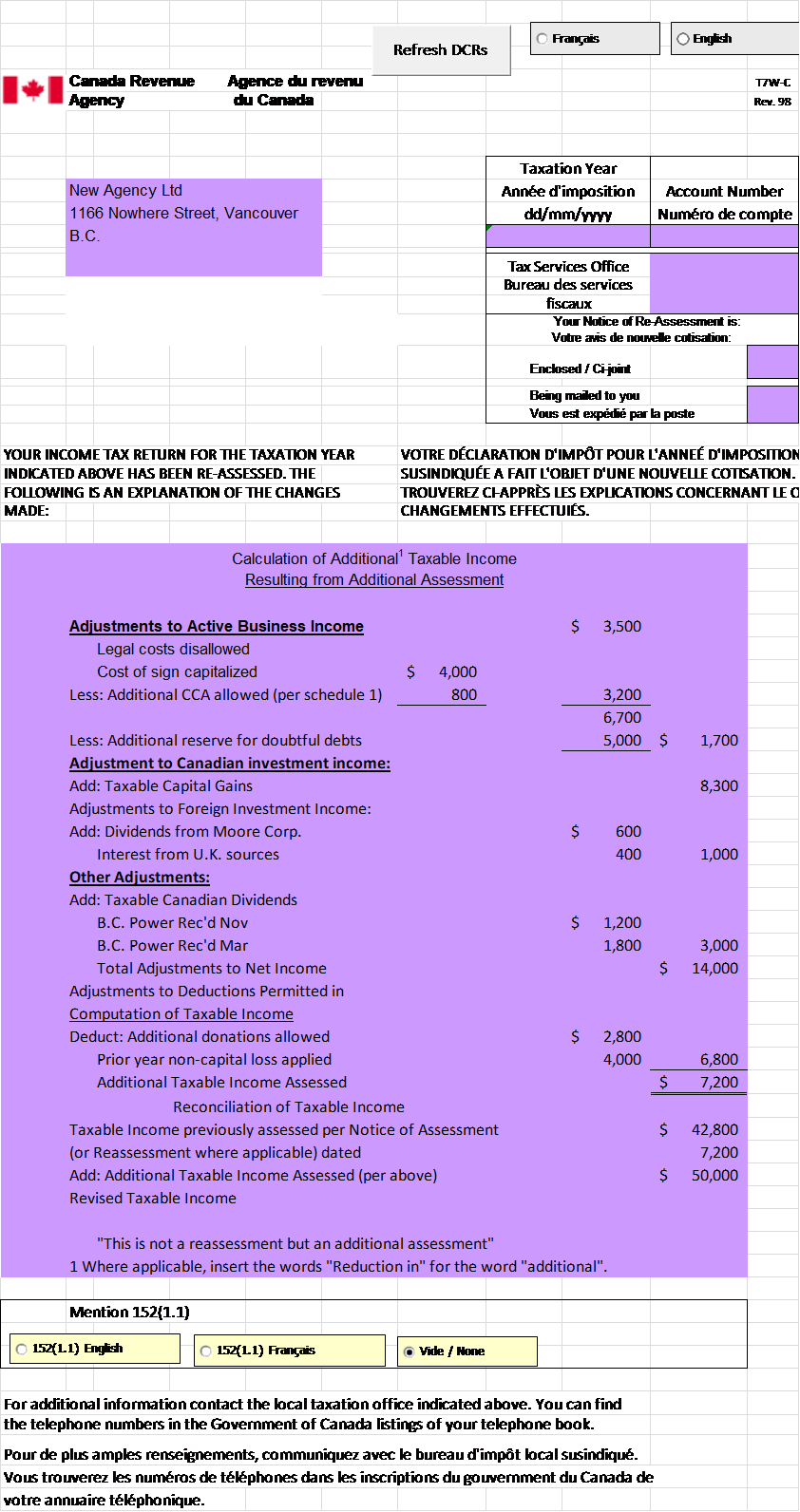
ABC Ltd. 1000 Main Street Anytown, BC A2A 2A2 |
||
| Net Income as filed | $12,000.00 | |
| Adjustment to Active Business Income: |
|
|
| Deduct: Reduction to Business Income |
$5,000.00 | |
| Adjustment to Canadian Investment Income | ||
| Add: Revised Proceeds of Disposition | $14,000.00 |
|
| Less: Adjusted Cost Base | 2,000.00 |
|
| Revised Capital Gain | $12,000.00 | |
| Revised Taxable Capital Gain | 9,000.00 | |
Revised Net Income |
$16,000.00 | |
| Revised Taxable Income | $16,000.00 | |
| (Prepared from a signed return) | ||
| Note: Leave the notice of assessment boxes and the assessment date blank. | ||
(mailing address) John E. Doe ABC Ltd. 1000 Main Street |
||
| Active Business Income: | ||
| Net Business Income | $10,000.00 |
|
| Canadian Investment Income | ||
| Add: | ||
| Proceeds of Disposition |
$15,000.00 | |
| Less: Adjusted Cost Base |
1,000.00 |
|
| Capital Gain | $14,000.00 | |
| Taxable Capital Gain | 10,500.00 | |
| Net Income | $20,500.00 | |
| Deduct: Non-Capital Loss from prior years |
5,000.00 |
|
| Taxable Income | $15,500.00 | |
| "This corporation income tax return has been prepared and assessed under the provisions of subsection 152(7) of the Income Tax Act. The tax payable amount in the Notice of Assessment reflects our action taken." | ||
| (Prepared by the auditor) | ||
| Note: Leave the notice of assessment boxes and the assessment date blank. |
Joe E. Doe 1234 Main Street Anytown, BC A2A 2A2 |
||
| Interest and other investment income | $399.96 |
|
| Other income | 1,200.00 | |
| Net business income | 45,000.00 | |
| Total Income |
$46,599.96 | |
| Deductions from Total Income: | ||
| Alimony allowance paid | $2,400.00 | |
| Carrying charges and interest expense | 75.00 |
$2,475.00 |
| Net Income | $44,124.96 | |
| Deductions from net income: | ||
| Non-capital losses of other years (see loss schedule attached) | 5,400.00 | |
| Taxable Income | $38,724.96 |
|
| Non-refundable tax credits: |
||
| Basic personal amount | $6,458.00 | |
| Canada Pension Plan Contribution |
1,938.00 | |
| (Prepared by the auditor) | ||
| Note: Leave the notice of assessment boxes blank. |
| Total income as filed | $52,000.00 |
| Add: Taxable benefit | 1,200.00 |
| Total Income |
$53,200.00 |
| Less deductions from total income as filed | 4,540.00 |
| Revised net income | $48,660.00 |
| Less deductions from net income as filed | 2,000.00 |
| Revised Taxable Income | $46,660.00 |
| Refundable tax credit (see note 1): | |
| Total revised charitable donations | $500.00 |
(Prepared from a signed return)
Note 1: There will be an explanation in this area only when the taxpayer claim has been increased by an audit adjustment.
Note 2: Leave the notice of assessment boxes blank.
ABC Ltd. 1234 Main Street Anytown, BC A2A 2A2 |
||
| Net Income as filed | $12,000.00 | |
| Adjustment to Active Business Income: |
|
|
| Deduct: Reduction to Business Income |
$5,000.00 | |
| Adjustment to Canadian Investment Income | ||
| Add Revised proceeds of disposition | $14,000.00 |
|
| Less adjusted cost base | 2,000.00 |
|
| Revised capital gain | $12,000.00 | |
| Revised taxable capital gain | 9,000.00 | |
Revised Net Income |
$16,000.00 | |
| Revised Taxable Income | $16,000.00 |
ABC Ltd. 1234 Main Street Anytown BC A2A 2A2 |
||
| Active Business Income: | ||
| Net Income as filed |
$10,000.00 |
|
| Canadian Investment Income: | ||
| Add: Proceeds of disposal | $15,000.00 | |
| Less: Adjusted Cost Base |
1,000.00 |
|
| Capital Gain | $14,000.00 | |
| Taxable Capital Gain | $10,500.00 | |
| Adjusted Net Income | $20,500.00 | |
| Deduct non-Capital Loss from previous years |
5,000.00 |
|
| Taxable Income | $15,500.00 |
"This corporation income tax return has been prepared and assessed under the provisions of subsection 152(7) of the Income Tax Act. The tax payable amount in the notice of assessment reflects our action taken."
(Prepared by the auditor)
Note: Leave the notice of assessment boxes and the assessment date blank.
A-11.2.9 Bankrupt and deceased taxpayers mailing address
When the taxpayer is reassessed while in bankruptcy, address Form T7W-C, Explanation of changes on reassessment, as follows:
Corporation
With trustee
Mr. John Doe
Trustee in Bankruptcy of the Estate in Bankruptcy of ABC Ltd.
Address to Trustee's address
The trustee's first name must be shown, and also, preferably, their middle initials, if known.
Without trustee
ABC Ltd. (in Bankruptcy)
Address to taxpayer's mailing address
Corporation in liquidation
Mr. John Doe, Liquidator
ABC Ltd.
Address to liquidator's address
Corporation in receivership
There is no specified style. Use the liquidation format.
Individual
Bankrupt
Trustee of the Estate of John Doe
Address to trustee's address
Deceased
T1 deceased (Date of death return)
John Doe, Deceased
c/o Jane Doe, Executrix (Executor / Administrator)
Address to Executrix / Executor
Note: The word “deceased” is not mandatory but is preferred.
T3
The Estate of the Late John Doe
c/o Jane Doe, Executrix
Address to Executrix / Executor
A-11.2.10 Form T99, T1 and T3 tax calculation information
To accurately prepare the entries for computer-generated reassessments, follow the instructions in this appendix.
Many related forms are referenced and must be taken into account to calculate T1 and T3 reassessments on Form T99 and to update the taxpayer’s file. Go to Forms and publications.
Internal forms to process assessments and reassessments are also available in Integras.
Form T99M, T2/T1/T3 supplementary tax calculation information, was eliminated in April 2013 and is no longer needed to complete Form T99, which has been revised to reflect eliminated Form T99M. Complete Area G on Form T99 if there is a change to multiple jurisdictions.
Tax calculation information -T1 reassessment
Strictly follow the instructions.
Identification area
Name of taxpayer or trust – Enter the name as shown on the return or the most recent reassessment in the file. PRINT the usual first name and initials first, and the surname last. For deceased taxpayers, enter “Estate of the late” before the name.
Account number - Enter the social insurance number (SIN) of the taxpayer being reassessed (to be included on Form T7W-C, Explanation of changes on reassessment). Enter a trust account number for a trust.
Identification area revised – Tick the “Yes” box, if the identification area is revised or the “No” box, if the identification area is not changed.
To change information on the taxpayer master file (TAPMA), enter the data online; use the Online Reassessment Program (RAP) or RAPID Option "L." Form 494, TAPMA master file change, and Form T495, Address/name change, are no longer used.
Changes that may be needed to the TAPMA account include:
- Spouse or common-law partner's account number
- Marital status
- Spouse or common-law partner's given name
- Remitter type
- Immigrant/emigrant status
- Language
- Previous surname
- Deceased status
- Birth date
- Bankrupt status
- Given names
- Surname
- Regular address, and
- Installment address
Tax year – Enter the taxation year being reassessed.
Current mailing address – Verify the name and address displayed on RAPID Options “I” or “E” before completing this area. Print the taxpayer’s most recent known mailing address, if different from the address shown on page 1 of the income tax and benefit return. If the address is different from the address on the current reassessment, indicate in red on the top of Form T99, “address for this notice only.” For a deceased taxpayer, change the address to indicate the name and address of the estate’s executors.
Area A –T7W-C EXPLANATION AREA
The explanation of changes must adequately describe each source of income being adjusted. Indicate the keypunch field number of the income area being adjusted in the “K.P. field number adjusted” column. When adjusting self-employment income, include both the gross and net self-employment income, as both fields must be keyed. Space is available for any additional comments or statements to be noted on Form T7W-C following the revised taxable income amount. List any headings required.
Complete the applicable blocks in respect to the notice of reassessment.
- Nil notice to be issued – Tick the box if it applies.
- Enclosed – To be completed by AIMS.
- Being mailed to you – To be completed by AIMS.
- English – Tick the box if taxpayer's notice is to be issued in English.
- French – Tick the box if taxpayer's notice is to be issued in French.
List changes only.
- No reconciliation to the previous total or taxable income is required. Only items changed as a result of the audit need be detailed.
- For example, should the income adjustment also increase the amount of the charitable donations allowable that would be subject to the 75% net-income limit for the year (resulting in increase in non-refundable tax credit), this will automatically be adjusted by the AIMS. However, if the actual amount of acceptable charitable donations has been adjusted, it will be shown under the applicable area of Form T7W-C.
Update each keypunch field that is changed on the reassessment and make adjustments to the fields affected by these changes. To ensure accurate preparation of the entries for the computer-generated reassessments, the instructions in this appendix have to be followed. Leave sufficient space for the clerk to complete the form, when listing adjustments. The narrative in the T7W-C EXPLANATION AREA contains an accurate and detailed description of each source of income being adjusted. For more information, go to Income Tax Audit Manual, Appendix A-11.2.2, Sample format for Form T7W-8, Explanation of assessment or of change made.
Enter the amount in the right hand column for the adjusted keypunch field on Area A. Make sure that the direction of the adjustment is designated ("+" or "-") properly, otherwise the taxpayer may not be reassessed correctly. If the field being changed is a positive amount (for example, business income is + $10,000.00), enter a “+” sign for an increase or a “-” sign for a decrease. If the field being changed is a negative amount (for example, the business loss is - $10,000.00), enter a “-” sign to increase the negative (loss) amount or a “+”sign to decrease the negative (loss) amount. Refer to the Income adjustment chart that follows.
| To increase a self-employment business loss of $5,000.00 to $12,000.00 |
Enter: - 135. |
| To decrease a self-employment business loss of $500.00 to $100.00 |
| Enter: + 135. |
| To change a self-employment business loss of $500.00 to a gain of $100.00 |
| Enter: + 135. |
The keypunch fields for gross income from self-employment, gross rental income, and gross proceeds on property dispositions need not be updated.
If an incorrect keypunch field was used on the initial assessment, make the correction showing, for example, 141 to 143, in the keypunch field column. This signifies that fishing income was incorrectly shown as farming income on the initial assessment and is to be corrected.
Capital gains/losses – Describe the capital disposition changes that must include both the revised total capital gain/loss and the revised taxable capital gain/loss to provide the taxpayer with a complete explanation of the change on Form T7W-C issued. Adjust only the total capital gain/loss field for update (see Chart of keypunch fields for capital gains/losses (Schedule 3) that follows), as the computer program automatically calculates the taxable portion or the amount of loss allowed to be included in the revised taxable income amount.
- Provide the keypunch field for the source of the capital gain/loss being adjusted as indicated on the chart that follows.
- Ensure the taxpayer's interest, dividend, and capital gain deduction has been adjusted to allow the taxpayer the maximum deduction in accordance with the adjustments made.
| Qualified small business corporation shares | Field 107 |
| Qualified farm property and qualified fishing property | Field 110 |
| Mortgage foreclosures and conditional sales repossessions | Field 124 |
| Mutual fund units and other shares including publicly traded shares | Field 132 |
| Real estate, depreciable property and other properties | Field 138 |
| Bonds, debentures, promissory notes and other similar properties | Field 153 |
| Other mortgage foreclosures and conditional sales repossessions | Field 155 |
| Personal-use property | Field 158 |
| Listed personal property | Field 159 |
| Farming and fishing income eligible for the capital gains deduction from the disposition of eligible capital property | Field 173 |
| Information slips – capital gains (or losses) from all T5, T5013, T4PS | Field 174 |
| Information slips – capital gains (or losses) from all T3 | Field 176 |
| Capital loss from a reduction in business investment loss | Field 178 |
| Reserves from line 6706 of Form T2017 | Field 192 |
If there is more than one adjustment in any area, give only the accumulated figures. If necessary, use a supplementary schedule.
Capital gains/loss: Reserves – where applicable, Form T7W-C description must include details concerning prior and current year reserves. For family farm property, family fishing property after May 1, 2006, and small business corporation shares sold to a child of the taxpayer, reserves that relate to disposition of capital property after November 12, 1981, must be shown separately from all other reserves (see keypunch fields). Separate keypunch fields are provided for reserves on Schedule 3 and these fields must be updated where changes are made. See Chart of application of losses with reserves that follows.
| The taxpayer filed a 2008 return with this information: | ||
| Net capital gain Real estate | $45,000 |
|
| Less: Current year reserve |
2,000 | |
| Net gain | $43,000 |
|
| The total capital gain for the year was $43,000 when the return was initially assessed and a taxable gain of $21,500 ($43,000 x 50%) was included in calculating total income. |
||
| Reassessment on the 2008 return is now processed to increase the net capital gain to $75,000 and add an additional reserve of $3,000. | ||
| Form T7W-C explanation on Form T99 includes: | ||
| Add: Revised net capital gain Real estate | $75,000 | |
| Less: Previous net capital gain Real estate |
$45,000 | |
| Additional net capital gain | $30,000 |
KP 138 |
| Add or (deduct) additional reserve from line 6706 of Form T2017 (negative amount to be shown in brackets) | ($3,000) |
KP 192 |
| Net gain | $27,000 |
|
| Additional taxable capital gain (at 50%) | $13,500 |
| The taxpayer filed a 2008 return with this information: | ||
| Net capital loss Shares | $2,500 | |
| Net capital gain Real estate | $1,200 | |
The total capital loss was $1,300 when the return was initially assessed and an allowable capital loss of $650 ($1,300 x 50%) was included in calculating total income. |
||
A reassessment on the 2008 return is processed to increase the capital loss on shares to $6,000. |
||
| Form T7W-C explanation on Form T99 includes: | ||
Subtract Previous net capital loss Shares |
$2,500 |
|
| Additional Net capital loss Shares |
3,500 |
KP 138 |
| Revised Net capital loss Shares | $6,000 |
|
| Less Previous net capital gain Real estate | 1,200 | |
| Revised Total capital loss | $4,800 |
|
| Less Capital loss reported | 1,300 |
|
| Additional Capital loss allowed | $3,500 | |
| Maximum Capital loss allowed in 2008 |
1,200 | |
| After this adjustment, the revised capital loss on shares is $6,000, of which $1,200 has been applied to the maximum capital gain. | ||
| Reassess the 2007 return to allow the remaining $2,400 (50% of $4,800) as the unclaimed net capital losses of other years, assuming that the net capital gain in 2007 is equal to or more than $4,800. | ||
Form T7W-C explanation on Form T99 for the 2007 return being reassessed includes this deduction from revised net income: |
||
| Capital loss of other years | $2,400 |
KP 253 |
Year 2000 inclusion rates
For dispositions of capital property made after February 27, 2000, the inclusion rate for capital gains and capital losses has been reduced from 75% to 66 2/3%. For dispositions of capital property made after October 17, 2000, the inclusion rate for capital gains and losses has been reduced from 66 2/3% to 50%. For individuals (and other taxpayers, including corporations with a taxation year corresponding to the calendar year), inclusion rates applicable for 2000 are:
| Inclusion rate per period | ||
|---|---|---|
| Period | Date | Taxable |
| 1 | January 1st to February 27th | 75% |
| 2 | February 28th to October 17th | 66 2/3% |
| 3 | October 18th to December 31st |
50% |
As with individuals, calculate the net gain or loss for each period.
When possible, show multiple adjustments in the same order as they appear on the return.
Use a second Form T99 if there is not enough space for the explanation on the first form. Staple the forms together with the adjustments to total income area on top. Alternatively, consider preparing a schedule, and show net adjustments on Form T99 according to the "attached schedule." When listing adjustments, leave sufficient space for the Tax Cal unit.
Capital losses – Application to other years
The application of losses may require the reassessment of a prior and/or subsequent year (see application of losses chart above).
- Calculate the allowable losses and advise how they are to be applied.
- Complete Form T99 for each year reassessed.
For more information, go to Income Tax Audit Manual:
- Chapter 29, Losses
- Chapter 11.3.3, Application of losses
Capital gains deduction and Form T657, Calculation of Capital Gains Deduction
Use Form T657 when the capital gains deduction claimed under section 110.6 of the ITA is changed. Send a copy of the revised Form T657 to the taxpayer. Taxpayers must request any additional allowable deductions in writing. A copy of the revised Form T657 is placed in the permanent document (PD) folder. Indicate on the top right corner of Form T657 that the deduction or form has been revised and the date it was revised.
Non-refundable tax credit area
Complete this portion if changes are needed as a result of the audit. No reconciliation to the previous total of the non-refundable tax credit (NRTC) is required – only items to be changed need to be detailed. Type a footnote on Form T7W-C to explain briefly why the credit is changed, but no calculation is needed, as it will be reflected directly on the notice of reassessment.
Any additional information the taxpayer should have is added at the bottom of the Form T7W-C explanation area, allowing sufficient space for the audit review support clerk to arrive at the revised taxable income.
Complete this information, if applicable:
Account number – Maximum 9 digits. Enter the applicable account numbers of the client involved, if applicable. Precede the number with a 0 if it is only an 8-digit number.
AIMS case number – 8-digit number assigned by AIMS for each case.
AIMS file number – 9-digit number assigned by AIMS for the principal file in the case.
Appeals case number – Case number assigned for Appeals, if applicable.
Taxpayer Relief Registry entry number – 8-digit number assigned by the Taxpayer Relief Registry (TRR) system. The TRR tracks taxpayer relief requests such as the number of penalties and/or interest waived and/or cancelled and refunds beyond the normal three-year period.
However, there is no specific box or line for Taxpayer Relief Registry entry number on the form. It can be hand written at the bottom of the form.
Area B – TO BE COMPLETED BY ONLINE RAP AREA
This area is completed by the AIMS clerk.
Area C – PENALTIES
Section of federal act
Enter the applicable subsection of the ITA: for example, 162(1), 162(2) or 163(1), 163(2)(a), (c), and (d).
Province and territory and Section of the provincial and territorial act
Enter the name of the province and/or territory and the section of the provincial and territorial act under which the penalty is being levied. For more information, go to Income Tax Audit Manual:
- 28.3.8, Provincial and territorial income tax provisions regarding repeated failure to report amounts; and
- 28.4.20, Provincial and territorial income tax provisions regarding gross negligence penalties.
Net amount subject to penalty
- For returns assessed or reassessed with a penalty under subsection 163(1) and/or 163(2) of the ITA, clearly note on Form T7W-C or Form T7W-C (PROV.), the amount of income subject to penalty so that the non-agreeing provinces (Alberta and Quebec for T2, Quebec for T1) are able to reconcile the amount subject to penalty.
- If the net amount subject to penalty is reduced by increased deductions for CPP, EI, other employment expenses, RRSP, etc., the required adjustment will be calculated by AIMS.
Other tax deducted, non-resident tax deducted
- Enter the additional tax deductions related to the penalized income added on reassessment.
Levy penalty if under $100
- Tick the “Yes” box if a penalty is to be levied if under $100 or the “No” box if no penalty is to be levied if under $100.
Area D – FOREIGN TAX CREDIT
- Enter the amounts in the applicable spaces.
- Provide the names of the countries and the applicable amounts for each country if there are foreign tax credits for more than one country.
- Exclude from "Foreign tax paid on foreign non-business income," amounts deducted under subsection 20(12) of the ITA.
Area E – FEDERAL INVESTMENT TAX CREDIT
This area must be completed regardless of whether the investment tax credit is being adjusted. Tick the appropriate boxes and complete the applicable blocks.
Federal investment tax credit (no change)
- If no adjustment is to be made to the federal investment tax applied on the initial assessment or the last reassessment, enter the amount of tax credit previously allowed. If this area is left blank, the computer will automatically allow the taxpayer the maximum credit available on reassessment.
Refundable (no change)
- Enter the amount of the investment tax credit used to calculate the refund allowable in the block annotated "ITC used."
- Enter the amount of the tax credit refund allowed previously, if no change is to be made to the amount allowed on initial or the last reassessment.
Federal investment tax credit (ITC) (revised)
Investment tax credit application
Complete the blocks as follows:
- Carried forward from preceding tax years – Enter the amount of tax credit unapplied from previous years whether it is to be used or not on this reassessment, less any credit that has expired in the current year.
- Current year credit – Enter the total amount of the investment tax credit available for the current tax year, this would take into account any adjustments to the rate or qualified property acquired.
- Investment tax credit applied from subsequent years – Enter the actual amount of credit to be applied (not the amount available) to the current year tax credit.
- Total credit available – Enter the total of block 1, 2 and 3.
- Investment tax credit allowed in the year – Enter the amount of tax credit to be applied to the current tax year. The full amount of block 3 (carry-back) should be used.
- Investment tax credit used for refundable ITC – Enter the amount of investment tax credit to be used in calculating the amount refundable to the taxpayer on this reassessment. This should be the full amount used, not the change to the amount. Enter in the refund block the amount of the refundable investment tax credit to be allowed on this reassessment (for example, $10,000 ITC at 20% = $2,000).
- Investment tax credit applied to prior years (carried back) – Enter the amount of tax credit that is to be carried back to a prior year.
- Investment tax credit available for carry forward – Enter the difference between total credit available (block 4) and the total of the amounts used in investment tax credit allowed (block 5), investment tax credit used for refundable (block 6) and investment tax credit applied to prior years (block 7). This amount should be brought forward to block 1 of Area E on the subsequent tax year, if there are concurrent reassessments.
Note: Ensure that a copy of the revised Form T2038 is forwarded to the taxpayer with Form T7W-C.
Qualified property acquired in the taxation year
Complete any changes to the qualified property acquired in the taxation year and the applicable rate to recalculate the investment tax credit earned for the current year. Ensure that only the qualified property and rate that are being changed are entered. Remember to use any unchanged amounts to calculate the total credit available for the tax year. The adjustment amount is reflected as the full amount of qualified property, not just the change (that is, previous qualified property was 50,000; revised amount is 70,000).
Investment tax credit carried back
Enter the available investment tax credit to be carried back in the block in the lower right-hand area. Indicate the year and the amount carried back.
For more information, go to Form T2038(IND), Investment tax credit (Individuals).
Area F – SPECIAL TAX CALCULATION INSTRUCTIONS
Tick the appropriate box on the left-hand side of the form if any of the indicated items is to be revised. Enter the revised amounts in the applicable box on the right side of the form, ensuring that the revised amount is entered, not just the amount of the change.
Labour-sponsored funds tax credits – Enter the net cost to the individual (or to a qualifying trust for the individual in respect of the share) for the original acquisition of the share by the individual. The tax credit is generally 15% of the net cost to the individual (or to a qualifying trust for the individual in respect of the share) for the original acquisition of the share by the individual or by the trust under subsection 127.4(6) of ITA. The allowable credit cannot be more than 15% of the net cost, to a maximum of $750 per year under subsection 127.4(5) of the ITA.
Dividend tax credit – Enter the taxable amount of dividends to be included in the taxpayer's income, ensure that the amount entered is the total of the sum of all eligible dividends (previous plus change) and other than eligible dividends (previous plus change). Specify the amount for taxable amount of eligible dividends and other than eligible dividends at the bottom of Area F.
For more information on the taxable amount of dividends (eligible and other than eligible) from taxable Canadian corporations, go to Schedule 4, Statement of Investment Income.
Investment tax credits –Enter the revised investment tax credit.
Federal political contribution tax credit – Enter the amount of revised contribution that is eligible for the current year tax credit.
Late filing penalty – Enter the amount of subsequent year loss if one applies; otherwise, tick the box.
Additional tax deductions at source (such as T4 slips) – Enter the amount of the additional tax deductions, ensuring that amended T4 and other relevant documents are in the taxpayer's file, if revised.
Other federal tax credits (specify) – Enter the amount of revised other federal tax credits, if applicable.
Provincial political contribution tax credit – Enter the amount of revised contribution that is eligible for the current year tax credit, if applicable.
Part XII.2 tax credit – Enter the amount of revised Part XII.2 tax credit.
Environmental tax credit - Enter the amount of revised environmental tax credit, if applicable.
Allowable business investment loss (ABIL) - Enter the amount of the revised allowable business investment loss. For more information, go to:
GST/HST credits – Enter the amount of revised GST/HST credits, if applicable.
Other provincial tax credits (specify) – Enter the amount of revised other provincial tax credits, if applicable.
Other credits (specify) – Enter the amount of revised other tax credits, if applicable.
Area G – MULTIPLE JURISDICTIONS
Complete this area only when there is income attributable to a permanent establishment outside the province in which an individual was resident in the year.
Complete Area G if any of the indicated items is revised. Enter the revised amounts in the appropriate box on the form, and make sure that the revised amount is entered, not just the amount of the change.
TYPE A – Type A Multiple Jurisdictions calculation is required.
If the aggregate of the business income (excluding any business losses) exceeds the individual's net income, tick the box in TYPE A.
TYPE B – Type B Multiple Jurisdictions calculation is required.
If the aggregate of the business income (excluding any business losses) is less than the individual's net income, tick the box in TYPE B.
Business income (%) column – Determine the percentage of business income allocation to each jurisdiction in business income (%) column.
Note: For more information on how to allocate business income, go to:
- Provincial Income Allocation Section – Reference Material
- Communiqué AD-21-01, Provincial Income Allocation Audits, see Other Issues – Multiple Jurisdictions Income Reallocation (MJIR) Schedule
Business income column – Allocate the amount of business income (from business, profession, commission, farming, and fishing) earned in the year to each province and territory where a taxpayer had a permanent establishment in the year.
Other than business income column – Allocate employment earnings, income from property, and other sources of income other than business income to the province of residence on December 31st.
Total income column– Enter the sum of the two columns, business income and other than business income.
Note: Foreign business income will generally be allocated to “Outside Canada.”
Provincial or territorial income tax relating to business income is generally payable to the province or territory where the permanent establishment generating that income is located.
However, there are situations where, at the end of the year, an individual resides in a province or territory of Canada, but all or part of the individual's business income, including income received as a retired, inactive, or limited partner, for the year was earned and can be allocated to a permanent establishment outside that province or territory, or outside Canada. If income was allocated to more than one jurisdiction on a previous assessment or reassessment for T1, Form T2203 will be in the file.
For more information on multiple jurisdictions for T1 returns, go to Form T2203, Provincial and Territorial Taxes - Multiple Jurisdictions.
The audit of the provincial allocation formula is necessary to ensure the interests of the agreeing provinces (all provinces except T2 – Alberta and Quebec, T1 – Quebec) are protected. For more information, go to 12.14.0, Multiple jurisdictions and allocation of income. Auditors should be concerned about allocations, as total taxes may not change but the allocation of taxes to particular provinces may be affected.
Area H - T3 RETURNS
Indicate sections of the federal act under which tax is to be calculated. For more information, refer to Special tax calculation instructions of a T3 reassessment below.
Upon completion of the form, enter the auditor's name, TSO, section, group-unit number, and the auditor’s telephone number. Enter the date the file is being processed in the area provided at the bottom of page 3.
IIf the reassessment results in an elective section being applied or adjusted, it will be the responsibility of the auditor to ensure that all required prior years information is included in the file before it is forwarded to AIMS.
In all other situations where it is evident that the taxpayer filed a return for the missing years and the tax data for those years are not available, contact the taxpayer for assistance. Where a taxpayer contact fails to produce the necessary prior year tax data to complete a tax calculation, estimates the amounts in conjunction with the taxpayer, using data from available returns.
Tax calculation information – T3 reassessment
Identification area
For instructions, refer to the identification area of Form T99 for a T1 reassessment.
Area A – T7W-C EXPLANATION AREA
To use Form T99 for a T3 reassessment, the auditor will:
- Stroke through total income previously assessed and enter previous taxable income in the hands of the trustee.
- Outline the revised taxable income in the hands of the trustee.
- Ignore the “K.P. field number adjusted” column on the right side of the form.
- Enter the description of all income adjustments in the normal manner.
- Complete all necessary mathematical calculations to arrive at revised taxable income in the hands of the trustee.
The auditor will also be responsible to complete any supporting schedules.
Areas B to F
Complete Areas B to F of Form T99, according to the tax calculation information of a T1 reassessment explained above.
Area G – MULTIPLE JURISDICTIONS
Complete this area only when there is business income attributable to a permanent establishment outside the province in which the trust was resident.
Complete Area G if any of the indicated items is revised. Enter the revised amounts in the appropriate box on the form, and make sure that the revised amount is entered, not just the amount of the change.
TYPE A – Type A Multiple Jurisdictions calculation is required.
Where the aggregate of the business income (excluding any business losses) from lines 06 to 09 of the trust's return (amount cannot be negative) exceeds the total net income from line 50 of the trust's return, tick the box in Type A.
TYPE B – Type B Multiple Jurisdictions calculation is required.
Where the aggregate of the business income (excluding any business losses) from lines 06 to 09 of the trust's return (amount cannot be negative) is less than the total net income from line 50 of the trust's return, tick the box in Type B.
For more information, go to Form T3MJ, T3 Provincial and Territorial Taxes - Multiple Jurisdictions.
Complete the remaining portion of Form T99 according to the tax calculation information of a T1 reassessment explained above.
Special tax calculation instructions
1972 and subsequent tax years
For 1972 and subsequent tax years, complete Area H of Form T99, because of the special types of trusts created. Enter the applicable section of the amended act under which part I tax is to be calculated, in accordance with these sections of the ITA:
- Section 117;
- Section 119;
- Subsection 122(1); and
- Subsection 122(3).
For 1972 and subsequent tax years, initiate Form T2SCH18, Schedule 18, Federal and Provincial or Territorial Capital Gains Refund, whenever a mutual fund trust is entitled to a capital gains refund.
A-11.2.11 Online reassessment program for T1 file
Form T919, Request for online RAP
Completion of form by Audit section
Area A – The auditor enters the case number, the file number, the name and SIN of the taxpayer to be reassessed. Where any of the TAPMA identification information has changed (for example, new address), the auditor will tick the box at the top of the form and provide the new information in the space provided.
Area B – The auditor will enter the process sequence number (PSN) for each year in the space provided and a brief explanation of the adjustment and the KP field affected, the + or – sign and the amount for each adjusted year.
Revisions to certain tax credits may require the spouse or common-law partner's information and tax returns as indicated. The auditor will complete the balance of the explanation (up to 60 characters) in the space provided after the phrase, “We have made an adjustment according to.”
Area C – The auditor enters their name, work location and the date where indicated, and passes the complete package to the team leader.
The team leader, after approving the adjustments, will sign and date Form T919, and then forward for processing as usual.
Completion of form by online reassessment program clerk
Area B – Upon receipt by online reassessment program (RAP), the clerk will enter the RAP online and change any TAPMA information if required. It is important to ensure that matching code 069 is entered on the MISCELLANEOUS INPUT SCREEN. The communication information provided by the auditor will be used for the explanation accompanying the RAP.
The clerk will record any explanation codes that may be necessary in the appropriate spaces on Form T919, as well as any other applicable codes as per TOM 19 EXHIBIT 1970-E.
If the returns cannot be reassessed online, they will be returned to the auditor for processing as a secondary file; otherwise, the file will be passed along for review as usual.
Area C – The audit clerk will have to complete screen 5 (UPDATE FILE RESULTS) from the menu INVENTORY ADD/UPDATE/BROWSE A CASE OR A FILE accessed from the AIMS MAIN MENU.
The clerk will sign and date the form in the space provided.
After verifying the adjustments and coding, the reviewer will sign and date Form T919 and approve the online RAP.
T1 transaction codes
Adjustments requiring transaction code 5 processing
Note: If a reassessment was processed using transaction code 5, any subsequent reassessment must be processed using transaction code 4 or 5.
1. The adjustment is a result of an appeal and:
the adjustment cancelled out of the T1 Cycle for a third time, or
“T420” is noted at the top of Form T99, T1 and T3 tax calculation information
2. There is an adjustment to CPP Refund and the QPP Refund shown on TAPMA is not being adjusted or vice versa.
3. Multiple jurisdiction returns previously assessed tax centre assessment (TCA) or reassessed code 5 with:
- a claim for British Columbia or Newfoundland venture capital tax credit (1995)
- election to average, or
- Manitoba investment tax credit
4. Adjustments to these bankruptcy returns:
- any return for a year prior to the year of bankruptcy
- any return for the year of bankruptcy
- a return for a year subsequent to the year of bankruptcy where both the taxpayer and the trustee have not been discharged, or
- Memo Fields 7814, 7817, 7818, and/or 7819 are being updated with the amounts of the losses (for more information on these fields, refer to TOM 1984.34)
5. A notice of assessment for the year was erroneously issued for a return filed for another year.
6. Data from a duplicate or amended return filed by the taxpayer, where more than one notice of assessment was issued, were combined on reassessment.
7. Any of the sub-codes 61, 62, and/or 65 are present.
8. Special circumstances dictate the desirability of manually issuing a notice of reassessment.
9. The return was previously assessed TCA or reassessed transaction code 5 and section 119 is being applied.
10. A negative balance was calculated on the initial assessment (other than a farmer's and fisher's election to average) and a "NIL" notice of reassessment is being issued.
Note: The federal tax or provincial tax showing on the Data Label or TAPMA will be a negative amount.
11. There is a claim for the Manitoba investment tax credit (current or carry-back).
12. The taxpayer has requested relief under Article XXIV of the Canada-US Tax Convention in respect of excess foreign tax credits.
13. One of the adjustments in a concurrent series is processed using Transaction Code 5; all adjustments in the series must be processed using Transaction Code 5, except for certain cases. Refer to TOM 1913 for the procedures.
14. A reassessment in excess of 20 field changes.
15. A return that will be statute-barred in 30 days or less and no waiver has been filed.
Note: This is for internal adjustments only.
16. An adjustment to reduce a claim for foreign taxes paid due to an adjustment made by a country other than Canada.
17. Reassessment to a tax where a cancellation of interest has previously occurred.
18. Where the issue involves a tax deducted transfer to Quebec and a transfer was previously allowed in respect of a TCA or a transaction 5 reassessment (memo field 438/695 cannot be used to effect the transfer; a DC224 is required).
19. T1 returns that are not updated on TAPMA (that is, subsection 70(2) Rights and things returns).
20. A reassessment involving years off TAPMA.
21. The taxpayer is requesting an adjustment to contribute to CPP based on self-employed earnings without having to revoke a previous election not to pay into the plan.
22. Reassessment to a tax year in which a remission order was previously granted.
Note: Transaction Code 5 is not required if a remission order on Ontario Tax Credit was granted by initial processing. This can be identified by a remission order transaction shown on Option N.5 and the remission order indicator (Field 7932) is not updated on Option C.
23. Reduction of an omission or negligence penalty or a change from negligence penalty to an omission penalty under the taxpayer relief legislation.
24. Reassessment involving a capital gains election late filing penalty.
25. A request processed under voluntary disclosure.
26. An adjustment is requested under taxpayer relief that has an impact on another tax year in which a debit is created.
27. A 163(2) penalty is being applied and the taxpayer is being penalized for the difference in the previous and revised Canada child tax benefit received by the taxpayer's spouse or common-law partner. For more information, go to TOM 19(15) 6.
28. A 163(2) penalty is being applied and the taxpayer is being penalized for the difference in the previous and revised Canada child tax benefit and/or GST/HST credit received by the taxpayer's spouse or common-law partner. For more information, go to TOM 19(15) 6.
Adjustments requiring transaction code 4 processing
Note: If a reassessment was processed using transaction code 4, any subsequent reassessment must be processed using transaction code 4 or 5.
1. Separate foreign business tax credit calculations are required for foreign taxes paid to four or more countries.
2. Separate foreign non-business tax credit calculations are required for foreign taxes paid to four or more countries.
3. Section 119 (election to average for farmers and fishers) has been or is being applied unless the return was processed TCA, in which case a transaction code 5 is required.
4. A gross negligence penalty under subsection 163(2) of the ITA is being applied and the taxpayer made an election under section 119 (election to average for farmers and fishers).
5. A gross negligence penalty under subsection 163(2) of the ITA is being applied and an adjustment is also being made to:
- dividends from taxable Canadian corporations
- tax adjustments
- foreign income
- foreign tax paid;
- overseas employment tax credit
6. A gross negligence penalty under subsection 163(2) of the ITA is being applied on elective income included in the adjustment as a tax adjustment.
7. A gross negligence penalty under subsection 163(2) of the ITA is being applied and there is also a change to the taxing province.
8. A gross negligence penalty under subsection 163(2) of the ITA is being applied and a forward averaging election or withdrawal is present on the return.
9. A gross negligence penalty under subsection 163(2) of the ITA previously applied is being reduced.
10. The return is for 1995 and there is an Alberta, Saskatchewan, or British Columbia royal tax rebate or a Manitoba mineral tax rebate.
11. The adjustment is to allow an ITAR 40 election or an ITAR 40 election was previously allowed:
- another tax adjustment is involved
- the return is for a beneficiary and the tax adjustment must be calculated on the prior year tax data of the deceased, or
- the taxpayer is bankrupt in the year or one of the affected years.
Note: If the criteria shown in number 11 do not apply and the adjustment does not otherwise require a transaction code 4 or 5, process the adjustment as a transaction Code 2.
12. Where the tax year in which the investment tax credit was acquired is part of a concurrent series and an adjustment is being made to carry-back the investment tax credit to a prior year in the series.
13. The refundable Quebec abatement (Field 440) must be reverted to the taxpayer's original figures.
14. Write-off of minor balances.
15. Adjustment to a return with a negative tax resulting from federal and/or British Columbia mining reclamation trust tax credit.
A-11.2.12 Submit Final RAP, T2 tax calculation information
Many related forms are discussed in this appendix and must be taken into account to calculate T2 reassessments in Final RAP and to update the corporation’s file. For forms available on InfoZone, go to Forms and publications.
Tax calculation information T2 reassessments
In submitting Final RAP in Integras, ensure that the information used is based on amounts as originally assessed or as revised by the latest reassessment.
Identification area
- Auditor identification information – Enter the auditor identification information:
Auditor’s name
TSO identifier
Section identifier
Group and unit identifier
Auditor’s telephone number, and
Date that submission is completed
- Corporation identification information – Enter the corporation identification information:
Name of corporation
Taxation year (fiscal period start and end), and
Enter the mailing address if the mailing address is different from the head office address (refer to amalgamated corporations in the case of a corporation where there has been an amalgamation).
- Corporation type – Enter one of the following codes (type of corporation that is changed), if changed:
Code 1 – Canadian-controlled private corporation
Code 2 – Other private corporation
Code 3 – Public corporation
Code 4 – Corporation controlled by a public corporation, or
Code 5 – Other corporation
A change of corporation type may bring significant tax consequences. If the type of corporation changed during the tax year, state the effective date of the change and the corporation type on a previously filed return in Area N.
- Late filing penalty code - Where the return is subject to a penalty, enter Code 1.
Where a penalty was erroneously assessed and the penalty is to be cancelled, enter Code 2, otherwise, leave blank.
- Business number;
- AIMS file number;
- Statute-barred date – Enter the statute-barred date; and
- Waiver of interest – Enter waiving period.
Areas A to M
Tick the "Yes" boxes in Areas A to M if an item has been changed or has been affected by a change. For example, if taxable income is being revised and this change affects the small business deduction, tick the "Yes" box in Area E. Then, enter the revised amount on the applicable revised schedule.
If there is no change to the amount originally claimed by the taxpayer or the amount previously assessed, do not tick the "Yes" box and leave the data field blank.
Area A – Multiple jurisdictions
The audit of the provincial income allocation is necessary to ensure the interests of the agreeing provinces (all provinces except T2 – Alberta and Quebec, T1 – Quebec) are protected. For more information, go to Income Tax Audit Manual, Chapter 12.14.0, Multiple jurisdictions and allocation of income.
Auditors should be concerned about allocations as total taxes may not change but the allocation of taxes to particular provinces may be affected. In addition, some provinces use the provincial income allocation formula for the determination of their capital taxes and HST allocations, making an accurate determination even more important to the agreeing provinces. If taxable income was allocated to more than one jurisdiction on a previous assessment or reassessment, Form T2SCH5, Schedule 5, Tax calculation supplementary – Corporations, will be in the file.
Where the jurisdiction has changed from a multiple to a single jurisdiction, tick the "Yes" box and enter the name of the new jurisdiction.
Where a single jurisdiction has changed to a new single jurisdiction or to multiple jurisdictions (MJ), tick the "Yes" box and enter the name of the new jurisdiction or MJ. If a single jurisdiction has changed to MJ, complete Form T2SCH5 and attach it to the Integras file.
Where there are changes to multiple jurisdictions, tick the "Yes" box and complete Form T2SCH5 and attach it to the Integras file.
Area B – Functional currency
For tax years that start on or after December 14, 2007, corporations resident in Canada throughout the tax year can elect to report in a functional currency, except for:
- investment corporations
- mortgage investment corporations, and
- mutual fund corporations
A functional currency is a currency of a country other than Canada that is:
- a qualifying currency (at time of writing, the British pound, the euro, the Australian and the U.S. dollar), and
- the primary currency in which the taxpayer maintains its records and books of account for financial reporting purposes for the tax year
Form T1296, Election, or Revocation of an Election, to report in a functional currency, must be filed to elect to report in a functional currency.
If an election was made under section 261, tick the "Yes" box and indicate the functional currency used from line 079 of the T2 return:
01 – United States dollar (USD)
02 – Great Britain pound sterling (GBPS)
03 – Australian dollar (AUD), or
04 – European Monetary Union (EURO)
Even if corporations elect to report in a functional currency, they still have to complete lines 840 and 898 of the T2 corporation income tax return in Canadian currency. They cannot change a functional currency once an election is made. If corporations cease to qualify as a functional currency reporter, they must revert to determining their Canadian tax results in Canadian dollars, and cannot make the election again.
Area C – Changes in investment income and income from an active business
Enter revised net income for tax purposes according to Form T7W-C, Explanation of changes on reassessment.
Deduct these items from revised net income:
- Taxable capital gains minus allowable capital losses
- Dividends deductible from income, Income Tax Act sections 112 and 113, and subsection 138(6)
- Property income minus property losses
- Property income from an interest in a trust
- Foreign business income
- Income from a specified investment business, and
- Income from a personal service business
The resulting amount is the total income from active business to enter in the Final RAP in Integras.
Area D – Calculation of taxable income – Loss carry-back
Initial carry-back of losses from subsequent year
Enter the fiscal period end (FPE) of the subsequent year and effective interest date (EID).
Increase in the initial carry-back from subsequent year
Enter the FPE of the subsequent year and EID. The increase will be considered as a separate payment with its own EID if the taxpayer has applied the amount when filing.
Determination of Effective Interest Date (EID)
The rules for determining the EID vary according to the FPE of the tax year in which the loss or tax credit being carried back arose.
The EID is 30 days after the latest of four (4) dates described in paragraph 161(7)(b) of the ITA:
(i) the first day immediately following that subsequent taxation year
(ii) the day on which the taxpayer's or the taxpayer's legal representative's return of income for that subsequent taxation year was filed
(iii) where an amended return of the taxpayer's income for the year or a prescribed form amending the taxpayer's return of income for the year was filed in accordance with subsection 49(4) or 152(6) or paragraph 164(6)(e), the day on which the amended return or prescribed form was filed, and
(iv) where, as a consequence of a request in writing, the Minister reassessed the taxpayer's tax for the year to take into account the deduction or exclusion, the day on which the request was made
Area E– Small business deduction (SBD)
Corporations that were Canadian-controlled private corporations (CCPCs) throughout the full taxation year may be entitled to claim a reduction. Where two or more CCPCs are associated with one another, the annual business limit must be allocated among them. If associated, enter the amount allocated in Form T2SCH23. For more information, go to Form T2SCH23, Schedule 23, Agreement Among Associated Canadian-Controlled Private Corporations to Allocate the Business Limit.
Effective January 1, 2008 the SBD rate is 17%. The rate is prorated for tax years that straddle December 31, 2007.
The SBD available is 17% of the least of the:
- income from active business carried on in Canada
- business limit
- taxable income
- reduced business limit
Active business income
Enter the amount of active business income according to Form T7W-C. The corporation calculates this amount on Form T2SCH7, Schedule 7, Aggregate Investment Income and Active Business Income.
Active business income is any income earned from a business, including any income incidental to the business but does not include income from a specified investment business or from a personal services business.
For a complete definition of active business income, see paragraphs 4 to 8 in Income Tax Interpretation Bulletin IT-73R6, The Small Business Deduction. Paragraph 10 of IT-73R6 explains the meaning of “carried on in Canada”.
Business limit for the year
Enter the amount of business limit according to Form T7W-C.
If a corporation is not associated with any other corporation, their business limit for the purposes of claiming an SBD is:
- $200,000 in 2002 and previous years
- $225,000 in 2003
- $250,000 in 2004
- $300,000 in 2005 and 2006
- $400,000 in 2007 and 2008
- $500,000 in 2009
Note: The business limit will be prorated for taxation years that are not calendar years.
CCPCs that are associated with other CCPCs must file Form T2SCH23, Schedule 23, Agreement Among Associated Canadian-Controlled Private Corporations to Allocate the Business Limit. For instructions, see Schedule 23 in Chapter 2 of Tax Guide T4012, T2 Corporation - Income Tax Guide.
Associated corporations can elect not to be associated for the purposes of the SBD by filing Form T2SCH28, Schedule 28, Election not to be Associated Through a Third Corporation. For instructions, see Schedule 28 in Chapter 2 of Tax Guide T4012, T2 Corporation - Income Tax Guide.
Large CCPCs that have taxable capital employed in Canada of $15 million or more do not qualify for the SBD:
- For CCPCs with taxable capital employed in Canada between $10 million and $15 million in the preceding taxation year, the business limit is reduced on a straight-line basis.
- Associated groups of CCPCs with combined taxable capital employed in Canada of more than $10 million will have a reduced business limit.
For the formula to calculate a large CCPC's reduced business limit, see Line 425 in Chapter 4 of Tax Guide T4012, T2 Corporation - Income Tax Guide.
Taxable income
Write in the amount of taxable income for the purposes of calculating the SBD.
Area F – Manufacturing and processing profits deduction
Form T2SCH27, Schedule 27, Calculation of Canadian Manufacturing and Processing Profits Deduction
Enter the revised Canadian manufacturing and processing profits.
Income that is eligible for the small business deduction is not eligible for the manufacturing and processing profits deduction.
Give the details (by preparing a revised schedule) for the revised calculation of manufacturing and processing profits. If the net income of the corporation is changed, the manufacturing and processing profits should be re-calculated and shown in the Final RAP in Integras.
Area G – Part IV tax (private and subject corporation at any time during the year)
When the corporation was a private or subject corporation at any time in the tax year, tick the "Yes" box and enter the revised amount of taxable dividends received that is subject to Part IV tax (subsection 186(1) of the ITA) in 1 of Area G.
Enter the revised amount of non-capital loss and/or revised farm loss claimed or to be claimed for purposes of Part IV tax in 2 of Area G.
If losses are applied from a subsequent year, enter the FPE and EID (See Area D).
Area H – Dividend refund
When the corporation was a private or subject corporation at the end of the tax year, enter the amount of taxable dividends paid in the tax year.
Area I – Surtax credit (applicable to taxation years 2006-2008)
Enter Part 1.3 tax payable for the year.
From above, deduct the following:
- surtax credit: current year
- carry-forward from preceding years, and
- carry-back from subsequent years
Enter the balance on total surtax credit (not to exceed Part 1.3 tax payable less Part 1.3 tax credit utilized before 1992).
For more information, go to Form T2SCH37, Schedule 37, Calculation of Unused Surtax Credit.
NOTE: Part I.3 tax is repealed for taxation years that begin after 2005 but remains relevant to calculate the unused surtax credit for years 2006 – 2008. After 2008, the unused surtax credits cannot be carried back. However, the surtax credit can also be applied against Part VI tax until 2015.
Area J – Federal investment tax credit (subsection 127(5) of the ITA)
If federal investment tax credit applies, complete Form T2SCH31, Schedule 31, Investment Tax Credit – Corporations, and attach the form in the file.
Follow the detailed instructions included with the form.
Area K – Section 163 of the ITA penalties
The auditor will provide an analysis of the total income subject to a penalty by type:
- Active business income or non-qualifying business income;
- Part IV Dividends;
- Canadian investment income;
- Foreign income from:
- Business income; and
- Non-business income.
- Other income.
When the active business income includes adjustments to Canadian manufacturing and processing profits or taxable production profits from mineral resources or gas & oil wells, provide a further analysis of the active business income under Area N Special instructions.
Section of federal act
Enter the applicable section.
Province and section of provincial act
Enter, where applicable, the section of the provincial and territorial act under which the penalty is being levied and the name of the province and territory. For more information, go to:
- 28.3.8, Provincial and territorial income tax provisions regarding repeated failure to report amounts; and
- 28.4.20, Provincial and territorial income tax provisions regarding gross negligence penalties.
Additional tax deductions
Enter the changes to the additional tax deductions or credits related to the penalized income added on reassessment.
When a penalty was levied on a previous reassessment and additional tax deductions were allowed, those tax deductions should be included in the additional tax deductions applied on the latest reassessment.
Non-penalized adjustments
"Non-penalized adjustments" box – if one of the three items was ticked, the lower base tax will be re-calculated excluding the particular item.
A ticked Yes box means that deductions or credits were claimed in error by the corporation on initial assessment or the latest previous assessment. Tick the identified adjustments not subject to penalty because of the nature of the item or amounts. This will cause the tax calculation unit to undertake a lower base tax computation excluding these items.
For example, if the "small business deduction" box is ticked, the lower base tax will be computed without the benefit of the small business deduction. Since this box will be completed in a situation where the particular item is being disallowed for reasons not amounting to gross negligence, the result will be a reduced penalty under subsection 163(2) and/or 163(1).
For more information, go to Chapter 28.0, Penalties.
Area L – Appeal
Tick "Yes" box, if the file is under a Notice of Objection or under Appeal.
Area M – Other tax credits
If there are changes to provincial or territorial tax credits or rebates, tick the "Yes" box and complete Form T2SCH5, Schedule 5, Tax Calculation Supplementary - Corporations, and attach the form in the file.
If there are changes to federal foreign and/or federal logging tax credits, tick the "Yes" box, and complete Form T2SCH21, Schedule 21, Federal and Provincial or Territorial Foreign Income Tax Credits and Federal Logging Tax Credit, and attach the form in the file.
Area N – Special instructions
Special taxes
Non-Canadian corporations carrying on business in Canada – Provide the amount of Part XIV tax if applicable. AIMS will pre-calculate federal Part I tax and provincial tax at the auditor’s request.
Tax credits
Provide details of Part XIII tax and non-resident tax deductions supported by NR4 slips.
Provide the amount of patronage dividend tax deductions under subsection 135(3) of the ITA which is supported by a T4A slip, Statement of Pension, Retirement, Annuity, and Other Income.
Specialty corporations
Investment corporation (public corporation)
- Provide the amount of the investment corporation deduction, if applicable.
A Canadian public corporation that is an investment corporation, as defined in subsection 130(3), can claim a deduction from Part I tax that the corporation would otherwise have to pay. This deduction is equal to 20% of the taxable income for the year that is more than the taxed capital gains for the year.
- Provide the amount of the "taxed capital gains," if applicable.
Mutual fund corporation (public corporation)
- If the mutual fund corporation qualifies as an investment corporation, provide the investment corporation deduction amount as outlined previously for investment corporations.
- Provide the amount of taxed capital gains.
- If the corporation has redeemed any of its shares in the year, enter the amount of capital gains redemptions determined by the formula under subsection 131(6) of the ITA, and submit the calculation thought Final RAP.
Non-resident-owned investment corporation
- If applicable, provide the amount of the net capital gains on taxable Canadian property.
- Provide the amount of the allowable refund, if the non-resident-owned investment corporation has paid a dividend in the year. The allowable refund will be calculated in accordance with subsection 133(8) of the ITA.
Cooperative corporation
- Provide the amounts of taxable dividends paid in the year for tax years; and
- Note the amount of the net taxable gains.
Credit unions
- If applicable, provide the amount of taxable dividends paid in the year, and the additional deduction from tax otherwise payable under Part I as calculated under subsection 137(3) of the ITA.
General insurance corporation
Note: An insurance corporation, as defined under subsection 248(1), is not subject to Part IV tax on taxable dividends pursuant to paragraph 186.1(b) of the ITA.
Part II tax
Part II tax (Tobacco Manufacturers’ Surtax) may become payable as the result of audit issuing reassessments. Every corporation shall pay a tax under this Part for each taxation year equal to 50% of the corporation's Part I tax on tobacco manufacturing profits for the year.
Review each reassessment separately to determine if any Part II tax is payable as it is not automatic for a reassessment to trigger Part II tax. The auditor must, in addition to advising AIMS, inform the taxpayer that Part II tax is payable as the result of the reassessment.
Waiver
If a "Waiver" was obtained for a particular year, it should be indicated in the Final RAP for that year.
General instructions
- Provide the taxable amounts for elective sections (for example, CCA recapture) and attach the calculation worksheet or a revised schedule (that is, Form T2SCH8, Schedule 8) to the Integras file. It will be the responsibility of the auditor to ensure that all information required from prior years is attached when the file is forwarded to the AIMS unit.
- Advise the AIMS unit of any change in the type of the corporation when it is different than indicated on page 1 of the T2 return.
- Taxable dividends received under subsection 113(2) of the ITA will be noted under Area N.
- If there is a "NIL Notice of Reassessment to be issued," note it in Area N.
- Loss applications of subsequent years – To enable accurate calculation of the late filing penalty and interest calculations, provide the amount of any losses being applied from a subsequent year.
- All files originating from Appeals should show "Appeals" in Area N.
- If there is a request to transfer tax refunds, provide the amount and to whom the amount should be transferred.
- Where the return is the first return of a newly amalgamated corporation or that of a parent corporation for its first tax year after winding-up a wholly-owned subsidiary, provide the date of the amalgamation or winding-up, and the names and account numbers of the predecessor or subsidiary corporations.
Note: For amalgamations and wind-ups, both predecessor and successor corporation returns have to be sent to the Tax Cal unit together, whether there are changes to the returns or not (re: carry-over of balances).
- If changes must be made, but no reassessment is issued, (for example, if taxes are involved in statute-barred year), submit Final RAP to update data: For update purposes only.
- CORTAX printout – Whenever an adjustment is made involving a carry forward from another year, such as a capital or non-capital loss or investment tax credit, obtain a printout to verify the information in the system. Include only the printout affecting the proposed adjustments.
- Provide an Appeals case number and Taxpayer Relief Registry entry number regarding the Proactive Taxpayer Relief for the processor in Area N, if applicable.
A-11.2.15 Instructions for completing Form T287, Priority assessments and reassessments control
The auditor completes three-part Form T287, as follows:
- Statute Barred Date;
- Follow-up Date – Insert date that is ten (10) working days prior to State Barred Date;
- Name of Individual, Corporation, or Trust;
- SIN, corporation number, or Account No.;
- Notice to be issued not later than – Insert last day on which notice may be issued;
- Date of last (Re)Assessment;
- Type of Return;
- Year(s) of return(s);
- Tax Direction – Increase or Decrease;
- ORIGINATED BY, Name, and Tel. No.;
- Reason for Priority; and
- Date in and Date out – Insert date form initiated; and date sent to calculation unit.
A-11.2.16 Permanent document folder and retention period – Under review
For T1 and/or T3
Information to be retained for a period exceeding five years or indefinitely
Documents that have a useful life in excess of five years or considered to have an indefinite life by the originator include:
1. Special elections, agreements, and returns:
| Form | Title |
|---|---|
| T123 | Election on Disposition of Canadian Securities |
| T664 | Election to Report a Capital Gain on Property Owned at the End of February 22, 1994 |
| T997-2 | Employment Tax Credit Discrepancies |
| T1157 | Election for Child Support Payments |
| T1158 | Registration of Family Support Payments |
| T2011 | Election to Average Income by Farmers and Fisherman |
| T2022 | Election in Respect of the Sale of Debts Receivable |
| T2023 | Election in Respect of Loans from Non-Residents |
| T2029 | Waiver in respect of the normal reassessment period or extended reassessment period |
| T2034 | Election to Establish Inventory Unit Prices for Animals |
| T2047 | Agreement in Respect of Unpaid Amounts |
| T2049 | Agreement in Respect of Unpaid Remuneration |
| T2057 | Election on Disposition of Property by a Taxpayer to a Taxable Canadian Corporation |
| T2058 | Election on Disposition of Property by a Partnership to a Taxable Canadian Corporation |
| T2059 | Election on Disposition of Property by a Taxpayer to a Canadian Partnership |
| T2060 | Election for Disposition of Property upon Cessation of Partnership |
| T2061 | Election to Defer Capital Gains on Property Otherwise Deemed Disposed of |
| T2062 | Request by a Non-Resident of Canada for a Certificate of Compliance Related to the Disposition of Taxable Canadian Property |
| T2062A | Request by a Non-Resident of Canada for a Certificate of Compliance Related to the Disposition of Canadian Resource or Timber Resource Property, Canadian Real Property (Other Than Capital Property), or Depreciable Taxable Canadian Property |
| T2062B | Notice of Disposition of a Life Insurance Policy in Canada by a Non-Resident of Canada |
| T2064 | Certificate with Respect to the Proposed Disposition of Property of a Non Resident of Canada |
| T2065(A) | Election by a Partnership in Respect of Adjusted Cost Base of a Partnership Interest |
| T2065(E) and (F) | Determination of Deemed Cost of a Partnership Interest |
| T2068 | Certificate with Respect to the Disposition of Property of a Non Resident of Canada |
| T2074 | For 1990 and prior: Non Resident Commitment to Pay Tax For 1991 and subsequent – Election, under Subsection 159(4) of the ITA, to Defer Payment of Income Tax on the Deemed Disposition of Property |
| T2075 | Election to Defer Payment of Income Tax, under Subsection 159(5) of the Income Tax Act by a Deceased Taxpayer's Legal Representative or Trustee |
| T2076 | Valuation Day Value Election for Capital Properties owned on December 31, 1971 |
| T2079 | Election Re: Expropriation Assets Acquired as Compensation for or a Consideration for Sale of Foreign Property Taken by or Sold to Foreign Issuer |
| T2091(IND) | Designation of a Property as a Principal Residence by an Individual (Other Than a Personal Trust) |
| T2101 | Election for Gains on Shares of a Corporation Becoming Public |
| T2140 | Part V Tax Return - Tax on Non-Qualified Investments of a Registered Charity |
| T2145 | Election in Respect of the Leasing of Property |
| T2146 | Election in Respect of Assigned Leases or Subleased Property |
| T2201 | Disability Tax Credit Certificate |
| T2211 | Calculation of Deemed Proceeds and Capital Gain Deferral on disposition of shares of a Small Business Corporation |
| T2216 | Election in Respect of a Small Business Bond |
| T2218 | Joint Election in Respect of a Small Business Bond |
| T977 2 | Employment Tax Credit Discrepancies |
| CPT16 | Application for Exemption From Coverage under the Canada Pension Plan on Account of Religious Beliefs |
| CPP2015 |
Statement of Earnings Source Deduction (Health and Welfare) |
| E.P.1602 | Notice of Acceptance of Pollution Abatement Property |
| CGC 5030-20 | |
| CGC 5030-21 |
2. Letters of authority regarding representatives, covering multiple periods;
3. Net capital losses carried forward;
4. Schedule of non-capital, and/or restricted farm losses;
5. Trust deeds, separation and divorce agreements;
6. Advance income tax rulings;
7. Other rulings and correspondence regarding transactions;
8. Pension plan funding;
9. Transactions with other parties (shareholders, goodwill, etc.);
10. Family court maintenance orders;
11. Legal document regarding custody and control of child;
12. Certificate regarding vow of perpetual poverty;
13. Correspondence regarding election for past services;
14. Revisions to the capital cost of depreciable property or to the adjusted cost base (ACB) of other capital property;
15. Details on the ACB, capital cost, and undepreciated capital cost for the rollover of property on death or by inter vivos transfer;
16. Formal requirement to keep books and records;
17. Basic herd information;
18. Particulars of election under subsection 44(1) exchange of property;
19. Documentation to support Indian Status;
20. Limited Partnership Agreement;
21. Information requested for Determination of Residence;
22. Penalty Reports and advice to taxpayers;
23. Collection documentation relating to problems involving extensive research, or other selected accounts whether or not they have tax outstanding; and
24. Remission order.
Information to be retained for a five year period
25. Special elections, agreements and returns:
| Form | Title |
|---|---|
| CPT20 | Election to Pay Canada Pension Contributions |
| T1-OVP | Individual Tax Return for RRSP Excess Contributions |
| T1E-OVP | Individual Tax Return for RESP Excess Contributions for ____ |
| T123* | Election on Disposition of Canadian Securities |
| T202 | Bankruptcy Discharge Order, including Pre and Post Bankruptcy information |
| T913 | Part XI.2 Tax Return - Tax for the Disposition of Certain Properties |
| T2016 | Part XIII Tax Return - Tax on Income from Canada of Approved Non-Resident Insurers |
| T2022* | Election in Respect of the Sale of Debts Receivable |
| T2023* | Election in Respect of Loans from Non-Residents |
| T2026 | Part XII Tax Return - Tax on Payments to the Crown by a Tax-Exempt Person |
| T2034* | Election to Establish Inventory Unit Prices for Animals |
| T2047 | Agreement in Respect of Unpaid Amounts |
| T2049 | Agreement in Respect of Unpaid Remuneration |
| T2057* |
Election on Disposition of Property by a Taxpayer to a Taxable Canadian Corporation |
| T2058* | Election on Disposition of Property by a Partnership to a Taxable Canadian Corporation |
| T2059* | Election on Disposition of Property by a Taxpayer to a Canadian Partnership |
| T2060* | Election for Disposition of Property Upon Cessation of Partnership |
| T2065* | Determination of Adjusted Cost Base of a Partnership Interest |
| T2100 | Joint Election in Respect of an Insurance Business Transferred by a Non-Resident Insurer |
| T2140 | Part V Tax Return - Tax on Non-Qualified Investments of a Registered Charity |
| T2211* | Calculation of Deemed Proceeds of Disposition and the Amount of Capital Gains Allowed for Deferment Upon the Disposition of Shares of the Capital Stock of a Small Business Corporation |
| T2216* |
Election in Respect of a Small Business Development Bond |
| T2218* | Election in Respect of a Small Business Bond |
| T2220 | Transfer from an RRSP or a RRIF to another RRSP or RRIF on Breakdown of Marriage or Common-law Partnership |
| T3012A | Tax Deduction Waiver on the Refund of Your Unused RRSP Contributions Made in ____ |
| TD3F | Fisher's Election to Have Tax Deduced at Source |
Note: *Invalid elections only
26. Net worth statements (no working papers);
27. Audit Reports (no working papers);
28. Waiver on Deductions at Source;
29. Request for refund of instalments;
30. Election to defer taxes payable over time;
31. Rulings cross referenced with T4 File;
32. Change in fiscal year ends;
33. Permission to destroy books and records;
34. Multiple unit residential construction certificates;
35. T3012A Copy 4 of all approved and denied T3012As;
36. TX73 Delinquent action docket for detailed examinations;
37. T980 Office examination/assessing review report;
38. Taxpayer relief provisions;
39. Letters requesting refund be applied to a spouse or common-law partner; and
40. TX21 for which there is no T1 Return.
For T2
Special return file storage
This schedule indicates in which permanent document (PD) folder the following special returns are to be stored and their retention period after they are processed.
| Form | Type | Stored in the PD folder of the: | Retention 5 years |
Retention Indefinite See Note 1 |
|---|---|---|---|---|
| T1E-OVP | return |
individual | X | |
| T123 |
election |
taxpayer | X | |
| T913 |
return |
institution or public authority | X | |
| T1046 | election |
corporation acquiring property and of the disposing taxpayer | X | |
| T2004 | election |
credit union | X | |
| T2010 |
election |
acquiring corporation and of the disposing taxpayer | X | |
| T2012 | election |
mortgage investment corporation | X | |
| T2016 |
return |
non-resident insurance company | X | |
| T2022 |
election (joint) |
vendor and of the purchaser taxpayers | X | |
| T2023 |
election |
resident corporation and of the subsidiary corporation | X | |
| T2026 |
return | tax exempt person | X | |
| T2027 |
election |
parent corporation and of the subsidiary corporation | X | |
| T2034 |
election |
taxpayer | X | |
| T2035 |
election |
joint exploration corporation and of the shareholder corporation | X | |
| T2043 | return | private corporation | X | |
| T2044 |
return |
financial institution | X | |
| T2045 |
agreement | financial institution | X | |
| T2046 |
return |
stored in HQ Charities Division | X | |
| T2047 |
agreement (joint) |
debtor and of the creditor taxpayers | X | |
| T2049 | agreement (joint) |
debtor and of the creditor taxpayers | X | |
| T2053 | election |
private corporation | X | |
| T2054 |
election |
private corporation | X | |
| T2054A |
election |
private corporation | X | |
| T2055 |
election |
mutual fund corporation | X | |
| T2056 |
return |
private corporation | X | |
| T2057 |
election (joint) |
taxpayer and of the corporation | X | |
| T2058 | election (joint) |
partnership (or partners) and of the corporation | X | |
| T2059 |
election (joint) |
taxpayer and of the partnership (or partners) | X | |
| T2060 |
election |
former partners | X | |
| T2063 |
election |
non-resident owned investment corporation | X | |
| T2067 | election |
corporation (public) | X | |
| T2073 | election |
corporation (private) | X | |
| T2076 | election |
individual | X | |
| T2079 | election |
taxpayer | X | |
| T2096 | return |
return of income of the taxpayer | N/A |
|
| T2099 | return |
return of income of the corporation |
N/A |
|
| T2100 | election (joint) |
non-resident insurer and of the related corporation | X | |
| T2101 | election |
individual | X | |
| T2107 | election |
resident corporation | X | |
| T2140 | return |
stored in HQ Charities Division | X | |
| T2141 | return |
return of income of the corporation | X | |
| T2142 | return |
corporation | X | |
| T2143 | election | mutual fund corporation or of the investment corporation | X | |
| T2147 | return |
large corporation | X | |
| T2148 | return |
financial institution | X | |
| T2149 | return |
insurance corporation | X | |
| T2150 | agreement |
related corporation | X | |
| T2152 | return |
labour-sponsored venture capital corporation | X | |
| T2156 | agreement (joint) |
debtor and of the related corporation or partnership | X | |
| T2211 | calculation |
both parties to the transfer | X | |
| T2216 | election |
lender and of the borrower | X | |
| T2218 | election |
lender and of the borrower | X | |
| T3009 | election |
employer's corporation and with the T4A file | X | |
| T3018 | election |
trust | X | |
| S 20(24) | election |
both parties to the election | X | |
| S 132.2 | election |
both parties to the election | X | |
| S 184(3) | election |
corporation with the T2054 that it relates to | X | |
| S 184(3.1) | election |
corporation with the T2054 that it relates to | X | |
| S 184(3.2) | election |
corporation with the T2054 that it relates to | X | |
| Reg. 500 | election |
non-resident owned investment corporation | X | |
| Reg. 501 | election |
corporation | X |
The T20 Audit Report T1.docx and T20 Audit Report T2.docx templates are available in the Integras Template Library. They are also available in the CRA Electronic Library > Compliance Programs Branch Reference Material > Audit > Income Tax – Forms and Letters > Forms > A-11.2.17.1 and A-11.2.17.2.
A-11.2.18 For future use
A-11.2.19 For future use
A-11.2.20 For future use
A-11.2.21 Penalty Recommendation Report
The Penalty Recommendation Report is available in the Integras Template Library. It is also available in the CRA Electronic Library > Compliance Programs Branch Reference Material > Audit > Income Tax – Forms and Letters > Forms > A-11.2.21.
A-11.2.22 Pursuit of Profit Report
The report is available in the Integras Template Library, listed as A-11.2.22 Pursuit of Profit Report. The report is also available in the CRA Electronic Library > Compliance Programs Branch Reference Material > Audit > Income Tax – Forms and Letters > Forms > A-11.2.22.
A-11.2.23 Farm Loss Report
The report is available in the Integras Template Library, and is listed as A-11.2.23 Farm Loss Report. It is also available in the CRA Electronic Library > Compliance Programs Branch Reference Material > Audit > Income Tax – Forms and Letters > Forms > A-11.2.23.
A-11.2.24 SMED Taxpayer Relief Recommendation Form
The form is available in the Integras Template Library, and is listed as A-11.2.24 SMED Taxpayer Relief Recommendation Form. It is also available in the CRA Electronic Library > Compliance Programs Branch Reference Material > Audit > Income Tax – Forms and Letters > Forms > A-11.2.24.
A-11.2.25 Assessment after Normal (Re)Assessment Period Recommendation Report
The report is available in the Integras Template Library, listed as A-11.2.25 Assessment after Normal (Re)Assessment Period Recommendation Report. It is also available in the CRA Electronic Library > Compliance Programs Branch Reference Material > Audit > Income Tax – Forms and Letters > Forms > A-11.2.25.
A-11.2.26 Capital Gain vs Income Report
The report is available in the Integras Template Library, listed as A-11.2.26 Capital Gain vs Income Report. It is also available in the CRA Electronic Library > Compliance Programs Branch Reference Material > Audit > Income Tax – Forms and Letters > Forms > A-11.2.26.
Appendix 11.3.0 Examples of forms and procedures used locally
The following forms and procedures are examples of those that have been developed locally to assist with the administration of the audit at the finalization stage. They are included here as they may have application in other TSO settings.
A-11.3.1 Routing slip for audit paper relating to paper returns
Explanatory notes for the Routing Slip:
- Attach the Routing Slip to each principal file.
- List the files that are sent to audit review with the principal file.
- Indicate the date the case was sent out.
- Attach a photocopy of the Routing Slip to each file that is included in the case that is sent to audit review. Identify the file by circling which type of return. It is at the left side of the taxpayer's name.
- Audit review will detach the Routing Slip to keep it for its records.
| From: | Audit | ||
| Employee's Name: | Group and Level: | ||
| Telephone: | Section and group: |
| File | T1 | T2 | Other | Taxpayer's Name | Account No. | Years |
| Principal | ||||||
| Secondary | ||||||
| Secondary | ||||||
| Secondary | ||||||
| Secondary | ||||||
| Secondary | ||||||
| Reference | ||||||
| Reference | ||||||
| Reference | ||||||
| Reference | ||||||
| Reference |
| Date sent out: | |
| Check if applicable | T287 |
| Initial assessing: Years |

| To: Notice Production Area Tax Centre | From: |
| Section: | |
| Phone #: | |
| Attention: Notice Production | |
| Section: |
Please Issue a T67AM [ ] Notice Of Determination Of Loss, Or [ ] Notice Of Re-Determination Of Loss To |
|
| Client's Name: | |
| Sin or Bn #: | |
Address:
|
|
| Year(s) Applicable: | |
| T1 Calendar Year(s): | |
| Non-capital loss is | $ |
| Net capital loss is | $ |
Restricted farm loss is |
$ |
| Farm loss is | $ |
Limited partnership loss is |
$ |
| Note: Complete only the section(s) that is(are) applicable. |
| To: Notice Production Area Tax Centre | From: |
| Section: | |
| Phone #: | |
| Attention: T2 Notice Production | |
| Section: |
Please Issue a T67AM [ ] Notice Of Determination Of Loss, Or [ ] Notice Of Re-Determination Of Loss To |
|
| Taxpayer's Name: | |
| Corp or BN #: | |
Address:
|
|
| Year(s) Applicable: | |
| T2 Fiscal Year(s) Ending: | |
| Non-capital loss is | $ |
| Net capital loss is | $ |
Restricted farm loss is |
$ |
| Farm loss is | $ |
Limited partnership loss is |
$ |
| Note: Complete only the section(s) that is(are) applicable. |
A-11.3.5 Procedures and supporting forms – Pro-forma returns
This appendix relates to procedures and supporting forms for processing Pro-forma returns under subsection 152(7) of the ITA.
When an auditor prepares either a T1 or T2 return or obtains a signed T1 or T2 return, an Initial Assessment Update Information should be completed immediately to update RAPID. The auditor should send the completed form to the Non-filer section, holding the return(s) until that section returns the form. This form is filed with the working papers if the case is to be processed through AIMS. If the case is not processed through AIMS the form is attached to the income tax return and sent to the TC.
Initial Assessment – Update Information Form
| To: Non-Filer Unit | From:
|
| Date: |
Phone #: |
Request for RAPI update regarding initial assessment
Please update the RAPI system with the following information about a tax return received from a taxpayer or prepared by a tax auditor {RAPI must be updated within 60 days of receiving or preparing the return(s)}:
| Taxpayer Name: | Account Number
|
| 1. T-1 Calendar year(s) | |
| 2. T-2 Fiscal year(s) ending |
| T-1 or T-2 return(s) received from the taxpayer |
| or |
| T-1 or T-2 return(s) prepared by the auditor under ITA 152(7) |
The upper right hand corner of the tax return(s) was (were) stamped by the auditor in red ink as received by the CRA (which reflects the "filed" date) as of:
| Attached for forwarding to the tax centre for initial assessing {auditor is not claiming any tax earned by auditor (TEBA) with respect to these returns}. |
| or |
| Retained by the auditor for processing at a later date as the auditor will be preparing an Audit Report, inputting AIMS File Results, and claiming TEBA with respect to these returns. |
Auditor's Signature
|
Date: |
AIMS/On-Line RAP Clerk
|
Date RAPI Updated |
Updating the taxpayer's account
The non-filer section can only update the current, and up to three previous, tax years. To update other years, an RTM is required to process a manual update as follows:
- For T1 returns, send the RTM to SPECIALITY SERVICES, TAX CENTRE. Provide the taxpayer's full name, SIN, tax years to be updated, and the date received for each return. Also, indicate if RAPID should be up-dated "Filed" or "152(7) Arbitrary Pending."
- For T2 returns, send the RTM to CORPORATION RECORDS, TAX CENTRE. Provide the taxpayer's full name, account number, fiscal period ending (provide complete date) and date of receipt of each return. Also, indicate if RAPID should be updated "Filed" or "152(7) Arbitrary Pending."
An additional RTM should be sent to the Corporate Records Section of the Tax Centre for the following situations:
- RAPID option RR.1 indicates Master Type "Charter Surrender" or "Surrender Pending;"
- Fiscal Period Ending is being revised; or
- First return for company and no account number has been created.
To reflect the income and tax changes as a result of unassessed returns in the Audit Report and on AIMS, the auditor obtains and completes an Initial Assessment from Audit Action form. All areas are to be completed including the date that the Initial Assessment – Update Information form was sent to the non-filer section. The completed Initial Assessment from Audit Action form should be stapled to page 1 of the unassessed return, and passed to the auditor's team leader for approval.
Where more than one return is obtained or prepared, all returns should be fastened together with the most recent return and the form on top. After approval the form will remain stapled to the front of the tax return.
| BN/SIN: | |
| Taxpayer name: | |
Initial assessment: a) Signed returns obtained by the auditor Year(s) ______________ b) Returns prepared by the auditor Year(s) ______________ c) Reason for including results in an Audit Report (explain briefly whether audit work was required for obtaining the returns) ____________________________________________________________________________________ ____________________________________________________________________________________ ____________________________________________________________________________________ ____________________________________________________________________________________ ____________________________________________________________________________________ |
|
| Auditor Name: | |
| Auditor Signature: | |
| Section/Group: | Date: |
Team Leader Approval:
|
|
| Date: |
|
| Date Update Information form sent to Non-filer Section: | |
| Date Update Information form forwarded to AIMS/On-line Section: |
Processing internally prepared returns
A tax return intercept should be requested if the auditor suspects that the taxpayer may send the return directly to the TC. A round trip memo addressed to Taxpayer Services/Accounts should be sent to the TC requesting an account intercept for the specified year(s) and should also indicate what is to be done with the return (e.g. send to the auditor). An account intercept is required by the TC to prevent the return(s) completed by the taxpayer from being processed.
If the return(s) completed by the taxpayer is/are processed by the TC before they are intercepted, the statistics can still be recorded on AIMS using the coding for "Adjustments Transferred to Others for Processing."
Review of the following screens in RAPID will verify the update:
- T2s – Option RR.1 will show "T2 Filed" opposite the fiscal year (page forward to get this screen).
- T1s – Option 1 provides the complete filing history.
In situations where the returns will not be processed immediately, the returns should be sent to the TC. The auditor can reserve the returns using RAPID Option A.3 (T1s) or Option UU.1 (T2s). After the returns have been initially assessed they will be returned to the auditor.
RAPID requires updating where the taxpayer's account was updated to indicate a subsection 152(7) return was pending and returns are received while the audit is in process. The original Initial Assessment-RAPID Update Form must be forwarded to the non-filer section with an attached T2003 (mailing slip) stating:
- Update the Rapid system as the taxpayer has now prepared returns for the years indicated.
- The previous subsection 152(7) of the ITA return was date stamped on day/month/year.
Documents required to process internally prepared returns
Where the income and tax changes of the unassessed returns are processed as an audit adjustment, the auditor prepares form T7W-8, Explanation of assessment or of change made, for T1s or T3s and forms T7W-9 and submit Final RAP in Integras for T2s.
Processing initial assessments where no audit action was taken
The originating auditor should apply the date and penalty stamp to the left of the keying field and above the refund calculation information on page 4 of the T1 return and in the "For CRA Use" box on the front of the T2 return. The date used should be the date that the auditor prepares the return or the date that the taxpayer gives the unassessed return to the auditor.
The Initial Assessment Update Information form should be completed immediately and sent to the non-filer section to update RAPID. The auditor should hold the return(s) until this form is returned.
If the auditor wants to retain the return(s) for processing with the audit file, put the Initial Assessment Update Information form with the working papers once it has been returned from the non-filer section. When the form is returned, it will be attached to the income tax return and sent to the TC.
A round trip memo should be sent to Corporate Records in the following situations for T2 returns:
- RAPID option RR.1 indicates Master Type "Charter Surrender" or "Surrender Pending";
- Fiscal Period Ending is being revised; or
- First return for company and no account number has been created.
Review of the following screens in RAPID will verify the update:
- T2s – Option RR.1 will show "T2 Filed" opposite the fiscal year (page forward to get this screen).
- T1s – Option I provides the complete filing history.
In situations where the returns will not be processed immediately, the returns should be sent to the TC. The auditor can reserve the returns using RAPID Option A.3 (T1s) or Option UU.1 (T2s). After the returns have been initially assessed they will be returned to the auditor.
Preparation, updating and changing returns and forms
T1 returns prepared by the auditor
To readily identify an arbitrarily assessed return, where there are taxes payable, "152(7)" should be entered in bold red to the immediate right of "Calculation of Total Income" on the T1 return.
For unassessed returns where a valid refund is due to the taxpayer, do not enter "152(7)." The initial assessing system will not assess returns noted "152(7)" where a refund is due to the taxpayer.
Where more than one initial assessment return is involved, there may be an offsetting effect to income tax payable and refundable. For example, a taxpayer with three unassessed years, one with tax refundable and two with taxes owing may result in net income tax payable over the three years. To ensure the return with the refund is assessed but not paid out, the auditor will alert the TC by attaching a T2003 mailing slip to the return, explaining the offset required.
Circle the "R" in the word "Return" on page 1 of the T1 income tax form in red ink. If computerized returns are generated, write the words "T1 Return" (using red ink) at the top of the first page. Prepare the return in accordance with these instructions. Ensure that the return is penalty stamped in accordance with the processing instructions.
If a blank copy of a T1 return cannot be obtained for the correct year being initially assessed, ensure that the year on the return being used is crossed out and the correct year is clearly entered.
Completing T1 returns
T1 returns are to be completed as follows:
- Identification Area
- Name and Address – enter the full name and address of the taxpayer.
- Social Insurance Number – enter if available.
- Enter all other available identification information in the applicable areas (i.e. 152(7), "R," province of residence, date of birth, etc.).
- Identify that Audit has prepared the return by entering explanation code 70030 in Field 600 at the bottom of page 1. Code 70030 is a standard explanation code that prints out on the following notice of assessment:
"We have used the information in our records to prepare an assessment of your federal and provincial/territorial taxes payable for XXXX (year). If you disagree with the amounts shown on this notice, please complete a tax return. Send it, together with all the necessary documents, to your tax centre."
- Income Area
- Enter all income amounts, ensuring that entries are in the correct fields.
- Field 102 – Ensure that commission income is dressed at field 102 when commission income is included at field 101.
- Ensure that the Gross Income box at field 162 to 170 is complete if a corresponding entry is made to the Net Income box at field 135 to 143.
- Deductions Area
- Enter all known allowable deductions, ensuring that the entries are in the correct fields. No expenses against income should be allowed unless they are documented.
- Deductions from Net Income
- Calculate and enter Taxable Income at field 260.
- Enter all known non-refundable Tax Credits.
- Field 338 – Enter 17% of amount in field 335.
- Calculate and enter the total non-refundable Tax Credits at field 350.
- Tax Calculation Area
- The tax calculation areas that are the responsibility of the auditor are covered in fields C through F of Form T99. Corresponding tax calculation areas of the return and schedules must be completed.
- Where special forms such as T2038 Investment Tax Credit or T657 Capital Gains Deduction are required, the information from these forms should be included on page 3 of the return.
- Page 4 Coding
- In the "Do Not Use This Area" section at the bottom of page 4 of the T1, enter code ‘699' in one of the blank boxes and enter the filing date in year/month/day format in the corresponding box to the right of this code. The date should agree with the date of the penalty stamp on page 1.
Prepare form T7W-8, Explanation of assessment or of change made, to explain the assessment.
T2 returns prepared by the auditor
To readily identify an assessment under subsection 152(2) of the ITA where there are taxes payable, "152(7)" should be entered in bold red to the immediate right of "Calculation of Taxable Income" on the T2 return.
For unassessed returns where a valid refund is due to the taxpayer, do not enter "152(7)." The initial assessing system will not assess returns noted "152(7)" where a refund is due to the taxpayer.
Where more than one initial assessment return is involved, there may be an offsetting effect to income tax payable and refundable. For example, a taxpayer with three unassessed years, one with tax refundable and two with taxes owing may result in net tax payable over the three years. To ensure the return with the refund is assessed but not paid out, the auditor will alert the TC by attaching a T2003, explaining the offset required.
Completing T2 returns
T2 returns are to be completed as follows:
- Identification area
- Business Number – enter if available. The Business Number can be located through RAPID Option FF or Option TT. If the Business Number cannot be located in these options, a round trip memo to T2 Taxroll at the TC should be prepared providing the following information:
- Request for corporate business number not available on option TT;
- Corporate name;
- Corporate address and mailing address;
- Fiscal years being initially assessed; and
- Incorporation date.
- Business Number – enter if available. The Business Number can be located through RAPID Option FF or Option TT. If the Business Number cannot be located in these options, a round trip memo to T2 Taxroll at the TC should be prepared providing the following information:
This round trip memo should be prepared as soon as the auditor becomes aware that a Business Number is not available. This will give the TC time to search and provide a Business Number to the auditor before the returns are sent for initial assessment.
- Enter the full corporate name and the address of the Head Office. If the mailing address is different from the Head Office address, complete Mailing Address Area.
- Complete "Return for tax year" area.
- For "Type of corporation at end of tax year," use the information currently available or indicate the corporation type as on previously filed returns.
- Enter all other available identification information in the applicable areas (for example, 152(7)).
- Computation of Taxable Income
- enter Net Income at field 111;
- enter deductions applicable in fields 115 to 126; and
- enter Taxable Income in field 127.
- Summary of Tax and Credits
- enter amounts payable in fields 129 to 143; and
- enter applicable credits in fields 145 to 157.
Final RAP – T2 tax calculation information
It is required to submit Final RAP for initial assessments.
Complete all applicable items in Final RAP that are the auditor’s responsibility. The auditor should ensure that the same items are completed on the T2 and T2 schedules.
Form T7W-9
Prepare Form T7W-9 to explain the assessment. An explanatory note should be added to the bottom of the T7W-9 as follows:
"This corporation income tax return has been prepared and assessed under the provisions of subsection 152(7) of the Income Tax Act. The tax payable amount in the Notice of Assessment reflects our action taken."
Updating and changing T1 and T2 returns prepared by the taxpayer
Updating is required when the taxpayer:
- Fails to enter information in the identification area;
- Fails to enter an item in the income, deductions, non-refundable tax credits, or total tax payable area that has been included in the calculations but has been omitted from the return;
- Has entered an amount in an area other than the proper field;
- Updating results in no change to the taxpayer's taxable income, tax payable, or refund due.
Auditors should use a red pen to make changes or corrections.
T1 returns
Updating
The auditor will update a signed return obtained from a taxpayer during the course of an audit:
- To delete an amount that the taxpayer has entered in the wrong location, draw a line through the taxpayer's entry.
- If it is necessary to relocate the taxpayer's figure to a field that has no entry, the return is updated by entering the amount in the correct field.
- If the applicable field already has an entry, draw a line through the existing figure and enter the correct total to the immediate left of the keying field.
Updating a return must not change the total amount of the taxpayer income, deductions, or calculation of income tax payable.
Changing
If there is a need to make changes to any amount in a signed return obtained from a taxpayer during the course of an audit, the auditor will circle the keypunch field number and enter the correct amount to the immediate right of the keying field. If the area to the immediate right is not blank, place the entry above, below, or to the left and connect to the proper space by drawing an arrow.
Since this action changes the total amount of the taxpayer's income, deductions, and/or calculation of tax payable, the auditor prepares form T7W-8, Explanation of assessment or of change made, to explain the changes.
If one or more of the years being initially assessed are being changed, form T7W-8 is required for each year. Three examples of situations when forms T7W-8 and T7W-C are prepared include:
Example 1 – Form T7W-C, Explanation of changes on reassessment, required
1994 and 1995 returns are to be reassessed; 1996 and 1997 returns are to be initially assessed as filed (no change).
- Form T7W-C is required for the reassessed 1994 and 1995 tax years.
- Form T7W-8 is not required for the 1996 and 1997 tax years, since these returns will be sent to the TC for initial assessing.
Example 2 – Form T7W-8, Explanation of assessment or of change made, required
1994 and 1995 returns to be initially assessed with changes; 1996 and 1997 returns are to be initially assessed as filed (no change).
- A T7W-8 will be required for all years so that the returns go as a package.
Example 3 – Form T7W-8, Explanation of assessment or of change made, not required
1996 and 1997 returns are to be initially assessed as filed (no change).
- A T7W-8 will not be required since the returns will be sent to the TC for processing.
T2 returns
Updating
The auditor will update and correct a signed return that was obtained from a taxpayer during the course of an audit.
Where the taxpayer has not completed a field:
- if the amount is NIL, leave the field blank
- if the amount is a loss, enter the correct amount of the loss in the field and circle it; and
- if the amount is positive, enter the correct amount in the field.
When an updating action is required to delete an amount that the taxpayer has entered in the wrong location, draw a line through the taxpayer's entry and enter the amount in the correct field. If the applicable field already has an entry, draw a line through the existing figure and enter the correct total to the immediate left of the keying field.
Changing
Where correcting action is required, draw a line through the incorrect amount and enter the correct amount immediately to the left of the keying field. If the area to the immediate left is not blank, place the entry above or below to the left and connect to the proper space by drawing an arrow.
Since this action will change the corporation's taxable income and/or tax payable, the auditor will prepare a T7W-9 to explain the changes as well as submit Final RAP.
If one or more years being initially assessed are changed, a T7W-9 will be required for each year.
Non-capital loss application on Form T7W-8, Explanation of assessment or of change made, or Form T7W-9
When a non-capital loss arises in a year being initially assessed and the taxpayer has requested the loss be applied to the previous year also being initially assessed, forms T7W-8 or T7W-9 for the previous year will not include the loss carry-back. A round trip memo to the TC – Initial Assessing – T1 or T2, is required so that the return will be reassessed at a later date to apply the loss carry-back. The round trip memo includes this information:
- Taxpayer's name;
- Social insurance number (T1) or business number (T2);
- The amount of the loss from ______ (year) that the taxpayer is requesting be applied to ______ (year) $___________;
- If the taxpayer is a corporation, the complete fiscal date should be stated using the format day/month/year; and
- The date the loss carry-back was requested (effective date for interest calculation purposes).
Penalties
Penalties under subsection 162(1) of the ITA should be applied on all initial assessments where the tax return was filed late and there was income tax payable. Subsection 162(2) may apply where the taxpayer has repeatedly filed returns late.
For more information, go to:
- 28.3.0, Repeated failures – Subsection 163(1) of the ITA; and
- 28.4.0, False statements or omissions.
Where a taxpayer provides the auditor with an unassessed income tax return and subsequent audit action results in an increase to the reported income, consider applying penalties. If penalties are not applied, the working papers disclose that penalties were considered and the reason for not applying penalties. Future occurrences may result in the application of penalties under subsection 163(1) if there is unreported income in one of the next three tax years.
Penalties under section 163 do not apply where a taxpayer is assessed under subsection 152(7) since the taxpayer had not previously filed a return for that year.
References:
i(1) Appendix A-11.2.1, Form T7W-C, Explanation of changes on reassessment, for T1 and Appendix A-11.2.3, Form T7W-C, Explanation of changes on reassessment, for T2
ii(2) Appendix A-11.2.2, Sample format for form T7W-8, Explanation of assessment or of change made; Appendix A-11.2.4, Sample format for form T7W-9; Appendix A-11.2.5, Sample pro-forma form T7W-8, Explanation of assessment or of change made ; Appendix A-11.2.6, Sample form T7W-8, Explanation of assessment or of change made ; Appendix A-11.2.7, Sample form T7W-9 ; and Appendix A-11.2.8, Sample – Form T7W-9
iii(3) Appendix A-11.2.10, Form T99, T1 and T3 tax calculation information
iv(4) Appendix A-11.2.12, Submit Final RAP, T2 tax calculation information; Appendix A-11.2.11, Online reassessment program for T1 file
v(5) 11.6.1, Form T20, Audit Report
vi(6) 11.6.2 Penalty Recommendation Report
vii(7) Update the outside of the PD folder to reflect documents added. If a PD folder is not available, use Form TX75A, T2 Permanent Document Filing Slip, to create the PD.