
Tax gap: A brief overview
This page provides a brief overview of the tax gap, a measure of potential tax revenue loss resulting from tax non-compliance, and contains Canada’s federal tax gap reports.
CRA’s tax gap reports
In 2026, the Canada Revenue Agency (CRA) published Canada’s second overall federal tax gap report, which includes updated estimates from tax years 2014 to 2022. The report also introduced payroll and cannabis as two new subcomponents.
In addition to the overall tax gap report, the CRA updated its methodological annex, which contains more technical details related to the methods used to estimate the different components of the federal tax gap. The purpose of this annex is to bring together methodologies for all tax gap components in a single document and present key methodological updates.
Since 2016, the CRA has published a series of tax gap reports, including estimates and their underlying methodologies.
What is the tax gap?
Broadly defined, the tax gap is the difference between the taxes that would be paid if all obligations were fully met in all instances, and taxes that are reported and collected.
The tax gap can be presented before and after accounting for compliance and collection results:
- Gross tax gap – Tax gap estimate before accounting for compliance and collection actions
- Net tax gap – Tax gap estimate after subtracting compliance and collection results from the gross tax gap
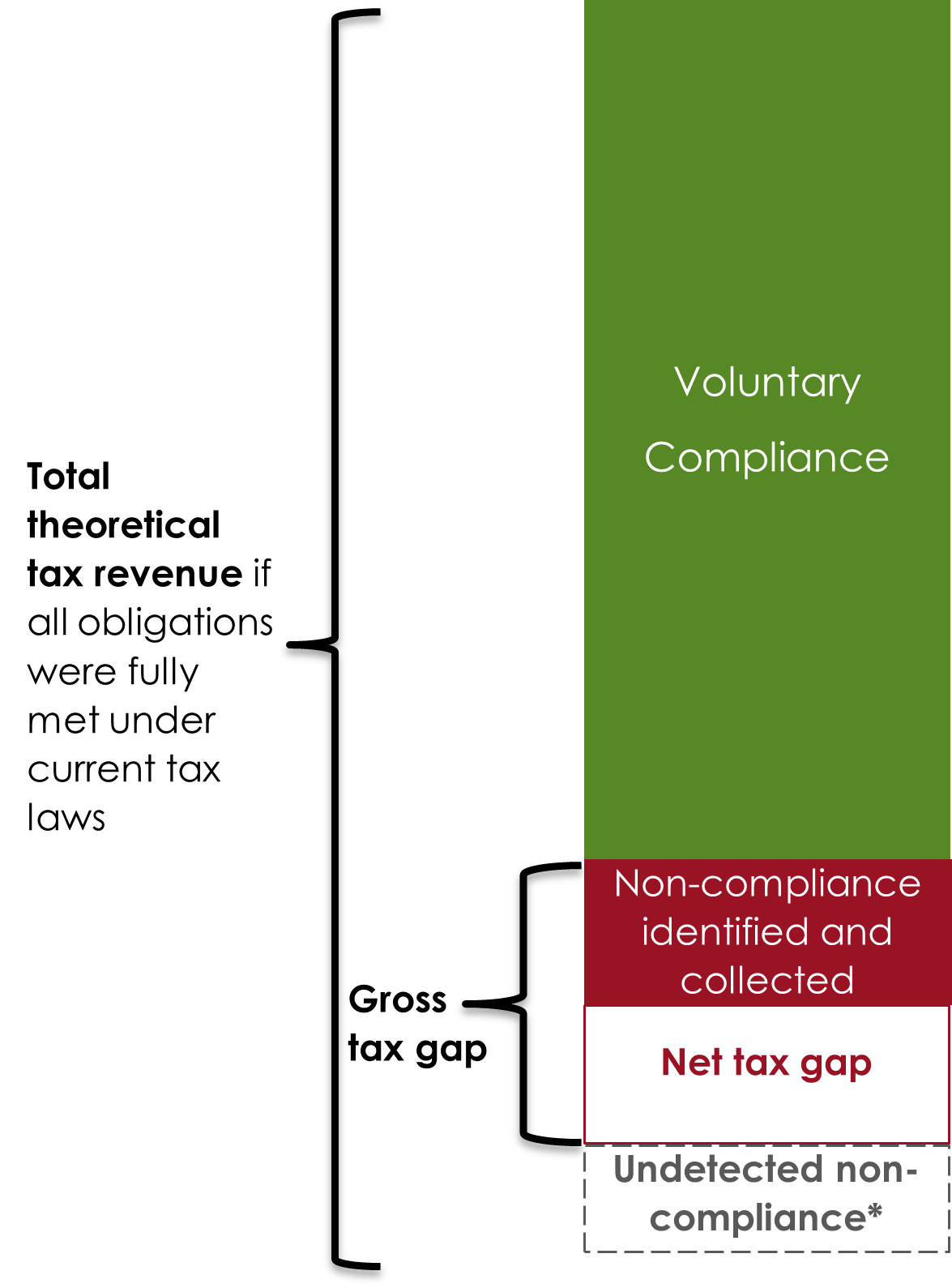
* Undetected non-compliance: All tax gap estimates are subject to varying degrees of uncertainty, and it is not possible to fully capture all non-compliance. The Canada Revenue Agency (CRA) studies the tax gap on an ongoing basis to improve methodologies and revise estimates based on the latest available data.
- Tax gap is a macro-level measure, best understood as trends over the medium to long term.
- Tax gap is a historical measure as it requires analysis of completed compliance and collection results, which can take several years to finalize.
- Tax gap encourages an open and transparent discussion on tax non-compliance.
- Along with other compliance indicators, the tax gap can help inform compliance and collection strategies in the long run.
- Tax gap is not a year-to-year performance measure.
- Tax gap estimates alone should not be used for decision-making related to tax administration or tax policy.
- It is not possible to measure the tax gap using a single methodology; tax gap methodologies and estimates must be frequently refined and updated as new data emerge.
Image description
Total theoretical tax revenue is a revenue under the assumption that all obligations were fully met under current tax laws. It comprises of voluntary compliance, gross tax gap and undetected non-compliance. The gross tax gap consists of identified and collected non-compliance and the net tax gap.
Why is there a tax gap?
The tax gap can arise from a wide variety of factors, it is the result of both intentional and unintentional actions. For instance:

Image description
There are two columns each containing two tabs in the colour blue with an icon beside each tab and the text is in white. In the first column the top icon shows a balance scale and says Hiding income or over-claiming deductions or credits. Below is a tab with an icon of a cross inside a circle and the text in the tab says Ignorance of Tax obligations. In the next column the top tab has an icon of pages and says Complex tax rules that increase mistakes on tax forms. The tab below has an icon of a briefcase and a sack with dollar sign and says Bankruptcies during a recession resulting in unpaid tax debt.
In addition, changes to tax rules and economic events can affect the tax gap. For example, changes to a tax form can improve reporting compliance, while increased bankruptcies in a recession can make payment compliance worse. Therefore, tax gap levels are not fully under the control of the government, and the tax gap is unlikely to ever reach zero. As a result, the tax gap is not a performance target for the CRA, but rather an important piece of information to monitor what is happening in the tax system.
Why measure the tax gap?
In April 2016, the Government of Canada committed to estimating the federal tax gap and a dedicated unit was established at the CRA to examine and publish a series of reports analyzing different components of the tax gap.
The publication of tax gap estimates and methods provides information to the Government of Canada and the public on tax non-compliance and helps to deliver on the Government’s commitment to transparency. Tax gap analysis provides insights to better understand the level of potential tax non-compliance and how it is evolving over time. A more insightful understanding of the tax gap can help the CRA better target its compliance and collection activities in the long run.
Understanding how and why taxpayers are non-compliant is critical to help preserve the integrity of the tax system and to protect Canada’s revenue base, which supports programs and benefits that improve the quality of life for all Canadians.
How is the CRA reducing the tax gap?
The CRA’s compliance and outreach activities can help to reduce the tax gap in Canada. Identifying ways to increase the rate of voluntary compliance is an important goal of tax administration. Since the gap can arise from a variety of sources, the CRA takes a multifaceted approach to reduce tax non-compliance.

Image description
There are two columns each containing two tabs in the colour blue with white text. The left column top tab icon depicts a graduation cap and says Educational outreach and support to reduce mistakes. The tab following underneath has an icon depicting a paper with a magnifying glass and says Audits to identify tax non-compliance. The right hand column top tab has an icon of a laptop and says Easier ways to complete returns, such as Auto-Fill My Return. The tab underneath has an icon of a hand and a dollar sign and says Taxpayer relief provisions to reduce the tax debt in certain circumstances.
Estimating the tax gap
Tax gap estimation is complex and requires nuanced analysis depending on the unique circumstances of each tax administration. In addition, tax gap estimates often require the analysis of historical data, particularly when examining compliance and collection activities which can take multiple years to complete.
In the overall tax gap report, a tax gap is estimated for two main forms of non-compliance for each component:

Image description
This figure contains one central dark blue tab labeled “Gross overall tax gap”, connected by two arrows to two light blue rectangular text boxes. The first text box on the top right is labeled “Reporting tax gap” and explains what it is: When taxpayers fail to provide complete or accurate information on their tax returns by under-reporting income or claiming deductions or credits to which they are not entitled. It is generally difficult to measure since it involves income, assets, and economic activities that are deliberately hidden, or errors that can be difficult to detect. Therefore, it usually requires complex statistical or econometric approaches. The second text box underneath is labeled “Payment tax gap” and describes what it is: When assessed taxes are not fully paid on time by taxpayers for a particular tax year. In contrast to the reporting gap, it can be calculated directly using CRA accounting records, where taxpayers have either paid or have not paid their taxes owing.
In general, there are two main approaches to estimating the reporting gap:
- Top-down approach uses independent external data, such as macroeconomic data, to estimate the theoretical value of tax, which is then compared with the actual tax amount reported. This approach is often used to estimate gaps related to indirect taxes, such as GST/HST and excise revenue.
- Bottom-up approach uses internal tax administration data, such as audit data, to extrapolate the level of non-compliance to the rest of the population. This approach is often used to estimate gaps related to direct taxes, such as corporation income tax.
The CRA usually presents the tax gap in constant dollars of the last available tax year to compare multiple years while accounting for inflation.
Going forward
Since the CRA began estimating the tax gap in 2016, Canada has established itself as one of the leading countries in both estimating and publishing tax gaps. Additionally, Canada plays a significant role in providing methodological guidance to the international community. The CRA will continue to study Canada’s tax gaps in consultation with experts and stakeholders to better understand tax non-compliance and to maintain the integrity of the tax system.