
Quarterly Financial Report - For the quarter ended September 30, 2025
1. Introduction
This quarterly financial report should be read in conjunction with the Main Estimates and Supplementary Estimates for fiscal year 2025 to 2026. It has been prepared by management, as required by section 65.1 of the Financial Administration Act and in the form and manner prescribed by the Directive on Accounting Standards, GC 4400 Departmental Quarterly Financial Report. It has been reviewed by the Internal Audit Committee of the Public Service Commission of Canada.
This quarterly report has not been subject to an external audit or review.
1.1 Authority and objectives
The Public Service Commission of Canada (the PSC) is an independent agency established under the Public Service Employment Act and listed in schedules I.1 and IV of the Financial Administration Act.
A summary description of the PSC’s programs can be found in its 2025 to 2026 departmental plan.
1.2 Basis of presentation
This quarterly report has been prepared by management using an expenditure basis of accounting. The accompanying Statement of Authorities includes the PSC’s spending authorities granted by Parliament and those used by the PSC consistent with the Main Estimates for the 2025 to 2026 fiscal year. This quarterly report has been prepared using a special purpose financial reporting framework designed to meet financial information needs with respect to the use of spending authorities.
The authority of Parliament is required before money can be spent by the government. Approvals are given in the form of annually approved limits through appropriation acts or through legislation in the form of statutory spending authority for specific purposes.
The PSC uses the full accrual method of accounting to prepare and present its annual departmental financial statements that are part of the departmental results reporting process. However, the spending authorities voted by Parliament remain on an expenditure basis.
1.3 Financial structure
The PSC has a financial structure comprised of voted budgetary authorities for program expenditures and statutory authorities for contributions to employee benefit plans.
In addition, the PSC has the authority to re-spend certain revenues received from other government departments and agencies in a fiscal year to offset expenditures incurred in that same year, for the provision of assessment and counseling products and services.
2. Highlights of fiscal quarter and fiscal year-to-date results
This section highlights the significant items that contributed to the change in resources available for the current year and in the actual expenditures for the quarter ended September 30, 2025.
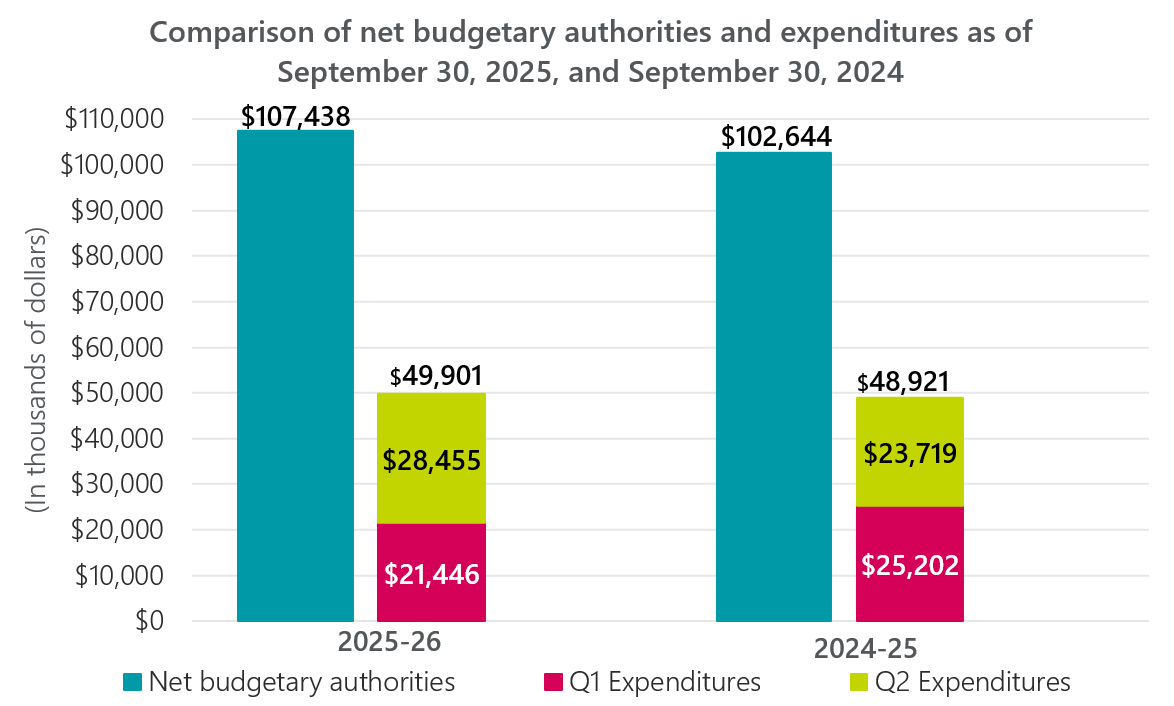
The following graph provides a comparison of the net budgetary authorities available for spending and the expenditures for the quarters ended September 30, 2025, and September 30, 2024, for the PSC’s combined Vote 1 – Program Expenditures and Statutory Authorities.
Text version
The graph shows total net budgetary authorities available for spending of $107 438 thousand as of September 30, 2025, and $102 644 thousand as of September 30, 2024. It also shows year-to-date expenditures of $49 901 thousand as of Septembre 30, 2025, compared to $48 921 thousand as of September 30, 2024.
| Year | Net budgetary authorities | Q1 Expenditures | Q2 Expenditures |
|---|---|---|---|
| 2025-2026 | $107,438 | $21,446 | $28,455 |
| 2024-2025 | $102,644 | $25,202 | $23,719 |
2.1 Significant changes to authorities
As shown in Section 6: Statement of Authorities, at September 30, 2025, there was an increase of $4,794,000 in authorities available for use in the current year, as compared to the previous year.
The variance is due mainly to the following:
- a $2,634,000 increase in funding from Treasury Board of Canada Secretariat to cover higher current and retroactive salary rates following the implementation of collective agreements in the previous and current year
- a $1,810,000 increase in funding due to adjustments in employer contributions to employee benefit plans
- a $695,000 increase in funding from the Treasury Board of Canada Secretariat submission to cover expenses from the Public Service Employment Act initiative
- a $588,000 increase in funding received from 3 other government departments for the Public Service Resourcing System platform for managing staffing and related activities
- a $634,000 decrease in funding related to frozen allotment for refocusing government spending
- a $197,000 decrease in funding as a result of transfers to support the realignment of digital services responsibilities
- a $102,000 decrease in carry-forward received in fiscal year 2025 to 2026 compared to the previous fiscal year
2.2 Significant variances in net expenditures from prior year
As shown in Section 7: Budgetary expenditures by standard object, total net budgetary expenditures during the quarter increased from $23,705,000 in 2024 to 2025 to $28,455,000 in 2025 to 2026, a variance of $4,750,000 or 20.0%.
The variance is due mainly to the following:
- an increase of $4,163,000 in personnel, mainly due to a timing issue:
- the Employee Benefit Plan, superannuation, Quebec Pension Plan, death benefits and employment insurance were paid in a different quarter compared to fiscal year 2024 to 2025
- these benefit payments were delayed due to late invoicing as a result of the dissolution of Parliament
- an increase of $ 438,000 in operating and maintenance spending, resulting from the following:
- an increase of $339,000 in other subsidies and payments, mainly due to an increased amount in salary overpayments
- an increase of $118,000 in acquisition of machinery and equipment, mainly resulting from higher purchases of office furniture and furnishing in the second quarter
- a decrease of $19,000 in miscellaneous expenses
- a decrease of $149,000 in revenues netted against expenditures, offset against expenditures, is attributed to a shift in billing timelines
- this year, billing was processed as services occurred, whereas last year it was delayed due to internal restructuring, impacting year-over-year revenue comparisons
3. Risks and uncertainties
The PSC operates in a dynamic, complex and fast-changing environment that requires it to be efficient, agile and innovative to support representative, non-partisan and merit-based hiring in federal departments and agencies across Canada. As part of its departmental planning and reporting cycle, the PSC reviews its organizational risks annually and conducts regular monitoring. This monitoring includes a strategic analysis of external risk factors and internal vulnerabilities, as well as opportunities to be leveraged, that may have an impact on the PSC’s results.
The PSC’s key risks can be found in its 2025 to 2026 departmental plan, which describes these risks in its operating context. The PSC actively mitigates the key risks identified to ensure sound program and service delivery, while enhancing the information technology tools used to provide these programs and services. Also, the PSC’s operational risks are identified in its 3-year strategic plan, along with corresponding mitigation strategies. This exercise was undertaken as part of a results-based budgeting initiative. The PSC is also required by the Treasury Board of Canada Secretariat to participate in a newly launched risk and compliance process covering prescribed areas of focus. This process supports the President of the PSC in verifying that the PSC has controls and practices in place to meet its accountabilities under legislation and Treasury Board policy.
To address a potential shift in the federal public service staffing environment as departments and agencies continue to refocus government spending to deliver results for Canadians, the PSC will:
- work with communities of practice to strengthen partnerships to maintain the competitiveness of the public service
- advance digital adoption, modernize recruitment, finance and procurement systems
- maintain outreach efforts to colleges and universities to further promote high-quality employment opportunities in the federal public service
At the same time, the PSC continues to actively mitigate risk to public trust in the political impartiality and non-partisanship of the federal public service by:
- investigating allegations of improper political activity and imposing corrective measures
- raising awareness among public servants of their rights and responsibilities related to political activities, and reminding them of related rules and processes
The PSC will review requests from employees seeking permission to run for public office, identify risks to political neutrality and impose conditions to address the risks. As well, to address the quickly evolving landscape of information technology and artificial intelligence, the PSC will actively leverage technical upgrades, enhance technological solutions and implement pilot test cases to improve user experience, both for internal and external stakeholders.
4. Significant changes in relation to operations, personnel and programs
As part of its ongoing efforts to modernize financial management and enhance operational efficiency, the PSC implemented a new financial system, FreeBalance Version 7, effective August 1, 2025.
5. Approved by senior officials
Approved by:
Marie-Chantal Girard
President
Farhat Khan, CPA
Chief Financial Officer
Gatineau, Canada
November 28, 2025
6. Statement of authorities (unaudited)
| Statement of authorities | Total available for use for the year ending March 31, 2026 1 | Used during the quarter ended September 30, 2025 | Year-to-date used at quarter-end |
|---|---|---|---|
| Vote 1 – Program Expenditures | 93,651 | 21,547 | 42,989 |
| Statutory – Refund of Previous Year Revenue | 0 | 10 | 13 |
| Statutory-Spending Proceed Disposal Crown Assets | 0 | 5 | 6 |
| Statutory – Employer Contributions to Employee Benefit Plans | 13,787 | 6,893 | 6,893 |
| Total Budgetary Authorities | 107,438 | 28,455 | 49,901 |
- Includes only authorities available for use and granted by Parliament at quarter-end.
6. Statement of authorities (unaudited) (continued)
| Statement of authorities | Total available for use for the year ending March 31, 20251 | Used during the quarter ended September 30, 2024 | Year-to-date used at quarter-end |
|---|---|---|---|
| Vote 1 – Program Expenditures | 90,667 | 20,723 | 42,931 |
| Statutory – Refund of Previous Year Revenue | 0 | 2 | 2 |
| Statutory – Employer Contributions to Employee Benefit Plans | 11,977 | 2,994 | 5,988 |
| Total Budgetary Authorities | 102,644 | 23,719 | 48,921 |
- Includes only authorities available for use and granted by Parliament at quarter-end.
7. Budgetary expenditures by standard object (unaudited)
| Standard objet | Planned expenditures for the year ending March 31, 2026 | Expended during the quarter ended September 30, 2025 |
Year-to-date used at quarter-end |
|---|---|---|---|
| Personnel | 103,241 | 27,178 | 47,322 |
| Transportation and telecommunications | 187 | 40 | 72 |
| Information | 243 | 32 | 52 |
| Professional and special services | 14,575 | 1,215 | 1,919 |
| Rentals | 1,783 | 291 | 1,380 |
| Repair and maintenance | 74 | 11 | 16 |
| Utilities, materials and supplies | 156 | 69 | 92 |
| Acquisition of machinery and equipment | 1,275 | 156 | 174 |
| Other subsidies and payments | 156 | 414 | 484 |
| Total gross budgetary expenditures | 121,690 | 29,406 | 51,511 |
| Less: Revenues netted against expenditures | (14,252) | (951) | (1,610) |
| Total net budgetary expenditures | 107,438 | 28,455 | 49,901 |
7. Budgetary expenditures by standard object (unaudited) (continued)
| Standard objet | Planned expenditures for the year ending March 31, 2025 | Expended during the quarter ended September 30, 2024 |
Year-to-date used at quarter-end |
|---|---|---|---|
| Personnel | 99,974 | 23,015 | 46,144 |
| Transportation and telecommunications | 117 | 29 | 38 |
| Information | 244 | 22 | 29 |
| Professional and special services | 13,659 | 1,358 | 1,903 |
| Rentals | 1,442 | 220 | 1,757 |
| Repair and maintenance | 63 | 2 | 3 |
| Utilities, materials and supplies | 116 | 46 | 61 |
| Acquisition of machinery and equipment | 1,166 | 38 | 75 |
| Other subsidies and payments | 115 | 75 | 194 |
| Total gross budgetary expenditures | 116,896 | 24,805 | 50,204 |
| Less: Revenues netted against expenditures | (14,252) | (1,086) | (1,283) |
| Total net budgetary expenditures | 102,644 | 23,719 | 48,921 |
Information contained in this publication or product may be reproduced, in part or in whole, and by any means, for personal or public non-commercial purposes without charge or further permission, unless otherwise specified. Commercial reproduction and distribution are prohibited except with written permission from the Public Service Commission of Canada.
For more information, contact
Public Service Commission of Canada
22 Eddy Street
Gatineau (Quebec) K1A 0M7
Email: cfp.infocom.psc@cfp-psc.gc.ca
Website of publisher: https://www.canada.ca/en/public-service-commission.html
© His Majesty the King in Right of Canada, as represented by the President of the Public Service Commission of Canada, 2025
Cat. No. SC12-4E-PDF (Electronic PDF, English)
ISSN 2819-4101
Cat. No. SC12-4F-PDF (Electronic PDF, French)
ISSN 2819-411X