
Quarterly Financial Report - For the quarter ended September 30, 2022
1. Introduction
This quarterly financial report should be read in conjunction with the Main Estimates and Supplementary Estimates for fiscal year 2022–23. It has been prepared by management, as required by section 65.1 of the Financial Administration Act and in the form and manner prescribed by the Directive on Accounting Standards, GC 4400 Departmental Quarterly Financial Report. It has been reviewed by the Internal Audit Committee of the Public Service Commission of Canada.
This quarterly report has not been subject to an external audit or review.
1.1 Authority and objectives
The Public Service Commission of Canada (the agency) is an independent agency established under the Public Service Employment Act and listed in schedules I.1 and IV of the Financial Administration Act.
A summary description of the agency’s programs can be found in its 2022–23 Departmental Plan.
1.2 Basis of presentation
This quarterly report has been prepared by management using an expenditure basis of accounting. The accompanying Statement of Authorities includes the agency’s spending authorities granted by Parliament and those used by the agency consistent with the Main Estimates for the 2022–23 fiscal year. This quarterly report has been prepared using a special purpose financial reporting framework designed to meet financial information needs with respect to the use of spending authorities.
The authority of Parliament is required before money can be spent by the government. Approvals are given in the form of annually approved limits through appropriation acts or through legislation in the form of statutory spending authority for specific purposes.
The agency uses the full accrual method of accounting to prepare and present its annual departmental financial statements that are part of the departmental results reporting process. However, the spending authorities voted by Parliament remain on an expenditure basis.
1.3 Financial structure
The agency has a financial structure comprised of voted budgetary authorities for program expenditures and statutory authorities for contributions to employee benefit plans.
In addition, the agency has the authority to re-spend certain revenues received from other government departments and agencies in a fiscal year to offset expenditures incurred in that same year, for the provision of assessment and counselling products and services.
2. Highlights of fiscal quarter and fiscal year-to-date results
This section highlights the significant items that contributed to the change in resources available for the current year and in the actual expenditures for the quarter ended September 30, 2022.
The following graph provides a comparison of the net budgetary authorities available for spending and the expenditures for the quarters ended September 30, 2022, and September 30, 2021, for the agency’s combined Vote 1 – Program Expenditures and Statutory Authorities.
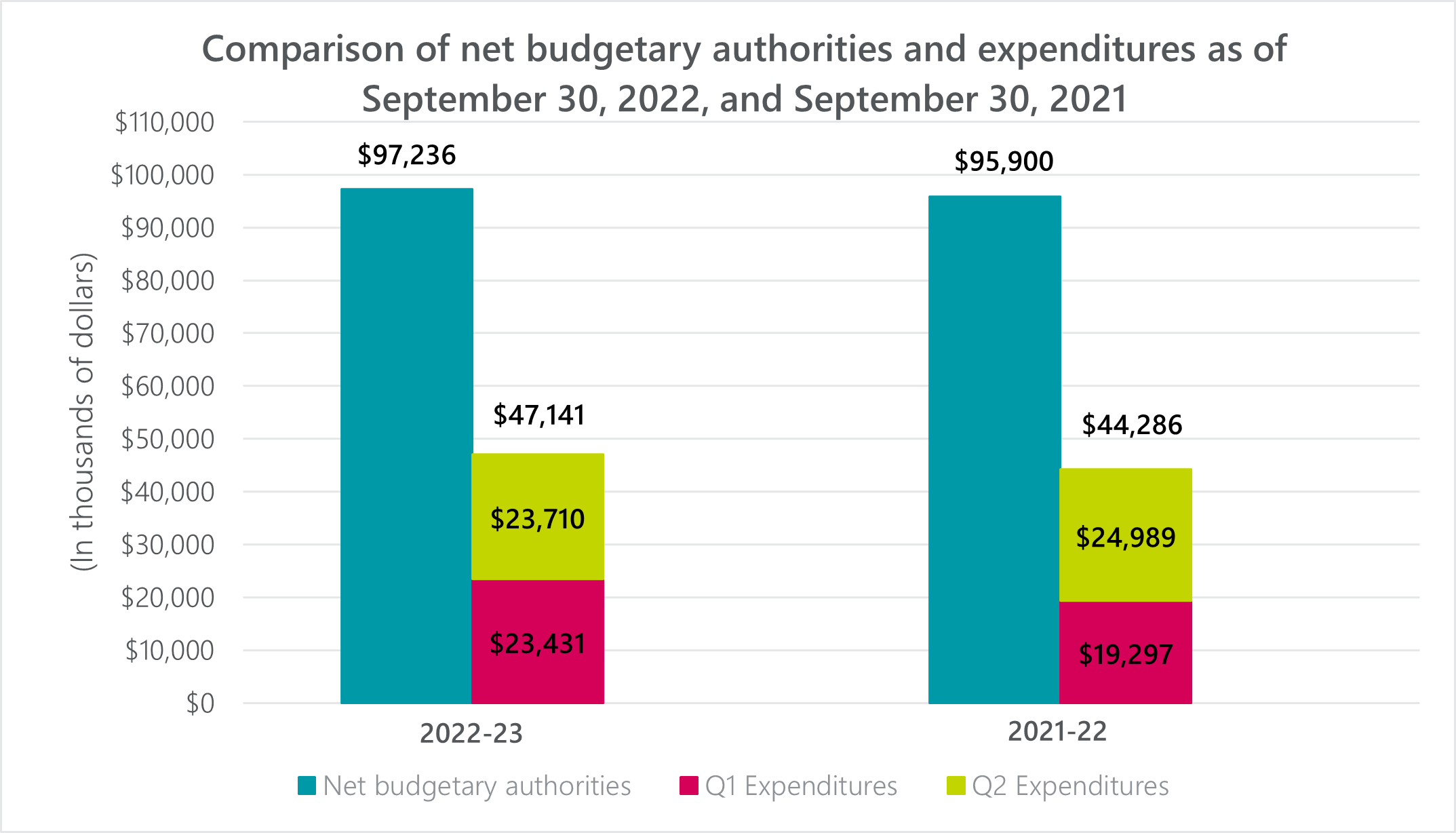
Text Alternative
| Year | Net budgetary authorities | Q1 expenditures | Q2 expenditures |
|---|---|---|---|
| 2022-23 | $97,236 | $23,431 | $23,710 |
| 2021-22 | $95,900 | $19,297 | $24,989 |
2.1 Significant changes to authorities
As shown in Section 6: Statement of Authorities, at September 30, 2022, there was an increase of $1,336,000 in authorities available for use in the current year, as compared to the previous year.
The variance is due mainly to the following:
- a $554,000 increase in funding received from the Treasury Board of Canada Secretariat to cover higher current salary rates following the implementation of collective agreements in previous years
- a $116,000 reduction in funding due to a transfer to Shared Services Canada to support a funding model for government-wide information technology services
- $181,000 in funding to offset the increase in Employee Benefit Plan rates for Legal Services charged by the Department of Justice
- a $63,000 increase in funding due to the reversal of the frozen allotment set in the past
- a $227,000 increase in funding due to adjustments in employer contributions to employee benefit plans
- a $33,000 increase in funding received from the Treasury Board of Canada Secretariat submission to cover expenses from the Federal Internship Program for Canadians with Disabilities
- a $394,000 increase in the year-end operating budget carry-forward
2.2 Significant variances in net expenditures from prior year
As shown in Section 7: Budgetary expenditures by standard object, total net budgetary expenditures during the quarter decreased from $24,989,000 in 2021–22 to $23,710,000 in 2022–23; a variance of $1,279,000 or 5.1%.
The variance is due mainly to the following:
- a decrease of $1,579,000 in personnel, mainly resulting from:
- a $2,632,000 decrease for the Employee Benefit Plan and superannuation, the Quebec pension plan, death benefits and employment insurance, due to payments completed during first quarter in 2022–23 compared to 2021–22, when payments started during the second quarter
- $310,000 more spending for indeterminate employees and summer students, and less spending for term employees
- $182,000 less spending in 2022–23 for damages due to Phoenix late claims for one-time payments completed in 2021–22
- $925,000 more accrual for payments to other government departments in 2022–23 ($1,405,00) compared to 2021–22 ($480,000) due to more employees that transferred in from other departments
- an increase of $897,000 in spending for operation and maintenance due to:
- an increase of $142,000 in acquisition of machinery and equipment, mainly due to the purchase of client computer equipment
- an increase of $286,000 in professional and special services, mainly due to an increase in training and consulting
- an increase of $383,000 in rentals due to invoicing of licence and maintenance fees for client software
- an increase of $65,000 in other subsidies and payments, mainly due to a higher amount in salary overpayments
- an increase of $17,000 in transportation and telecommunications, mainly resulting from an increase in travel and relocation
- an increase of $597,000 in revenues netted against expenditures, due mainly to:
- an increase in prices of various products offered by the agency
- a higher demand for e-testing and test administration services and coaching caused by postponed language testing and extended eligibility during the pandemic
- the agency adapted to the virtual work environment caused by the pandemic, and made its invoicing processes more efficient
3. Risks and uncertainties
The agency is evolving in a dynamic and complex environment that requires it to be effective, adaptive and innovative to support staffing in federal departments and agencies across Canada. As part of its departmental planning and reporting cycle, the agency undertakes an annual review of its organizational risks, as well as quarterly monitoring of mitigation strategies, activities and changes that are likely to have an impact on its expected results. This monitoring includes strategic oversight of the changes in external risk factors and internal vulnerabilities that may have an impact on the agency’s results.
The agency’s operational context, key risks as well as mitigation strategies can be found in its 2022–23 Departmental Plan.
Since the release of this departmental plan, changes to the agency’s enabling legislation, the Public Service Employment Act, are being implemented, and the agency has developed tools to guide departments and agencies on the resulting impacts to the hiring process. The agency will continue to work with departments and agencies, looking beyond the 4 employment equity groups and geographic and official language representation, at a wider range of socio-demographic and intersecting identity factors, to remove or reduce barriers and biases in the staffing system.
4. Significant changes in relation to operations, personnel and programs
Upon the President’s retirement, the Privy Council Office has appointed an acting deputy head who assumed all the responsibilities until the appointment of a permanent deputy head.
5. Approved by senior officials
Approved by:
Stan Lee
Interim President
Eva Jacobs, CPA, CGA
Acting Chief Financial Officer
Gatineau, Canada
November 29, 2022
6. Statement of authorities (unaudited)
| Fiscal year 2022–23 (in thousands of dollars) | |||
|---|---|---|---|
| Total available for use for the year ending March 31, 2023 1 | Used during the quarter ended September 30, 2022 | Year-to-date used at quarter-end |
|
| Vote 1 – Program Expenditures | 85,311 | 20,729 | 41,173 |
| Statutory – Refund of Previous Year Revenue | 0 | 0 | 6 |
| Statutory – Employer Contributions to Employee Benefit Plans | 11,925 | 2,981 | 5,962 |
| Total Budgetary Authorities | 97,236 | 23,710 | 47,141 |
1. Includes only authorities available for use and granted by Parliament at quarter-end.
6. Statement of authorities (unaudited) (continued)
| Fiscal year 2021–22 (in thousands of dollars) | |||
|---|---|---|---|
| Total available for use for the year ending March 31, 2022 1 | Used during the quarter ended September 30, 2021 | Year-to-date used at quarter-end | |
| Vote 1 – Program Expenditures | 84,201 | 19,140 | 38,437 |
| Statutory – Refund of Previous Year Revenue | 0 | 0 | 0 |
| Statutory - Spending of proceeds from the disposal of surplus Crown assets | 0 | 0 | 0 |
| Statutory – Employer Contributions to Employee Benefit Plans | 11,699 | 5,849 | 5,849 |
| Total Budgetary Authorities | 95,900 | 24,989 | 44,286 |
1. Includes only authorities available for use and granted by Parliament at quarter-end.
7. Budgetary expenditures by standard object (unaudited)
| Fiscal year 2022–23 (in thousands of dollars) | |||
|---|---|---|---|
| Planned expenditures for the year ending March 31, 2023 | Expended during the quarter ended September 30, 2022 |
Year-to-date used at quarter-end | |
| Personnel | 93,980 | 22,600 | 44,452 |
| Transportation and telecommunications | 333 | 28 | 40 |
| Information | 237 | 22 | 47 |
| Professional and special services | 14,220 | 1,889 | 2,710 |
| Rentals | 1,483 | 516 | 1,009 |
| Repair and maintenance | 62 | 4 | 8 |
| Utilities, materials and supplies | 150 | 90 | 116 |
| Acquisition of machinery and equipment | 873 | 187 | 749 |
| Other subsidies and payments | 150 | 140 | 326 |
| Total gross budgetary expenditures | 111,488 | 25,476 | 49,457 |
| Less: Revenues netted against expenditures | (14,252) | (1,766) | (2,316) |
| Total net budgetary expenditures | 97,236 | 23,710 | 47,141 |
7. Budgetary expenditures by standard object (unaudited) (continued)
| Fiscal year 2021–22 (in thousands of dollars) | |||
|---|---|---|---|
| Planned expenditures for the year ending March 31, 2022 | Expended during the quarter ended September 30, 2021 |
Year-to-date used at quarter-end | |
| Personnel | 91,151 | 24,179 | 42,210 |
| Transportation and telecommunications | 667 | 11 | 12 |
| Information | 206 | 63 | 98 |
| Professional and special services | 14,887 | 1,603 | 2,233 |
| Rentals | 1,415 | 133 | 991 |
| Repair and maintenance | 98 | 4 | 5 |
| Utilities, materials and supplies | 178 | 45 | 67 |
| Acquisition of machinery and equipment | 1,371 | 45 | 57 |
| Other subsidies and payments | 179 | 75 | 120 |
| Total gross budgetary expenditures | 110,152 | 26,158 | 45,793 |
| Less: Revenues netted against expenditures | (14,252) | (1,169) | (1,507) |
| Total net budgetary expenditures | 95,900 | 24,989 | 44,286 |