
Spotlight on Preference for Appointment
Table of Contents
Overview
In external advertised appointment processes, the Public Service Employment Act (PSEA) gives preference for appointment to eligible veterans first, and then to Canadian citizens and permanent residents, provided they meet the essential qualifications.
Once those with a priority entitlement who meet the essential qualifications are considered and appointed, the preference is to be applied in the following order:
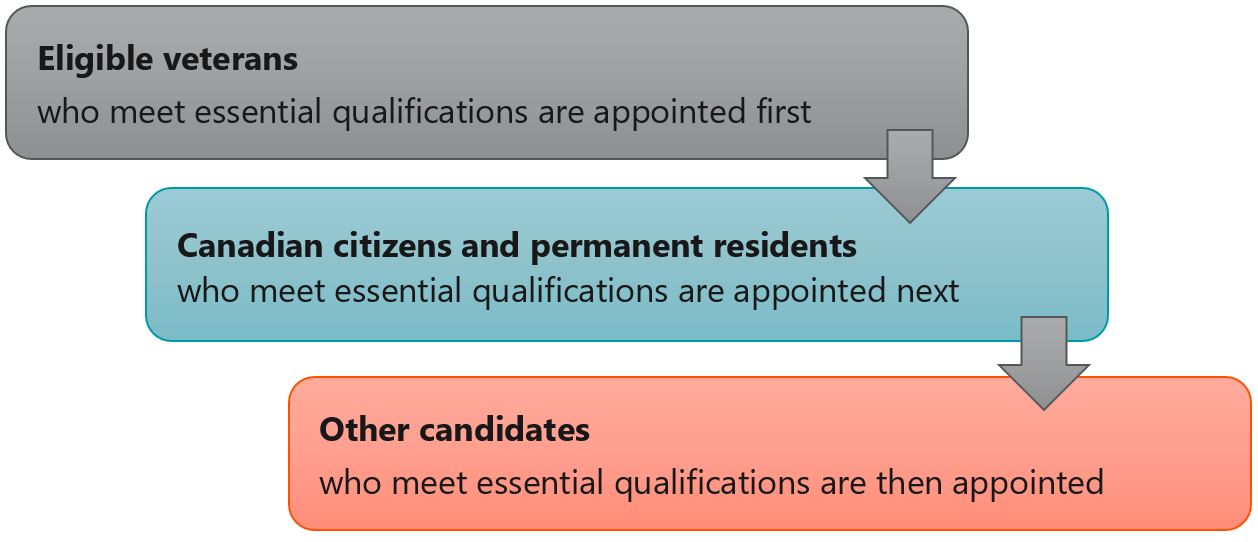
Order of precedence for preference for appointment in jobs open to the public, after all qualified persons with a priority entitlement have been considered and appointed - Text version
The top row explains that eligible veterans who meet the essential criteria are appointed first.
The middle row explains that Canadian citizens and permanent residents who meet the essential criteria are appointed next.
The bottom row explains that other candidates who meet the essential criteria are then appointed.
Preference applies at the time of each appointment that results from an external advertised process.
If more than one person with the same order of preference meets the essential qualifications, managers can apply the other merit criteria (asset qualifications, operational requirements and organizational needs) to select between them. Selection can also be based on proficiency level or results obtained for essential qualifications.
Considerations
Managing the process
Under the Public Service Employment Act, managers can assess candidates in the order of their choice, using different assessment approaches. For example, they could choose to:
- assess and appoint all veterans before considering other candidates
- assess all candidates at the same time and apply preference to the selection decision
- apply a volume management strategy and assess a subset of candidates chosen based on certain criteria (for example, random selection)
- use an assessment in waves approach
Important: When a volume management or assessment in waves strategy is used, eligible veterans must be included, as they must be appointed first if they meet the essential qualifications.
For any assessment approach, the order of preference must be respected at the time of each appointment. Time of appointment refers to when the letter of offer is signed by both the sub-delegated manager and the person proposed for appointment, regardless of the effective date of the appointment.
Confirming preference
The hiring team can use any reasonable source of information to confirm whether a person meets the conditions for preference. Examples include:
- a written statement in the résumé, job application or other related document
- interview questions or references
- any documents related to a veteran’s military career or release
- any proof of citizenship or permanent residence (for example: passport, Canadian citizenship or permanent residence card, Canadian birth certificate)
The Public Service Resourcing System prompts applicants to indicate their citizenship status (Canadian citizen, permanent resident, other). Veterans are also prompted to enter their Canadian Forces Service Number. This information (last name and Service Number) is then matched with information from the Department of National Defence. Individuals with a veteran preference are identified as suchwhen referred to the hiring manager.
Individuals who are entitled to a preference may not be properly identified in the system for various reasons, including:
- there could be a discrepancy between how a veteran entered their Canadian Forces Service Number and the information recorded by the Department of National Defence, which could prevent a proper match between the 2 data sources
- a person may have failed to properly indicate their Canadian citizenship or permanent resident status
If a veteran indicates that they are eligible from a preference, but it is not reflected in the system, the Public Service Resourcing System Client Support Services (cfp.srfp-psrs.psc@cfp-psc.gc.ca) may confirm the applicant’s status or contact the Department of National Defence if necessary.
Hiring departments and agencies must have the necessary information to be able to demonstrate that the order of preference has been respected for each appointment resulting from an external advertised process, including when an alternative resourcing system (other than the Public Service Resourcing System) is used to manage applications.
Using current information
Since a candidate’s preference may change during an appointment process, the hiring team must ensure that the most up‑to‑date candidate information is used at the time of each appointment.
For example:
- a candidate may have obtained Canadian citizenship or permanent residency after submitting their application
- since a veteran’s preference for appointment is valid for 5 years following release from the Canadian Forces, a candidate may:
- become a veteran after applying for a job
- be eligible for preference when they apply, but no longer do at the time of appointment
Visit Staffing: Hiring Veterans for more information on managing the validity period for preference for veterans.
Verification of updated information by the hiring team
The hiring team must check for any new or updated information to confirm they are working with the most current data:
- when using the Public Service Resourcing System, by using the refresh status function at strategic points (accessible only on the Government of Canada network)
- when using an alternative resourcing system to manage applications, by ensuring the required information is available and accurate at the time of appointment
It may also be necessary to verify directly with candidates.
Updating of information by candidates
To ensure information is up to date, the hiring team should remind candidates to keep their applicant profile current and to report any changes to their order of preference to the hiring team.
Additional resources
For more information
Hiring managers can contact their human resources services to discuss how certain issues are handled within their department or agency.
The Public Service Commission of Canada provides support through staffing support advisors designated for each organization.
Useful links
- Public Service Employment Act: Section 39
- Staffing: Hiring Veterans
- Public Service Resourcing System Support Centre (accessible only on the Government of Canada network)
- PSC Staffing Interpretation Centre
Scenario
A hiring manager launches an external advertised appointment process to fill 5 positions. Applicants include eligible veterans, Canadian citizens, permanent residents and other individuals.
Below are 4 approaches that the manager could use to manage applications.
Approach 1: Application of other merit criteria
The manager would like to focus on only those applicants with an asset experience and invite them for an exam. Candidates without the asset experience will be eliminated from the process.
- The manager could screen applicants who have the asset experience, but must include eligible veterans even if they don’t have the asset experience
- All eligible veterans who meet the essential qualifications must be appointed ahead of Canadian citizens and permanent residents
Approach 2: Random selection
The manager would like to randomly select candidates and then assess this subset of candidates, as the positions to be filled don’t require specialized skills or considerable experience.
- The manager could randomly select from among Canadian citizens and permanent residents, but must also include all eligible veterans
- All eligible veterans who meet the essential qualifications must be appointed ahead of Canadian citizens and permanent residents
Approach 3: Top-down approach
The manager would like to invite all candidates who have met the essential screening criteria for an exam to assess 3 additional essential qualifications (each with a pass mark of 60%). Candidates to be invited include eligible veterans, Canadian citizens, permanent residents and other individuals.
The manager would then like to select only the 15 candidates with the highest overall score in the exam for the interview phase (top-down approach).
- The manager may choose a top-down approach among eligible veterans only, and select the 15 with the highest overall test scores for the interview phase, provided they meet the 60% pass mark for each of the essential qualifications
- If there are any remaining positions to be filled, the manager must appoint all eligible veterans who meet the essential qualifications before appointing anyone else
- The manager may then choose a top-down approach among Canadian citizens and permanent residents only, provided they meet the 60% pass mark for each of the essential qualifications
- If there are any remaining positions to be filled, the manager must appoint all Canadian citizens and permanent residents who meet the essential qualifications before appointing anyone else
- The manager may then use a top-down approach among the remaining candidates who meet the 60% pass mark for each of the essential qualifications
Approach 4: Change of status - Updated information
A pool of qualified candidates has been established, and the manager has filled 5 positions in accordance with the order of preference for appointment. All veterans who meet the essential qualifications have been appointed.
A few months later, the manager wants to fill another position.
The manager assesses the asset qualifications to select among Canadian citizens and permanent residents who have met all the essential qualifications. In the meantime, one of them informs the manager that they now benefit from a preference as a veteran, but they do not meet the asset qualifications currently being assessed.
- The manager must first confirm that the applicant is an eligible veteran
- If the candidate is an eligible veteran, they must be appointed before any other candidate since they meet all the essential qualifications
- A manager must always respect the order of preference at the time of each appointment