
Select findings on antimicrobial use and resistance
Download the alternative format
(PDF format, 438 KB,1 page)
Organization: Public Health Agency of Canada
Published: 2019-01-14
Cat.: # HP40-230/2018E-PDF
ISBN: # 978-0-660-28310-4
Pub.: # 180546
The Canadian Integrated Program for Antimicrobial Resistance Surveillance (CIPARS)
CIPARS identifies trends in antimicrobial use (AMU) and in antimicrobial resistance (AMR) in the Canadian food chain.
The complex battle against antimicrobial resistance
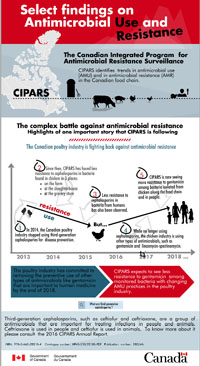
- Highlights of one important story that CIPARS is following: the Canadian poultry industry is fighting back against antimicrobial resistance
- CIPARS identifies trends in antimicrobial use (AMU) and antimicrobial resistance (AMR) across Canada, and more specifically, along the food chain from food animals to the Canadian consumer.
- The graph shows a downward trend arrow starting from 2013 continue to go down in 2014, since the Canadian poultry industry has taken the decision to stop using cephalosporins for disease prevention in poultry:
- In 2014, the Canadian poultry industry stopped using third-generation cephalosporins for disease prevention.
- Since then, CIPARS has found less resistance to cephalosporins in bacteria found in chicken in 3 places: on the farm, at the slaughterhouse, and at the grocery store.
- Less resistance to cephalosporins in bacteria from humans has also been observed.
- While no longer using cephalosporins, the chicken industry is using other types of antimicrobials, such as gentamicin and lincomycin-spectinomycin.
- CIPARS is now seeing more resistance to gentamicin among bacteria isolated from chicken along the food chain and in people.
Antimicrobial use
The poultry industry has committed to removing the preventive use of other types of antimicrobials like gentamicin that are important to human medicine by the end of 2018.
Antimicrobial resistance
2016 to present: CIPARS expects to see less resistance to gentamicin among monitored bacteria with changing AMU practices in the poultry industry.
What are third-generation cephalosporins?
Third-generation cephalosporins, such as ceftiofur and ceftriaxone, are a group of antimicrobials that are important for treating infections in people and animals. Ceftriaxone is used in people and ceftiofur is used in animals.
Related links
To know more about it please consult the 2016 CIPARS Annual Report.