
Dressing your baby for sleep
Learn about overheating, children's sleepwear and sleep sacks.
On this page
Overheating
Keep your baby warm, not hot. If the room temperature is comfortable for you, it will be comfortable for your baby too. Sleepwear needs to be appropriate for the temperature of the room so that babies are comfortable but don't overheat. Overheating is a risk factor for sudden infant death syndrome (SIDS).
It's not safe to let babies sleep in their outerwear. Remove your baby's snowsuit, raincoat, jacket or other type of outerwear once indoors. This will reduce the risk of your baby overheating or suffocating.
Babies do not need hats when they're indoors. A hat can make them too hot.
- After your baby was born, your health care provider may have put a hat on your baby. This is important to help them conserve heat immediately after birth, and only meant for a short period.
Safety tips for children's sleepwear
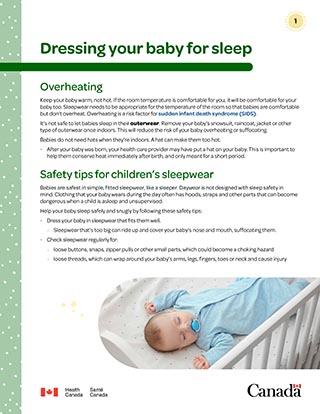
Babies are safest in simple, fitted sleepwear, like a sleeper. Daywear is not designed with sleep safety in mind. Clothing that your baby wears during the day often has hoods, straps and other parts that can become dangerous when a child is asleep and unsupervised.
Help your baby sleep safely and snugly by following these safety tips:
- Dress your baby in sleepwear that fits them well.
- Sleepwear that's too big can ride up and cover your baby's nose and mouth, suffocating them.
- Check sleepwear regularly for:
- loose buttons, snaps, zipper pulls or other small parts, which could become a choking hazard
- loose threads, which can wrap around your baby's arms, legs, fingers, toes or neck and cause injury
- Fix any loose buttons, snaps, zipper pulls and threads.
- Check that belts, ties or sashes on bathrobes are stitched firmly to the centre back, to prevent them from wrapping around your baby's neck.
- Do not put your baby to sleep in a bathrobe.
Health Canada has flammability requirements for children's sleepwear. For more information on types of sleepwear and how flammability requirements help to protect your baby, please visit our web page on children's sleepwear.
Sleep sacks
Many parents and caregivers use sleep sacks for their baby. If you use a sleep sack, you don't need a blanket.
If you use a sleep sack, follow these tips:
- Make sure the sleep sack is the right size for your baby.
- If it's too big, your baby can slip down inside the sack, which can make your baby overheat or suffocate.
- If it's too small, your baby may not be able to move their hips and legs freely, which can be dangerous, especially if they roll onto their tummy.
- Make sure the sleep sack is appropriate for the temperature of the room (lightweight if the room is warm).
- Stay away from weighted swaddles, sleep sacks and blankets, as they are not safe for your baby.
There's no research to support the use of swaddle sleep sacks. If you choose to use one for your baby, be sure to follow these safe swaddling techniques:
- swaddle loosely so that your baby has room to breathe and can still move their hips and legs
- stop swaddling around 2 months of age before your baby can roll over
- swaddling isn't safe for babies when they're on their tummies