
Travel-related dengue, Zika and chikungunya in Canada, 2012–2023

 Download this article as a PDF (132 KB)
Published by: The Public Health Agency of Canada
Issue: Volume 51-5, May 2025: Travel Health
Date published: May 2025
ISSN: 1481-8531
Submit a manuscript
About CCDR
Browse
Volume 51-5, May 2025: Travel Health
Infographic
Travel-related dengue, Zika and chikungunya in Canada, 2012–2023: Results from a feasibility pilot study on laboratory-based surveillance
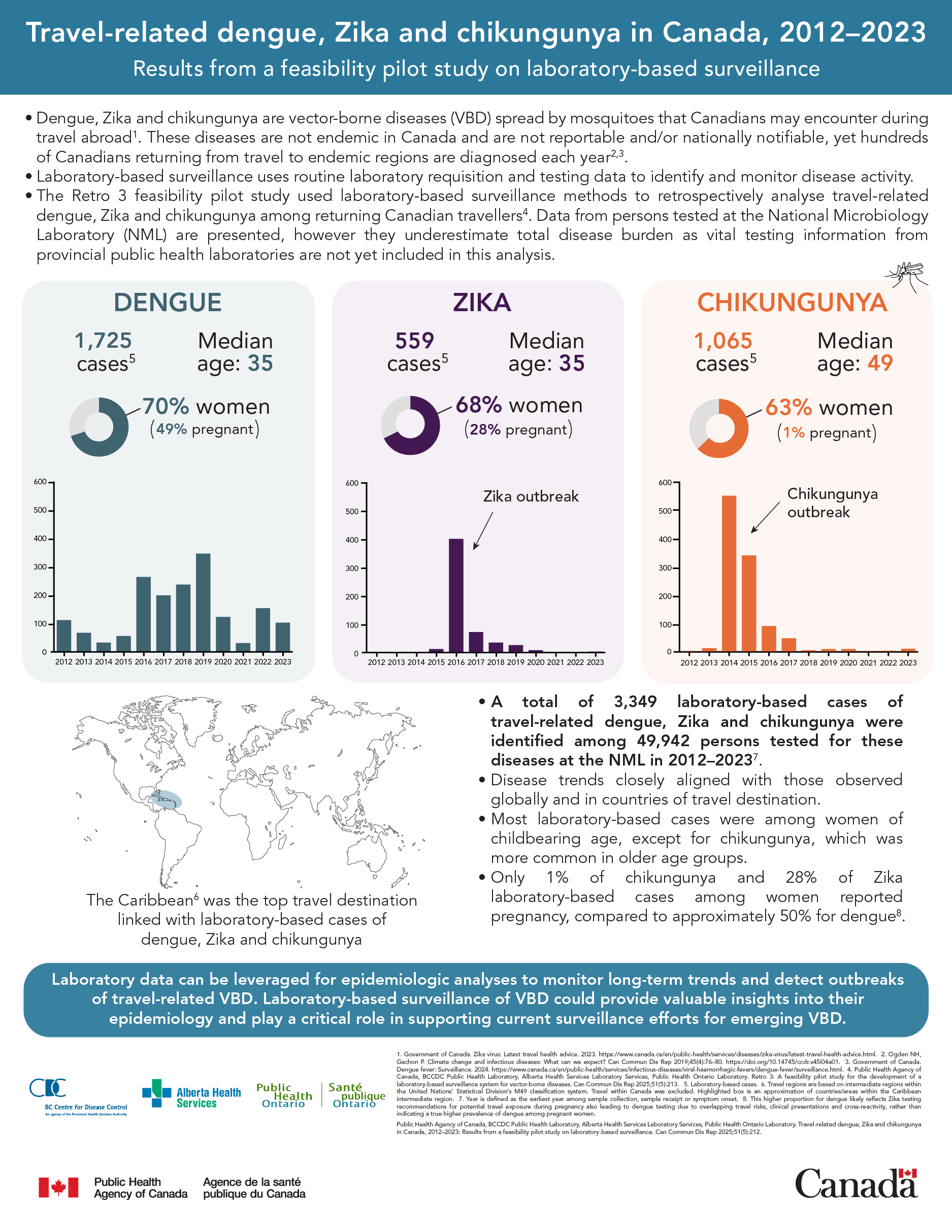
Text description: Infographic
Dengue, Zika and chikungunya are vector-borne diseases (VBD) spread by mosquitoes that Canadians may encounter during travel abroad Footnote 1. These diseases are not endemic in Canada and are not reportable and/or nationally notifiable, yet hundreds of Canadians returning from travel to endemic regions are diagnosed each year Footnote 2Footnote 3.
Laboratory-based surveillance uses routine laboratory requisition and testing data to identify and monitor disease activity.
The Retro 3 feasibility pilot study used laboratory-based surveillance methods to retrospectively analyse travel-related dengue, Zika and chikungunya among returning Canadian travellers Footnote 4. Data from persons tested at the National Microbiology Laboratory (NML) are presented, however they underestimate total disease burden as vital testing information from provincial public health laboratories are not yet included in this analysis.
Dengue
A total of 1,725 laboratory-based cases of travel-related dengue Footnote a were identified among persons tested for dengue at the NML between 2012 and 2023:
- Median age was 35 years
- 70% were women, of which 49% were pregnant
| Year Footnote b | Number of laboratory-based cases |
|---|---|
| 2012 | 112 |
| 2013 | 67 |
| 2014 | 33 |
| 2015 | 56 |
| 2016 | 264 |
| 2017 | 199 |
| 2018 | 237 |
| 2019 | 346 |
| 2020 | 123 |
| 2021 | 31 |
| 2022 | 154 |
| 2023 | 103 |
Zika
A total of 559 laboratory-based cases of travel-related Zika Footnote c were identified among persons tested for Zika at the NML between 2012 and 2023:
- Median age was 35 years
- 68% were women, of which 28% were pregnant
| YearFootnote b | Number of laboratory-based cases |
|---|---|
| 2012 | 0 |
| 2013 | 0 |
| 2014 | 0 |
| 2015Footnote d | 12 |
| 2016Footnote d | 400 |
| 2017 | 72 |
| 2018 | 35 |
| 2019 | 26 |
| 2020 | 8 |
| 2021 | 2 |
| 2022 | 1 |
| 2023 | 3 |
Chikungunya
A total of 1,065 laboratory-based cases of travel-related chikungunya Footnote e were identified among persons tested for chikungunya at the NML between 2012 and 2023:
- Median age was 49 years
- 63% were women, of which 1% were pregnant
| YearFootnote b | Number of laboratory-based cases |
|---|---|
| 2012 | 1 |
| 2013 | 11 |
| 2014Footnote f | 548 |
| 2015Footnote f | 338 |
| 2016 | 89 |
| 2017 | 46 |
| 2018 | 4 |
| 2019 | 8 |
| 2020 | 8 |
| 2021 | 1 |
| 2022 | 2 |
| 2023 | 9 |
TravelFootnote g
Travel history data was available in NML laboratory requisition records for nearly 90% of persons tested, encompassing destinations spread over 180 countries across all seven continents. The Caribbean emerged as the most common travel destination linked to laboratory-based cases of dengue, Zika and chikungunya, followed by Central America. For Zika and chikungunya, South America was the next most frequent destination, whereas for dengue, it was Southeast Asia.
Conclusion
- A total of 3,349 laboratory-based cases of travel-related dengue, Zika and chikungunya were identified among 49,492 persons tested for these diseases at the NML in 2012–2023.
- Disease trends closely aligned with those observed globally and in countries of travel destination.
- Most laboratory-based cases were among women of childbearing age, except for chikungunya, which was more common in older age groups.
- Only 1% of chikungunya and 28% of Zika laboratory-based cases among women reported pregnancy, compared to approximately 50% for dengue. This higher proportion for dengue likely reflects Zika testing recommendations for potential travel exposure during pregnancy also leading to dengue testing due to overlapping travel risks, clinical presentations and cross-reactivity, rather than indicating a true higher prevalence of dengue among pregnant women.
Laboratory data can be leveraged for epidemiologic analyses to monitor long-term trends and detect outbreaks of travel-related VBD. Laboratory-based surveillance of VBD could provide valuable insights into their epidemiology and play a critical role in supporting current surveillance efforts for emerging VBD.
Public Health Agency of Canada, BCCDC Public Health Laboratory, Alberta Health Services Laboratory Services, Public Health Ontario Laboratory. Travel-related dengue, Zika and chikungunya in Canada, 2012–2023: Results from a feasibility pilot study on laboratory-based surveillance. Can Commun Dis Rep 2025;51(5):212.
