
Archived - Hep C in Canada 2018: infographic

Volume 44-7/8, July 5, 2018: Can we eliminate hepatitis C?
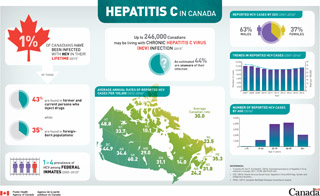
- Up to 246,000 Canadians may be living with Chronic hepatitis C virus (HCV) infection (2011)Footnote 1
- An estimated 44% are unaware of their infection
- 1% of Canadians have been infected with HCV in their lifetime (2011)Footnote 1
- Of those 43% are found in former and current persons who inject drugs while 35% are found in foreign-born populations
- 1 in 4 prevalence of HCV among federal inmates (2005-2012)Footnote 2
- The Public Health Agency of Canada collects information on reported cases of HCV infection through Canadian Notifiable Diseases Surveillance System (CNDSS)Footnote 3.
- Between 2012 and 2016, the average rate of reported HCV infection in Canada was 30.0 per 100,000 population.
- Between 2012 and 2016 the average rate of HCV infection, above the national average (30.0), were found in Saskatchewan (60.2), followed by the Yukon Territory (48.8), British Columbia (44.9), Prince Edward Island (35.3), Alberta (34.6), Northwest Territories (33.7), Nova Scotia (31.8), and Ontario (31.1).
- The rates of reported HCV infection in Canada were lower than the national average in remaining provinces and territories: Manitoba (29.0), New Brunswick (24.2), Newfoundland and Labrador (23.5), Quebec (14.0), and Nunavut (10.1).
- Among reported cases of HCV infection between 2007 and 2016, nearly two-thirds (63%) were among males and 37% were in femalesFootnote 3.
- Between 2007 and 2016, the rates of reported cases of HCV infection showed a decreasing trend between 2007 (36.4 per 100,000 population) and 2012 (29.4 per 100,000 population) and since 2012, the rates have been stable at around 30.0 per 100,000 populationFootnote 3.
- Highest number of cases in 2016 was reported in the age group 40-59 years (4,129) followed by 25-39 years age group (3,889), and age 60 years and above (2,038). In 2016, a total of 1,193 cases of HCV infection were reported in those less than 25 years of ageFootnote 3.
References
- Footnote 1
-
Trubnikov M, Yan P, Archibald C. (2014). Estimated prevalence of Hepatitis C Virus infection in Canada, 2011. CCDR; 40(19):429-436.
- Footnote 2
-
CSC. (2016). Health Services Quick Facts: Hepatitis C Virus (HCV) Age, Gender and Indigenous Ancestry.
- Footnote 3
-
PHAC. (2018). Canadian Notifiable Diseases Surveillance System.
Download this article as a PDF
Published by: The Public Health Agency of Canada
Issue: Volume 44-7/8 : Can we eliminate hepatitis C?
Date published: July 5, 2018
ISSN: 1481-8531