
Vaccine administration: A guide to landmarking

Download in PDF format
(2.6 MB, 3 pages)
Organization: Public Health Agency of Canada
Date published: July 2026
Why is landmarking important?
- Landmarking is important to reach the appropriate tissue site (dermis, subcutaneous tissue or muscle), optimize the immune response, reduce the risk of injection site reactions, and avoid inadvertent injection into a blood vessel or injury to a nerve.
General considerations
- Route and site of vaccine administration should be based on the recipient’s factors (e.g. age, muscle mass) and immunizing agent.
- Aspiration prior to injection of vaccine is not recommended.
- Vaccine providers should incorporate routine infection control practices into all immunization procedures, such as:
- Performing hand hygiene before vaccine preparation, between vaccine recipients, and whenever the hands are soiled.
For more information on vaccine administration practices, including infection prevention and control: Vaccine administration practices: Canadian Immunization Guide.
Additional resource: Vaccine administration: A guide to selecting needle gauge and length.
Routes of administration
There are 3 routes of vaccine administration by injection:

Figure 1 : Descriptive text
A cross section of the different layers of the skin is depicted, progressing from the most superficial to the deepest layer: epidermis, dermis and hypodermis. Beneath these, a layer of muscle is depicted. Blood vessels (vein and artery) are depicted within the dermis and hypodermis. For intramuscular injection, a needle is shown inserted at a 90-degree angle (perpendicular to the skin) into the layer of muscle below the hypodermis (subcutaneous tissue). For subcutaneous injection, a needle is shown inserted at a 45-degree angle into the hypodermis (subcutaneous tissue). For intradermal injection a needle is shown inserted at a 5- to 15-degree angle into the dermis.
Administration by the intramuscular (IM) route
- Stretch skin flat (between thumb and forefinger).
- Insert needle at a 90-degree angle and as far as possible into the muscle.
- For deltoid administration, the injection site is about 2 to 3 finger-widths below the acromion.
- The deltoid site is often selected for toddlers and young children as temporary muscle pain post-vaccination in the anterolateral thigh muscle may affect ambulation.
Intramuscular injection landmarking
There are 2 sites for IM injection in individuals aged 12 months and older. For infants less than 12 months of age, the anterolateral thigh is used.
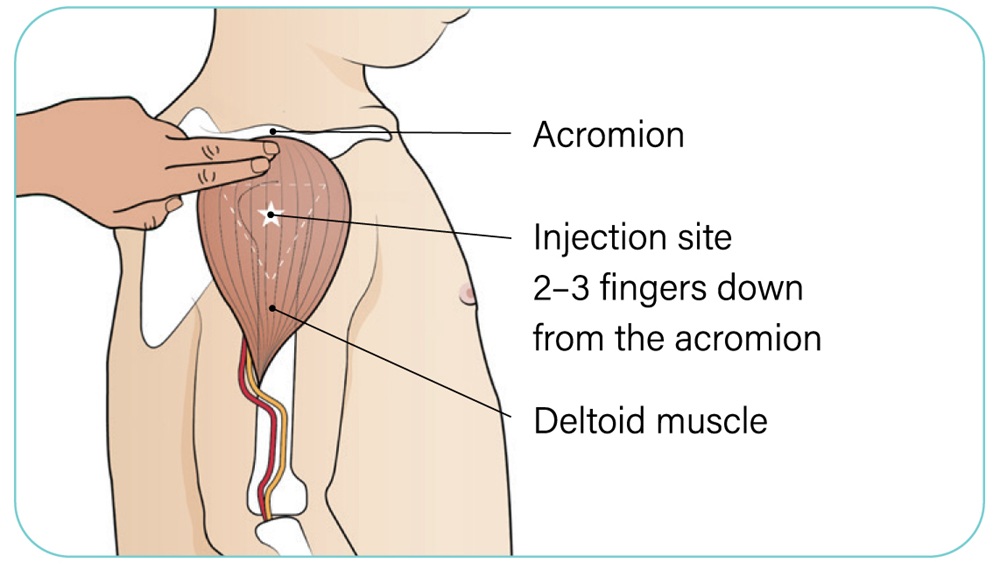
Figure 2 : Descriptive text
A lateral view of the deltoid muscle is shown. For intramuscular route of administration in the deltoid, a needle is inserted at a 90-degree angle about 2 to 3 finger-widths below the acromion, into the central and thickest part of the deltoid muscle.
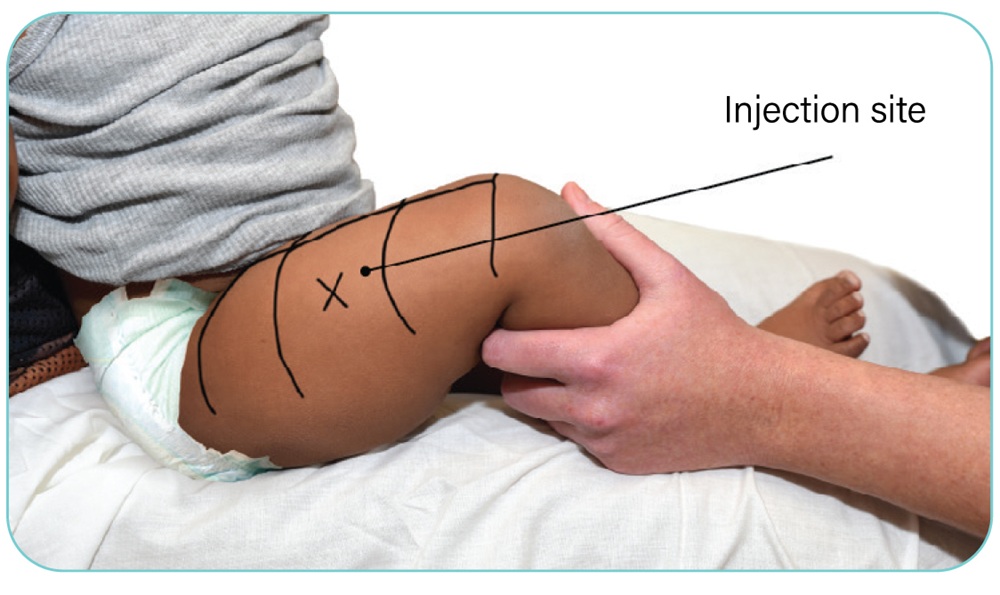
Figure 3 : Descriptive text
An anterolateral view of the thigh is shown. For intramuscular route of administration in the anterolateral thigh, which specifically targets the vastus lateralis muscle, insert the needle at a 90-degree angle into the outer aspect of the middle third of the thigh.
Administration by the subcutaneous (SC) route
- Pinching of the skin may be necessary to ensure injection into the subcutaneous tissue and avoid the muscle.
- Insert needle at a 45-degree angle.
Subcutaneous injection landmarking
The upper triceps area of the arm is the usual site for SC injection for those 12 months and older. For infants less than 12 months of age, the anterolateral thigh is the usual site.
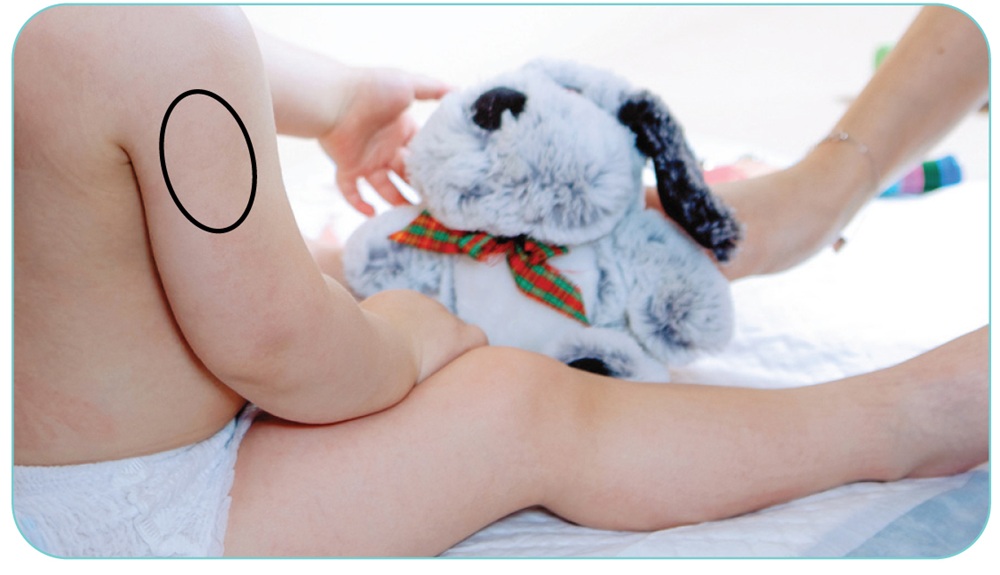
Figure 4 : Descriptive text
A posterolateral view of the upper arm is shown. For upper arm subcutaneous administration, insert the needle at a 45-degree angle into the fatty tissue overlying the triceps muscle.
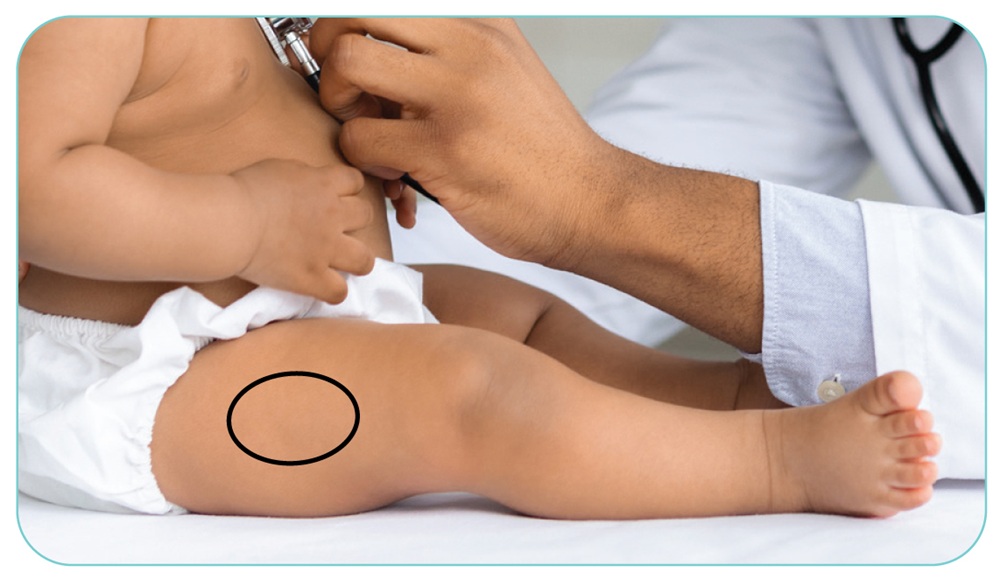
Figure 5 : Descriptive text
An anterolateral view of the thigh is shown. For anterolateral thigh area subcutaneous administration, insert the needle at a 45-degree angle into the fatty tissue overlying the thigh.
Administration by the intradermal (ID) route
- The site of ID administration is product specific. For each product administered intradermally, refer to the specific product monograph or product guidance documents.
- Options for ID administration include: inner (volar) forearm, the area over the deltoid muscle, the suprascapular area on the back or the area over the anterolateral thigh.
- Typically administered at a 5-degree to 15-degree angle.
- A wheal 6 mm to 10 mm in diameter should form indicating proper administration into the dermis.
- If a wheal does not form, remove the needle and repeat the procedure with a new needle and syringe, preferably in a separate anatomic injection site or in the same anatomic injection site but separated by at least 2.5 cm (1 inch).
Intradermal injection landmarking
For individuals of all ages, there are 4 possible sites for ID injection.
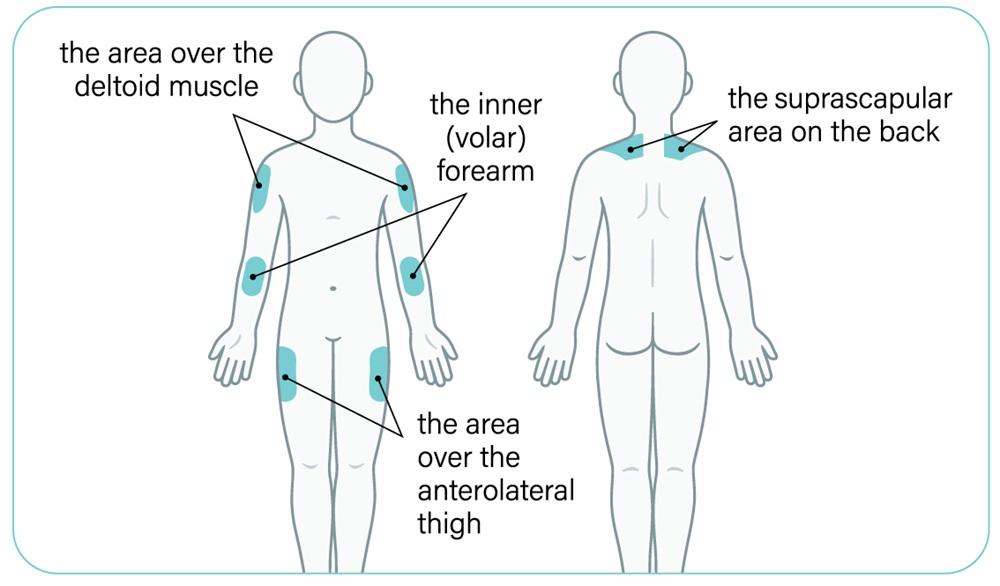
Figure 6 : Descriptive text
An anterior and posterior view of possible intradermal injection sites are shown. Possible intradermal injection sites include the area over the deltoid, the area over the anterolateral thigh, the suprascapular area on the back and the inner (volar) forearm.
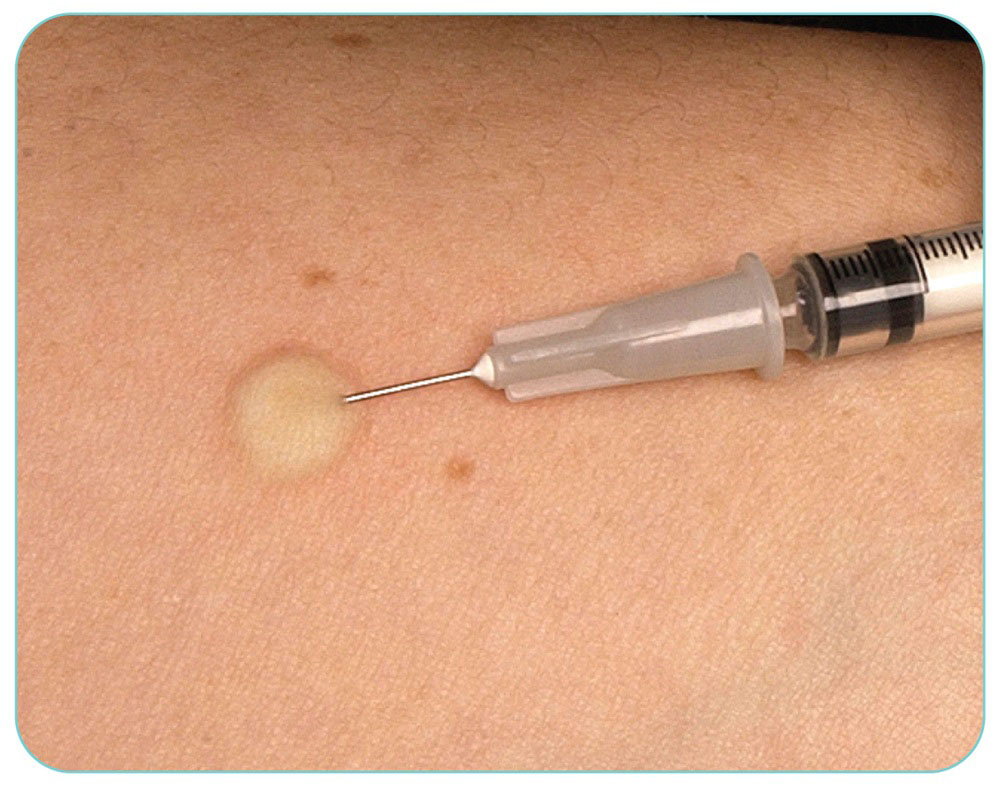
Figure 7 : Descriptive text
The image depicts an intradermal injection. A needle is being inserted intradermally at a 5- to 15-degree angle and a wheal 6 mm to 10 mm in diameter is formed indicating proper administration into the dermis.
Footnotes
- Footnote 1
-
Courtesy of the Australian Technical Advisory Group on Immunisation. Australian Immunisation Handbook, Australian Government Department of Health, Disability and Ageing, Canberra, 2024, Immunisation.Handbook@Health.gov.au.
- Footnote 2
-
Courtesy of the U.S. Centers for Disease Control and Prevention.