
Highlights from the 2019 childhood National Immunization Coverage Survey (cNICS)
The childhood National Immunization Coverage Survey (cNICS)
cNICS is a survey conducted every two years by Statistics Canada on behalf of the Public Health Agency of Canada since 2011. The survey is given to parents and guardians and measures the proportion of children who have received all routine vaccinations by ages two, seven, fourteen, or seventeen years.
Results from this survey help understand how well Canadian children are protected against vaccine preventable diseases, as well as what parents and guardians know and think about vaccines.
Survey results are used to:
- Measure progress towards achieving Canada's national vaccination coverage goals by 2025.
- Understand how well vaccination programs are working, and how they could be improved.
- Report Canada's vaccination coverage to the World Health Organization.
Key Results
The 2019 survey showed that:
- 90% of two-year old children had received at least one dose of measles vaccine;
- 78% of two-year old children had received all recommended doses (four) of diphtheria, tetanus and pertussis vaccine; and,
- 1.7% of two-year-old children had not received any vaccine.
The results show that in 2019, like in previous years, a majority of 2-year-old children had received all vaccines recommended for them by their 2nd birthday. Despite this, more work needs to be done to ensure Canada meets its coverage goal of 95% for all recommended childhood vaccines Figure 1).
Figure 1. Percentage of 2-year-old children vaccinated before their second birthday, childhood National Immunization Coverage Survey, 2013, 2015, 2017 and 2019.
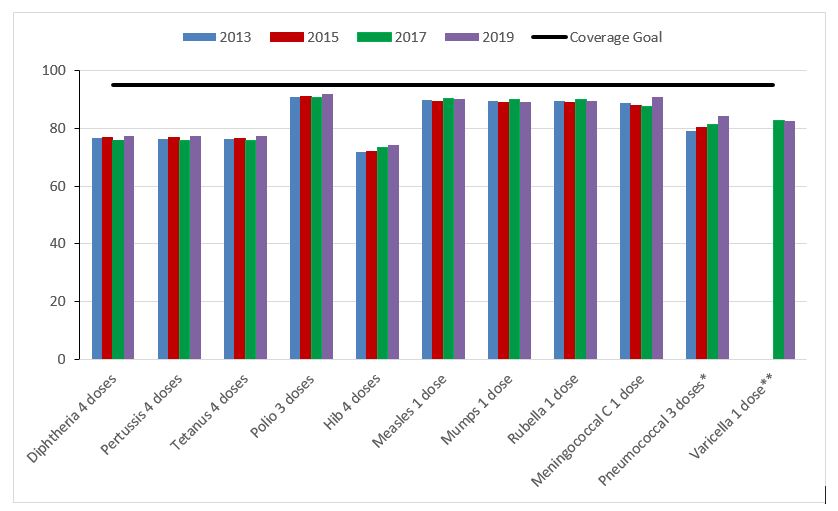
- Figure 1 note *
-
Three doses by 2nd birthday for all provinces and territories, except Nunavut and Northwest Territories where four doses are required by the child's 2nd birthday.
- Figure 1 note **
-
Estimates for the varicella vaccine are not shown for 2013 and 2015 due to data quality concerns.
Figure 1 - Text Description
| Antigen | 2013 | 2015 | 2017 | 2019 |
|---|---|---|---|---|
| Diphtheria 4 doses | 76.6 | 76.9 | 75.8 | 77.5 |
| Pertussis 4 doses | 76.4 | 77.0 | 75.8 | 77.5 |
| Tetanus 4 doses | 76.4 | 76.7 | 75.8 | 77.5 |
| Polio 3 doses | 90.9 | 91.2 | 90.7 | 91.9 |
| Hib 4 doses | 71.9 | 71.9 | 73.4 | 74.4 |
| Measles 1 dose | 89.7 | 89.2 | 90.2 | 90.2 |
| Mumps 1 dose | 89.4 | 88.9 | 89.9 | 89.2 |
| Rubella 1 dose | 89.4 | 88.9 | 90.0 | 89.4 |
| Meningococcal C 1 dose | 88.7 | 87.8 | 87.6 | 91.1 |
| Pneumococcal 3 dosesFigure 1 Table 1 footnote * | 79.2 | 80.3 | 81.4 | 84.4 |
| Varicella 1 doseFigure 1 Table 1 footnote ** | - | - | 82.9 | 82.7 |
Data for cNICS are collected primarily from vaccination cards or booklets held by parents and guardians, in which some vaccine doses received by children may be missing or recorded with incomplete or illegible information. Therefore, the actual vaccine coverage is likely somewhat higher than cNICS estimates.
Attitudes and beliefs about vaccines among parents and guardians
To better understand the factors influencing decisions on vaccination, parents and guardians were asked about their views on vaccines (Table 1).
- Most parents and guardians of two-year-old children agree that childhood vaccines are safe (96%) and effective (98%).
- The majority of parents and guardians understand the concept of "community immunity", with 97% agreeing that vaccinating their child can help to protect the health of others.
- Most also trust that other parents have their children vaccinated (96%).
- On the other hand, 49% are concerned about potential side effects of vaccines.
- 11% of parents and guardians believe that alternative practices such as homeopathy or naturopathy can replace vaccines. Numerous studies have shown this is not true, and that using alternative practices instead of vaccines leaves children at risk of serious diseases.
| Statement | Percentage of parents and guardians who agree |
|---|---|
| In general, vaccines help to protect my child's health | 97% |
| In general, childhood vaccines are effective | 98% |
| Having my child vaccinated helps to protect the health of others in my community | 97% |
| In general, childhood vaccines are safe | 96% |
| Most parents in my community have their children vaccinated with all recommended vaccines | 96% |
| Unvaccinated children are at higher risk of getting some serious diseases. | 94% |
| In general, I am concerned about the potential side effects from vaccines | 49% |
| In general, a vaccine can give you a serious case of the very same disease it was meant to prevent | 21% |
| In general, the use of alternative practices, such as homeopathy or naturopathy, can eliminate the need for vaccination | 11% |
What you need to know
- Vaccination is the best way to prevent serious diseases that can cause severe complications, or even death.
- Community immunity also protects those infants who are too young to be vaccinated and those who are unable to be vaccinated due to medical reasons.
- Vaccines are safe and effective. They go through many tests before they are approved and can be used in Canada.
For more information about vaccines
- Learn more about vaccine preventable diseases and vaccination for children.
- Find out more about how vaccines work in A Parent's Guide to Vaccination.
A detailed report describing results from the cNICS 2019 is available
For more information, please contact us at: coverage-couvertures@phac-aspc.gc.ca.