
Vision 2030: Moving data to public health action (infographic)
Download in PDF format
(308 KB, 1 pages)
Organization: Public Health Agency of Canada
Date Published: February 2025
Related links
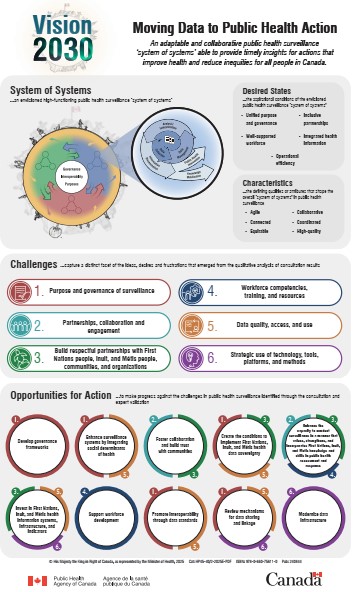
The vision for public health surveillance in Canada by 2030 is an adaptable and collaborative public health surveillance 'system of systems' able to provide timely insights for actions that improve health and reduce inequities for all people in Canada.
The core of an envisioned high-functioning public health surveillance 'system of systems' includes:
- governance
- interoperability
- purposes
Each individual system involves:
- data collection
- data management
- analysis/interpretation
- information dissemination:
- public health intervention
- knowledge mobilization
Desired states are the aspirational conditions of the envisioned public health surveillance 'system of systems.' These desired states are:
- unified purpose and governance
- inclusive partnerships
- well-supported workforce
- integrated health information
- operational efficiency
Characteristics are the defining qualities or attributes that shape the overall 'system of systems' in public health surveillance:
- agile
- collaborative
- connected
- coordinated
- equitable
- high-quality
Challenges capture a distinct facet of the ideas, desires and frustrations that emerged from the qualitative analysis of the consultation results:
- purpose and governance of surveillance
- partnerships, collaboration and engagement
- build respectful partnerships with First Nations people, Inuit and Métis people, communities, and organizations
- workforce competencies, training, and resources
- data quality, access, and use
- strategic use of technology, tools, platforms, and methods
Opportunities for action are areas to make progress against the challenges in public health surveillance identified through the consultation and expert validation:
- develop governance frameworks (aims to address challenge 1)
- enhance surveillance systems by integrating social determinants of health (aims to address challenges 1 and 5)
- foster collaboration and build trust with communities (aims to address challenges 2 and 3)
- create the conditions to implement First Nations, Inuit, and Métis health data sovereignty (aims to address challenges 1, 3, and 5)
- enhance the capacity to conduct surveillance in a manner that values, strengthens, and incorporates First Nations, Inuit, and Métis knowledge and skills in public health assessment and response (aims to address challenges 2, 3, and 4)
- invest in First Nations, Inuit, and Métis health information systems, infrastructure, and indicators (aims to address challenges 3, 5, and 6)
- support workforce development (aims to address challenge 4)
- promote interoperability through data standards (aims to address challenges 1 and 5)
- review mechanisms for data sharing and linkage (aims to address challenges 1, 5 and 6)
- modernize data infrastructure (aims to address challenge 6)