
Infographic: Inequalities in working poor Canadians
Download the alternative format
(PDF format, 342 KB, 1 page)
Organization: Public Health Agency of Canada
- Cat.: HP35-113/2-2019E-PDF
- ISBN: 978-0-660-29680-7
- Pub.: 180806
Pan-Canadian Health Inequalities Reporting Initiative
Inequalities in Working Poor Canadians
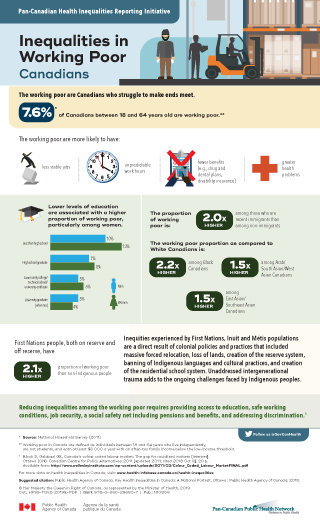
The working poor are Canadians who struggle to make ends meet.
7.6%Footnote * of Canadians between 18 and 64 years old are working poor.Footnote **
The working poor Canadians are more likely to have:
- less stable jobs
- unpredictable work hours
- fewer benefits (e.g., drug and dental plans, disability insurance)
- greater health problems
Lower levels of education are associated with a higher proportion of working poor, particularly among women.
| Level of education | Prevalence (%) | |
|---|---|---|
| Men | Women | |
| Less than high school | 10 | 13 |
| High school graduate | 7 | 8 |
| Community college/Technical school/University certificate | 5 | 6 |
| University graduate | 5 | 4 |
The proportion of working poor is:
- 2.0 times higher among those who are recent immigrants than those who are non-immigrants
The working poor proportion as compared to White Canadians is:
- 2.2 times higher among Black Canadians
- 1.5 times higher among East Asian/Southeast Asian Canadians
- 1.5 times higher among Arab/South Asian/West Asian Canadians
First Nations people, both on reserve and off reserve, have
- 2.1 times higher proportion of working poor than non-Indigenous people
Inequities experienced by First Nations, Inuit and Métis populations are a direct result of colonial policies and practices that included massive forced relocation, loss of lands, creation of the reserve system, banning of Indigenous languages and cultural practices, and creation of the residential school system. Unaddressed intergenerational trauma adds to the ongoing challenges faced by Indigenous peoples.
Reducing inequalities among the working poor requires providing access to education, safe working conditions, job security, a social safety net including pensions and benefits, and addressing discrimination.Footnote 1
Follow us @GovCanHealth
For more data on health inequalities in Canada, visit:
www.health-infobase.canada.ca/health-inequalities
Suggested citation: Public Health Agency of Canada. Key Health Inequalities in Canada: A National Portrait. Ottawa: Public Health Agency of Canada; 2018.
© Her Majesty the Queen in Right of Canada, as represented by the Minister of Health, 2019 | Cat.: HP35-113/2-2019E-PDF | ISBN: 978-0-660-29680-7 | Pub.: 180806