
Infographic: Inequalities in perceived mental health in Canada
Download the alternative format
(PDF format, 720 KB, 1 page)
Organization: Public Health Agency of Canada
- Cat.: HP35-113/3-2019E-PDF
- ISBN: 978-0-660-29682-1
- Pub.: 180804
Pan-Canadian Health Inequalities Reporting Initiative
Inequalities in Perceived Mental Health in Canada
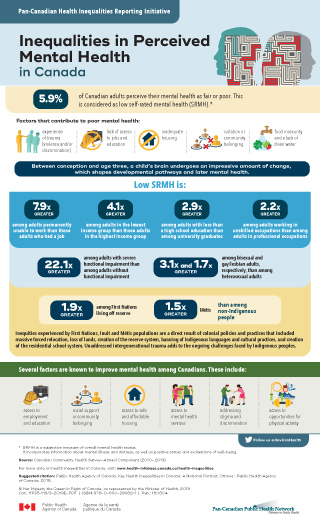
5.9% of Canadian adults perceive their mental health as fair or poor. This is considered as low self-rated mental health (SRMH).Footnote *
Factors that contribute to poor mental health:
- experience of trauma (violence and/or discrimination)
- lack of access to jobs and education
- inadequate housing
- isolation or community belonging
- food insecurity and a lack of clean water
Between conception and age three, a child’s brain undergoes an impressive amount of change, which shapes developmental pathways and later mental health.
Low SRMH is:
- 7.9 times greater among adults permanently unable to work than among adults who had a job
- 4.1 times greater among adults in the lowest income group than among adults in the highest income group
- 2.9 times greater among adults with less than a high school education than among university graduates
- 2.2 times greater among adults working in unskilled occupations than among adults in professional occupations
- 22.1 times greater among adults with severe functional impairment than among adults without functional impairment
- 3.1 and 1.7 times greater among bisexual or gay/lesbian adults, respectively, than among heterosexual adults
1.9 times greater among First Nations living off reserve
1.5 times greater among Métis
than among non-Indigenous people
Inequities experienced by First Nations, Inuit and Métis populations are a direct result of colonial policies and practices that included massive forced relocation, loss of lands, creation of the reserve system, banning of Indigenous languages and cultural practices, and creation of the residential school system. Unaddressed intergenerational trauma adds to the ongoing challenges faced by Indigenous peoples.
Several factors may improve mental health among Canadians. These include:
- access to employment and education
- social support or community belonging
- access to safe and affordable housing
- access to mental health services
- addressing stigma and discrimination
- access to opportunities for physical activity
Follow us @GovCanHealth
Source: Canadian Community Health Survey - Annual Component (2010-2013)
For more data on health inequalities in Canada, visit:
www.health-infobase.canada.ca/health-inequalities
Suggested citation: Public Health Agency of Canada. Key Health Inequalities in Canada: A National Portrait. Ottawa: Public Health Agency of Canada; 2018.
© Her Majesty the Queen in Right of Canada, as represented by the Minister of Health, 2019 | Cat.: HP35-113/3-2019E-PDF | ISBN: 978-0-660-29682-1 | Pub.: 180804