
Inequalities in High Alcohol Consumption in Canada - Infographic
Download the alternative format
(PDF format, 380 K, 1 page)
Organization: Public Health Agency of Canada
Published: 2018-05-30
Pan-Canadian Health Inequalities Reporting Initiative
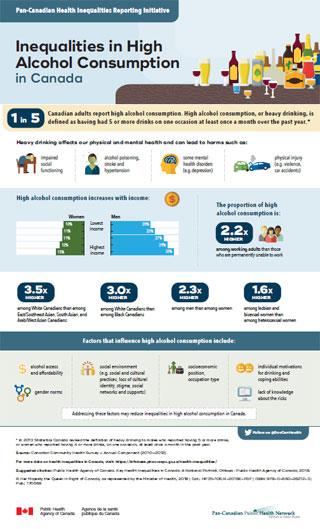
1 in 5 Canadian adults report high alcohol consumption. High alcohol consumption, or heavy drinking, is defined as having had 5 or more drinks on one occasion at least once a month over the past year.*
Heavy drinking a-ffects our physical and mental health and can lead to harms such as:
- Impaired social functioning
- alcohol poisoning, stroke and hypertension
- some mental health disorders (e.g. depression)
- physical injury (e.g. violence, car accidents)
High alcohol consumption increases with income.
From the lowest to the highest income group, the respective prevalence of high alcohol consumption for women is 10%, 11%, 11%, 12%, and 15%.
From the lowest to the highest income group, the respective prevalence of high alcohol consumption for men is 20%, 23%, 27%, 29%, and 33%.
The proportion of high alcohol consumption is:
- 2.2X higher among working adults than those who are permanently unable to work
- 3.5X higher among White Canadians than among East/Southeast Asian, South Asian, and Arab/West Asian Canadians
- 3.0X higher among White Canadians than among Black Canadians
- 2.3X higher among men than among women
- 1.6X higher among lesbian and bisexual women than among heterosexual women
Factors that influence high alcohol consumption include:
- alcohol access and affordability
- gender norms
- social environment (e.g. social and cultural practices, loss of cultural identity, stigma, social networks and supports)
- socioeconomic position, occupation type
- individual motivations for drinking and coping abilities
- lack of knowledge about the risks
Addressing these factors may reduce inequalities in high alcohol consumption in Canada.
Follow us @GovCanHealth
* In 2013 Statistics Canada revised the definition of heavy drinking to males who reported having 5 or more drinks, or women who reported having 4 or more drinks, on one occasion, at least once a month in the past year.
Source: Canadian Community Health Survey - Annual Component (2010-2012).
For more data on health inequalities in Canada, visit: https://infobase.phac-aspc.gc.ca/health-inequalities/
Suggested citation: Public Health Agency of Canada. Key Health Inequalities in Canada: A National Portrait. Ottawa : Public Health Agency of Canada; 2018.
©Her Majesty the Queen in Right of Canada, as represented by the Minister of Health, 2018 | Cat.: HP35-106/4-2018E-PDF | ISBN: 978-0-660-26212-3 |
Pub.: 170568