
Inequalities in Food Insecurity in Canada - Infographic
Download the alternative format
(PDF format, 195 K, 1 page)
Organization: Public Health Agency of Canada
Published: 2018-05-30
Pan-Canadian Health Inequalities Reporting Initiative
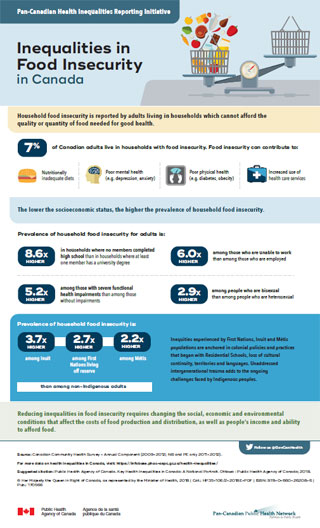
Household food insecurity is reported by adults living in households which cannot afford the quality or quantity of food needed for good health.
7% of Canadian adults live in households with food insecurity. Food insecurity can contribute to:
- Nutritionally inadequate diets
- Poor mental health (e.g. depression, anxiety)
- Poor physical health (e.g. diabetes, obesity)
- Increased use of health care services
The lower the socioeconomic status, the higher the prevalence of household food insecurity.
Prevalence of household food insecurity for adults is:
- 8.6X higher in households where no members completed high school than in households where at least one member has a university degree
- 6.0X higher among those who are unable to work than among those who are employed
- 5.2X higher among those with severe functional health impairments than among those without impairments
- 2.9X higher among people who are bisexual than among people who are heterosexual
Prevalence of household food insecurity is:
- 3.7X higher among Inuit
- 2.7X higher among First Nations living off reserve
- 2.2X higher among Métis
than among non-Indigenous adults
Inequities experienced by First Nations, Inuit and Métis populations are anchored in colonial policies and practices that began with Residential Schools, loss of cultural continuity, territories and languages. Unaddressed intergenerational trauma adds to the ongoing challenges faced by Indigenous peoples.
Reducing inequalities in food insecurity requires changing the social, economic and environmental conditions that affect the costs of food production and distribution, as well as people's income and ability to afford food.
Follow us @GovCanHealth
Source: Canadian Community Health Survey - Annual Component (2009-2012; NB and PE only 2011-2012).
For more data on health inequalities in Canada, visit: https://infobase.phac-aspc.gc.ca/health-inequalities/
Suggested citation: Public Health Agency of Canada. Key Health Inequalities in Canada: A National Portrait. Ottawa : Public Health Agency of Canada; 2018.
©Her Majesty the Queen in Right of Canada, as represented by the Minister of Health, 2018 | Cat.: HP35-106/2-2018E-PDF | ISBN: 978-0-660-26208-6 |
Pub.: 170566