
Infographic: Inequalities in children in low income families in Canada
Download the alternative format
(PDF format, 478 KB, 1 page)
Organization: Public Health Agency of Canada
- Cat.: HP35-113/4-2019E-PDF
- ISBN: 978-0-660-29684-5
- Pub.: 180802
Pan-Canadian Health Inequalities Reporting Initiative
Inequalities in children in low income families in Canada
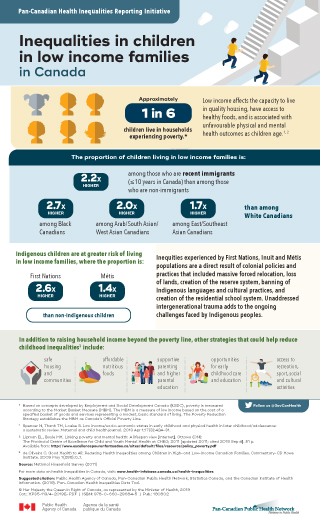
Approximately 1 in 6 children live in households experiencing poverty.Footnote *
Low income affects the capacity to live in quality housing, have access to healthy foods, and is associated with unfavourable physical and mental health outcomes as children age.Footnote 1, Footnote 2
The proportion of children living in low income families is:
- 2.2 times higher among those who are recent immigrants (≤10 years in Canada) than among those who are non-immigrants
- 2.7 times higher among Black Canadians
- 2.0 times higher among Arab/South Asian/West Asian Canadians
- 1.7 times higher among East/Southeast Asian Canadians
than among White Canadians
Indigenous children are at greater risk of living in low income families, where the proportion is:
- First Nations
- 2.6 times higher
- Métis
- 1.4 times higher
- than non-Indigenous children
Inequities experienced by First Nations, Inuit and Métis populations are a direct result of colonial policies and practices that included massive forced relocation, loss of lands, creation of the reserve system, banning of Indigenous languages and cultural practices, and creation of the residential school system. Unaddressed intergenerational trauma adds to the ongoing challenges faced by Indigenous peoples.
In addition to raising household income beyond the poverty line, other strategies that could help reduce childhood inequalities includeFootnote 3:
- safe housing and communities
- affordable nutritious foods
- supportive parenting and higher parental education
- opportunities for early childhood care and education
- access to recreation, sport, social and cultural activities
Follow us @GovCanHealth
Source: National Household Survey (2011)
For more data on health inequalities in Canada, visit:
www.health-infobase.canada.ca/health-inequalities
Suggested citation: Public Health Agency of Canada, Pan-Canadian Public Health Network, Statistics Canada, and the Canadian Institute of Health Information. (2018). Pan-Canadian Health Inequalities Data Tool.
© Her Majesty the Queen in Right of Canada, as represented by the Minister of Health, 2019 | Cat.: HP35-113/4-2019E-PDF | ISBN: 978-0-660-29684-5 | Pub.: 180802