
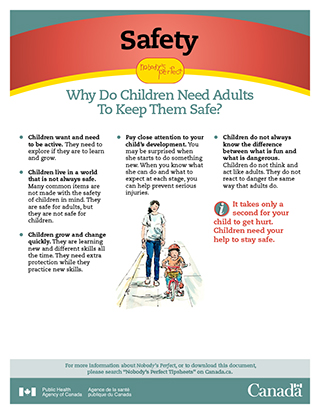
Safety: Why Do Children Need Adults To Keep Them Safe?
- Children want and need to be active. They need to explore if they are to learn and grow.
- Children live in a world that is not always safe. Many common items are not made with the safety of children in mind. They are safe for adults, but they are not safe for children.
- Children grow and change quickly. They are learning new and different skills all the time. They need extra protection while they practice new skills.
- Pay close attention to your child's development. You may be surprised when she starts to do something new. When you know what she can do and what to expect at each stage, you can help prevent serious injuries.
- Children do not always know the difference between what is fun and what is dangerous. Children do not think and act like adults. They do not react to danger the same way that adults do.
Key Message
It takes only a second for your child to get hurt. Children need your help to stay safe.
What You Can Do To Keep Your Child Safe
- Be prepared. Think ahead. Look for possible dangers in your home and when you go outside. Remove the dangers if you can.
- Protect your child. Remove dangerous things in your home so your child can play safely. Sometimes you cannot remove the danger outside. Help your child stay safe even when there is danger. For example, you cannot stop all the cars on the street. But you can hold your child's hand when you cross the street.
- Notice the new things your child can do. Check often to see if your child can now reach something that is dangerous.
- Stay close to your child. Many injuries happen when a parent or caregiver is not close by. Stay close to a young child so you can reach her quickly if she is in danger. When your baby is younger than 1 year old, stay very close unless she is in a safe place, like an approved crib or a playpen.
- Start early to teach your child about being safe. Talk to your child about what is safe and what is not safe. Teach your child how to look for dangers.
- Be a good example. Be safe yourself so your child can learn from you. For example, wear a helmet when you are riding a bike so your toddler will learn to wear one too.
- Be ready in case your child is injured. Keep a First Aid kit in your home and in the homes of those who care for your child. Have up-to-date training in First Aid and CPR (cardiopulmonary resuscitation). Make a list of emergency telephone numbers and keep the list near the telephone. Include the number for the Poison Control Centre.
Download the alternative format
(PDF format, 1.1 MB, 2 page)
Organization: Public Health Agency of Canada
Program providers: Please use this space to input your organization's information.