
Multi-drug combinations in opioid- or stimulant-related toxicity deaths in Canada: Infographic
Download in PDF format
(164 KB, 1 page)
Organization: Public Health Agency of Canada
Published: 2025-02-26
January 2018 to December 2023.
What are multi-drug combinations?
Multi-drug combinations are the involvement (detection and/or contribution) of more than 1 psychoactive substance or substance class in a death. The number of substances involved in opioid or stimulant toxicity deaths in Canada has increased, along with changes in the toxicity of the drug supply and polysubstance use (intentional or unintentional). Footnote 1 Footnote 2 Footnote 3
Impact in Canada
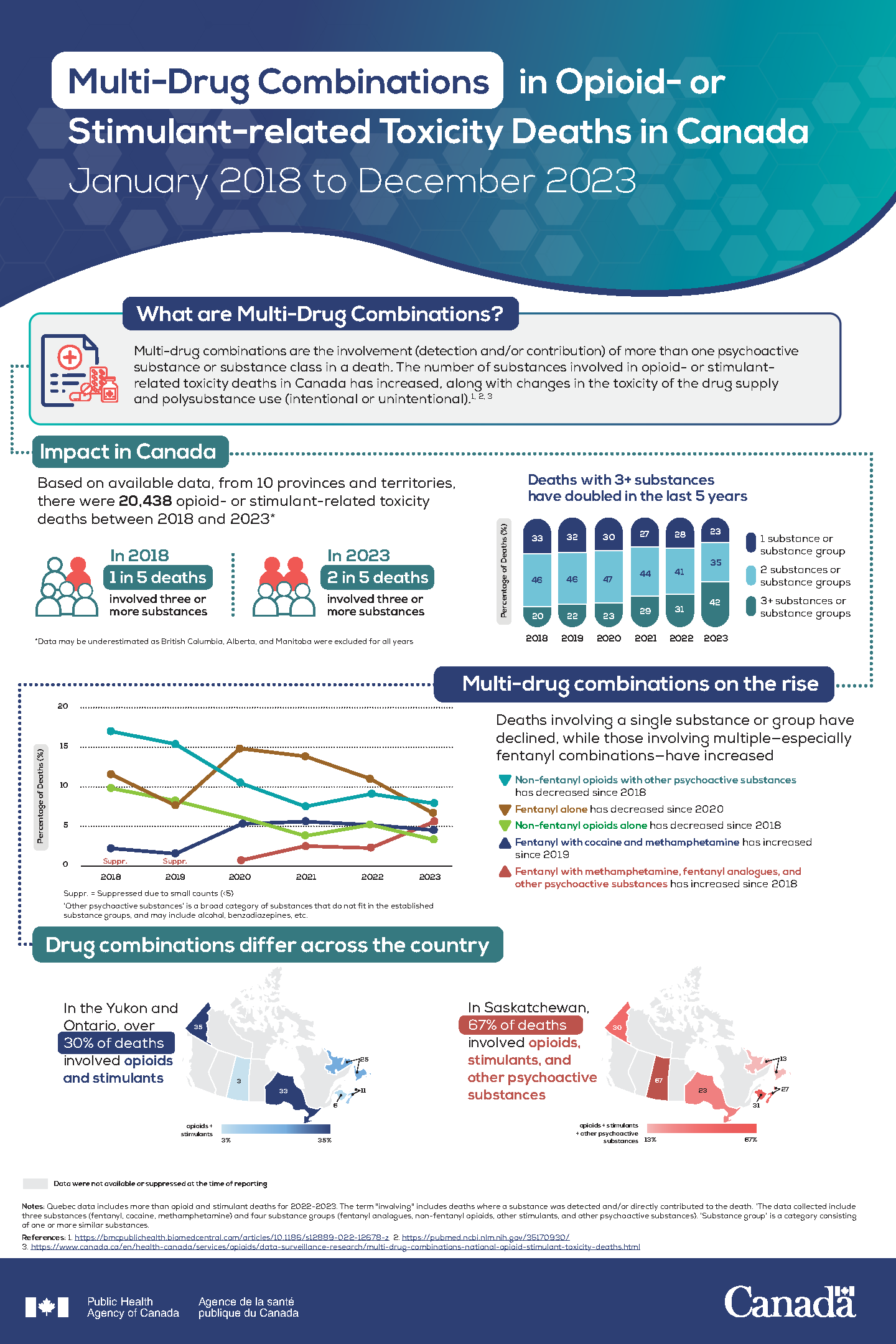
Based on available data, from 10 provinces and territories, there were 20,438 opioid- or stimulant-related toxicity deaths between 2018 and 2023.Footnote *
Multi-drug deaths with 3 or more substances have doubled in the last 5 years.
- In 2018, 1 in 5 deaths involved three or more substances.
- In 2023, 2 in 5 deaths involved three or more substances.
| Number of substances and substance groups | Year of death | |||||
|---|---|---|---|---|---|---|
| 2018 | 2019 | 2020 | 2021 | 2022 | 2023 | |
| 1 | 799 (33%) | 794 (32%) | 1,119 (30%) | 1,156 (27%) | 1,087 (28%) | 841 (23%) |
| 2 | 1,108 (46%) | 1,132 (46%) | 1,773 (47%) | 1,889 (44%) | 1,589 (41%) | 1,274 (35%) |
| 3 + | 491 (20%) | 540 (22%) | 865 (23%) | 1,247 (30%) | 1,179 (31%) | 1,555 (42%) |
| TotalFootnote * | 2,398 (100%) | 2,466 (100%) | 3,757 (100%) | 4,292 (100%) | 3,855 (100%) | 3,670 (100%) |
Multi-drug combinations on the rise
Deaths involving a single substance or group have declined, while those involving multiple – especially fentanyl combinations – have increased.
- Non-fentanyl opioids with other psychoactive substances has decreased since 2018.
- Fentanyl alone has decreased since 2020.
- Non-fentanyl opioids alone has decreased since 2018.
- Fentanyl with cocaine and methamphetamine has increased since 2019.
- Fentanyl with methamphetamine, fentanyl analogues, and other psychoactive substances has increased since 2018.
| Substance and substance group combination | Year of death | |||||
|---|---|---|---|---|---|---|
| 2018 | 2019 | 2020 | 2021 | 2022 | 2023 | |
| Fentanyl | 280 (12%) | 189 (8%) | 559 (15%) | 598 (14%) | 425 (11%) | 241 (7%) |
| Non-fentanyl opioids | 238 (10%) | 203 (8%) | 232 (6%) | 166 (4%) | 195 (5%) | 122 (3%) |
| Non-fentanyl opioids + other psychoactive substances | 409 (17%) | 381 (15%) | 392 (10%) | 323 (8%) | 352 (9%) | 293 (8%) |
| Fentanyl + cocaine + methamphetamine | 44 (2%) | 34 (2%) | 174 (5%) | 214 (6%) | 186 (5%) | 151 (4%) |
| Fentanyl + methamphetamine + fentanyl analogues + other psychoactive substances | Suppr. | Suppr. | 22 (1%) | 95 (2%) | 80 (2%) | 188 (6%) |
Suppr. = Suppressed due to small counts (<5)
"Other psychoactive substances" is a broad category of substances that do not fit in the established substance groups, and may include alcohol, benzodiazepines, etc.
Drug combinations differ across the country
In the Yukon and Ontario, over 30% of deaths involved opioids and stimulants.
In Saskatchewan, 67% of deaths involved opioids, stimulants, and other psychoactive substances.
| Substance group Combination | Reporting provinces/territories | |||||||||||||||||||
|---|---|---|---|---|---|---|---|---|---|---|---|---|---|---|---|---|---|---|---|---|
| NB | NL | NS | NT | ON | PE | QC | SK | YT | NU | |||||||||||
| Opioids + stimulants | 5 (6%) | 13 (25%) | 11 (11%) | n/a | 908 (33%) | Suppr. | n/a | 10 (3%) | 7 (35%) | Suppr. | ||||||||||
| Opioids + stimulants + other substances | 37 (41%) | 7 (13%) | 28 (27%) | n/a | 641 (23%) | n/a | n/a | 221 (67%) | 6 (30%) | Suppr. | ||||||||||
Suppr. = Suppressed
n/a = Not available
Notes: Quebec data includes more than opioid and stimulant deaths for 2022 to 2023. The term "involving" includes deaths where a substance was detected and/or directly contributed to the death. The data collected include 3 substances (fentanyl, cocaine, methamphetamine) and 4 substance groups (fentanyl analogues, non-fentanyl opioids, other stimulants, and other psychoactive substances). "Substance group" is a category consisting of 1 or more similar substances.
- *
-
Data may be underestimated as British Columbia, Alberta, and Manitoba were excluded for all years.
- Footnote 1
-
Konefal S, Sherk A, Maloney-Hall B, et al. Polysubstance use poisoning deaths in Canada: an analysis of trends from 2014 to 2017 using mortality data. BMC Public Health. 2022;22:269. Available from: https://bmcpublichealth.biomedcentral.com/articles/10.1186/s12889-022-12678-z
- Footnote 2
-
Boileau-Falardeau M, Contreras G, Gariépy G, Laprise C. Patterns and motivations of polysubstance use: a rapid review of the qualitative evidence. Health Promot Chronic Dis Prev Can. 2022;42(2):47-59. Available from: https://pubmed.ncbi.nlm.nih.gov/35170930/
- Footnote 3
-
Government of Canada. Multi-drug combinations in national apparent opioid and stimulant toxicity deaths. 2024. Available from: https://www.canada.ca/en/health-canada/services/opioids/data-surveillance-research/multi-drug-combinations-national-opioid-stimulant-toxicity-deaths.html