
Strategic funding model for scale-up: The experience of the Innovation Strategy (infographic)
Download in PDF format
(79 KB, 1 page)
Organization: Public Health Agency of Canada
Date published: 2023-02-01
Scale-up
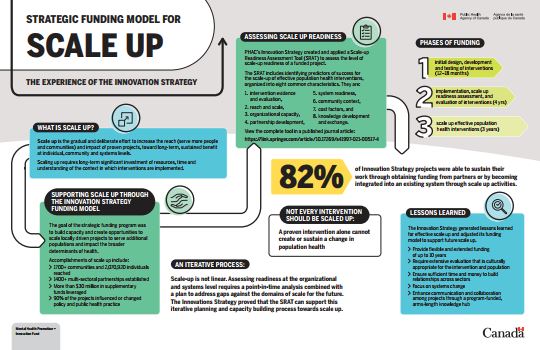
Scale-up is the gradual and deliberate effort to increase the reach and impact of proven projects, toward long-term, sustained benefit at individual, community, and systems levels. Increasing the reach of a project allows it to serve more people and communities. Scaling up requires long-term, significant investment of resources, time, and understanding of the context in which interventions are implemented.
Supporting scale-up through the Innovation Strategy funding model
The goal of the strategic funding program was to build capacity and create opportunities to scale locally-driven projects to serve additional populations and impact the broader determinants of health.
Accomplishments of scale-up
- Over 1700 communities and 2,070,920 individuals reached
- Over 1400 multi-sectoral partnerships established
- More than $30 million in supplementary funds leveraged
- 90% of the projects influenced or changed policy and public health practice
Assessing scale-up up readiness
PHAC's Innovation Strategy created and applied a Scale-up Readiness Assessment Tool (SRAT) to assess the level of scale-up readiness of a funded project. The SRAT includes identifying predictors of success for the scale-up of effective population health interventions, organized into eight common characteristics:
- Intervention evidence and evaluation
- Reach and scale
- Organizational capacity
- Partnership development
- System readiness
- Community context
- Cost factors
- Knowledge development and exchange
The complete SRAT tool is available in a published journal article.
Phases of funding
- Initial design, development, and testing of interventions (12 to 18 months)
- Implementation, scale up readiness, and evaluation of interventions (4 years)
- Scale up effective population health interventions (3 years)
82% of Innovation Strategy projects were able to sustain their work through obtaining funding from partners or by becoming integrated into an existing system through scale-up activities.
Not every intervention should be scaled-up. A proven intervention alone cannot create or sustain a change in population health.
An iterative process
Scale-up is not linear. Assessing readiness at the organizational and systems level requires a point-in-time analysis combined with a plan to address gaps against the domains of scale for the future. The Innovation Strategy proved that the SRAT can support this iterative planning and capacity building process towards scale-up.
Lessons learned
The Innovation Strategy generated lessons learned for effective scale-up and adjusted its funding model to support future scale up.
- Provide flexible and extended funding of up to 10 years
- Require extensive evaluation that is culturally appropriate for the intervention and population
- Ensure sufficient time and money to build relationships across sectors
- Focus on systems change
- Enhance communication and collaboration among projects through a program-funded, arms-length knowledge hub