
Viral hepatitis estimates among key populations in Canada, 2021 (infographic)
Download in PDF format
(152 KB, 1 page)
Organization: Public Health Agency of Canada
Date published: 2025-01-17
Hepatitis B and C disproportionately affect certain populations and communitiesFootnote 1.
Hepatitis C
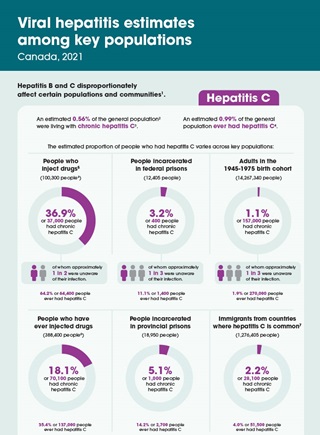
An estimated 0.56% of the general populationFootnote 2 were living with chronic hepatitis CFootnote 3. An estimated 0.99% of the general population ever had hepatitis CFootnote 4.
The estimated proportion of people who had hepatitis C varies across key populations:
- People who inject drugsFootnote 5 (100,300 peopleFootnote 6):
- An estimated 36.9% or 37,000 people had chronic hepatitis C, of whom approximately 1 in 2 were unaware of their infection.
- An estimated 64.2% or 64,400 people ever had hepatitis C.
- People who have ever injected drugs (388,400 peopleFootnote 6):
- An estimated 18.1% or 70,100 people had chronic hepatitis C.
- An estimated 35.4% or 137,000 people ever had hepatitis C.
- People incarcerated in provincial prisons (18,950 people):
- An estimated 5.1% or 1,000 people had chronic hepatitis C.
- An estimated 14.2% or 2,700 people ever had hepatitis C.
- First Nations Peoples (1,048,400 people):
- An estimated 3.3% or 34,300 people had chronic hepatitis C.
- An estimated 8.0% or 84,000 people ever had hepatitis C.
- People incarcerated in federal prisons (12,405 people):
- An estimated 3.2% or 400 people had chronic hepatitis C, of whom approximately 1 in 3 were unaware of their infection.
- An estimated 11.1% or 1,400 people ever had hepatitis C.
- Immigrants from countries where hepatitis C is commonFootnote 7 (1,276,405 people):
- An estimated 2.2% or 28,100 people had chronic hepatitis C.
- An estimated 4.0% or 51,500 people ever had hepatitis C.
- Adults in the 1945-1975 birth cohort (14,267,340 people):
- An estimated 1.1% or 157,000 people had chronic hepatitis C, of whom approximately 1 in 3 were unaware of their infection.
- An estimated 1.9% or 270,000 people ever had hepatitis C.
- Gay, bisexual and other men who have sex with men (669,613 peopleFootnote 6):
- An estimated 0.9% or 6,300 people had chronic hepatitis C.
- An estimated 3.0% or 20,100 people ever had hepatitis C.
The estimated proportion of people living with chronic hepatitis C was the highest among people who inject drugs.
The estimated number of people living with chronic hepatitis C was the highest among adults born between 1945 and 1975.
There was insufficient information to provide national estimates among Inuit and Métis Peoples, and estimates of awareness for some key populations.
Hepatitis B
An estimated 0.68% of the general population were living with chronic hepatitis BFootnote 8.
The estimated proportion of people who had hepatitis B varies across key populations:
- Immigrants from countries where hepatitis B is commonFootnote 9 (5,599,485 people):
- An estimated 4.2% or 237,000 people had chronic hepatitis B.
- Gay, bisexual and other men who have sex with men (669,613 peopleFootnote 6):
- An estimated 1.4% or 9,300 people had chronic hepatitis B.
- People incarcerated in federal prisons (12,405 people):
- An estimated 0.3% or <100 people had chronic hepatitis B.
The highest estimated proportion and number of people living with chronic hepatitis B were among immigrants from countries where hepatitis B is common.
There was insufficient information to provide national estimates among people who inject drugs, First Nations, Inuit and Métis Peoples and people incarcerated in provincial prisons, and estimates of awareness for all key populations.
Although the overall viral hepatitis burden is low in the general Canadian population, the 2021 national estimates indicate that certain populations and communities remain disproportionately affected, and that a significant number of people in Canada would benefit from targeted testing and treatment.
Footnotes
- Footnote 1
-
Due to the extensive overlap between these key populations, they were not considered to be mutually exclusive. Methods, full results and reference list available in Périnet S. et al., National hepatitis B and C estimates for 2021: measuring Canada's progress towards eliminating viral hepatitis as a public health concern, Canada Communicable Disease Report (submitted).
- Footnote 2
-
General population estimates and Canada's progress towards elimination available at https://www.canada.ca/content/dam/phac-aspc/documents/services/publications/diseases-conditions/progress-towards-eliminating-viral-hepatitis-threat-2021/progress-towards-eliminating-viral-hepatitis-threat-2021.pdf.
- Footnote 3
-
This represents people with viremic infection as a proxy for chronic hepatitis C.
- Footnote 4
-
This represents people living with positive hepatitis C virus antibody status, including those with chronic hepatitis C, those who spontaneously resolved the infection, and those with treatment-related cure.
- Footnote 5
-
Within the past 12 months.
- Footnote 6
-
Population size was estimated using a direct multiplier method.
- Footnote 7
-
Country or regional hepatitis C virus antibody prevalence estimate 2% or greater.
- Footnote 8
-
This represents people with positive hepatitis B surface antigen as a proxy for chronic hepatitis B.
- Footnote 9
-
Country or regional hepatitis B surface antigen prevalence estimate 2% or greater.