
Tick surveillance in Canada: Infographic 2021
Download in PDF format
(517 KB, 1 pages)
Organization: Public Health Agency of Canada
Date published: 2024
Cat.: HP37-39E-PDF
ISSN: 2816-9123
Pub.: 240433
Highlights from the 2021 report on blacklegged and western blacklegged ticks
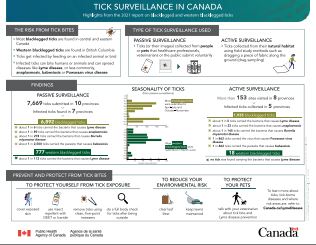
The risk from tick bites
- Most blacklegged ticks are found in central and eastern Canada.
- Western blacklegged ticks are found in British Columbia.
- Ticks get infected by feeding on an infected animal or bird.
- Infected ticks can bite humans or animals and can spread diseases like Lyme disease, anaplasmosis, babesiosis, and Powassan virus disease.
Type of tick surveillance used
Passive and active surveillance methods were used to collect data on ticks in Canada.
Passive surveillance:
- Ticks (or their images) collected from people or pets that healthcare professionals, veterinarians or the public submit voluntarily
Active surveillance:
- Ticks collected from their natural habitat using field study methods such as dragging a piece of fabric along the ground (drag sampling)
Findings from passive surveillance
- 7,669 ticks were submitted in 10 provinces.
- Infected ticks were found in 7 provinces.
- 6,892 blacklegged ticks were found.
- About 1 in 6 ticks carried the bacteria that causes Lyme disease.
- About 1 in 89 ticks carried the bacteria that causes anaplasmosis.
- About 1 in 278 ticks carried the bacteria that causes Borrelia miyamotoi disease.
- About 1 in 2,500 ticks carried the parasite that causes babesiosis.
- 777 western blacklegged ticks were found.
- About 1 in 112 ticks carried the bacteria that causes Lyme disease.
Seasonality of ticks
- Most blacklegged ticks were submitted from April to July and October to November.
- Most western blacklegged ticks were submitted from March to June.
Findings from active surveillance
- More than 153 sites were visited in 8 provinces.
- Infected ticks were collected in 5 provinces.
- 1,935 blacklegged ticks were found.
- About 1 in 5 ticks carried the bacteria that causes Lyme disease.
- About 1 in 23 ticks carried the bacteria that causes anaplasmosis.
- About 1 in 145 ticks carried the bacteria that causes Borrelia miyamotoi disease.
- About 1 in 862 ticks carried the virus that causes Powassan virus disease.
- About 1 in 862 ticks carried the parasite that causes babesiosis.
- 18 western blacklegged ticks were found.
- No tick carried the bacteria that causes Lyme disease.
How to prevent and protect from tick bites
To protect yourself from tick exposure, you can:
- cover exposed skin
- use insect repellent with DEET or Icaridin
- remove ticks using clean, fine-point tweezers
- do a full body check for ticks after being outside
To reduce your environmental risk:
- clear leaf litter
- keep lawns maintained
To protect your pets:
- talk to your veterinarian about tick bite and Lyme disease prevention