
Lyme disease surveillance in Canada: Annual edition 2018 (infographic)
Download in PDF format
(1,200 KB, 1 page)
- Organization: Public Health Agency of Canada
- Date published: September 2023
What is the risk?
- Lyme disease is the most frequently reported vector-borne disease in Canada.
- The greatest risk of acquiring Lyme disease occurs in regions where populations of ticks carrying the bacteria, Borellia burgdorferi, have become established.
Who's at greater risk?
- Children aged 5-14 years
- Adults aged 60-74 years
- People with occupational and recreational exposures are at greater risk of acquiring Lyme disease
How to manage?
- Most cases of Lyme disease can be effectively treated with 2 to 4 weeks of antibiotics if diagnosed early.
Facts reported in 2018
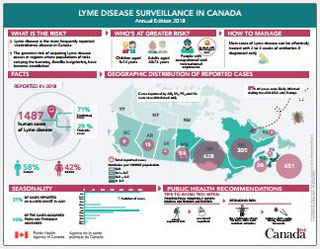
Reported in 2018:
- 1,487 cases of Lyme disease were reported, of which, 71% were confirmed cases and 29% probable cases
- 58% cases were males
- 42% cases were females
Geographic distribution of reported cases
| Province | Number of reported Lyme disease cases |
|---|---|
| British Columbia | 9 |
| Alberta | 15 |
| Saskatchewan | 2 |
| Manitoba | 54 |
| Ontario | 628 |
| Quebec | 305 |
| New Brunswick | 20 |
| Nova Scotia | 451 |
| Prince Edward Island | 1 |
| Newfoundland & Labrador | 2 |
Cases reported by Alberta, Saskatchewan, Prince Edward Island and Newfoundland & Labrador were travel-related only. 8% of reported cases were likely infected during travel in the USA or Europe.
Seasonality
- 31% of cases reported illness onset in July
- 95% of the cases occurred from May through November
Public health recommendations: Tips to avoid tick bites
Protecting yourself when doing outdoor activity:
- cover exposed skin
- use insect repellent
Reducing risk:
- do a full-body check for ticks after each outdoor activity
- remove ticks using clean, fine-tipped tweezers