
Chlamydia, gonorrhea and infectious syphilis in Canada, 2017 - infographic
Download the alternative format
(PDF format, 425 KB, 1 pages)
Organization: Public Health Agency of Canada
Published: 2019-11-07
The Public Health Agency of Canada collects information on reported cases of sexually transmitted infections; chlamydia, gonorrhea and infectious syphilis through the Canadian Notifiable Diseases Surveillance System (CNDSS).
Chlamydia
Trends in chlamydia by age and sex, 2008 - 2017
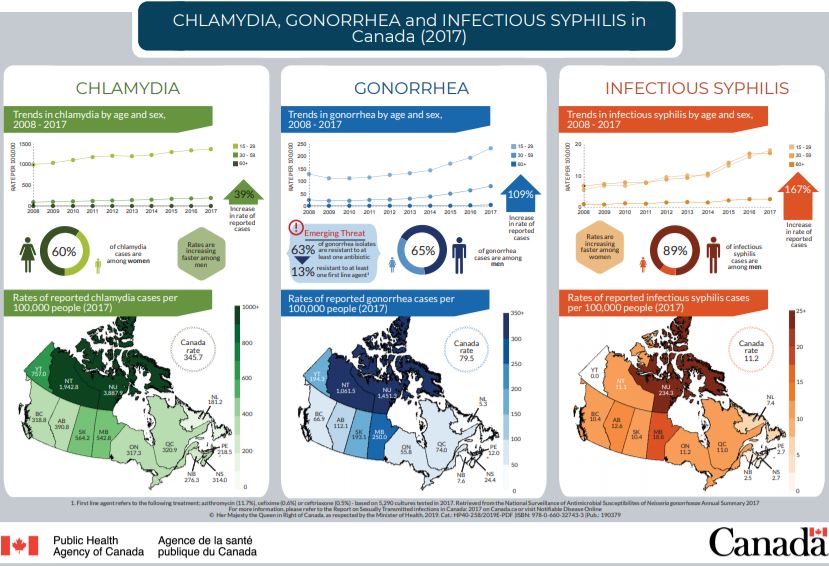
- Between 2008 and 2017, there was a 39% increase in the rate of reported cases of chlamydia.
- Rates of chlamydia are highest among 15 - 29 year olds, followed by the 30 - 59 and 60+ age groups.
| Year | Age group | ||
|---|---|---|---|
| 15-29 | 30-59 | 60+ | |
| 2008 | 998.2 | 97.2 | 2.7 |
| 2009 | 1037.9 | 103.7 | 3.4 |
| 2010 | 1107.4 | 115.8 | 4.2 |
| 2011 | 1175.6 | 125.9 | 4.4 |
| 2012 | 1203.8 | 136.9 | 4.6 |
| 2013 | 1192.2 | 141.5 | 4.9 |
| 2014 | 1224.0 | 153.1 | 5.9 |
| 2015 | 1293.5 | 171.0 | 6.4 |
| 2016 | 1330.7 | 183.4 | 7.1 |
| 2017 | 1369.7 | 192.6 | 7.9 |
- Although 60% of chlamydia cases are reported among women, rates are increasing faster among men.
Rates of reported chlamydia cases per 100,000 people (2017)
- The Canadian rate of chlamydia for 2017 was 345.7 per 100,000 people.
- In 2017, rates of chlamydia below the national rate were reported in Quebec (320.9), British Columbia (318.8), Ontario (317.3), Nova Scotia (314.0), New Brunswick (276.3), Prince Edward Island (218.5) and Newfoundland and Labrador (181.2).
- In 2017, rates of chlamydia above the national rate were reported in Alberta (390.8), Manitoba (542.8), Saskatchewan (564.2), Yukon (757.0), Northwest Territories (1,942.8) and Nunavut (3,887.9).
Gonorrhea
Trends in gonorrhea by age and sex, 2008 - 2017
- Between 2008 and 2017, there was a 109% increase in the rate of reported cases of gonorrhea.
- Rates of gonorrhea were highest among 15 - 29 year olds, followed by the 30 - 59 and 60+ age groups.
| Year | Age group | ||
|---|---|---|---|
| 15-29 | 30-59 | 60+ | |
| 2008 | 128.4 | 25.4 | 2.0 |
| 2009 | 112.5 | 22.1 | 1.7 |
| 2010 | 111.7 | 23.0 | 2.3 |
| 2011 | 115.1 | 25.2 | 2.2 |
| 2012 | 125.7 | 27.0 | 2.1 |
| 2013 | 132.5 | 31.5 | 2.1 |
| 2014 | 144.7 | 39.1 | 3.0 |
| 2015 | 170.1 | 51.0 | 3.3 |
| 2016 | 194.5 | 64.3 | 4.8 |
| 2017 | 232.8 | 80.3 | 5.4 |
- Most cases of gonorrhea (65%) were reported among men.
Emerging Threat
- In 2017, 63% of gonorrhea isolates were resistant to at least one antibiotic
- Of these, 13% were resistant to at least one first line agentFootnote 1
Rates of reported gonorrhea cases per 100,000 people (2017)
- The Canadian rate of gonorrhea for 2017 was 79.5 per 100,000 people.
- In 2017, rates of gonorrhea below the national rate were reported in Quebec (74.0), British Columbia (66.9), Ontario (55.8), Nova Scotia (24.4), Prince Edward Island (12.0), New Brunswick (7.6) and Newfoundland and Labrador (5.3).
- In 2017, rates of gonorrhea above the national rate were reported in Alberta (112.1), Saskatchewan (193.1), Yukon (194.3), Manitoba (250.0), Northwest Territories (1,061.5) and Nunavut (1,451.3).
Infectious syphilis
Trends in infectious syphilis by age and sex, 2008 - 2017
- Between 2008 and 2017, there was a 167% increase in the rate of reported cases of infectious syphilis.
- Rates of infectious syphilis were highest among 15 - 29 and 30 - 59 year olds, while the rate for the 60+ age group remained lower.
| Year | Age group | ||
|---|---|---|---|
| 15-29 | 30-59 | 60+ | |
| 2008 | 5.4 | 6.7 | 0.9 |
| 2009 | 6.8 | 7.3 | 0.8 |
| 2010 | 6.7 | 7.8 | 1.2 |
| 2011 | 7.8 | 7.7 | 1.0 |
| 2012 | 9.5 | 8.7 | 1.4 |
| 2013 | 10.1 | 9.3 | 1.6 |
| 2014 | 10.0 | 10.6 | 1.4 |
| 2015 | 13.2 | 14.1 | 2.1 |
| 2016 | 15.9 | 17.0 | 2.5 |
| 2017 | 18.1 | 17.2 | 2.5 |
- Most cases of infectious syphilis (89%) were reported among men, although rates are increasing faster among women.
Rates of reported infectious syphilis cases per 100,000 people (2017)
- The Canadian rate of infectious syphilis for 2017 was 11.2 per 100,000 people.
- In 2017, rates of infectious syphilis at or below the national rate were reported in Northwest Territories (11.1), Ontario (11.2), Quebec (11.0), British Columbia (10.4), Saskatchewan (10.4), Newfoundland and Labrador (7.4), Prince Edward Island (2.7), Nova Scotia (2.7), New Brunswick (2.5) and Yukon (0.0).
- In 2017, rates of infectious syphilis above the national rate were reported in Alberta (12.6), Manitoba (18.8), and Nunavut (234.3).
For more information, please refer to the Report on Sexually Transmitted infections in Canada: 2017 on Canada.ca or visit Notifiable Disease Online
Footnotes
- Footnote 1
-
First line agent refers to the following treatment; azithromycin (11.7%), cefixime (0.6%) or ceftriaxone (0.5%) - based on 5,290 cultures tested in 2017. Retrieved from the National Surveillance of Antimicrobial Susceptibilites of Neisseria gonorrhoeae Annual Summary 2017