
Canadian results from the 2017 EMIS (European Men-who-have-sex-with-men Internet Survey)
Download the alternative format
(PDF format, 146 KB, 1 pages)
Organization: Public Health Agency of Canada
Date published: November 2019
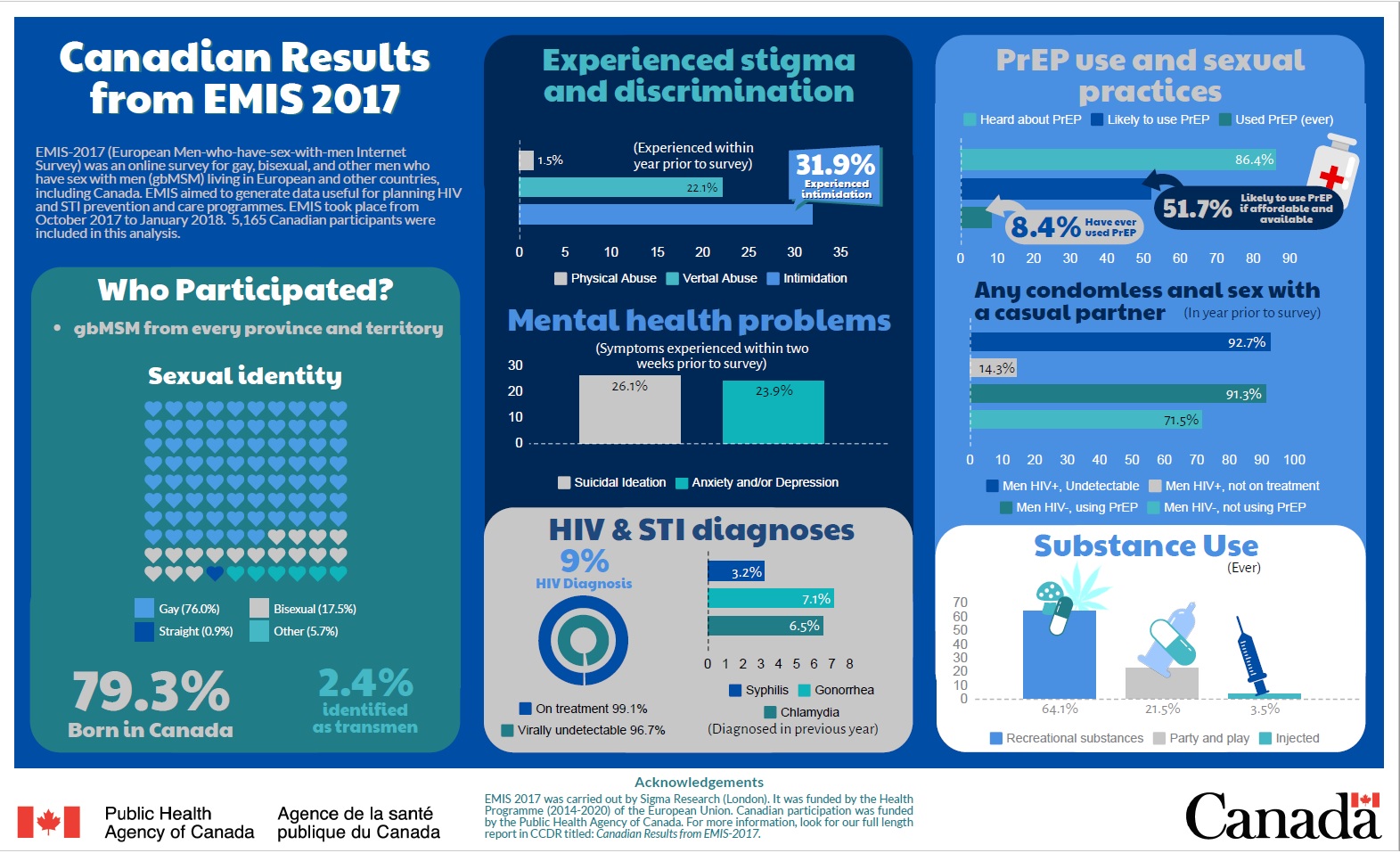
EMIS-2017 (European Men-who-have-sex-with-men Internet Survey) was an online survey for gay, bisexual, and other men who have sex with men (gbMSM) living in European and other countries, including Canada. EMIS aimed to generate data useful for planning HIV and STI prevention and care programmes. EMIS took place from October 2017 to January 2018. 5,165 Canadian participants were included in this analysis.
Who participated?
gbMSM from every province and territory.
- 76.0% of the participants identified as gay
- the remaining participants identified as bisexual (17.5%), straight (0.9%) or another term (5.7%)
- 2.4% identified as transmen
- 79.3% of participants reported Canada as their birth country
| Sexual identity | Proportion (%) |
|---|---|
| Gay | 76 |
| Bisexual | 17.5 |
| Straight | 0.9 |
| Other | 5.7 |
| Gender identity | Proportion (%) |
|---|---|
| Cisman | 97.6 |
| Transman | 2.4 |
| Born in Canada | Proportion (%) |
|---|---|
| Yes | 79.3 |
| No | 20.7 |
Experienced stigma and discrimination
- 1.5% of participants had experience physical abuse, including being punched, kicked, beaten or hit because someone knew or presumed they were attracted to men
- 22.1% had experienced verbal abuse, including insults because someone knew or presumed they were attracted to men
- 31.9% had experienced intimidation, including being stared at or intimidated because someone knew or presumed they were attracted to men
Mental health problems
Participants were asked to identify mental health related symptoms experienced over the previous 2 weeks prior to completing the survey
- 26.1% reported suicidal ideation in the previous 2 weeks ranging from some days to nearly every day
- 23.9% reported symptoms of moderate to severe anxiety and/or depression
| Experiences of stigma and discrimination in previous year | Proportion (%) |
|---|---|
| Physical abuse | 1.5 |
| Verbal abuse | 22.1 |
| Intimidation | 31.9 |
| Mental health problems | Proportion (%) |
|---|---|
| Suicidal ideation | 26.1 |
| Anxiety and/or depression | 23.9 |
HIV and STI diagnoses
- 9% of participants reported having been diagnosed with HIV
- 99.1% of those who self-reported as HIV positive, reported that they were currently on antiretroviral therapy (ART)
- Of those on ART, 96.7% of participants reported having an undetectable viral load
- Participants were asked about the STBBI diagnoses in the previous year to completing the survey
- 3.2% of participants reported having been diagnosed with syphilis
- 7.1% of participants reported having been diagnosed with gonorrhea
- 6.5% of participants reported having been diagnosed with chlamydia
| HIV status | Proportion (%) |
|---|---|
| HIV diagnosis | 9 |
| On treatment | 99.1 |
| Undetectable viral load | 96.7 |
| STBBI | Proportion (%) |
|---|---|
| Syphilis | 3.2 |
| Gonorrhea | 7.1 |
| Chlamydia | 6.5 |
PrEP use and sexual practices
PrEP use
- 86.4% of participants had heard of PrEP
- While 51.7% reported that they were likely to use PrEP if affordable and available, only 8.4% of participants were currently using PrEP at the time of the survey
| PrEP | Proportion (%) |
|---|---|
| Knowledge of PrEP | 86.4 |
| Likelihood to use PrEP | 51.7 |
| Current PrEP use | 8.4 |
Sexual practices
Participants were asked about their history of condomless anal intercourse (CAI) with casual partners in the previous year.
- Of men who reported being HIV-positive and undetectable, 92.7% of them reported participating in CAI with casual partners
- Of men who reported being HIV-positive and not using treatment, 14.3% of them reported participating in CAI with casual partners
- Of men who reported being HIV-negative and using PrEP, 91.3% of them reported participating in CAI with casual partners
- Of men who reported being HIV-negative and not using PrEP, 71.5% of them reported participating in CAI with casual partners
| Sexual practices | Proportion (%) |
|---|---|
| HIV+, Undetectable | 92.7 |
| HIV-, not using PrEP | 14.3 |
| HIV+, not on treatment | 91.3 |
| HIV-, using PrEP | 71.5 |
Substance use
- 64.1% of participants reported ever using recreational substances, including cannabis as it was not yet legal at the time of the survey
- 21.5% of participants reported ever engaging in Party and Play or Chemsex
- 3.5% of participants reported ever injecting drugs
| Substance use | Proportion (%) |
|---|---|
| Recreational substances | 64.1 |
| Party and play substances | 21.5 |
| Injectable substances | 3.5 |
Acknowledgements
EMIS 2017 was carried out by Sigma Research (London). It was funded by the Health Programme (2014-2020) of the European Union. Canadian participation was funded by the Public Health Agency of Canada. For more information, look for our full-length report in CCDR titled: Canadian results from EMIS-2017.