
Mental Illness in Canada - Infographic
Download in PDF format
(856 KB, 1 page)
Organization: Public Health Agency of Canada
Published: October 2020
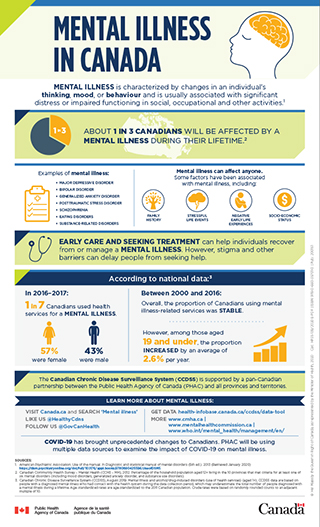
Mental illness is characterized by changes in an individual’s thinking, mood, or behaviour and is usually associated with significant distress or impaired functioning in social, occupational and other activitiesFootnote 1.
About 1 in 3 Canadians will be affected by a mental illness during their lifetimeFootnote 2.
Examples of mental illness:
- Major depressive disorder
- Bipolar disorder
- Generalized anxiety disorder
- Posttraumatic stress disorder
- Schizophrenia
- Eating disorders
- Substance-related disorders
Mental illness can affect anyone. Some factors have been associated with mental illness, including:
- Family history
- Stressful life events
- Negative early life experiences
- Socio-economic status
Early care and seeking treatment can help individuals recover from or manage a mental illness. However, stigma and other barriers can delay people from seeking help.
According to national dataFootnote 3:
In 2016-2017:
- 1 in 7 Canadians used health services for a mental illness
- 57% were female and 43% were male
Between 2000 and 2016:
- Overall, the proportion of Canadians using mental illness-related services was STABLE.
- However, among those aged 19 and under, the proportion INCREASED by an average of 2.6% per year.
The Canadian Chronic Disease Surveillance System (CCDSS) is supported by a pan-Canadian partnership between the Public Health Agency of Canada (PHAC) and all provinces and territories.
Learn more about mental illness:
- VISIT Canada.ca and search ‘Mental illness’
- GET DATA health-infobase.canada.ca/ccdss/data-tool/
- LIKE US @HealthyCdns
- FOLLOW US @GovCanHealth
- MORE
COVID-19 has brought unprecedented changes to Canadians. PHAC will be using multiple data sources to examine the impact of COVID-19 on mental illness.
Sources:
- Footnote 1
-
American Psychiatric Association. Use of the manual. In Diagnostic and statistical manual of mental disorders (5th ed.). 2013 (Retrieved January 2020) https://dsm.psychiatryonline.org/doi/full/10.1176/appi.books.9780890425596.UseofDSM5
- Footnote 2
-
Canadian Community Health Survey – Mental Health (CCHS – MH), 2012. Percentage of the household population aged 12+ living in the 10 provinces that met criteria for at least one of six mental disorders (including mood disorders, generalized anxiety disorder, and substance use disorders).
- Footnote 3
-
Canadian Chronic Disease Surveillance System (CCDSS), August 2019. Mental illness and alcohol/drug-induced disorders (use of health services) (aged 1+); CCDSS data are based on people with a diagnosed mental illness who had contact with the health system during the data collection period, which may underestimate the total number of people diagnosed with a mental illness during a lifetime. Age-standardized rates are age-standardized to the 2011 Canadian population. Crude rates were based on randomly rounded counts to an adjacent multiple of 10.
Her Majesty the Queen in Right of Canada, as represented by the Minister of Health, 2020 Cat.: HP35-138/2020E-PDF | ISBN: 978-0-660-35701-0 | Pub.: 200151