
Infographic: Suicidal ideation among adults in Canada during the COVID-19 pandemic
Download the alternative format
(PDF format, 440 KB, 2 pages)
Organization: Public Health Agency of Canada
Published: 2022-10-18
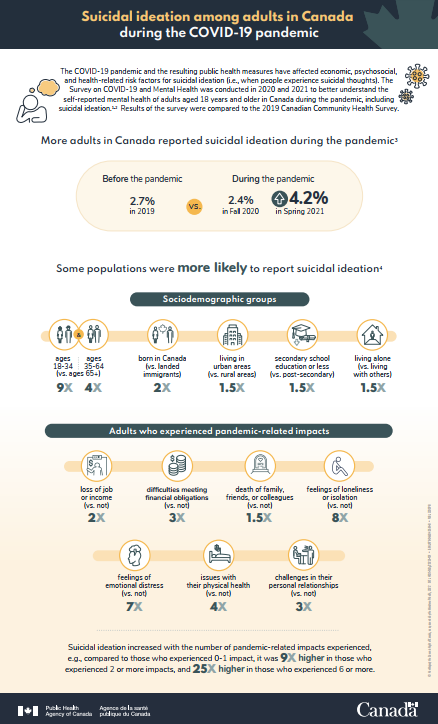
The COVID-19 pandemic and the resulting public health measures have affected economic, psychosocial, and health-related risk factors for suicidal ideation (i.e., when people experience suicidal thoughts). The Survey on COVID-19 and Mental Health was conducted in 2020 and 2021 to better understand the self-reported mental health of adults aged 18 years and older in Canada during the pandemic, including suicidal ideation.Footnote 1,Footnote 2 Results of the survey were compared to the 2019 Canadian Community Health Survey.
More adults in Canada reported suicidal ideation during the pandemic
Before the pandemic, in 2019, 2.7% of adults in Canada reported suicidal ideation. During the pandemic, 2.4% of adults reported suicidal ideation in fall 2020. This percentage rose significantly in spring 2021 to 4.2%.Footnote 3
Some populations were more likely to report suicidal ideationFootnote 4
Sociodemographic groups
Reports of suicidal ideation were:
- 9 times more likely among adults aged 18-34, and 4 times more likely among adults aged 35-64, compared to those 65 and over
- 2 times more likely among adults born in Canada, compared to landed immigrants
- 1.5 times more likely among adults living in urban areas, compared to those living in rural areas
- 1.5 times more likely among adults with secondary school education or less, compared to those with post-secondary education
- 1.5 more likely among adults living alone, compared to those living with others
Adults who experienced pandemic-related impacts
Reports of suicidal ideation were:
- 8 times more likely among those who experienced feelings of loneliness or isolation, compared to those who did not
- 7 times more likely among those who experienced feelings of emotional distress, compared to those who did not
- 4 times more likely among those who experienced issues with their physical health, compared to those who did not
- 3 times more likely among those who experienced challenges in their personal relationships, compared to those who did not
- 3 times more likely among those who experienced difficulties meeting their financial obligations, compared to those who did not
- 2 times more likely among those who experienced loss of their job or income, compared to those who did not
- 1.5 times more likely among those who experienced the death of family, friends, or colleagues, compared to those who did not
Additionally, the likelihood of reporting suicidal ideation increased with the number of pandemic-related impacts an individual experienced. Compared to those who experienced 1 impact or less, reports of suicidal ideation were 9 times higher in those who experienced 2 or more impacts and 25 times higher in those who experienced 6 or more impacts.
Adults with symptoms of mental illness
Reports of suicidal ideation were:
- 14 times more likely among adults with moderate to severe symptoms of major depressive disorder, compared to those without
- 10 times more likely among adults with moderate to severe symptoms of post-traumatic stress disorder, compared to those without
- 8 times more likely among adults with moderate to severe symptoms of generalized anxiety disorder, compared to those without
Other populations
Reports of suicidal ideation were:
- 3 times more likely among those experienced stressful/traumatic events in their lifetime, compared to those who did not
- 2 times more likely among those who reported increased alcohol consumption during the pandemic, compared to those who did not
- 2 times more likely among those who reported increased cannabis use during the pandemic, compared to those who did not
- 2 times more likely among those who had concerns of violence in their own home, compared to those who did not
- 2 times more likely among those who did not exercise to improve their health, compared to those who did
Although an increase in suicidal ideation was observed in spring 2021, there is currently no evidence of an increased number of deaths by suicide since the pandemic beganFootnote 5. This could change as data are updated. Monitoring changes in the population over time using surveys and administrative data can help identify groups that are at increased risk of suicide and inform suicide prevention efforts.
Information about the data
The two cycles of Survey on COVID-19 and Mental Health were conducted by Statistics Canada from September to December 2020 and February to May 2021. Participants were asked if they had seriously contemplated suicide since the COVID-19 pandemic began. In the 2019 Canadian Community Health Survey, participants were asked if they had seriously contemplated suicide in the past 12 months.
Help is available
Reading about suicide may bring about difficult emotions. If you or someone you know is in immediate danger, please call 9-1-1.
Help is available 24/7 for suicide prevention and mental health. Here are some resources:
- Talk Suicide Canada: 1-833-456-4566 (or text 45645 from 4pm to midnight ET)
- Kids Help Phone: 1-800-668-6868 or text CONNECT to 686868
- Hope for Wellness Helpline for Indigenous peoples: 1-855-242-3310
- Trans Lifeline: 1-877-330-6366
- For Quebec residents: 1-866-APPELLE (277-3553)
- Wellness Together Canada
- Preventing suicide: Warning signs and how to help
Visit the Government of Canada's website on Coronavirus disease (COVID-19)
Like us: @HealthyCdns
Follow us: @GovCanHealth
Footnotes
- Footnote 1
-
Statistics Canada. Survey on COVID-19 and Mental Health. 2020 (Retrieved June 2022). Available from: https://www23.statcan.gc.ca/imdb/p2SV.pl?Function=getSurvey&Id=1283036
- Footnote 2
-
Statistics Canada. Survey on COVID-19 and Mental Health. 2021 (Retrieved June 2022). Available from: https://www23.statcan.gc.ca/imdb/p2SV.pl?Function=getSurvey&SDDS=5330
- Footnote 3
-
More detailed methods and results can be found in the journal articles: Suicide ideation in Canada during the COVID-19 pandemic and Prevalence of suicidal ideation among adults in Canada: Results of the second Survey on COVID-19 and mental health.
- Footnote 4
-
The estimates were based on pooled data of the 2020 and 2021 Survey on COVID-19 and Mental Health.
- Footnote 5
-
Statistics Canada. Deaths, 2020. The Daily. Available from: https://www150.statcan.gc.ca/n1/daily-quotidien/220124/dq220124a-eng.htm