
HIV prevention: What you need to know (infographic)
Download in PDF format
(214 KB, 2 pages)
Organization: Public Health Agency of Canada
Date published: 2024
Cat.: HP40-264/2024E-PDF
ISBN: 978-0-660-74524-4
Pub.: 240633
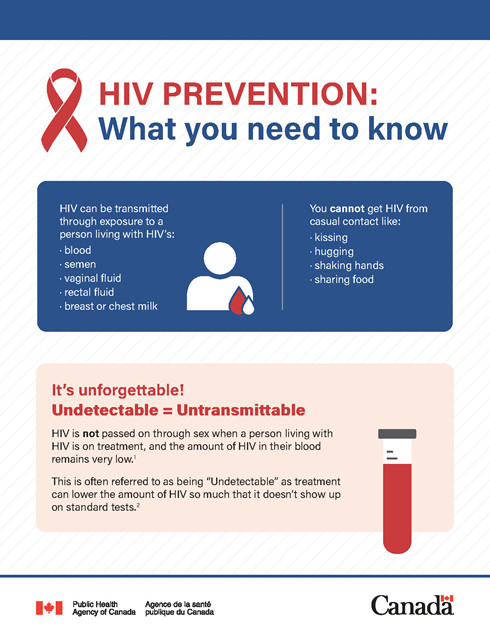
HIV can be transmitted through exposure to a person living with HIV's:
- blood
- semen
- vaginal fluid
- rectal fluid
- breast or chest milk
You cannot get HIV from casual contact like:
- kissing
- hugging
- shaking hands
- sharing food
It's unforgettable! Undetectable = Untransmittable
HIV is not passed on through sex when a person living with HIV is on treatment, and the amount of HIV in their blood remains very low.Footnote 1
This is often referred to as being "Undetectable" as treatment can lower the amount of HIV so much that it doesn't show up on standard tests.Footnote 2
Be PrEPared
HIV pre-exposure prophylaxis (HIV PrEP) is medication that you can take to prevent HIV if you don't already have it.
HIV PrEP is available as either a daily pill or as an injection you receive from a health professional every couple of months.
Talk to a health professional and ask them if HIV PrEP is right for you.
PEP talk
HIV post-exposure prophylaxis (HIV PEP) is medication that you can take after a high-risk exposure to HIV to prevent an infection.
Start HIV PEP as soon as possible after exposure, up to a maximum of 72 hours afterwards.
If you think you may have been recently exposed to HIV, visit a health professional right away and ask them if HIV PEP is right for you.
Use condoms or other physical barriers when unsure of the HIV status of your partner(s).
Avoid sharing equipment for drug-injection, tattoos and piercings. Use new equipment every time.
To learn more: Visit Canada.ca/HIV
Footnotes
- Footnote 1
-
Defined as maintaining a viral load less than 200 copies of HIV per milliliter of blood measured every 4 to 6 months.
- Footnote 2
-
Due to ongoing advances in testing, the exact amount of HIV that is "undetectable" may continue to change. It's important to remember that any test result that shows a number less than 200 copies per milliliter means that HIV cannot be passed on.