
HIV in Canada: 2023 surveillance highlights
Download the alternative format
(PDF format, 235 KB, 1 page)
Organization: Public Health Agency of Canada
Published: 2024
From: Public Health Agency of Canada
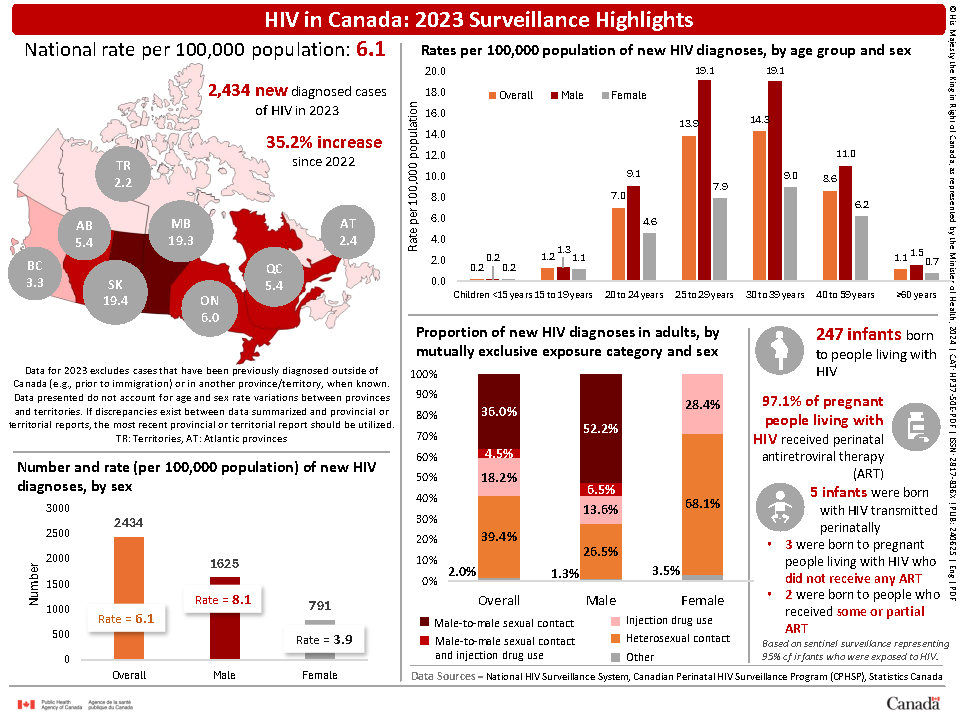
- 2,434 new HIV diagnoses in 2023 (35.2% increase since 2022)
- National rate of new HIV diagnoses for 2023 – 6.1 per 100,000 population
2023 Data Notes
- Data for 2023 excludes cases that have been previously diagnosed outside of Canada (e.g. prior to immigration) or in another province/territory, when known.
- Data presented do not account for age and sex rate variations between provinces and territories.
- If discrepancies exist between data summarized and provincial or territorial reports, the most recent provincial or territorial report should be utilized.
- TR: Territories, AT: Atlantic provinces
New diagnosis rate per 100,000 population in 2023, by province or territory
- Provincial and territorial HIV diagnosis rates:
- Territories – 2.2
- British Columbia – 3.3
- Alberta – 5.4
- Saskatchewan – 19.4
- Manitoba – 19.3
- Ontario – 6.0
- Quebec – 5.4
- Atlantic – 2.4
Number and rate (per 100,000 population) of new HIV diagnoses, by sex
- 1,625 new HIV diagnoses in males – Rate of 8.1
- 791 new HIV diagnoses in females – Rate of 3.9
Rates per 100,000 population of new HIV diagnoses, by age group and sex
- Overall:
- Children <15 years of age – 0.2
- 15-19 years of age – 1.2
- 20-24 years of age – 7.0
- 25-29 years of age – 13.9
- 30-39 years of age – 14.3
- 40-59 years of age – 8.6
- ≥60 years of age – 1.1
- In males:
- Children <15 years of age – 0.2
- 15-19 years of age – 1.3
- 20-24 years of age – 9.1
- 25-29 years of age – 19.1
- 30-39 years of age – 19.1
- 40-59 years of age – 11.0
- ≥60 years of age – 1.5
- In females:
- Children <15 years of age – 0.2
- 15-19 years of age – 1.1
- 20-24 years of age – 4.6
- 25-29 years of age – 7.9
- 30-39 years of age – 9.0
- 40-59 years of age – 6.2
- ≥60 years of age – 0.7
Distribution of new HIV diagnoses, by mutually exclusive exposure category and sex
- Overall:
- Male-to-male sexual contact – 36.0%
- Male-to-male sexual contact and injection drug use – 4.5%
- Injection drug use – 18.2%
- Heterosexual contact – 39.4%
- Other – 2.0%
- In males:
- Male-to-male sexual contact – 52.2%
- Male-to-male sexual contact and injection drug use – 6.5%
- Injection drug use – 13.6%
- Heterosexual contact – 26.5%
- Other – 1.3%
- In females:
- Injection drug use – 28.4%
- Heterosexual contact – 68.1%
- Other – 3.5%
Perinatal HIV Surveillance in 2023
- 247 infants born to people living with HIV.
- 97.1% of pregnant people living with HIV received perinatal antiretroviral therapy (ART).
- 5 infants were born with HIV transmitted perinatally: 3 were born to pregnant people living with HIV who did not receive any ART, and 2 were born to people who received some or partial ART.
- Based on sentinel surveillance representing 95% of infants who were exposed to HIV.
Data Sources
National HIV Surveillance System (HASS), Canadian Perinatal HIV Surveillance System (CPHSP), Statistics Canada