
Enhanced Surveillance of Antimicrobial-Resistant Gonorrhea in Canada (infographic)
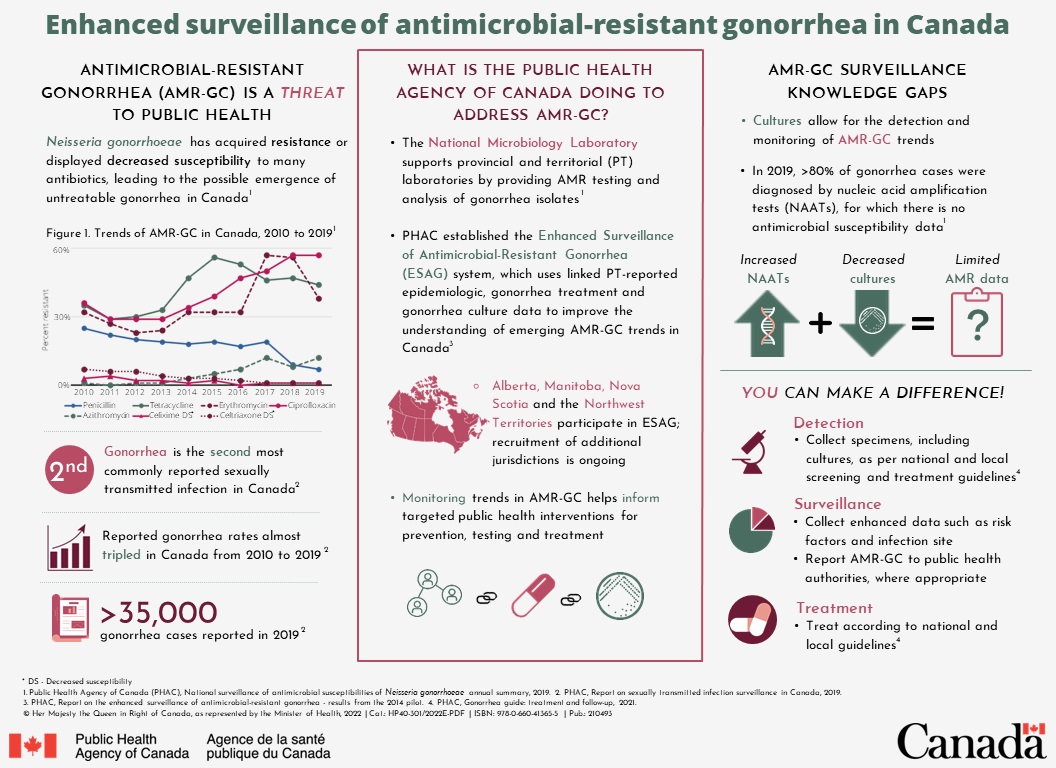
Antimicrobial-Resistant Gonorrhea (AMR-GC) is a threat to public health
Neisseria gonorrhoeae has acquired resistance or displayed decreased susceptibility to many antibiotics, leading to the possible emergence of untreatable gonorrhea in CanadaFootnote 1
Download the alternative format
(PDF format, 283 KB, 1 page)
Organization: Public Health Agency of Canada
Date Published: July 13, 2022
ISBN: 978-0-660-41365-5
Cat: HP40-301/2022E-PDF
Pub.: 210493
Figure - Text description
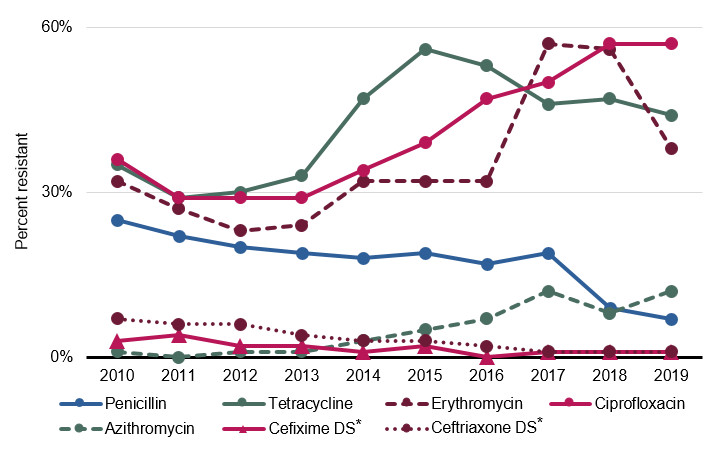
A line graph with seven lines representing the proportion of Neisseria gonorrhoeae isolates (based on the total number of isolates tested nationally) resistant to azithromycin, ciprofloxacin, erythromycin, penicillin, tetracycline and decreased susceptibility to cefixime and ceftriaxone in Canada from 2010 to 2019.
| Year | Proportion of Neisseria gonorrhoeae isolatesFootnote * | ||||||
|---|---|---|---|---|---|---|---|
| Penicillin - Resistant | Tetracycline - Resistant | Erythromycin - Resistant | Ciprofloxacin - Resistant | Azithromycin - Resistant | Cefixime - Decreased Susceptibility | Ceftriaxone -Decreased Susceptibility | |
| 2010 | 25% | 35% | 32% | 36% | 1% | 3% | 7% |
| 2011 | 22% | 29% | 27% | 29% | 0% | 4% | 6% |
| 2012 | 20% | 30% | 23% | 29% | 1% | 2% | 6% |
| 2013 | 19% | 33% | 24% | 29% | 1% | 2% | 4% |
| 2014 | 18% | 47% | 32% | 34% | 3% | 1% | 3% |
| 2015 | 19% | 56% | 32% | 39% | 5% | 2% | 3% |
| 2016 | 17% | 53% | 32% | 47% | 7% | 0% | 2% |
| 2017 | 19% | 46% | 57% | 50% | 12% | 1% | 1% |
| 2018 | 9% | 47% | 56% | 57% | 8% | 1% | 1% |
| 2019 | 7% | 44% | 38% | 57% | 12% | 1% | 1% |
|
|||||||
- Gonorrhea is the second most commonly reported sexually transmitted infection (STI) in CanadaFootnote 2
- Reported gonorrhea rates almost tripled in Canada from 2010 to 2019Footnote 2
- Greater than 35,000 gonorrhea cases were reported in 2019Footnote 2
What is the Public Health Agency of Canada doing to address AMR-GC?
- The National Microbiology Laboratory supports provincial and territorial (PT) laboratories by providing AMR testing and analysis of gonorrhea isolatesFootnote 1
- PHAC established the Enhanced Surveillance of Antimicrobial-Resistant Gonorrhea (ESAG) system, which uses linked PT-reported epidemiologic, gonorrhea treatment and gonorrhea-culture data to improve the understanding of emerging AMR-GC trends in CanadaFootnote 3
- Alberta, Manitoba, Nova Scotia and the Northwest Territories participate in ESAG; recruitment of additional jurisdictions is ongoing
- Monitoring trends in AMR-GC helps inform targeted public health interventions for prevention, testing and treatment
AMR-GC surveillance knowledge gaps
- Cultures allow for the detection and monitoring of AMR-GC trends
- In 2019, more than 80% of gonorrhea cases were diagnosed by nucleic acid amplification tests (NAATs), for which there is no antimicrobial susceptibility dataFootnote 1
- An increase in NAATs and a decrease in cultures can lead to limited AMR data
You can make a difference!
Detection
- Collect specimens, including cultures, as per national and local screening and treatment guidelinesFootnote 4
Surveillance
- Collect enhanced data such as risk factors and infection site
- Report AMR-GC to public health authorities, where appropriate
Treatment
- Treat according to national and local guidelinesFootnote 4
References
- Footnote 1
-
Public health Agency of Canada (PHAC). National surveillance of antimicrobial susceptibilities of Neisseria gonorrhoeae annual summary 2019. [https://www.canada.ca/en/services/health/publications/drugs-health-products/national-surveillance-antimicrobial-susceptibilities-neisseria-gonorrhoeae-annual-summary-2019.html] 2021.
- Footnote 2
-
PHAC. Report on sexually transmitted infection surveillance in Canada, 2019. [https://www.canada.ca/en/public-health/services/publications/diseases-conditions/report-sexually-transmitted-infection-surveillance-canada-2019.html#s5-3] 2022.
- Footnote 3
-
PHAC. Report on the enhanced surveillance of antimicrobial-resistant gonorrhea - results from the 2014 pilot. [https://www.canada.ca/en/public-health/services/publications/diseases-conditions/gonorrhea-2014-pilot-surveillance-antimicrobial-resistant.html] 2018.
- Footnote 4
-
PHAC. Gonorrhea guide: treatment and follow-up. [https://www.canada.ca/en/public-health/services/infectious-diseases/sexual-health-sexually-transmitted-infections/canadian-guidelines/gonorrhea/treatment-follow-up.html#a2_3] 2021.