
Colorectal cancer in Canada
Tell us what you think
Help us improve our products, answer our quick survey.
Download the alternative format
(PDF format, 261 KB, 1 page)
Organization: Public Health Agency of Canada
Published: 2019-XX-XX
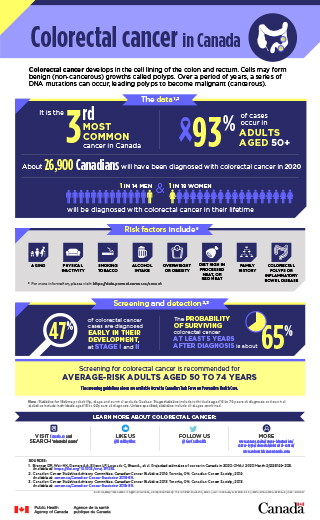
Colorectal cancer develops in the cell lining of the colon and rectum. Cells may form benign (non-cancerous) growths called polyps. Over a period of years, a series of DNA mutations can occur, leading polyps to become malignant (cancerous).
The data Footnote 1,Footnote 2
- Colorectal cancer is the 3rd most common cancer in Canada
- 93% of cases occur in adults aged 50+
- About 26,900 Canadians will have been diagnosed with colorectal cancer in 2020
- 1 in 14 men will be diagnosed with colorectal cancer in their lifetime
- 1 in 18 women will be diagnosed with colorectal cancer in their lifetime
Risk factors includeFootnote *
- Aging
- Physical inactivity
- Smoking tobacco
- Alcohol intake
- Overweight or obesity
- Diet high in processed meat, or red meat
- Family history
- Colorectal polyps or inflammatory bowel disease
Screening and detection Footnote 2,Footnote 3
- 47% of colorectal cancer cases are diagnosed early in their development, at Stage I and II
- The probability of surviving colorectal cancer at least five years after diagnosis is about 65% in Canada
Screening for colorectal cancer is recommended for average-risk adults aged 50 to 74 years.
The screening guidelines above are available from the Canadian Task Force on Preventive Health Care.
Notes:
Statistics for lifetime probability, stage and survival exclude Quebec. Stage statistics include individuals aged 18 to 79 years at diagnosis and survival statistics include individuals aged 15 to 99 years at diagnosis. Unless specified, statistics include all stages combined.
Learn more about colorectal cancer:
Visit: Canada.ca and search ‘colorectal cancer’
Like us: @HealthyCdns
Follow us: @GovCanHealth
More: Canadian Cancer Society | Colorectal Cancer Canada
Footnotes:
- Footnote *
-
For more information, please visit: https://data.prevent.cancer.ca/current
Sources:
- Footnote 1
-
Brenner DR, Weir HK, Demers AA, Ellison LF, Louzado C, Shaw A, et al. Projected estimates of cancer in Canada in 2020. CMAJ. 2020 March 2;192:E199-205. Available at: https://doi.org/10.1503/cmaj.191292.
- Footnote 2
-
Canadian Cancer Statistics Advisory Committee. Canadian Cancer Statistics 2019. Toronto, ON: Canadian Cancer Society; 2019. Available at: cancer.ca/Canadian-Cancer-Statistics-2019-EN.
- Footnote 3
-
Canadian Cancer Statistics Advisory Committee. Canadian Cancer Statistics 2018. Toronto, ON: Canadian Cancer Society; 2018. Available at: cancer.ca/Canadian-Cancer-Statistics-2018-EN.
© Her Majesty the Queen in Right of Canada, as represented by the Minister of Health, 2020 | Cat.: HP35-83/2-2020E-PDF | ISBN: 978-0-660-35269-5 | Pub.: 200097