
Childhood Cancer Counts in Canada
Download in PDF format
(313 KB, 1 pages)
Organization:Public Health Agency of Canada
Date published: 2022-02-14
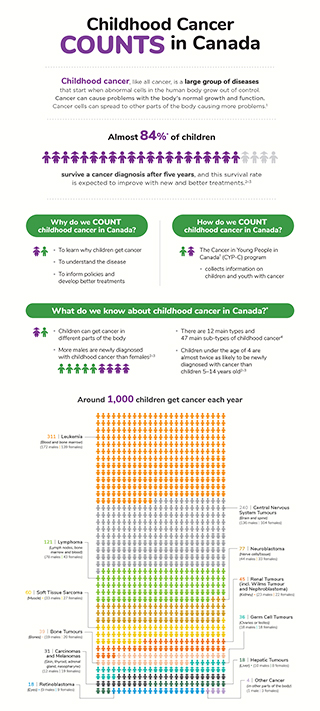
Childhood cancer, like all cancer, is a large group of diseases that start when abnormal cells in the human body grow out of control. Cancer can cause problems with the body's normal growth and function. Cancer cells can spread to other parts of the body causing more problems.Footnote 1
Almost 84%Footnote * of children survive a cancer diagnosis after five years, and this survival rate is expected to improve with new and better treatments.Footnote 2Footnote 3
Why do we count childhood cancer in Canada?
- To learn why children get cancer
- To understand the disease
- To inform policies and develop better treatments
How do we count childhood cancer in Canada?
The Cancer in Young People in CanadaFootnote † (CYP-C) program
- collects information on children and youth with cancer
What do we know about childhood cancer in Canada?Footnote *
- Children can get cancer in different parts of the body
- There are 12 main types and 47 main sub-types of childhood cancerFootnote 4
- More males are newly diagnosed with childhood cancer than femalesFootnote 2Footnote 3
- Children under the age of 4 are almost twice as likely to be newly diagnosed with cancer than children 5–14 years oldFootnote 2Footnote 3
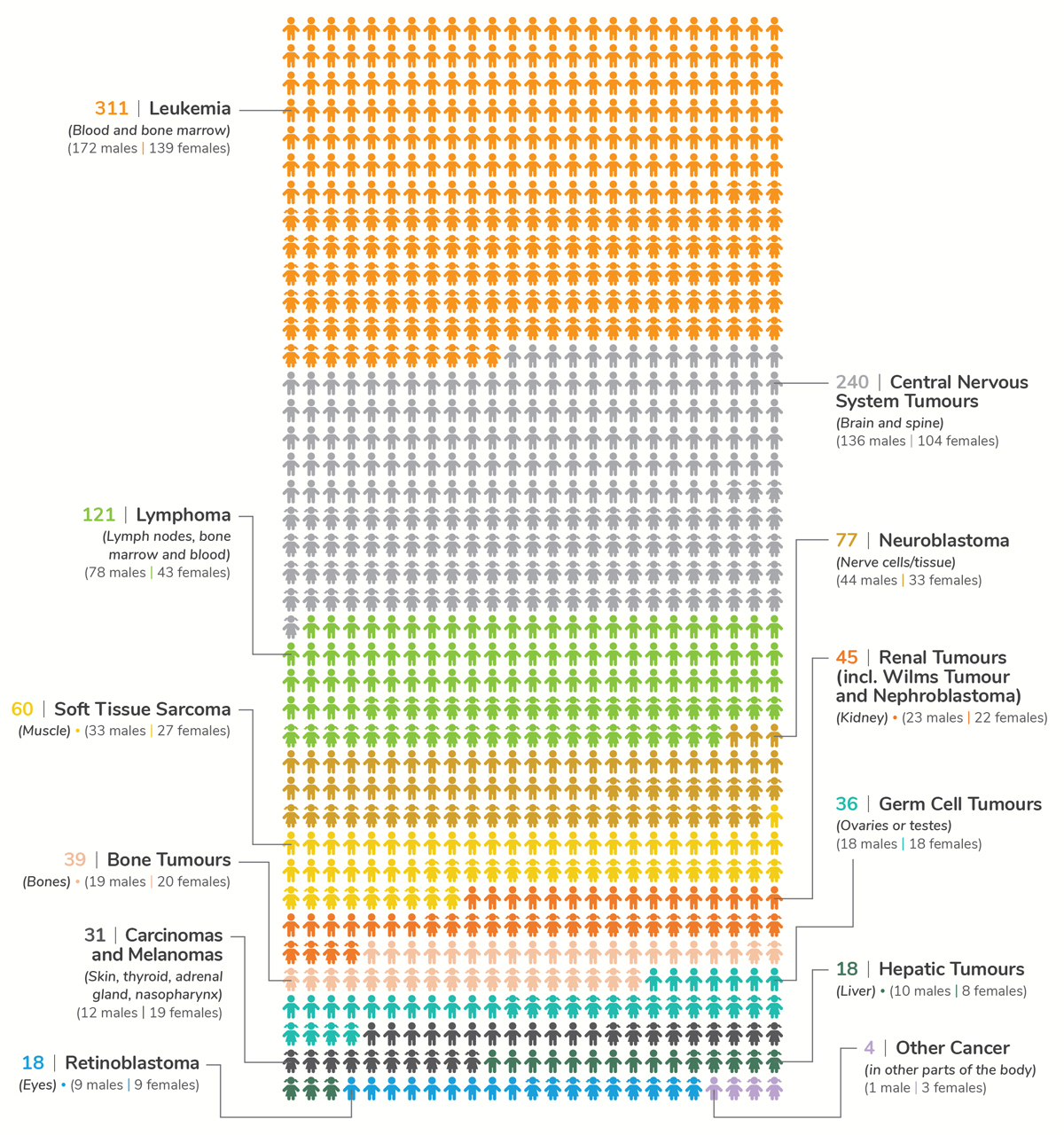
Around 1,000 children get cancer each year
Text description
For every 1,000 children diagnosed with cancer, the expected numbers of each of the 12 main types of cancer are as follows:
| Males | Females | Total | |
| Leukemia | 172 | 139 | 311 |
| Central Nervous System Tumours | 136 | 104 | 240 |
| Lymphoma | 78 | 43 | 121 |
| Neuroblastoma | 44 | 33 | 77 |
| Soft Tissue Sarcomas | 33 | 27 | 60 |
| Renal Tumours | 23 | 22 | 45 |
| Malignant Bone Tumours | 19 | 20 | 39 |
| Germ Cell Tumours | 18 | 18 | 36 |
| Carcinomas and Melanomas | 12 | 19 | 31 |
| Retinoblastoma | 9 | 9 | 18 |
| Hepatic Tumours | 10 | 8 | 18 |
| Other | 1 | 3 | 4 |
| TOTAL | 1000 | ||
How has the pandemic impacted childhood cancer in Canada?
- Current data showed no significant change in the numbers of new childhood cancer cases reported during the COVID-19 pandemicFootnote 5
- Children with cancer may be at greater risk of severe illness from COVID-19
- Experts across Canada continue to investigate the impact of COVID-19 on children with cancer
- For additional information visit: Cancer and COVID-19 Resources
What can we do about childhood cancer in Canada?
- Cancer specialists are available to provide care across the country
- If you or someone you know is experiencing a cancer diagnosis, learn more by visiting:
For more information:
- Visit the Cancer in Young People in Canada Program
- Read Cancer in Young People in Canada: A Report from the Enhanced Childhood Cancer Surveillance System
- Access Cancer in Young People in Canada Data Tool
- Contact cypc-ccjc@phac-aspc.gc.ca
References:
- Footnote 1
-
Canadian Cancer Society. What is cancer? [Internet]. Toronto: Canadian Cancer Society; 2021 [cited 2021 Mar 1]. Available from: https://cancer.ca/en/cancer-information/what-is-cancer
- Footnote 2
-
Public Health Agency of Canada. Cancer in Young People in Canada: A Report from the Enhanced Childhood Cancer Surveillance System [Internet]. Ottawa: Public Health Agency of Canada; 2017 [cited 2021 Jan 27]. Available from: www.canada.ca/en/health-canada/services/publications/science-research-data/cancer-young-people-canada-surveillance-2017.html
- Footnote 3
-
Centre for Surveillance and Applied Research, Public Health Agency of Canada. Cancer in Young People in Canada Data Tool. 2021 Edition. Public Health Infobase. Ottawa (ON): Public Health Agency of Canada, 2020. Available from: https://health-infobase.canada.ca/data-tools/cypc/
- Footnote 4
-
seer.cancer.gov [Internet]. Bethesda: International Classification of Childhood Cancer (ICCC) Recode ICD-0-3/WHO 2008 [cited 2022 Jan 20]. Available from: https://seer.cancer.gov/iccc/iccc-who2008.html
- Footnote 5
-
Pelland-Marcotte MC, Xie L, Barber R, Elkhalifa S, Frechette M, Kaur J, et al. Incidence of childhood cancer in Canada during the COVID-19 pandemic. CMAJ [Internet]. 2021 Nov [cited 2021 Dec 20]; 193(47): E1798-E1806. Available from: www.cmaj.ca/content/193/47/E1798
- Footnote *
-
This infographic includes 2015–2019 statistics for children ages 0–14; Data source: Public Health Agency of Canada, Cancer in Young People in Canada Data Tool, 2021
- Footnote †
-
The Public Health Agency of Canada provides funding and supports collaboration through the Cancer in Young People in Canada (CYP-C) program. The resulting progress in research and treatment is made possible by the contributions of the study participants, participating paediatric oncology centres, members of the CYP-C. Management and Advisory Committees, the Pediatric Oncology Group of Ontario (POGO) and the C17 Council, a network of all the seventeen pediatric cancer centres across Canada