
Healthcare for Indigenous women: A story of struggles to positive strides
Download in PDF format
(482 KB, 1 page)
Organization: Public Health Agency of Canada
Date published: 2024-05-10
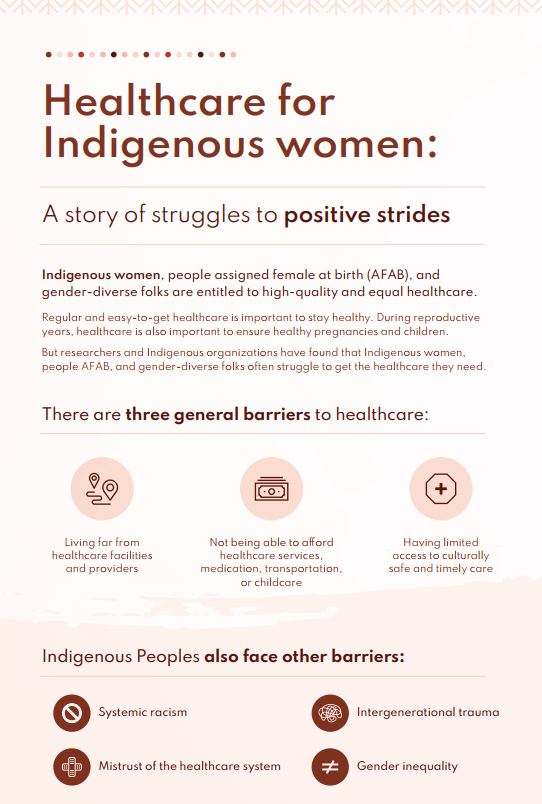
Indigenous women, people assigned female at birth (AFAB), and gender-diverse folks are entitled to high-quality and equal healthcare.
Regular and easy-to-get healthcare is important to stay healthy. During reproductive years, healthcare is also important to ensure healthy pregnancies and children.
But researchers and Indigenous organizations have found that Indigenous women, people AFAB, and gender-diverse folks often struggle to get the healthcare they need.
There are three general barriers to healthcare:
- Living far from healthcare facilities and providers
- Not being able to afford healthcare services, medication, transportation, or childcare
- Having limited access to culturally safe and timely care
Indigenous Peoples also face other barriers:
- Systemic racism
- Gender inequality
- Intergenerational trauma
- Mistrust of the healthcare system
Healthcare challenges by the numbers
Today, these barriers are making it harder for off-reserve First Nations, Métis, and Inuit women, people AFAB, and gender-diverse folks to get the healthcare they need compared to non-Indigenous people.
First Nations women & people AFAB
Among off-reserve First Nations women and people AFAB compared to non-Indigenous counterparts:
- 80% had a regular healthcare provider (compared to 89%)
- 9% accessed immediate, non-urgent care at an emergency department (compared to 6%)
- 10% reported that they did not receive healthcare when needed (compared to 7%)
Métis women & people AFAB
Among Métis women and people AFAB compared to non-Indigenous counterparts:
- 16% reported waiting over two weeks for an appointment with their regular care provider (compared to 12%)
- 36% visited an emergency department for any care in the past year (compared to 26%)
- 11% reported that they did not receive healthcare when needed (compared to 7%)
Inuit women & people AFAB
Among Inuit women and people AFAB compared to non-Indigenous counterparts:
- 29% living in remote areas had a regular healthcare provider (compared to 88%)
- 22% reported waiting over two weeks for an appointment with their regular care provider (compared to 12%)
- 12% could not get any healthcare appointment in the past year (compared to 6%)
These gaps were even larger during and soon after pregnancy
Among new and expecting Indigenous mothers compared to non-Indigenous counterparts:
- 71% had a regular healthcare provider (compared to 89%)
- 52% visited an emergency department for any care in the past year (compared to 36%)
- Fewer Indigenous mothers saw a family doctor, eye specialist, dentist, or any other specialist (including a gynecologist) in the past year
The gap in having a healthcare provider grew bigger over time.
- In 2015, 74% of Indigenous mothers had a regular healthcare provider compared to 85% of non-Indigenous mothers (a gap of 11%).
- In 2020, 48% of Indigenous mothers had a regular healthcare provider compared to 97% of non-Indigenous mothers (a gap of 49%).
Changing the Story
Indigenous Peoples, governments and organizations are working to address the situation by following the Truth and Reconciliation Commission's Calls to Action on Health (#18 to 24).
They advocate for:
Primary care that is easy to access (Calls to Action #19 & 21)
- Some provinces and territories are teaming up with pharmacists and nurses to add new ways to get care. Indigenous midwives are also making sexual and reproductive healthcare more accessible in their communities.
Primary care that is safe and supportive (Calls to Action #23 & 24)
- Indigenous leaders are partnering with the Canadian Medical Association and the Government of Canada to provide more healthcare training on Indigenous cultures and increase the number of Indigenous healthcare providers.
Primary care that is strengthened by Indigenous voices (Calls to Action #23 & 24)
- Indigenous leaders are advising the Government of Canada to address racism in healthcare and support Indigenous health and worldviews.
Learn more
Indigenous Peoples and cultures / Healthcare disparities for off-reserve Indigenous women and people assigned female at birth
This product was created by researchers from the Public Health Agency of Canada and University of Calgary and Indigenous advisors from Les Femmes Michif Otipemisiwak—Women of the Métis Nation, Native Women's Association of Canada, Pauktuutit Inuit Women of Canada, 2 Spirits in Motion, and Faces to the Sun Consulting Inc.