
Vaccine uptake in Canadian adults: Highlights from the 2018-2019 Seasonal Influenza Vaccination Coverage Survey
The Seasonal Influenza Vaccination Coverage Survey is a yearly telephone survey that collects information about the flu shot in Canada. Each flu season, the survey estimates how many people get the flu shot as well as knowledge, attitudes, and beliefs about the flu shot. This year, the participants were also asked about other recommended vaccines for adults: pertussis (whooping cough), tetanus, pneumococcal and shingles.
Purpose of this survey
Results from the survey provide information about how well Canadians are protected against vaccine preventable diseases as well as what they know and think about vaccines.
Survey results are used to:
- measure progress towards achieving Canada’s national vaccination coverage goals
- assess how well vaccination programs are working, and how they could be improved
- report Canada’s vaccination coverage to the World Health Organization (WHO)
Key results
Influenza vaccine
The flu season in Canada normally runs from November to April. Anyone can get the flu, which can sometimes lead to severe complications or death. Some people are at higher risk for complications due to the flu, including:
- young children
- people with certain chronic medical conditions
- seniors
- pregnant women
The influenza vaccine, also known as the flu shot, is the best way to prevent the disease. Every Canadian older than 6 months of age should get the flu shot every year.
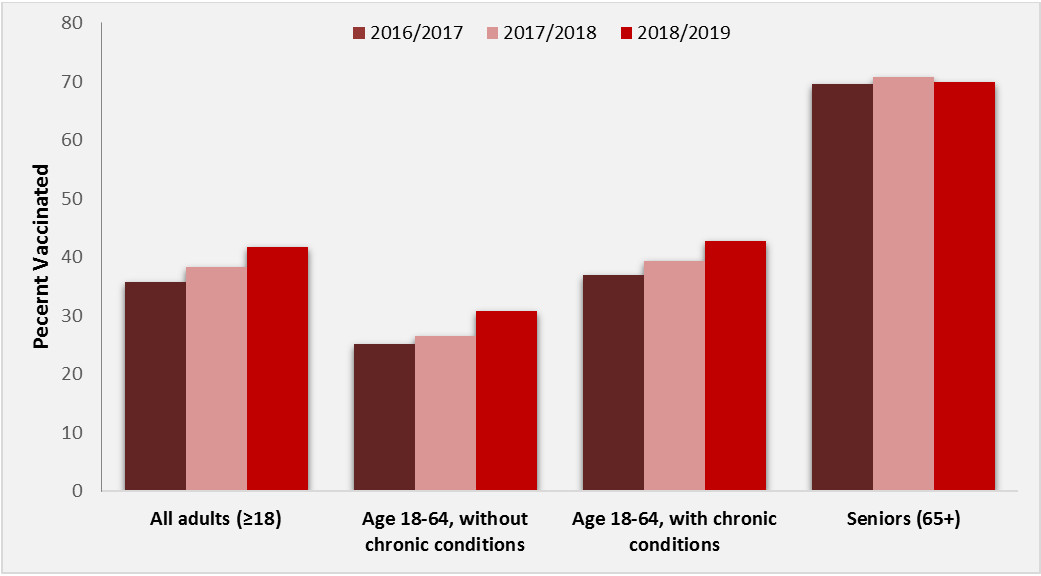
Figure 1: Text description
| Flu season | Percent vaccinated (%) |
|---|---|
| 2016-2017 | 35.8 |
| 2017-2018 | 38.3 |
| 2018-2019 | 41.8 |
| Flu season | Percent vaccinated (%) |
|---|---|
| 2016-2017 | 25.1 |
| 2017-2018 | 26.5 |
| 2018-2019 | 30.8 |
| Flu season | Percent vaccinated (%) |
|---|---|
| 2016-2017 | 37.0 |
| 2017-2018 | 39.4 |
| 2018-2019 | 42.8 |
| Flu season | Percent vaccinated (%) |
|---|---|
| 2016-2017 | 69.5 |
| 2017-2018 | 70.7 |
| 2018-2019 | 69.9 |
Who got the flu shot
While vaccine coverage for adults in the 2018/19 season was higher than the coverage in the 2016/17 and 2017/18 seasons, not enough Canadian adults got the flu shot.
Canada’s goal is to have 80% of those at higher risk of complications from the flu vaccinated. This includes seniors (65 years of age and older) and adults aged 18-64 years with chronic medical conditions.
In the 2018/19 season:
- only 4 in 10 Canadian adults (42%) received the flu shot
- more females (47%) than males (37%) were vaccinated
- vaccination in seniors (70%) and adults with chronic medical conditions (43%) fell short of the national goal of 80%
Timing and place of vaccination
- Most respondents were vaccinated in October or November (80%).
- Getting the flu shot early in the flu season helps protect from infection before the flu begins to spread.
- Most respondents were vaccinated at pharmacies (35%) or doctor’s offices (33%).
Reasons to get the vaccine
- The most common reason for adults getting their flu shot was to prevent infection or avoid getting sick (45%).
Other vaccines
Tetanus and pertussis (whooping cough) vaccines
In Canada, adults can be vaccinated against tetanus with either the tetanus-diphtheria (Td) or the tetanus-diphtheria-pertussis (Tdap) vaccines. All adults should receive 1 dose of Tdap in adulthood to be protected from pertussis, and all pregnant women should receive 1 dose of Tdap to protect their babies until they can be vaccinated themselves. Also, all adults should receive one dose of tetanus vaccine (either Td or Tdap) every 10 years to be protected from tetanus.
- Only 33% of adults reported having been vaccinated against pertussis after 18 years of age.
- 69% of Canadian adults reported having received the tetanus vaccine in the previous 10 years.
- More females (37%) than males (28%) received pertussis vaccine. There was no difference between females and males for tetanus vaccine.
- The most common reason for not getting pertussis or tetanus vaccine was the perception that these vaccines are not necessary.
Pneumococcal vaccine
The bacterium Streptococcus pneumoniae, also known as pneumococcus, is a common cause of pneumonia, and can also cause blood infections referred to as invasive pneumococcal disease (IPD). People with some underlying medical conditions and seniors (65 years of age and older) are at higher risk of IPD and should receive the pneumococcal vaccine if not previously vaccinated.
- The results showed that 58% of seniors reported having received a pneumococcal vaccine in adulthood. The number remains below the national vaccination coverage goals for pneumococcal vaccine, which is 80% among adults aged 65 years and older.
- Only 25% of adults (18-64 years of age) with underlying medical conditions were vaccinated against pneumococci.
- Pneumococcal vaccination rate was higher for females (67%) compared to males (47%) in the 65 years and older age group.
- The most common reason among seniors for not getting a pneumococcal vaccine was the perception that the vaccine is not necessary.
- The most common reason for non-vaccination among younger adults with underlying medical conditions was that they had never heard of the vaccine.
Shingles vaccine
Shingles is a painful skin rash with blisters, usually on part of one side of the body. It is triggered by the same virus that causes varicella (chicken pox). Any person who has had varicella in the past can get shingles, but most people who get the disease are older than 50 or have a weakened immune system. One dose of shingles vaccine is recommended for adults 50 years of age and older.
- Among adults 50 years of age and older, 28% reported receiving their shingles vaccine.
- The most common reason among adults 50 years of age and older for not getting a shingles vaccine was the perception that the vaccine is not necessary.
Knowledge, attitudes and beliefs
Most adults (91%) reported that they knew enough about vaccines to make a decision about getting vaccinated.
Regarding the flu, most of the respondents believed that getting sick with the flu can be serious and that the flu can affect many people.
While 87% of individuals agreed that the flu shot is safe, there are still 43% of respondents who believed they might get the flu from the flu vaccine – which is not true for any flu shot in Canada.
Two thirds of respondents (69%) agreed that the opinion of their family doctor, general practitioner or nurse practitioner is an important part of their decision for getting the flu shot.
To summarize:
Flu vaccination coverage in adults was higher in 2018/19 than in previous seasons.
Although the national flu vaccination coverage goals (80%) for those at higher risk remain unmet, flu shot uptake among seniors is approaching this goal (70%).
The most common reason for getting the flu shot was to prevent infection or avoid getting sick, whereas the most common reason for non-vaccination was the perception that the vaccine was not necessary. In fact, these recommended vaccines give adults the protection they need to stay healthy.
While a greater proportion of seniors reported having received a pneumococcal vaccine in adulthood compared to younger adults, the number still fell short of the national goal of 80%.
Additional information:
- Everyone 6 months and older should get the flu shot
- Where to get the flu shot
- Adults need vaccines too
- Download or order free flu awareness materials
A full report of the survey results is available. For more information about the Seasonal Influenza Coverage Survey and the adult National Immunization Coverage Survey (aNICS), or to obtain the report in an alternative format, please contact us at: phac.coverage-couvertures.aspc@canada.ca