
Diabetes: What Canada’s doing
On this page
- Framework for Diabetes in Canada
- Scan of initiatives: 2023 to 2024
- Diabetes funding
- Other diabetes activities
Framework for Diabetes in Canada
The Framework for Diabetes in Canada was completed on October 5, 2022, in response to the National Framework for Diabetes Act.
The framework aims to bring people and organizations together to ensure better health for people living with diabetes in Canada.
Summary of framework
The framework identifies several principles. These guide how we support those living with diabetes and improve health outcomes. The principles emphasize the importance of:
- addressing health equity, which means ensuring that everyone has the same opportunities to be healthy
- applying a person-centred approach by respecting individual experiences and considering each person’s well-being
- outlining the differences between types of diabetes
- supporting innovation, such as exploring new research leading to better diabetes management, treatment options and quality of life
- promoting leadership, collaboration and information exchange across organizations to develop ways to reduce the risk of diabetes
The framework also includes 6 components. These represent areas for opportunities to advance efforts on diabetes:
- research
- prevention
- monitoring and data collection
- learning and knowledge sharing
- management, treatment and care
- access to diabetes devices, medicines and financial supports
What we heard
The principles and components in the framework are shaped by what we heard from people in Canada. We engaged many different people and groups from diverse sectors to:
- better understand the impacts of diabetes
- inform the development of the framework
- help identify priorities for advancing efforts on diabetes in Canada
Engagement activities included:
- interviews and discussions with organizations
- an online feedback tool to identify gaps and opportunities to help advance action on diabetes in Canada
- virtual dialogue sessions that brought together organizations and individuals, including people living with diabetes and their caregivers
We also considered existing strategies and frameworks addressing diabetes and chronic diseases in Canada and abroad as we developed the framework.
Development of the framework also included guidance from:
- provincial and territorial governments
- an external advisory group on diabetes made up of key organizations, including persons with lived experience
- an interdepartmental advisory group on diabetes, made up of several federal departments who play a direct or indirect role in addressing diabetes
We included Indigenous Peoples and organizations in the engagement process to inform the framework. As a result, the National Indigenous Diabetes Association is undertaking a national Indigenous-led engagement process with Indigenous Peoples, communities and organizations to:
- allow enough time for meaningful and ongoing engagement
- address the unique needs and circumstances of diverse Indigenous communities
This approach aims to capture the unique interests, circumstances and perspectives of First Nations, Inuit and Métis. It also supports reconciliation and their right to self-determination.
We developed a framework infographic based on what we heard to summarize our findings.
Framework for Diabetes in Canada (infographic)
Scan of initiatives: 2023 to 2024
We engaged with organizations across Canada about what they consider important for addressing diabetes. We reached out for insight from 2023 to 2024 to follow up on actions already underway. A total of 72 initiatives were identified from those engaged:
- research institutions
- non-government organizations
- provincial and territorial governments
We asked about the 6 interconnected components in the framework. The following percentages represent the proportion of initiatives by component.
- 25% for learning and knowledge sharing
- 19% for prevention
- 17% for management, treatment and care
- 14% for research
- 14% for access to diabetes devices, medicines and financial supports
- 11% for surveillance and data collection
We also asked about the 5 principles from the framework. These principles were covered by initiatives as follows:
- 63% addressed health equity
- 51% promoted leadership, collaboration and information exchange
- 47% applied a person-centred approach
- 44% supported innovation
- 21% differentiated between types of diabetes
Populations represented in the diabetes initiatives
The following graph shows the diverse populations that were represented by the identified initiatives, including groups known to face higher rates of diabetes. Several initiatives contributed to advancing health equity by addressing one or more priority populations.
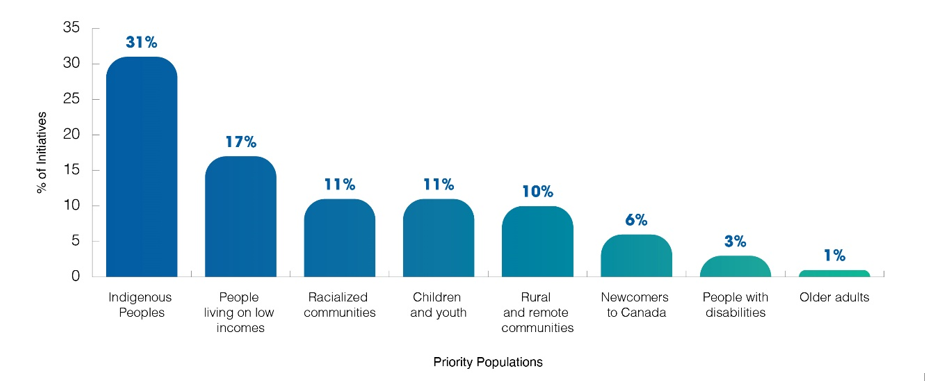
Text description
| Priority populations | Percentage of initiatives |
|---|---|
| Indigenous Peoples | 31% |
| People living on low incomes | 17% |
| Racialized communities | 11% |
| Children and youth | 11% |
| Rural and remote communities | 10% |
| Newcomers to Canada | 6% |
| People with disabilities | 3% |
| Older adults | 1% |
Key findings
Of the multiple actions on diabetes being taken across Canada:
- initiatives are working to address health inequities by engaging populations with a higher risk of diabetes as well as individuals with lived experience
- collaborative efforts and information sharing are helping in the prevention and management of diabetes
- provinces and territories are making progress in addressing diabetes through strategic planning and diabetes-related initiatives
Efforts are also underway in support of Indigenous Peoples and communities which include:
- prevention and health services
- Indigenous-led partnership initiatives
- culturally appropriate information and approaches
There are ongoing efforts to capture the unique interests and perspectives of Indigenous peoples and communities in Canada.
Opportunity areas
Our engagement identified 3 overarching gaps to address diabetes in Canada, which are:
- addressing the social and structural determinants of health
- focusing on changing the rules, laws and systems that shape the conditions that affect how healthy we can be
- multi-sectoral actions and engagement with the private sector
- gathering support and ideas across organizations to effectively address diabetes prevention, management and treatment
- advancing innovation and sharing of new technologies
- exploring new research, leading to better diabetes management, treatment options and quality of life
Limitations
Data from our engagement aren’t representative of all initiatives taking place across Canada. They provide insights into some of the initiatives that stakeholders have chosen to profile.
We recognize that diabetes is a complex disease. There’s still work to do to ensure better health outcomes for people living with diabetes in Canada.
We invite all interested organizations to use the framework to address diabetes and advance opportunities in ways that:
- meet their mandates and objectives
- are adapted to their respective community contexts
Diabetes funding
In 2021, the Government of Canada committed $25 million over 5 years for:
- developing a national framework for diabetes
- diabetes research, surveillance and prevention
We’re using $15 million to renew the Partnership to Defeat Diabetes between the Canadian Institute of Health Research and Breakthrough T1D (formerly known as the Juvenile Diabetes Research Foundation). The foundation and its donors are providing an additional investment of $15 million to jointly fund a total of $30 million in type 1 diabetes research.
We've also invested an additional $10 million over 5 years for a Diabetes Prevention Challenge, which will help to:
- identify new approaches to diabetes prevention
- promote the development and testing of new interventions to reduce the risks associated with type 2 diabetes
Type 2 diabetes challenge (Impact Canada)
We invest about $20 million each year through the Healthy Canadians and Communities Fund. This goes towards improving healthy living behaviours among people living in Canada by encouraging:
- healthy eating
- physical activity
- quitting (cessation) or avoiding tobacco
The fund promotes these behaviours among populations at greater risk of chronic diseases, such as diabetes. Funded projects focus on:
- supporting health behaviour changes
- building physical and social environments that enable better health
Healthy Canadians and Communities Fund
We recognize that partners from different areas must work together to improve health and the conditions that shape it. This includes making sure everyone has the opportunity to be in good physical and mental health. The Intersectoral Action Fund supports communities by funding projects that:
- address complex health challenges
- support intersectoral action on the social determinants of health
Other diabetes activities
It’s important to help people in Canada reduce the risk of chronic diseases, including diabetes. That's why we're committed to working with partners to:
- promote health
- encourage healthy behaviours
- reduce the rates of chronic diseases
- support people to lead healthier lives in Canada
Related links
- Insulin
- Diabetes partners and links
- Updates to life-sustaining therapy eligibility: Disability tax credit
Printable documents about the framework
Legal, policy and engagement documents
- Framework for Diabetes in Canada
- National Framework for Diabetes Act
- Diabetes strategies in Canada and abroad
- Supporting the advancement of the framework for diabetes in Canada: Dialogues report
- Informing a framework for Diabetes in Canada: Stakeholder engagement summary
- Indigenous Engagement on a National Diabetes Framework (National Indigenous Diabetes Association)
Data and research
- Canadian Chronic Disease Surveillance System
- 100 Years of Insulin: Accelerating Canadian Discoveries to Defeat Diabetes