
Chapter 1: Introduction to the Canadian recommendations for the prevention and treatment of malaria
Last complete chapter revision: June 2026
On this page
Preamble
The Committee to Advise on Tropical Medicine and Travel (CATMAT) provides the Public Health Agency of Canada (PHAC) with ongoing and timely medical, scientific, and public health advice relating to tropical infectious disease and health risks associated with international travel. PHAC acknowledges that the advice and recommendations set out in this statement are based upon the best current available scientific knowledge and medical practices, and is disseminating this document for information purposes to both travellers and the medical community caring for travellers.
Persons administering or using drugs, vaccines, or other products should also be aware of the contents of the product monograph(s) or other similarly approved standards or instructions for use. Recommendations for use and other information set out herein may differ from that set out in the product monograph(s) or other similarly approved standards or instructions for use by the licensed manufacturer(s). Manufacturers have sought approval and provided evidence as to the safety and efficacy of their products only when used in accordance with the product monographs or other similarly approved standards or instructions for use.
Introduction
Malaria is a common and potentially fatal parasitic infection in human beings. It is a protozoan disease transmitted by the bite of infected female anopheline mosquitoes. Rarely, transmission may occur through transfused bloodReference 1Reference 2, solid organ transplantationReference 2, needle sharing, or from mother to fetusReference 3. Five main species of the genus Plasmodium cause malarial infection in humans: Plasmodium falciparum and Plasmodium vivax cause most cases globally, whereas Plasmodium ovale and Plasmodium malariae global disease burden is low. The fifth species, Plasmodium knowlesi, is a zoonotic parasite found predominantly in Southeast Asia. The clinical impact of molecularly identified zoonotic Plasmodium cynomolgi and Plasmodium simium in humans is not yet fully understoodReference 4Reference 5.
Clinical manifestations of malaria are dependent on the age and immune status of the host. The spectrum of clinical effects ranges from asymptomatic parasitemia and uncomplicated malaria to severe malaria and death. The disease is characterized by non-specific symptoms, such as myalgia, fatigue, headache, abdominal pain, and malaise, which are followed by irregular fever and rigors. Nausea, vomiting, and jaundice also commonly occur. In endemic areas, undifferentiated fever is most commonly caused by malaria. The alternate-day or periodic fevers described in the literature are less commonly observed among travellers in Canada, due to early presentation to health services and prompt treatmentReference 6.
Because the symptoms of malaria are nonspecific, definitive diagnosis is not possible without parasitologic testing, which can be done using blood film microscopy, an antigen detection test (rapid diagnostic test), or molecular testing. See Malaria: Chapter 6 for information on malaria diagnosis.
Infections caused by P. falciparum have the highest fatality rate, however P. vivax and P. knowlesi can also cause severe disease. Most deaths due to malaria are preventable. Malaria-associated deaths are frequently the result of delays in diagnosis and treatmentReference 7Reference 8.
According to the World Health Organization (WHO), an estimated 282 million cases of malaria occurred worldwide in 2024, an increase of 9 million cases from 2023. Five countries accounted for nearly half of all malaria cases globally: Nigeria (24.3%), the Democratic Republic of the Congo (12.5%), Uganda (4.7%), Ethiopia (4.4%) and Mozambique (3.6%). In 2024, an estimated 610,000 deaths due to malaria occurred worldwide, with over half occurring in four countries: Nigeria (30.3%), the Democratic Republic of the Congo (11.1%), Niger (5.8%), and the United Republic of Tanzania (4.3%)Reference 8.
The Sustainable Development Goals (SDG) aim to end malaria epidemics by 2030. To meet this target, the Global Technical Strategy for Malaria (GTS), adopted by WHO Member States in 2015, proposes to reduce malaria mortality and incidence by at least 90%, eliminate malaria from at least 35 countries where it was transmitted, and prevent re-establishment of malaria in all countries that are malaria-free, by 2030Reference 9. Figure 1 shows global progress towards eliminating malaria, between 2000 and 2024. Although many countries have achieved considerable reductions in malaria incidence and mortality since 2015, globally, malaria incidence has increased. Among the biggest challenges to malaria control and elimination are the emergence and spread of artemisinin partial resistance in Africa, the declining sensitivity of rapid diagnostic tests, the expansion of invasive mosquito species to urban settings in Africa, and widespread mosquito resistance to insecticidesReference 8Reference 10.
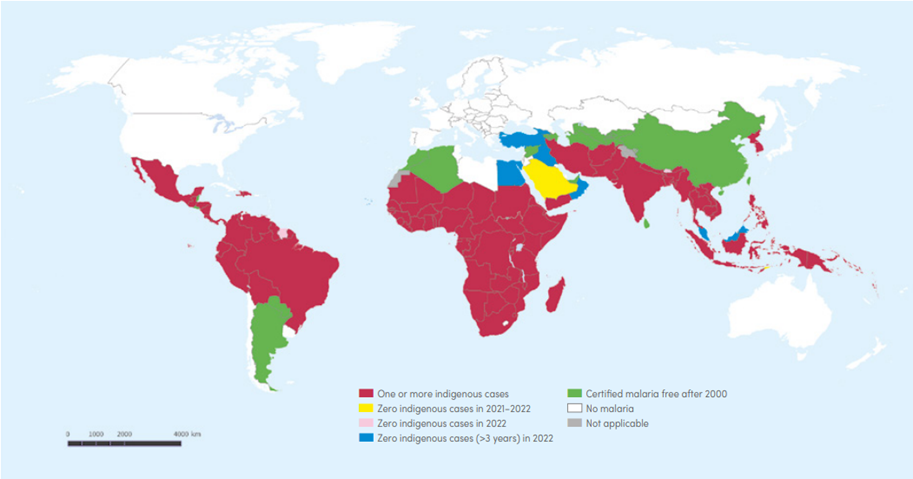
WHO considers countries and areas with zero indigenous cases for at least 3 consecutive years to have eliminated malaria. In 2024, Malaysia reported zero indigenous cases caused by human Plasmodium species for the seventh consecutive year, Saudi Arabia reported zero indigenous cases for the fourth consecutive year, and Bhutan reported zero indigenous cases for the third consecutive year, ending the malaria epidemic. Timor-Leste and Suriname were both certified malaria free in 2025. Georgia had a resurgence in 2002, but by 2015 was reporting zero indigenous cases and was certified malaria free in 2025Reference 8.
Figure 1: Text description
Areas with one or more indigenous cases:
WHO African Region
- Angola
- Benin
- Botswana
- Burkina Faso
- Burundi
- Cameroon
- Central African Republic
- Chad
- Comoros
- Congo
- Côte d’Ivoire
- Democratic Republic of the Congo
- Equatorial Guinea
- Eritrea
- Eswatini
- Ethiopia
- Gabon
- Gambia
- Ghana
- Guinea
- Guinea-Bissau
- Kenya
- Liberia
- Madagascar
- Malawi
- Mali
- Mauritania
- Mozambique
- Namibia
- Niger
- Nigeria
- Rwanda
- Sao Tome and Principe
- Senegal
- Sierra Leone
- South Africa
- South Sudan
- Togo
- Uganda
- United Republic of Tanzania
- Zambia
- Zimbabwe
WHO region of the Americas
- Bolivia
- Brazil
- Colombia
- Costa Rica
- Dominican Republic
- Ecuador
- French Guiana
- Guatemala
- Guyana
- Haiti
- Honduras
- Mexico
- Nicaragua
- Panama
- Peru
- Venezuela
WHO Eastern Mediterranean region
- Afghanistan
- Djibouti
- Iran
- Pakistan
- Somalia
- Sudan
- Yemen
WHO South-East Asia region
- Bangladesh
- North Korea
- India
- Myanmar
- Nepal
- Thailand
WHO Western Pacific region
- Cambodia
- Indonesia
- Lao People’s Democratic Republic
- Papua New Guinea
- Philippines
- South Korea
- Solomon Islands
- Vanuatu
- Viet Nam
Areas with zero indigenous cases (>3 years) in 2024
- Bhutan
- Iraq
- Malaysia
- Oman
- Saudi Arabia
- Türkiye
Areas certified malaria free after 2000
- Algeria
- Argentina
- Armenia
- Azerbaijan
- Belize
- Cabo Verde
- China
- Egypt
- El Salvador
- Georgia
- Kyrgyzstan
- Maldives
- Morocco
- Paraguay
- Sri Lanka
- Suriname
- Syrian Arab Republic
- Tajikistan
- Timor-Leste
- Turkmenistan
- United Arab Emirates
- Uzbekistan
Areas with no malariaNote de bas de page b
WHO African region
- Lesotho
- Mauritius
- Seychelles
WHO region of the Americas
- Antigua and Barbuda
- Bahamas
- Barbados
- Canada
- Chile
- Cuba
- Dominica
- Grenada
- Jamaica
- Saint Kitts and Nevis
- Saint Lucia
- Saint Vincent and the Grenadines
- Trinidad and Tobago
- United States of America
- Uruguay
WHO Eastern Mediterranean region
- Bahrain
- Jordan
- Kuwait
- Lebanon
- Libya
- Qatar
- Tunisia
WHO European region
- Albania
- Andorra
- Austria
- Belarus
- Belgium
- Bosnia and Herzegovina
- Bulgaria
- Croatia
- Cyprus
- Czechia
- Denmark
- Estonia
- Finland
- France
- La Réunion
- Germany
- Greece
- Hungary
- Iceland
- Ireland
- Israel
- Italy
- Kazakhstan
- Latvia
- Lithuania
- Luxembourg
- Malta
- Monaco
- Montenegro
- Moldova
- Netherlands
- North Macedonia
- Norway
- Poland
- Portugal
- Romania
- Russia
- San Marino
- Serbia
- Slovakia
- Slovenia
- Spain
- Sweden
- Switzerland
- Ukraine
- United Kingdom
WHO Western Pacific region
- Australia
- Brunei Darussalam
- Cook Islands
- Fiji
- Japan
- Kiribati
- Marshall Islands
- Micronesia
- Mongolia
- Nauru
- New Zealand
- Niue
- Palau
- Samoa
- Singapore
- Tonga
- Tuvalu
In Canada, where there is currently no sustained autochthonous transmission, nearly all cases of malaria are diagnosed among travellers entering or returning to Canada from destinations where malaria is endemic. Although malaria remains overwhelmingly travel-associated at present, environmental changes such as rising temperatures and shifting precipitation patterns may increase the suitability for local Anopheles mosquito-borne transmission in some regions over timeReference 11. Ongoing surveillance of travel-related cases is therefore essential, both to guide prevention strategies for travellers and to detect any early indications of changing transmission risk within Canada.
The Canadian Notifiable Diseases Surveillance System (CNDSS) is a passive surveillance system coordinated by PHAC. It is used to monitor more than 40 nationally notifiable infectious diseases, and is the longest-standing single source for estimating total malaria cases in Canada. There are two important limitations, however, to malaria data in the CNDSS:
- Reporting is voluntary and there is incomplete national coverage. Notifications by provinces and territories to the federal level is voluntary. In 2018, Ontario – which historically accounted for the highest proportion of malaria cases in Canada – removed malaria from its list of reportable diseases. As a result, national malaria case numbers in the CNDSS are missing data for Ontario, from 2018 onwards.
- Only malaria diagnoses meeting the CNDSS case definition are reported. Only malaria cases confirmed by blood-smear microscopy are included in the CNDSS, which excludes cases identified by molecular testing. Importantly, the CNDSS does not verify this information directly, instead relying on provinces and territories to check that their cases adhere to the case definition.
Therefore, the true number of malaria cases in Canada is higher than the number of cases reported in the CNDSS. As well, the dataset is missing important ancillary information, such as travel history and clinical details.
To complement the data in CNDSS, and fill some of the identified gaps in epidemiological and clinical information, PHAC also leverages data from the Canadian Malaria Network (CMN) and the Canadian Travel Medicine Network (CanTravNet). The CMN is a collaboration with PHAC and Health Canada’s Special Access Program, which maintains supplies of intravenous artesunate and quinine at major medical centres across the country; these drugs are used to treat severe malaria. The CMN dataset therefore provides a good estimate of severe malaria case numbers in Canada, including in Ontario. CanTravNet, on the other hand, contains data on malaria diagnoses – regardless of severity – at its various sentinel sites. Membership has evolved over time, but as of 2023 included hospitals from British Colombia, Alberta, Manitoba, Ontario and Quebec.
From 2014 to 2023, there were 4,332 laboratory confirmed cases of malaria reported to the CNDSS, with a median of 437 cases per year. Annual case counts reached a period high of 611 cases in 2016 and a period low of 185 cases in 2020—coinciding with the COVID-19 pandemic's disruption of international travel. When analyzed by age and sex, malaria was most commonly diagnosed in males 20-39 years of age (23.7%, 1,028), followed by males 40-59 years of age (20.0%, 866). In general, more males than females were diagnosed with malaria, with an overall male-to-female case ratio of 1.7:1. This trend was also observed in the CanTravNet dataset, and has been reported elsewhere in the literatureReference 12Reference 13Reference 14. Children under the age of 5 made up 4.8% (209) of malaria cases in the CNDSS. This age group is more likely to experience severe diseaseReference 15Reference 16, and accounted for 7.4% of severe or complicated malaria cases over the same time period in the CMN (75/1,013). Consistent with the literatureReference 15Reference 17, elderly cases were also more likely to experience severe malaria, with cases 60 years and older accounting for 11.0% (111) of cases in the CMN compared to 7.4% (322) in the CNDSS.
Both the CMN and CanTravNet contain species information, as well as information on the patient’s purpose of travel and country of acquisition. Comparing these two datasets can provide insight into whether severe cases of malaria differ from the overall malaria case population in Canada. From 2014 to 2023, a total of 912 cases of malaria were reported to CanTravNet. Where the species of Plasmodium was known, P. falciparum caused 77.0% (629/817) of infections, followed by P. vivax (10.9%, 89), P. ovale (10.5%, 86) and P. malariae (2.4%, 20); this included 7 cases of mixed infections caused by two or more Plasmodium species. Over the same period, a total of 1,013 patients diagnosed with severe or complicated malaria were reported to the CMN. Where the species of Plasmodium was known, P. falciparum caused 96.5% (719/745) of severe infections, considerably higher than observed in CanTravNet, and consistent with global trends in severe malariaReference 18. A small number of severe cases were infected with P. vivax or other Plasmodium species, including 11 cases with mixed infections.
Where reason of travel was known, cases most often reported travelling to visit friends and relatives (50.0% in CanTravNet and 57.5% in the CMN); this includes Canadian residents returning to Canada after travelling abroad, as well as foreign nationals visiting Canada from their home countries. Immigration (20.0% in CanTravNet and 18.4% in the CMN) and business (9.6% in CanTravNet and 9.4% in the CMN) were the second and third most common reasons for travel. Unlike the broader Canadian overseas traveller population, the majority of whom travel for leisure or recreation (66.3% in the 2023 National Travel Survey)Reference 19, less than 1 in 10 malaria cases reported travelling for vacation purposes (8.8% in CanTravNet and 5.5% in the CMN).
Among cases with known country or region of exposure, Africa was the attributed region of acquisition for the majority of cases (90.7% in CanTravNet and 96.4% in the CMN); this is consistent with global trends in malaria, with 94% of all cases globally in 2024 estimated to have occurred in the WHO African RegionReference 8. Eight African countries in particular accounted for over 50% of cases in both CanTravNet and the CMN: Nigeria, Cameroon, Côte d’Ivoire, the Democratic Republic of the Congo, Uganda, Guinea, Ghana and the United Republic of Tanzania.
While acknowledging the limitations of malaria surveillance data in Canada, data from the CNDSS, CMN and CanTravNet demonstrate that malaria remains a concern for Canadian travellers, with over 400 cases diagnosed per year. The risk of infection is not uniform, with more cases occurring among young and middle-aged males, and those travelling to visit friends and relatives, especially in high-endemicity African countries like Nigeria. As illustrated in the CMN, over 100 malaria cases per year in Canada will develop severe disease, a medical emergency that if left untreated, can result in death. Together, this underscores the need to provide up-to-date, evidence-based guidance to Canadian travellers and health practitioners on how to prevent, diagnose and treat malaria.
Acknowledgements
This chapter was prepared by the Malaria Chapter 1 Working Group: K Plewes (lead), D Curtis, T Lee, and was approved by CATMAT.
CATMAT gratefully acknowledges the contribution of: A Collares, M Laplante, A McCarthy and C Yao.
CATMAT Members: M Libman (Chair), YG Bui (Vice-Chair), K Plewes (Malaria Sub-Committee Chair), I Bogoch, C Hogan, K Kazmi, A Khatib, P Lagacé-Wiens, J Lee and C Yansouni.
Liaison representatives: J Pernica (Association of Medical Microbiology and Infectious Disease Canada) and K O'Laughlin (US Centers for Disease Control and Prevention).
Ex-officio representatives: V Donici, D Marion and S Schofield (National Defence and the Canadian Armed Forces), M Tunis and C Jensen (National Advisory Committee on Immunization [NACI] Secretariat, PHAC) and R Zimmer (Biologic and Radiopharmaceutical Drugs Directorate, Health Canada).
Conflicts of interest
None declared.
Footnotes
- Footnote a
-
This map is intended as a visual aid only; see Appendix 1 for specific country recommendations. Reproduced with permission from: WHO, 2025.
- Footnote b
-
Some of the countries labeled “No malaria” in Figure 1 have reported imported cases of malaria with very limited local transmission in the past.
References
- Reference 1
-
1. Slinger R, Giulivi A, Bodie-Collins M, Hindieh F, John RS, Sher G, et al. Transfusion-transmitted malaria in Canada. CMAJ. 2001;164(3):377–379.
- Reference 2
-
Ashley EA, White NJ. The duration of Plasmodium falciparum infections. Malar J. 2014;13:500.
- Reference 3
-
Davies HD, Keystone J, Lester ML, Gold R. Congenital malaria in infants of asymptomatic women. CMAJ. 1992;146(10):1755–1756.
- Reference 4
-
da Silva BP, Lourenço-de-Oliveira R, de Aguiar Barros J, Brasil P, Daniel-Ribeiro CT, de Fátima Ferreira da Cruz M. Autochthonous simian malaria in Brazil outside the Amazon: Emergence, zoonotic transmission and implications for disease control. One Health. 2024;19:100928.
- Reference 5
-
Muh F, Erwina A, Fitriana F, Syahada JH, Cahya AD, Choe S, et al. Plasmodium cynomolgi: what should we know? Microorganisms. 2024;12(8):1607.
- Reference 6
-
Hahn WO, Pottinger PS. Malaria in the traveler: How to manage before departure and evaluate upon return. Med Clin North Am. 2016;100(2):289-302.
- Reference 7
-
Bell D, Wongsrichanalai C, Barnwell JW. Ensuring quality and access for malaria diagnosis: how can it be achieved? Nat Rev Microbiol. 2006;4(9):682–695.
- Reference 8
-
World Health Organization. World malaria report 2025: addressing the threat of antimalarial drug resistance. World Health Organization; 2025. Available from: https://www.who.int/teams/global-malaria-programme/reports/world-malaria-report-2025
- Reference 9
-
World Health Organization. Global technical strategy for malaria 2016-2030. World Health Organization; 2015. Available from: https://www.who.int/publications/i/item/9789241564991
- Reference 10
-
World Health Organization. Malaria threats map. 2026 [updated February 1, 2026]. Available from: https://apps.who.int/malaria/maps/threats/
- Reference 11
-
Siebels K, Ng V, Ogden N, Schofield S, Ludwig A. Current and future temperature suitability for autochthonous transmission of malaria in Canada. Int J Health Geogr. 2025;24:21.
- Reference 12
-
UK Health Security Agency. Malaria imported into the UK: 2023. UK Health Security Agency; 2024. Available from: https://www.gov.uk/government/publications/malaria-in-the-uk-annual-report/malaria-imported-into-the-uk-2023#age-and-sex
- Reference 13
-
Briggs J, Murray M, Nideffer J, Jagannathan P. Sex-linked differences in malaria risk across the lifespan. In: Klein SL, Roberts CW, editors. Sex and gender differences in infection and treatments for infectious diseases. Cham: Springer International Publishing; 2023. p. 185–208.
- Reference 14
-
Kendjo E, Houzé S, Mouri O, Taieb A, Gay F, Jauréguiberry S, et al. Epidemiologic trends in malaria incidence among travelers returning to metropolitan France, 1996-2016. JAMA Netw Open. 2019;2(4):e191691.
- Reference 15
-
Wångdahl A, Wyss K, Saduddin D, Bottai M, Ydring E, Vikerfors T, et al. Severity of Plasmodium falciparum and non-falciparum malaria in travelers and migrants: a nationwide observational study over 2 decades in Sweden. J Infect Dis. 2019;220(8):1335–1345.
- Reference 16
-
Ladhani S, Aibara RJ, Riordan F, Shingadia D. Imported malaria in children: a review of clinical studies. Lancet Infect Dis. 2007;7(5):349–357.
- Reference 17
-
Mühlberger N, Jelinek T, Behrens RH, Gjørup I, Coulaud JP, Clerinx J, et al. Age as a risk factor for severe manifestations and fatal outcome of falciparum malaria in European patients: observations from TropNetEurop and SIMPID Surveillance Data. Clin Infect Dis. 2003;36(8):990–995.
- Reference 18
-
Daily JP, Parikh S. Malaria. N Engl J Med. 2025;392(13):1320–1333.
- Reference 19
-
Statistics Canada. Table 24-10-0045-01 Travel by Canadian residents in Canada and abroad by trip purpose (x 1,000). [updated February 24, 2026]. Available from: https://www150.statcan.gc.ca/t1/tbl1/en/cv!recreate.action?pid=2410004501&selectedNodeIds=1D4&checkedLevels=1D1,2D1,2D2,3D1&refPeriods=20230101,20231001&dimensionLayouts=layout2,layout2,layout3,layout2,layout2&vectorDisplay=false